Ian Chew
1.2K posts


Quoted in Bloomberg today:
“If the ceasefire is broken, the oil market faces resurging risks,” said June Goh, senior oil market analyst at Sparta Commodities SA, citing the possibility of further attacks against oil infrastructure after inventories had fallen.
bloomberg.com/news/articles/…
#oott
English
Ian Chew retweetledi

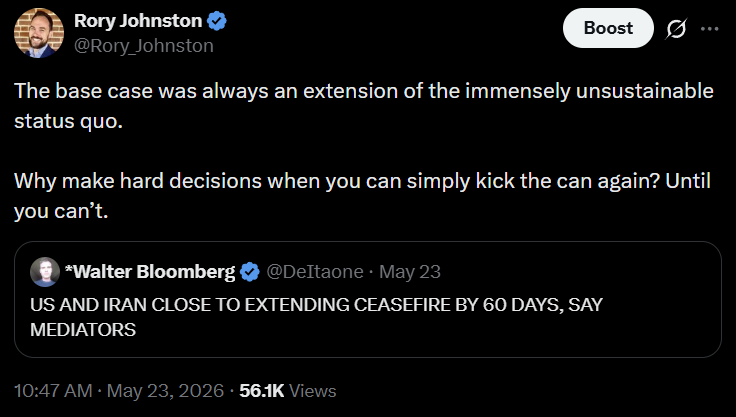
I am in the camp that I would rather see the Strait of Hormuz reopen just so people can see how the situation (normal flows) won’t be resolved anytime soon.
And if normal flows don’t return, you need inbound tankers, production shut in continues.
English
Ian Chew retweetledi

The reason we're not seeing a massive flush here is that the tape has been relentlessly pricing this move in since last week.
Alright, now that the risk premium has flushed out and the tape has fully priced it in, let’s get back to the good old napkin math.
If DC actually folds and swallows the draft MoU Tehran is dictating, the SoH is functionally under Iranian control.
I’m highly skeptical about how many actual physical barrels are going to clear that choke point once they start calling the shots.
English

Ian Chew retweetledi

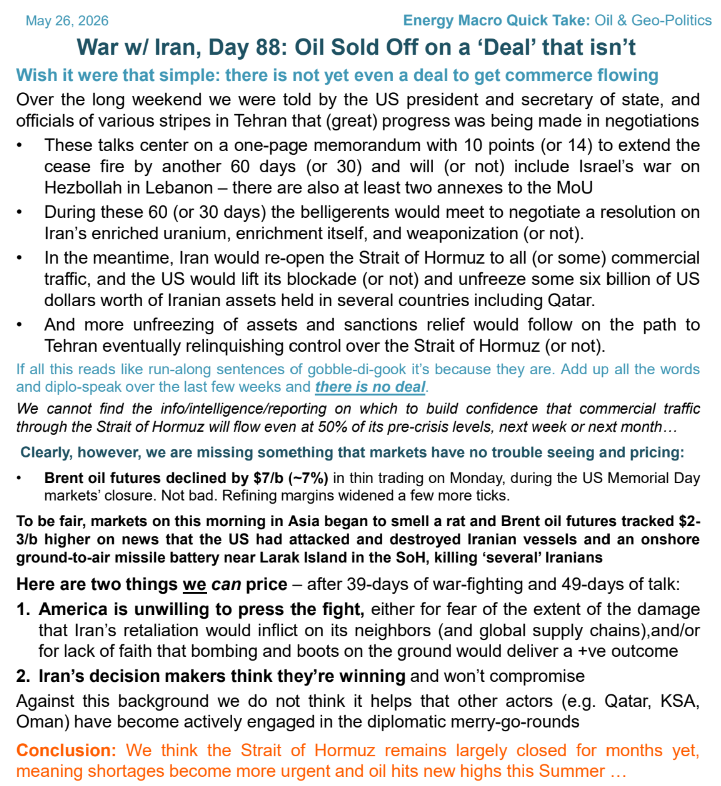
The vociferous Jan Stuart of Piper Sandler, who in one page captures the tweet-driven mental exhaustion many of us are experiencing:
English
@Rory_Johnston @CRUDEOIL231 @BNNBloomberg Happy to hear that you're getting the limelight, Rory! Excited to watch the interview clip when it's out
English

They usually do, and will do 🙂
Doubt anything I said will surprise you, though—negotiation optimism grinding up against competing interpretations of the details, etc.
Every day an effort to parse down headline chaos to "well, Strait's still closed..."
Got a comment in there about IRGC fishing boat counts, though 😉
English
Heads up that I'll be joining @BNNBloomberg to discuss the latest head fakes in oil land in the next ~10 minutes.
GIF
English
Ian Chew retweetledi
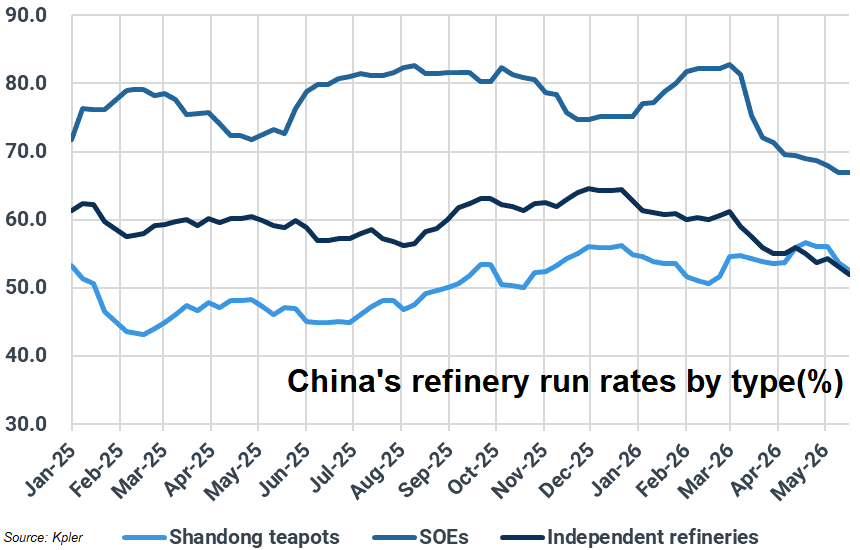
I’ve been grinding away trying to map out China’s recent crude plays, but after going through today's report, I have to hand it to OIES—they scripted the plumbing way better than me.
Here is my quick breakdown after running through their print, alongside the Chinese refinery throughput chart to help connect the dots.
-
Three months into the Hormuz crunch, and Beijing is completely blindsiding the market with its crude playbook. A heavyweight that easily sucked in 11mb/d over the last five years just saw its import prints plunge to 9.3mb/d in April. Now, the forward data says May and June seaborne arrivals are about to crater straight into the gutter at 6.5mb/d.
Instead of running its usual playbook of panic-dumping the SPR to backstop the market during a supply crisis, Beijing just completely cock-blocked refiners from touching the strategic vaults, only greenlighting commercial stock draws.
To make it worse, refiners aren't even willing to bleed their own commercial inventories, while state traders are acting like total penny-pinchers—happily flipping premium WAF cargoes back into the market and hoarding dirt-cheap Russian barrels instead.
This is a complete 180 from the 2021 power crunch, when Beijing panicked and ordered everyone to grab supply 'at any cost.' The heavyweights and policymakers in Beijing clearly think they can outmaneuver this supply shock and keep the economic damage locked down by playing a few smart, tactical micro-levers.
China’s true red line for freezing out imports is hardwired to the scale of their run cuts. If they try to copy-paste their five-year average throughput of 14.1mb/d, the exact moment seaborne arrivals drop below 9.2mb/d, they’re trapped—they either have to open the strategic taps wide or start chasing expensive market barrels. Instead, chopping runs by 5% down to a 13.4mb/d baseline is hands-down their most realistic, long-term survival play.
In this setup, if domestic crude extraction and pipeline taps keep humming, they can easily coast for a few months without taking a single economic hit, even with seaborne prints scraping a measly 7.9–8.5mb/d, because transportation fuels like gas and diesel will still be taken care of.
However cranking run cuts to a nuclear 10% scenario means they could survive without chasing a single market barrel even if seaborne flows dry up to 7.2mb/d—but they'd have to throw petrochemical feedstocks like naphtha and LPG under the bus just to keep gas and diesel flowing, a desperate move that runs on borrowed time and stalls out after a few months unless the whole economy is in a total tailspin.
To micromanage this whole run-rate circus, China's refining complex is pulling a highly responsive lever: the yield shift.
Beijing explicitly told state majors like Sinopec and PetroChina to ditch chemical feedstocks and prioritize flooding the market with gas and diesel, and these plants immediately saluted by shifting their product yields by several percentage points on a dime.
As a result, the real bloodbath isn't happening at the refining gate—it's completely decimating the downstream petrochemical chain. With Hormuz blocked, their seaborne naphtha inflows were already sliced in half, but a 5% run cut is about to bleed domestic naphtha and LPG supplies by tens of millions of tons a quarter, sending a compounding, fatal shock straight through the petchem feedstock backbone.
They are keeping wheels turning by guaranteeing gas and diesel, but the squeeze on industrial chemical feedstocks is completely running on borrowed time.
To paper over the massive raw material hole in the petchem chain, Beijing is shoving its massive 'Coal-to-Chemicals' complex into the spotlight, branding it as a strategic shield against volatile crude under the 15th Five-Year Plan.
Thanks to dirt-cheap, stable domestic coal, inland plants churning out olefins and methanol are running hot to boost volumes, but this quick fix hits a hard ceiling when it comes to replacing lost barrels at scale due to structural bottlenecks.
The core infrastructure is trapped deep in the northwestern sticks like Inner Mongolia, meaning slamming those products down to the massive manufacturing teeth on the southeastern coast comes with a punishing logistics and freight premium.
Most importantly, coal gasification routes physically cannot clone key aromatics or specialized LPG chemical chains—the feedstock deficit is mathematically locked in.
On top of that, the fact that Beijing is sitting on a massive 1.1-1.3 billion barrel pile without tapping it proves that institutional red tape is locking up the plumbing.
The 100 million barrels buried deep in dark underground rock caverns—completely invisible to satellites—are almost entirely SPR, requiring endless red tape like complex auctions and market disclosures, so Beijing is hoarding it as a nuclear option.
Even for the commercial barrels that are accessible, refiners are terrified to draw down because plotting out the repayment timeframe to replace that crude is a total mathematical nightmare in this chaotic macro environment.
Beijing is pulling off a highly calculated micromanagement script here: they are completely freezing out the inventory draw requests from state-owned heavyweights like Sinopec, who are nakedly exposed to global benchmarks and were the first to aggressively slash throughput.
Instead, they are using the Shandong teapots as a human shield—handing these independent refiners tax breaks and strict run-rate mandates because they have the flexibility to stomach toxic, illicit Iranian and Russian barrels to cushion the margin bleed.
Bottom line, this entire web of macro levers—starving imports, shifting yields, hunting for distressed barrels, and burning through coal-to-chem assets—will keep the lights on and protect the economic skeleton through the peak of summer, but only under that tight 5% run cut baseline that keeps seaborne arrivals pinned at roughly 8mb/d.
But with May and June seaborne prints already locked in at a subterranean 6.5mb/d, the expiration date on this makeshift band-aid play cannot stretch into autumn.
Short of letting their entire national refining infrastructure suffer a catastrophic meltdown, Beijing is running straight into a hard physical wall.
Before late summer wraps up, they will be forced to either open the strategic floodgates and dump their massive stockpiles or make a frantic U-turn right back into the international physical market, chasing heavy volumes aggressively at any price.
#oott #iran
English

Robin you picked the fight. So you can see your exact words. Completely unacceptable!!
Biggest story of 2026: we're 3 months into the biggest supply shock for oil ever and oil prices have NOT gone to $150 or $200. It's always the same commodity analysts making these kind of doom forecasts. Zero analysis. Zero content. Just fear-mongering...
English

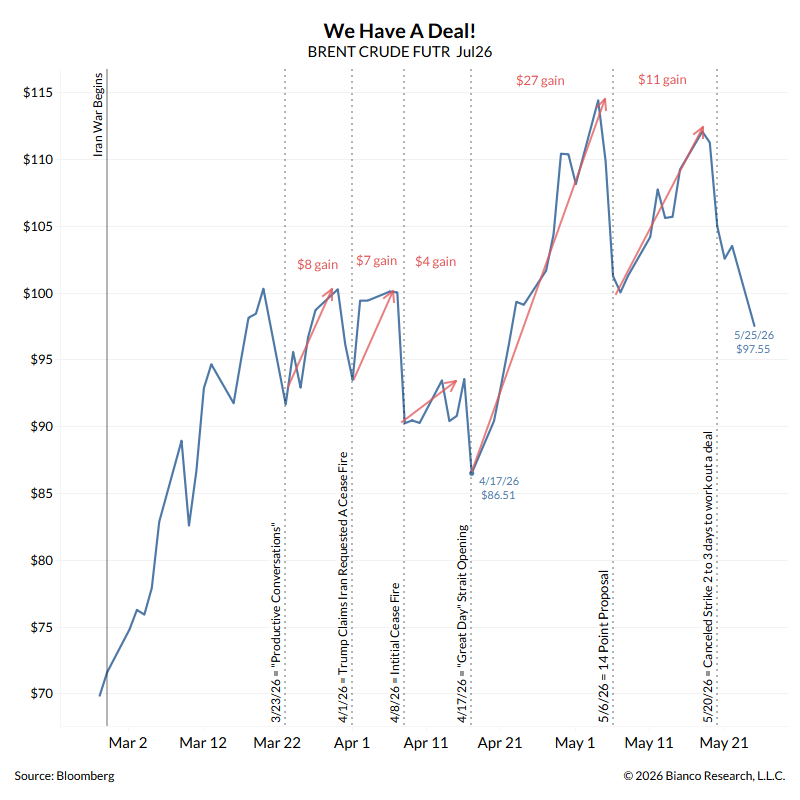
On @cnbcAsiaTV this morning, @CommodMkt said, "Sell The Tweet, Buy The Molcule." Currie detailed that Trump tweeted five times that the war was effectively over, but it has not happened.
The chart shows my guess of the five times. Currie is correct. If you bought the crude oil collapse every time Trump said the war is over, you made $58, even though the price is only up $27 since the war started. Not a bad trading strategy!
We are currently on the 6th tweet saying that the war is over; it is still a work in progress.
Is this the next great crude oil buying opportunity?
Jeffrey Currie 🆔++@CommodMkt
Five "deal" announcements, zero closed (yet). That's a trend. Sell the tweet, buy the molecule. Iran's leverage increases with every day that passes and inventories decline, while it decreases for the West. Thank you to @SquawkCNBC Asia for having me on this morning. Attached is the clip: 50 years of efficiency made oil cheaper per unit of GDP but more irreplaceable in function -- it is the rare earth of the macro system. cnbc.com/video/2026/05/…
English

Trump is obviously bored by this MoU talks with Iran, time for something serious, not even RU sending Oreshnik on Ukraine is qualified, but this is 👇
Pool is bigger than a skyscraper.... Genius, he must have spent hours on this gem.
Commentary Donald J Trump Truth Social Posts On X@TrumpTruthOnX
New media post from Donald J. Trump ( TruthSocial: May 26 2026, 7:19 AM ET )
English
Confirming the demand for Abaxx’s financial-physical settled contracts in global gas which we have long argued will likely become the most important marginal molecule in the global energy complex over the next decade. This growth trajectory is set to continue as gas entrenches itself as the swing molecule.
𝘚𝘶𝘱𝘦𝘳-𝘚𝘪𝘨𝘯𝘢𝘭@qftnoise
Today Abaxx traded a record 6,600 LNG contracts : 🔹66 million MMBtu 🔹1.277 Million tonnes 🔹18.9 LNG cargo ships equal to Prism Courage below (350 contracts per ship), in 1 day!!
English

strangely enough, this is how many oil investors feel as well....
Rory Johnston@Rory_Johnston
US-Iran negotiation status:
English
So you say we get 15 million barrels per day of oil export the second day after Hormuz is open?
Definitely weeks or more like months to achieve everything on the list. Right?
Right? 😅😅
Peter Wood@Peter__Wood
Order of business: Reopen the SoH Reposition ships Restart oilfields Re-activate plants Regain operational tempo Repair facilities Refill strategic reserves Reassess evacuation strategy [bypass pipelines] Reflect on geopolitical consequences
English
@tleilax___ 1% - Nuclear
1% - Hormuz
1% - No war
1% - War reparations
1% - Abraham Accords
English


US forces carried out defensive airstrikes in southern Iran Monday - Fox News
#MacroEdge
English
Ian Chew retweetledi
Whatever is on the other side of this will make 1929 look tame
English
Ian Chew retweetledi
@DarioCpx @ErikSTownsend Great observation. Let me scream this to the top of my lungs: COMMODITY CARRY IS LONG VOL. You want this as that’s why USO has done so well. Everything you know about financial markets is upside down in commodities.
English
Fellow oil traders: IGNORE the tornado of headlines.
Focus on a few things that won’t change.
1. The math is the math.
Regardless of jawboning or inventory buildup, we are in a FLOW deficit.
July is where inventory hits operational mimimum and oil shortage will be apparent.
Let time work its magic.
(h/t: @CommodMkt for the deficit vs. flow framing)
2. Understand that this is a zero-sum game:
- GCCs won't give up on controlling oil production via OPEC
- Iran won't give up on nuclear and Hormuz (this is an existential crisis)
- Israel won't give up on regional hegemony (that means making sure Iran doesn't have nuclear)
Thanks @HFI_Research and @PauloMacro for all the insights.
English
@Rory_Johnston Agreed. It's in both parties' best interests
- US doesn't need to expend munitions they don't really have and risk further unpopularity
- Iran doesn't need to get bombed
English