Mr Crypto 

2K posts

Mr Crypto  banner
Mr Crypto 

Mr Crypto 

@Mr______Crypto

Web3 Explorer • Concrete Access • Prompt Eng / AI Whisperer

Mirpur, Pakistan Katılım Haziran 2025
825 Takip Edilen587 Takipçiler
Sabitlenmiş Tweet
Mr Crypto 
Mr Crypto @Mr______Crypto·
For years, institutional capital in DeFi lending has faced a binary choice: • Chase volatile yields • Or remain overly conservative @ConcreteXYZ is changing that.

Mr Crypto  tweet media
English
14
0
96
2.2K
Mr Crypto 
Mr Crypto @Mr______Crypto·
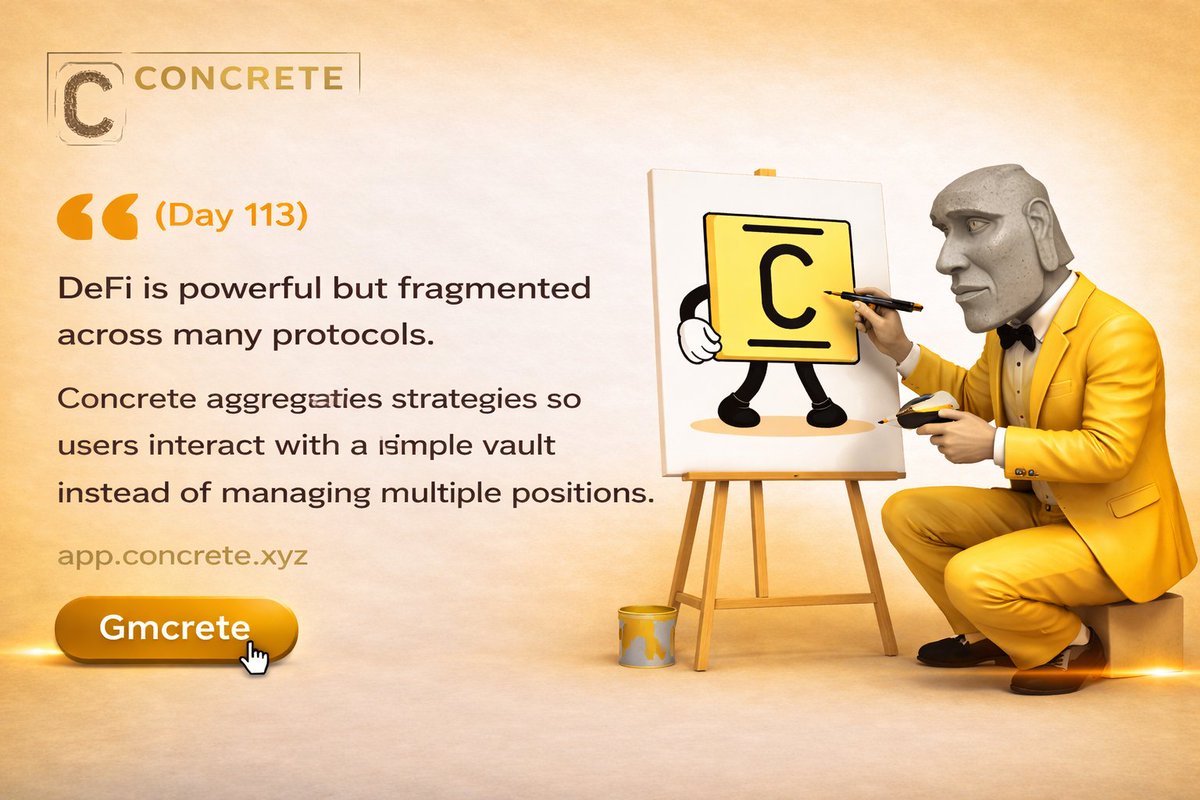
Gmcrete 🗿 Day 113 ☺️ DeFi is powerful but fragmented across many protocols. Concrete aggregates strategies so users interact with a single vault instead of managing multiple positions. Experlor Concrete here: app.concrete.xyz
Mr Crypto  tweet media
Mr Crypto @Mr______Crypto

Gmcrete 🗿 Day 101 🚀 DeFi’s biggest problem isn’t yield. It’s execution. Concrete turns complex strategies into automated vaults that allocate capital across the best opportunities. Deposit once. Let the system work.

English
6
0
12
89
Will
Will@doan665228·
DeFi is growing at an incredible pace, but alongside that growth comes an increasingly obvious problem fragmentation today, users are faced with hundreds of protocols spread across multiple chains, each offering constantly shifting yields and an overwhelming number of strategies. The opportunities are everywhere but capturing them requires continuous attention in practice, keeping capital productive in DeFi has become an active, time-consuming process rather than a passive one. Participating in DeFi is no longer as simple as depositing assets and waiting for returns users must monitor APY fluctuations, move liquidity between protocols, claim and reinvest rewards, and pay gas fees for every adjustment. On top of that, they need to track risk across multiple positions at once. This creates a significant operational burden, adding friction and inefficiency to what is supposed to be an open and accessible financial system. As complexity increases a natural consequence emerges capital inefficiency funds often sit idle, remain stuck in outdated strategies, or fail to adapt quickly enough to better opportunities this leads to a growing opportunity cost not because opportunities don’t exist but because managing them manually is too demanding the result is a system where potential is high, but actual capital utilization falls short. This is where vault infrastructure becomes essential Instead of requiring users to manage every step themselves, vaults shift DeFi from manual strategy execution to automated capital systems. These systems can rebalance positions, aggregate liquidity, continuously deploy capital, and compound rewards without constant user intervention. By reducing operational complexity vaults make DeFi more efficient scalable, and user-friendly. Concrete vaults represent a structured approach to this evolution. Rather than focusing on short-term yield chasing, they are designed to manage capital through clearly defined systems the Allocator actively deploys capital across opportunities, the Strategy Manager defines the available strategy universe, and the Hook Manager enforces risk constraints combined with automated compounding and fully onchain capital deployment, the system operates continuously and transparently the key idea is simple optimize how capital is deployed, not just where it goes at any given moment. A practical example of this approach is Concrete DeFi USDT, which offers approximately 8.5% stable yield instead of requiring users to actively manage their positions, the vault structure handles strategy execution automatically capital remains continuously productive, rewards are compounded, and efficiency is maintained without manual intervention this not only improves returns but also reduces the likelihood of user error and missed opportunities. Looking ahead, one thing is clear DeFi will only become more complex over time in such an environment manual strategy management does not scale. Infrastructure will increasingly replace constant repositioning, and vaults are likely to become the default interface for deploying capital. Ultimately, the future of DeFi may not be defined by who finds the best yield, but by who builds the most effective systems to manage capital and in that future vault infrastructure is not just an improvement it is a necessity. @ConcreteXYZ
Will tweet media
English
8
0
9
61
jakper90
jakper90@jakper90·
Baca "Why DeFi Needs Vault Infrastructure" oleh jakper90 di Medium: @perjak232/why-defi-needs-vault-infrastructure-5744a2be06bf" target="_blank" rel="nofollow noopener">medium.com/@perjak232/why…
English
2
0
3
31
hatro.linea.eth |Concrete🗿
Concrete.xyz stands out with its "one-click DeFi" model, making it easy for users to access productivity without the complexity of traditional methods, while also supporting multi-chain (multi-chain) and CeFi-DeFi connectivity. Recently, Concrete announced support and partnerships for infrastructure development projects around native BTC collateral on Sui, particularly projects like Hashi.🚀🛠️The combination of Sui's speed and advanced architecture with Concrete.xyz's professional yield infrastructure is unlocking significant potential for native asset yield and BTC DeFi on the blockchain. @ConcreteXYZ
hatro.linea.eth |Concrete🗿 tweet mediahatro.linea.eth |Concrete🗿 tweet media
English
5
0
6
42
Samuel
Samuel@donsam_samuel·
Day 27 of Consistently checking in on the @ConcreteXYZ quest website. I'm excited seeing Concrete expanding the more. DeFi just got better on multiple chains. Meanwhile, I didn't get my Bags for last week's article. Some people said that all rewards has been distributed. Who still hasn't got his 400 Bags?
Samuel tweet media
Samuel@donsam_samuel

Day 26 of Consistently checking in on the @ConcreteXYZ quest website. Good news 👇 Concrete is coming to SUI Network! The expansion continues. DeFi has to be efficient and sustainable in all networks. This is a very good work that will continue. gmcrete


English
6
2
10
141
JTN ☄️ (✱,✱)
Why DeFi Needs Vault Infrastructure ◾️ DeFi today is extremely fragmented. There are hundreds of protocols, multiple chains, and constantly changing yields. New strategies appear every day, and capital flows quickly between opportunities. > But with this level of complexity, managing capital manually becomes very difficult. ◾️ Users have to constantly monitor APY, move liquidity between protocols, claim rewards, and rebalance positions. Every action costs time, attention, and gas fees. Over time, this creates friction and makes the system less efficient. ➥ Because of this, a lot of capital ends up sitting idle, stuck in outdated strategies, or simply missing better opportunities. This is not a problem of access, but a problem of management. This is where DeFi vaults come in. ◾️ Vaults represent a shift from manual management to managed DeFi, where capital is handled by structured systems instead of individuals. Instead of constantly reacting to the market, users can rely on systems that handle onchain capital deployment more efficiently. > With automated compounding, vaults can continuously grow capital without constant user interaction. They can rebalance positions, aggregate liquidity, and deploy funds in a more consistent and efficient way. This improves overall capital efficiency and reduces wasted opportunities. > Concrete vaults are built around this idea. They are not just yield tools, but infrastructure for managing capital. With components like the Allocator, Strategy Manager, and Hook Manager, Concrete vaults define how capital is deployed, how strategies are chosen, and how risk is enforced. > A clear example is Concrete DeFi USDT, which offers around 8.5% stable yield. Instead of chasing unstable returns, the vault focuses on consistent performance, supported by structured management and automation. This is the direction of institutional DeFi where systems are designed for stability, efficiency, and scale, not constant manual action. ◾️ As DeFi grows, manual strategy management will not scale. Vault infrastructure will become the default way to deploy and manage capital. The future of DeFi is not about who finds the best yield, it is about who builds the best systems. ➥ Explore @ConcreteXYZ at: app.concrete.xyz
JTN ☄️ (✱,✱) tweet media
English
6
0
18
408
Cao Thần Quang
Cao Thần Quang@caothanquang369·
Why DeFi Needs Vault Infrastructure The DeFi ecosystem has grown into a massive landscape of protocols, chains, and strategies. Every day, new pools launch, yields change, incentives shift, and risk conditions evolve. For users, this creates opportunity but it also creates a problem. In today’s DeFi, keeping capital productive requires constant attention. Hundreds of protocols Multiple chains Changing APYs Endless strategy options The opportunity set is large, but managing it manually is difficult. Fragmentation Is the Default State of DeFi Unlike traditional finance, DeFi does not have a unified capital layer. Liquidity is scattered across: lending markets AMMs vaults restaking systems RWAs structured products To stay efficient, users must continuously monitor where yield is highest, where risk is lowest, and where incentives exist. This fragmentation turns capital management into a full-time job. And most users simply cannot keep up. The Operational Burden of Manual DeFi Managing positions in DeFi means doing everything yourself: checking APY changes moving liquidity between protocols claiming rewards compounding manually paying gas fees every time tracking risk across multiple positions Each adjustment costs time, gas, and attention. The more complex DeFi becomes, the harder it is to stay efficient. Friction increases. Mistakes increase. Capital efficiency decreases. Idle Capital and Hidden Opportunity Cost Because managing positions is difficult, capital often becomes inefficient. Funds may: sit idle in wallets remain in outdated strategies miss higher-yield opportunities stay exposed to unnecessary risk This creates hidden opportunity cost. Not because opportunities don’t exist but because managing them manually does not scale. As DeFi grows, the need for automated capital systems becomes obvious. From Manual Yield Chasing → Vault Infrastructure Mature financial systems do not rely on users to move money manually between opportunities. They rely on infrastructure. This is where DeFi vaults come in. Vault infrastructure allows capital to be managed automatically through defined systems instead of constant manual repositioning. Concrete vaults are designed for this shift. They enable: automated compounding onchain capital deployment liquidity aggregation continuous rebalancing simplified user interaction Instead of chasing yield, users deposit into managed DeFi infrastructure that keeps capital productive. This is how DeFi moves toward real capital efficiency. How Concrete Vaults Manage Capital Concrete vaults are built as structured systems for capital deployment. Each vault operates through dedicated components: • Allocator → actively deploys capital across opportunities • Strategy Manager → defines the allowed strategy universe • Hook Manager → enforces risk rules and constraints • automated compounding → rewards are reinvested automatically • onchain capital deployment → all actions executed transparently • managed DeFi infrastructure → users interact with one vault, not dozens of protocols This design focuses on efficient capital allocation rather than manual yield chasing. It brings DeFi closer to institutional DeFi standards. Example: Concrete DeFi USDT A clear example is Concrete DeFi USDT. The vault currently targets ~8.5% stable yield while maintaining structured risk controls. Instead of users moving funds between lending markets, pools, and farms, the vault: deploys capital automatically compounds rewards reallocates liquidity when needed keeps funds continuously productive The result is a smoother experience and more consistent capital efficiency. Vault structure makes yield more sustainable because strategy execution is handled by infrastructure, not manual action. Explore Concrete at app.concrete.xyz 🚨 The Big Shift Coming to DeFi DeFi will not become simpler. It will become more complex. More chains More protocols More strategies More risk layers Manual strategy management will not scale. Infrastructure will replace constant repositioning. Vaults will become the default interface for deploying capital. The future of DeFi may not belong to those who find the highest yield. It may belong to those who build the best systems to manage capital. @ConcreteXYZ
Cao Thần Quang tweet media
English
5
0
14
147
MIZZY
MIZZY@mizzy_web3·
Good night CT 😴 DeFi is powerful. But it’s broken behind the scenes. Hundreds of protocols. Multiple chains. Constantly changing yields. And users? Manually tracking everything just to stay relevant. ⚠️ The reality: • Monitoring APY all day • Moving liquidity constantly • Paying gas every step • Managing risk everywhere Still… Capital sits idle. Strategies become outdated. Better opportunities get missed. This is the core problem 👇 DeFi is growing… but manual management doesn’t scale. 🏗️ That’s where Vault Infrastructure comes in. Instead of chasing yield manually, vaults turn DeFi into automated capital systems: 👉 Auto rebalancing 👉 Liquidity aggregation 👉 Automated compounding 👉 Continuous deployment ⚙️ @ConcreteXYZ Vaults take it further: Allocator ⬇️ active capital deployment ⬇️ Strategy Manager ⬇️ structured strategies ⬇️ Hook Manager ⬇️ Risk enforcement Result? Smarter capital. Better efficiency. Less friction. Example: Concrete DeFi USDT → ~8.5% stable yield No constant switching. No manual stress. Just efficient capital. 🚀 The future of DeFi isn’t about finding yield… It’s about building systems that manage it. Explore → app.concrete.xyz #DeFi #Web3 #Crypto #Vaults #binance
English
3
1
8
78
JuttBroz
JuttBroz@Xterio22·
Most DeFi “security” stops at approvals. @ConcreteXYZ goes further. 🏦 Vaults that don’t just hold capital — they govern its destination 🧱 Infrastructure that turns intent into enforcement 🗿 A system where funds move with rules, not risk Cross-chain isn’t the future if it’s blind. Concrete Vaults make it aware, controlled, unstoppable. This is what real security feels like. @ConcreteXYZ
JuttBroz tweet media
JuttBroz@Xterio22

Let's dive into @ConcreteXYZ vaults ERA Total Value Locked (TVL): DefiLlama: $1.079 billion Official site: $1.053 billion (assets on platform) Cumulative assets processed: $11.25 billion (shows insane capital velocity — deposits → strategies → compounding at scale) Operating across 5 chains TVL Breakdown by Chain Ethereum: $949.8M (~88% dominance) Stable (stable-focused vaults/category): $70.38M Berachain: $46.29M Arbitrum: $12.95M Katana: ~$1.4K (minimal) Ethereum is the clear powerhouse, with new vaults (especially USDT) pulling the bulk of inflows. Protocol revenue (captured share): Lower at $371K cumulative (most yield flows back to depositors — classic allocator model). What’s Driving the Growth? Binance Wallet integration — instant retail/institutional inflows into USDT vaults. New vault launches (ctDeFiUSDT etc.) with on-chain risk engine + auto-allocation. Multi-chain + composability (ctASSETs usable across DeFi). Polychain/YZi/VanEck backing + “Vaults Era” narrative shift away from manual farming. This is the Vaults Era winning. @ConcreteXYZ — infrastructure > hype. 🧱📈 @d3crypt0r25 @crypttoji @nic_builds

English
6
1
17
150
Timity🗿
Timity🗿@Timityy_XO·
A key innovation in @ConcreteXYZ is its approach to programmable security, particularly for cross-chain workflows. In multi-chain environments, where vaults deploy assets across ecosystems, security risks multiply, including bridge vulnerabilities, oracle manipulations, smart contract exploits, and unauthorized rebalancing actions. Concrete enforces programmable security through real-time, pre-execution enforcement mechanisms. This means security rules must be enforced before any sensitive cross-chain operation executes. Instead of relying solely on static audits or reactive monitoring, Concrete integrates dynamic, customizable guards that can be programmable. Implementing this has been possible through collaboration with security partners such as @zeroshadow_io and @HypernativeLabs
Timity🗿 tweet media
Concrete@ConcreteXYZ

x.com/i/article/2034…

English
10
0
19
409
Mr Crypto  retweetledi
Mr Crypto 
Mr Crypto @Mr______Crypto·
Excited about this move: @ConcreteXYZ is backing Hashi on Sui to build out native BTC collateralization infrastructure. Bitcoin stays secure on its chain but becomes programmable collateral for lending,
Mr Crypto  tweet media
Concrete@ConcreteXYZ

Structured deployment paths will matter if BTC-backed capital is going to be used more productively onchain. Concrete is thrilled to support Hashi on Sui and the infrastructure forming around native BTC collateralization.


English
13
1
33
456
ytre 🍊,💊
ytre 🍊,💊@Taras_Heviuk·
DeFi today is powerful… but risky. Liquidations, volatile returns, and constant monitoring are a reality for most users. Concrete is creating a smarter level for DeFi. What does Concrete do? Concrete is a risk-aware yield protocol that helps you: - Protect your positions. - Reduce the risk of liquidation. - Automatically optimize your yield. Instead of managing everything manually, Concrete does all the hard work for you. In modern DeFi: - You are constantly chasing annual percentage yield (APY). - You are moving funds between protocols. - You are managing risk manually. - This leads to: - Inefficiency. - Stress. - Missed opportunities. Concrete is changing that. Here’s how it works. - Smarter yield. Not just high annualized returns, but risk-adjusted returns. - Liquidation protection. Helps mitigate one of the biggest risks in DeFi. - Capital efficiency. Your funds work better, not harder. -Less manual work. No need to constantly rebalance positions. Why you should pay attention . ~$1 billion TVL. Backed by leading funds. Solves real DeFi problems. If you’re already in DeFi you’ll understand why this is important. And if not…this is a tool that makes it easy to get started. @ConcreteXYZ @crypttoji
ytre 🍊,💊 tweet media
English
4
0
31
175