Ai Fujiki

1.5K posts

Ai Fujiki banner
Ai Fujiki

Ai Fujiki

@Ms_amour19

Head of Corp Dev @SakanaAILabs🐠/ Ex-M&A Banker @GoldmanSachs👩‍💻 (Tokyo & SF) / Loves 🎹📕🐶🧘‍♀️🍷🥂🎬🎤🪩👠✈️

Katılım Ekim 2011
845 Takip Edilen1.2K Takipçiler
Ai Fujiki retweetledi
Sakana AI
Sakana AI@SakanaAILabs·
We’re launching the beta for our new commercial AI product: Sakana Fugu 🐡, a multi-agent orchestration system! Blog: sakana.ai/fugu-beta Fugu hits SOTA on SWE-Pro, GPQA-D, and ALE-Bench, and has been our internal secret weapon. It dynamically coordinates frontier models, autonomously selecting the optimal agent combinations and roles for each task. Available as an OpenAI-compatible API, you can seamlessly integrate Fugu into your existing workflows with minimal changes. 🐟 Fugu Mini: High-speed orchestration optimized for latency 🐡 Fugu Ultra: Full model pool utilization for deep, complex reasoning Apply for the beta test here: forms.gle/BtKkhc2CfLKk1d…
Sakana AI tweet media
English
25
153
660
342.9K
Ai Fujiki retweetledi
Sakana AI
Sakana AI@SakanaAILabs·
LLMは頭の中でコイントスができるか? ブログ:pub.sakana.ai/ssot 論文(#ICLR2026):arxiv.org/abs/2510.21150 一見簡単そうで奥深いこの問題を「プロンプトだけ」で解決した論文 "SSoT: Prompting LLMs for Distribution-Faithful and Diverse Generation" が #ICLR2026 に採択されました。 LLMに「コイントスをして」と100回プロンプトすると、出力の表と裏の比率は50:50から大きく離れてしまいます。明示的に確率の指示が与えられても、LLMがそれに忠実に従って出力を生成することは難しい問題です。 このことは、コイントスに留まりません。LLMに小説のアイデアを何本か出してもらったら似たような案ばかり出てきた、という経験はないでしょうか。コイントスを歪ませるのと同じ確率的な偏りが、創作やブレインストーミングなど多様な出力が求められるタスク全般で多様性を抑制しています。 私たちはこれらの問題の解決策として、String Seed of Thought (SSoT)というプロンプトを発見しました。SSoTは、LLMに頭の中で一旦ランダムな文字列を考えさせ、その文字列を操作させて結果を出力させるという非常にシンプルな手法です。外部の乱数生成器は一切使いません。 SSoTにより出力のバイアスはオープンモデルでもクローズドなモデルでも幅広いLLMで低減されます。一部のreasoningモデルでは、実際に乱数を使った場合とほぼ変わらない精度を達成しました。これは、2択の選択肢だけでなく一般の離散分布について有効です。 さらに重要なのは、SSoTはモデル出力の多様性を高めるのに使えることです。創作的な文書作成などにおいて、SSoTをプロンプトに加えるだけで、出力される文書などの多様性が高まることがわかりました。 本手法はコンテンツ生成やアイディア出し、推論時スケーリングの新手法の開発など、LLMを実世界のシステムに組み込んでいく上で重要な基盤になると考えています。 SSoTのメカニズム、理論的な解析、インタラクティブなデモについてはブログと論文をご覧ください。 OpenReview:openreview.net/forum?id=luXtb…
Sakana AI@SakanaAILabs

Can LLMs flip coins in their heads? When prompted to “Flip a fair coin” 100 times, the heads to tails ratio drifts far from 50:50. LLMs can understand what the target probability should be, but generating outputs that faithfully follow a given distribution is a separate problem. This bias extends beyond coin flips. When LLMs are asked to generate multiple story ideas or brainstorm solutions, the outputs tend to cluster around a narrow range. The same probabilistic skew that distorts coin flips limits diversity in creative generation, recommendations, and other tasks where varied outputs are needed. We discovered a prompting technique named String Seed of Thought (SSoT). The method is simple: instruct the LLM to generate a random string in its own output, then manipulate that string to derive its answer. It requires only a small addition to the prompt and no external random number generator. SSoT significantly reduces output bias across a wide range of LLMs, both open and closed. With reasoning models (such as DeepSeek-R1), it reaches accuracy close to that of actual random sampling. The method generalizes from binary choices to n-way selections and arbitrary probability distributions. On the NoveltyBench diversity benchmark, SSoT outperformed other approaches across all six categories while maintaining output quality. This work will be presented at #ICLR2026! Blog: pub.sakana.ai/ssot Paper: arxiv.org/abs/2510.21150 Openreview: openreview.net/forum?id=luXtb…

日本語
7
176
840
306.6K
Ai Fujiki retweetledi
Sakana AI
Sakana AI@SakanaAILabs·
What happens when you put competing neural networks in a Petri Dish and start changing the rules while they adapt? Last year we released Petri Dish NCA, where neural nets are the organisms that learn during simulation. Today we're releasing Digital Ecosystems: a browser-based platform for interactive artificial life research. The setup: several small CNNs share a 2D grid, each seeing only a 3x3 neighborhood. No global plan. They compete for territory by attacking neighbours and defending against incoming attacks, learning via gradient descent online while the simulation runs. What we didn't expect was the role of the learning itself. Gradient descent isn't just optimising each species' strategy. Instead, it acts to stabilize the whole system during simulation. Species that overextend get pushed back by the loss. Species that stagnate get nudged to grow. This means you can push parameters toward edge-of-chaos regimes: a zone characterised by emergent complexity. Letting the neural networks learn acts to hold the complex system together while you explore and interact. The platform lets you steer all of this interactively. You can draw walls to create niches, erase parts of the system online, and tune 40+ system parameters to explore the most interesting configurations. We find it mesmerizing to watch species carve out territories and reorganise when you perturb them. Everything runs client-side in your browser, no install needed. Blog: pub.sakana.ai/digital-ecosys… Code: github.com/SakanaAI/digit…
English
38
199
1.1K
235.4K
Ai Fujiki
Ai Fujiki@Ms_amour19·
Happy Friday 🙌
Ai Fujiki tweet media
English
0
0
3
339
Ai Fujiki retweetledi
Sakana AI
Sakana AI@SakanaAILabs·
Mistral AI 🇫🇷 🤝 Sakana AI 🇯🇵
Sakana AI tweet media
Indonesia
36
112
1.7K
163.4K
Ai Fujiki retweetledi
Sakana AI
Sakana AI@SakanaAILabs·
🐟Ultra Deep Researchアシスタント「Sakana Marlin」、βテスター募集🐟 Sakana AIは、当社初の商用プロダクトとして、独自のエージェント技術によるビジネス向けAIリサーチアシスタント「Sakana Marlin」を開発しました。 sakana.ai/marlin-beta Sakana Marlinは、高度なビジネス調査を完遂する 、独自の長期推論技術に基づく自律型リサーチアシスタントです。 主な特徴 ・ テーマを与えると、8時間近くにわたり自律的にリサーチ ・ 詳細な調査ドキュメントとまとめスライドを自動生成 ・ 複数人のチームが数週間かけるプロフェッショナルな戦略調査を想定 複雑な社会情勢の中で良質な判断を下すため、AIのポテンシャルを最大限生かすソリューションとして構想しました。 本技術は、先日Nature誌にも掲載された科学的発見の自動化「AIサイエンティスト」の知見と、戦略的探索を可能にする「AB-MCTS」を融合。長く考えた分だけアウトプットの質が向上する「効率的な推論スケーリング」を実現しています。 クローズドβテストを実施します 金融機関・事業会社の経営戦略/事業企画部門、コンサルファーム、シンクタンクなど、日常的に高度なリサーチに取り組む方が対象です(期間中無料)。皆様からのフィードバックをもとに改善を重ねていきます。 ▼ クローズドβテスター応募はこちら forms.gle/MYHGP1wi2q4PHY…
Sakana AI tweet media
日本語
13
106
448
276.5K
suganuma
suganuma@wkpeco·
やる気、本気、狂気
日本語
1
0
8
260
Ai Fujiki retweetledi
Max Verstappen
Max Verstappen@Max33Verstappen·
Time for a break. Arigato 🇯🇵
Max Verstappen tweet mediaMax Verstappen tweet mediaMax Verstappen tweet media
English
949
6.4K
88.7K
1.5M
Ai Fujiki retweetledi
Takuya Akiba
Takuya Akiba@iwiwi·
GENIAC通信に取材頂いた記事が公開されました。最近またモデル開発がアツいと思ってる理由とかを話してます。 ❌開発をリード ⭕️天才を集めてあとは応援
Sakana AI@SakanaAILabs

経済産業省のウェブサイトにて、Sakana AI リサーチサイエンティスト 秋葉拓哉(@iwiwi) のロングインタビューが掲載されました。 meti.go.jp/policy/mono_in… Sakana Chat/Namazuのモデル開発をリードした秋葉が、研究者としてのあゆみを振り返りつつ、モデルのファインチューニングからエージェント 、そして再びエージェントと組み合わせたモデルの事後学習へという技術トレンドの変遷と、その中でSakana AIが見据えるビジョンを語りました。 秋葉「エージェントと密結合したモデルの開発ができる...言い換えれば、この数年でやりたかったことが、ついに具現化できるタイミングが訪れた(のが今だと考えています)」 ぜひ全文をお読みください。🐟

日本語
0
17
181
26.4K
Ai Fujiki retweetledi
Yutaro Yamada
Yutaro Yamada@_yutaroyamada·
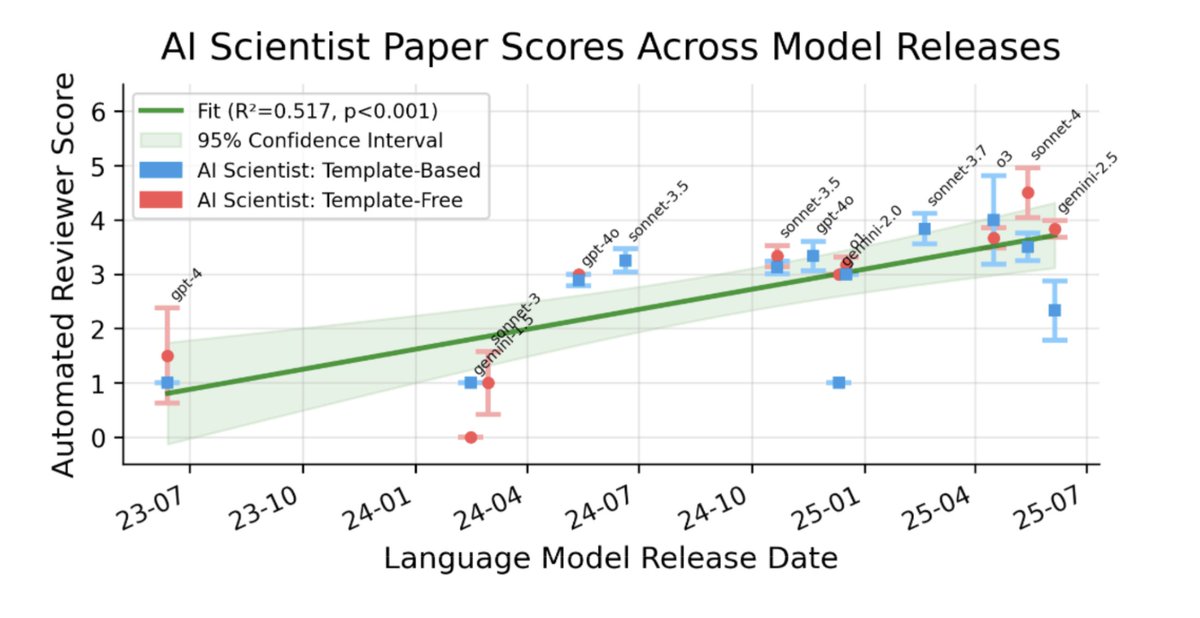
Still remember the experiment grind over New Year's break--really great to see this out in Nature today! AI automation of AI research is heating up fast, and I'm excited to see what becomes possible as models keep improving (see the figure below!)
Yutaro Yamada tweet media
Sakana AI@SakanaAILabs

The AI Scientist: Towards Fully Automated AI Research, Now Published in Nature Nature: nature.com/articles/s4158… Blog: sakana.ai/ai-scientist-n… When we first introduced The AI Scientist, we shared an ambitious vision of an agent powered by foundation models capable of executing the entire machine learning research lifecycle. From inventing ideas and writing code to executing experiments and drafting the manuscript, the system demonstrated that end-to-end automation of the scientific process is possible. Soon after, we shared a historic update: the improved AI Scientist-v2 produced the first fully AI-generated paper to pass a rigorous human peer-review process. Today, we are happy to announce that “The AI Scientist: Towards Fully Automated AI Research,” our paper describing all of this work, along with fresh new insights, has been published in @Nature! This Nature publication consolidates these milestones and details the underlying foundation model orchestration. It also introduces our Automated Reviewer, which matches human review judgments and actually exceeds standard inter-human agreement. Crucially, by using this reviewer to grade papers generated by different foundation models, we discovered a clear scaling law of science. As the underlying foundation models improve, the quality of the generated scientific papers increases correspondingly. This implies that as compute costs decrease and model capabilities continue to exponentially increase, future versions of The AI Scientist will be substantially more capable. Building upon our previous open-source releases (github.com/SakanaAI/AI-Sc…), this open-access Nature publication comprehensively details our system's architecture, outlines several new scaling results, and discusses the promise and challenges of AI-generated science. This substantial milestone is the result of a close and fruitful collaboration between researchers at Sakana AI, the University of British Columbia (UBC) and the Vector Institute, and the University of Oxford. Congrats to the team! @_chris_lu_ @cong_ml @RobertTLange @_yutaroyamada @shengranhu @j_foerst @hardmaru @jeffclune

English
1
12
60
9.3K
Ai Fujiki
Ai Fujiki@Ms_amour19·
AI自身がAI研究を自動化する「AIサイエンティスト」がNature本誌に掲載されました!AI研究のフロンティアが切り拓かれるのをこんなに近くで見ることができてワクワク&誇りに思います。 私のような文系人間でもちゃんと理解できる内容だったので、ぜひ元の論文も多くの方に読んでみて欲しいなと思います👩‍🎓📚 nature.com/articles/s4158…
Sakana AI@SakanaAILabs

The AI Scientist: Towards Fully Automated AI Research, Now Published in Nature Nature: nature.com/articles/s4158… Blog: sakana.ai/ai-scientist-n… When we first introduced The AI Scientist, we shared an ambitious vision of an agent powered by foundation models capable of executing the entire machine learning research lifecycle. From inventing ideas and writing code to executing experiments and drafting the manuscript, the system demonstrated that end-to-end automation of the scientific process is possible. Soon after, we shared a historic update: the improved AI Scientist-v2 produced the first fully AI-generated paper to pass a rigorous human peer-review process. Today, we are happy to announce that “The AI Scientist: Towards Fully Automated AI Research,” our paper describing all of this work, along with fresh new insights, has been published in @Nature! This Nature publication consolidates these milestones and details the underlying foundation model orchestration. It also introduces our Automated Reviewer, which matches human review judgments and actually exceeds standard inter-human agreement. Crucially, by using this reviewer to grade papers generated by different foundation models, we discovered a clear scaling law of science. As the underlying foundation models improve, the quality of the generated scientific papers increases correspondingly. This implies that as compute costs decrease and model capabilities continue to exponentially increase, future versions of The AI Scientist will be substantially more capable. Building upon our previous open-source releases (github.com/SakanaAI/AI-Sc…), this open-access Nature publication comprehensively details our system's architecture, outlines several new scaling results, and discusses the promise and challenges of AI-generated science. This substantial milestone is the result of a close and fruitful collaboration between researchers at Sakana AI, the University of British Columbia (UBC) and the Vector Institute, and the University of Oxford. Congrats to the team! @_chris_lu_ @cong_ml @RobertTLange @_yutaroyamada @shengranhu @j_foerst @hardmaru @jeffclune

日本語
0
1
22
3.6K
Ai Fujiki
Ai Fujiki@Ms_amour19·
Fintech企業のように投資家側が一律net revenueで評価するのだとは思うけど、SECの判断気になる
Ethan Choi@EthanChoi7

The way @OpenAI and @AnthropicAI account for revenue / ARR is apples to oranges. Should Anthropic treat their revenue from AWS and other hyperscalers the same as OAI, they would be a materially lower in rev… If they both IPO in the coming quarters, not sure how the SEC is going to let these two companies have different accounting treatment for essentially the same type of revenue. OpenAI TAKES OUT the 80% revenue share that goes to @Microsoft Azure and others so reports this 3rd party revenue on a NET basis in their total revenue. Anthropic INCLUDES the revenue share that goes to @amazon AWS and others in their revenue so reports this 3rd party revenue on a GROSS basis in their total revenue. IMO, OpenAI taking more conservative approach that reflects the reality of the economics of these hyperscaler partnerships.

日本語
0
0
1
719
Ai Fujiki retweetledi
Josh Wolfe
Josh Wolfe@wolfejosh·
We are in the era of tech-driven COGNITIVE WARFARE offense + defense a VERY key breakthrough work from Lux family co @SakanaAILabs they just engineered a proprietary new AI tech to detect (hostile, foreign) state actors in social media influence + information operations...
hardmaru@hardmaru

We recently worked with The Yomiuri Shimbun to analyze more than a million social media posts to map out state-sponsored information campaigns. #en" target="_blank" rel="nofollow noopener">sakana.ai/narrative-inte… Keyword searches are fragile for modern OSINT. To fix this, our team used an ensemble of different LLMs combined with our Novelty Search algorithm to extract underlying narratives purely from context. (e.g., The system successfully mapped posts demanding "a politician retract a statement" to the broader, hidden narrative of "Taiwan interference"). The system clusters these granular narratives hierarchically and generates testable hypotheses, citing specific evidence. Human journalists took the AI-generated hypotheses, interviewed real-world government sources, and verified the timeline of the coordinated campaign our system uncovered. Fascinating look at human-AI collaboration for intelligence analysis.

English
1
11
87
15.4K
Ai Fujiki retweetledi
heartkilla
heartkilla@artem_aruchomu·
インテリジェンスチームのエンジニアとして開発した技術(Narrative Novelty Search via Multi-LLM Reasoning)を社内のアナリストに活用してもらい、読売新聞の記事のタネを発掘しました。 読売新聞の方は、こうした分析や仮説をもとに実際に取材を行い、検証しました。 AI研究者、エンジニア、アナリスト、そして報道記者が連携した、新しい時代のコラボレーションを示す事例だと思います。
Sakana AI@SakanaAILabs

Sakana AIは、読売新聞社と共同でSNS空間での中国による対日批判を分析しました。独自に開発したAI技術を搭載する当社のシステムが、SNSの膨大なデータから文脈やニュアンスを深く読み取り、批判投稿とナラティブを抽出。その構造を可視化し、さらに実用的な仮説構築までを実行しました。 【記事】 読売新聞(1) yomiuri.co.jp/politics/20260… 読売新聞(2) yomiuri.co.jp/national/20260… 今回の分析に用いたSakana AIの独自AI技術には三つの特徴があります。第一に、投稿文の文脈、ニュアンスからナラティブを抽出することです。例えば「高市首相の誤った発言の撤回を要請」という投稿から「台湾問題への介入と内政干渉」というナラティブを抽出しましたが、これは「台湾」というキーワード検索では発見できないものです。 第二に、独自開発したノベルティー・サーチ技術です。3種類の異なる大規模言語モデル(LLM)が集合知的に推論を重ねてSNS上の重要情報を探索し、粒度の高いナラティブを抽出します。それをさらに抽象度の高いグループにまとめて階層的に可視化することで、情報空間の大きな流れを詳細に把握できます。 第三に、仮説構築です。抽出・分類されたナラティブから、AIが仮説を無数に生成します。判断過程や具体的なデータなどの根拠も示されるため、分析担当者はその内容を精査し、再度分析を指示するなどして、信頼性が高いと考えられる仮説を絞り込むことができます。 今回は、SNSの計110万件にのぼる膨大な投稿の分析から、複数の仮説が導き出されました。このうち、「高市首相の国会答弁後、中国が統一的な対日批判戦略を検討してから大規模な対日批判を開始した」という仮説について、読売新聞が日中双方の政府関係者らに取材し、専門家の意見も踏まえて検証・裏付けを行いました。 AIは人間には見出せないインサイトを発見し、人間はそれを見てAIと対話しながらさらなる分析や対策を検討する--今回の読売新聞社との共同研究はそうした新しい分析の実践の形を示したと考えています。 防衛・インテリジェンス領域においては、本調査で対象とした認知戦をはじめとして、「情報力」の果たす役割がかつてないほど大きくなっています。 Sakana AIはこうした背景も踏まえ、「金融」と並ぶ注力領域として「防衛・インテリジェンス」分野を位置付け、最先端のAI技術を実装する取組を進めています。日本発のAI開発企業として、引き続き防衛・インテリジェンス領域でのAI実装を本格化していきます。

日本語
0
3
33
5.3K
Ai Fujiki
Ai Fujiki@Ms_amour19·
@usutaku_channel さんにインスタで紹介頂き、一夜明けたら私個人のフォロワー200人増えてた🥹💣🙌 影響力がすごすぎる。当社のイントロもストーリーで発信頂きありがとうございます!
Ai Fujiki tweet media
日本語
0
0
4
526