Sabitlenmiş Tweet
Md. Muddassir Quamar
4.3K posts
Md. Muddassir Quamar
@MuddassirQuamar
Associate Professor, Jawaharlal Nehru University @JNU_official_50 Formerly @IDSAIndia #InternationalAffairs #MiddleEast #Gulf RTs not endorsement
New Delhi Katılım Ağustos 2009
341 Takip Edilen927 Takipçiler

With the MA IRWM class of 2025-27 at the end of course WA406 Society and Culture in WANA.

English
Md. Muddassir Quamar retweetledi

Congratulations to @palkisu Palki Sharma on the launch of #IndiaGlobalReview — which promises to be a bold new platform bringing an Indian perspective to global affairs with clarity, balance and conviction.
Palki has long been a voice of sobriety and credibility, presenting the best of India on the front foot with confidence and intellectual depth.
We at @sisjnu_official look forward to creating a meaningful synergy between academia, diplomacy, public policy and responsible journalism.
Palki Sharma@palkisu
#IndiaGlobalReview #IGR An important announcement ⬇️
English
Md. Muddassir Quamar retweetledi

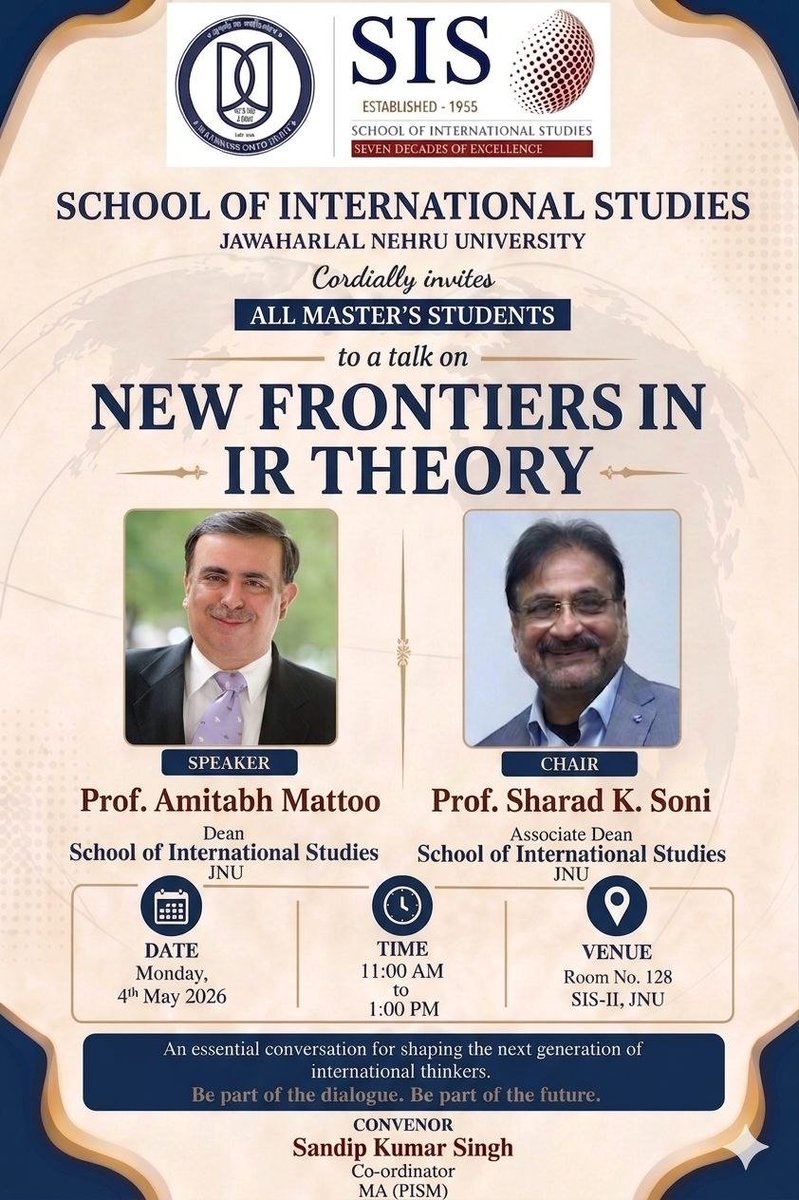
“New Frontiers in IR Theory” at SIS, JNU 🌍
Join Prof. @amitabhmattoo (Speaker) with Prof. @sharadksoni1 (Chair) for a deep dive into evolving global ideas.
🗓 May 4, 2026
⏰ 11 AM–1 PM
📍 SIS-II, Room No. 128
Convenor: Shri Sandip Kumar Singh
(@IndianIR).
English
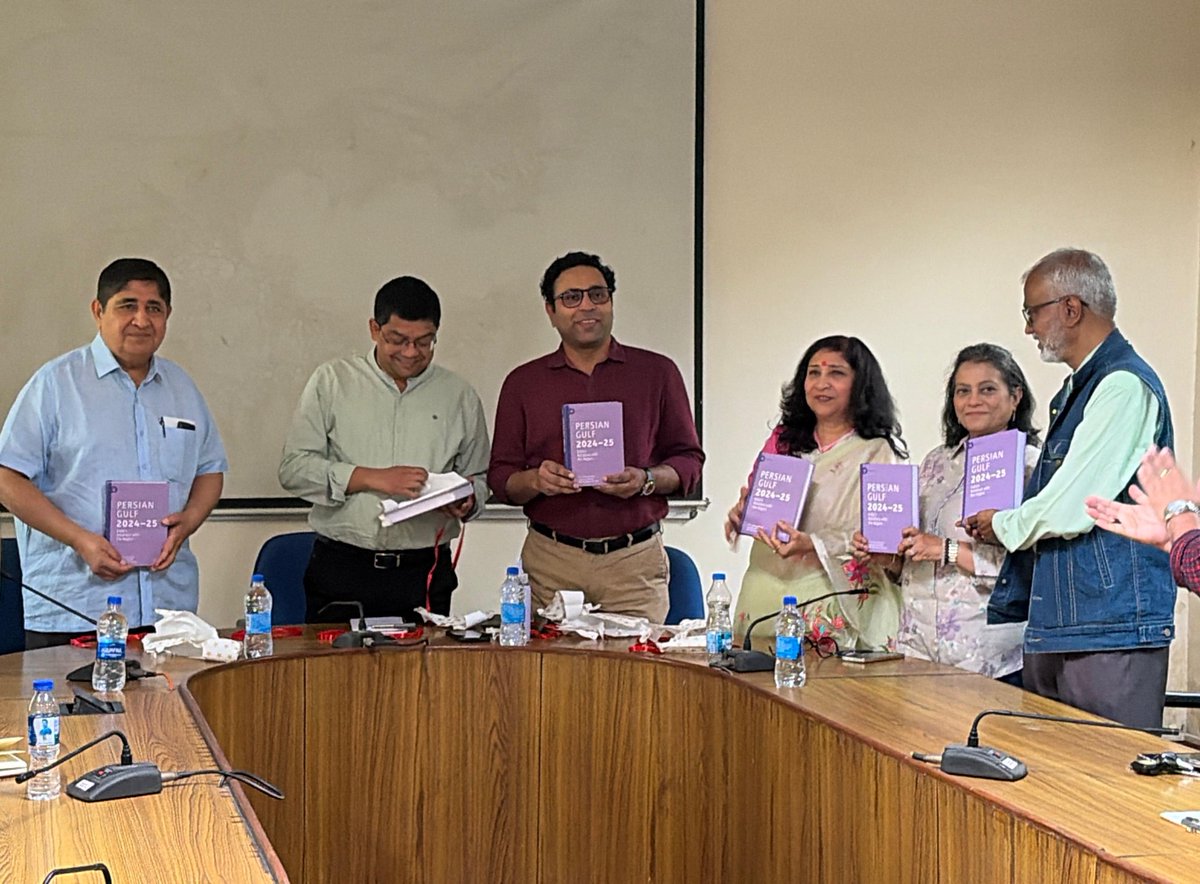
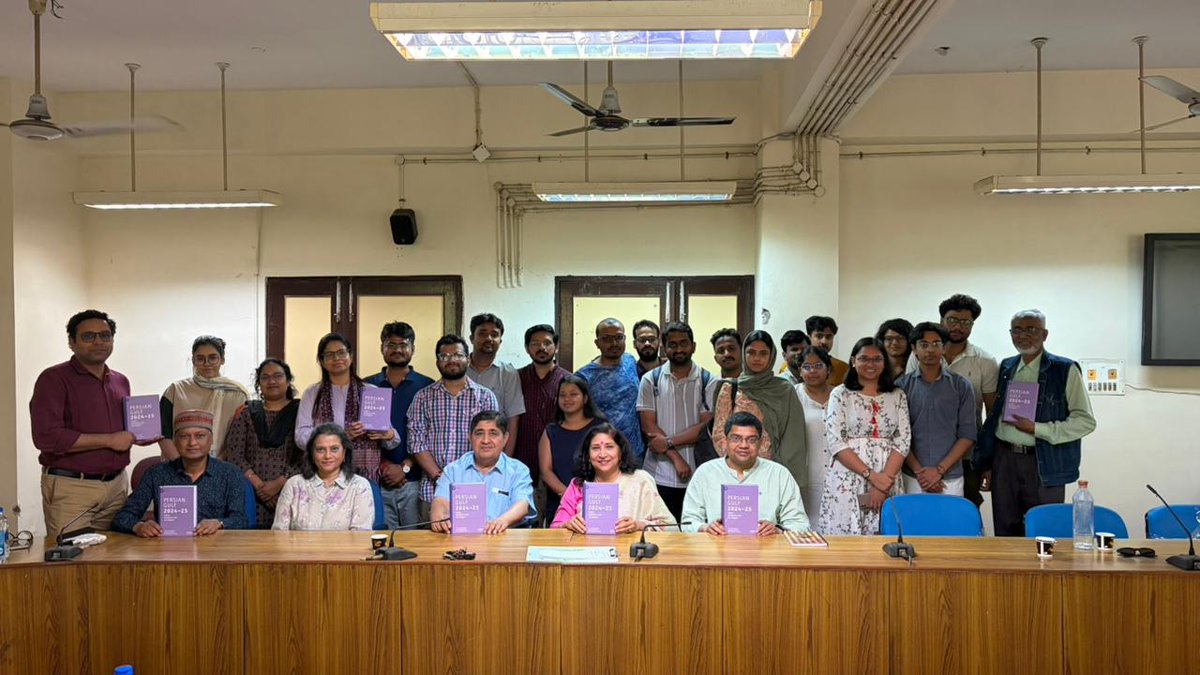
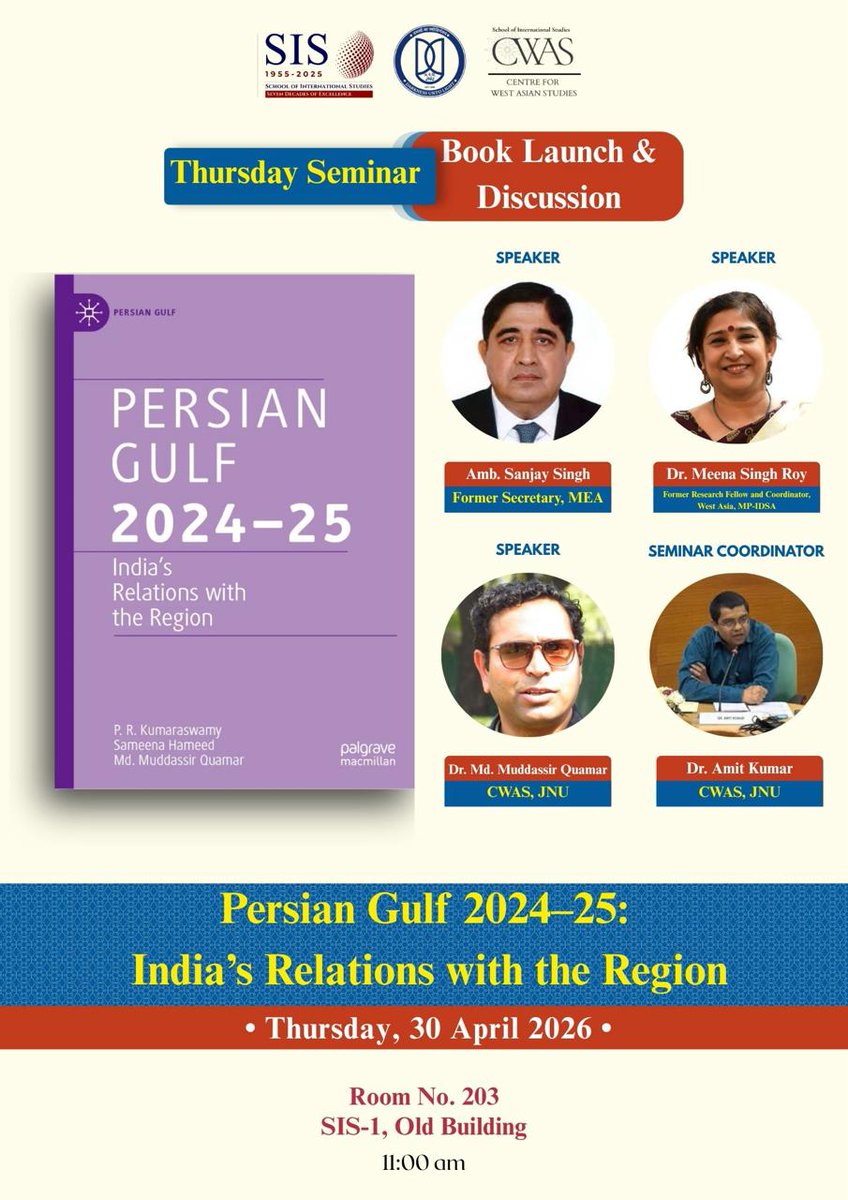
Book Launch and Discussion of Persian Gulf 2024-25: India's Relations with the Region at SIS, JNU
link.springer.com/book/10.1007/9…


English
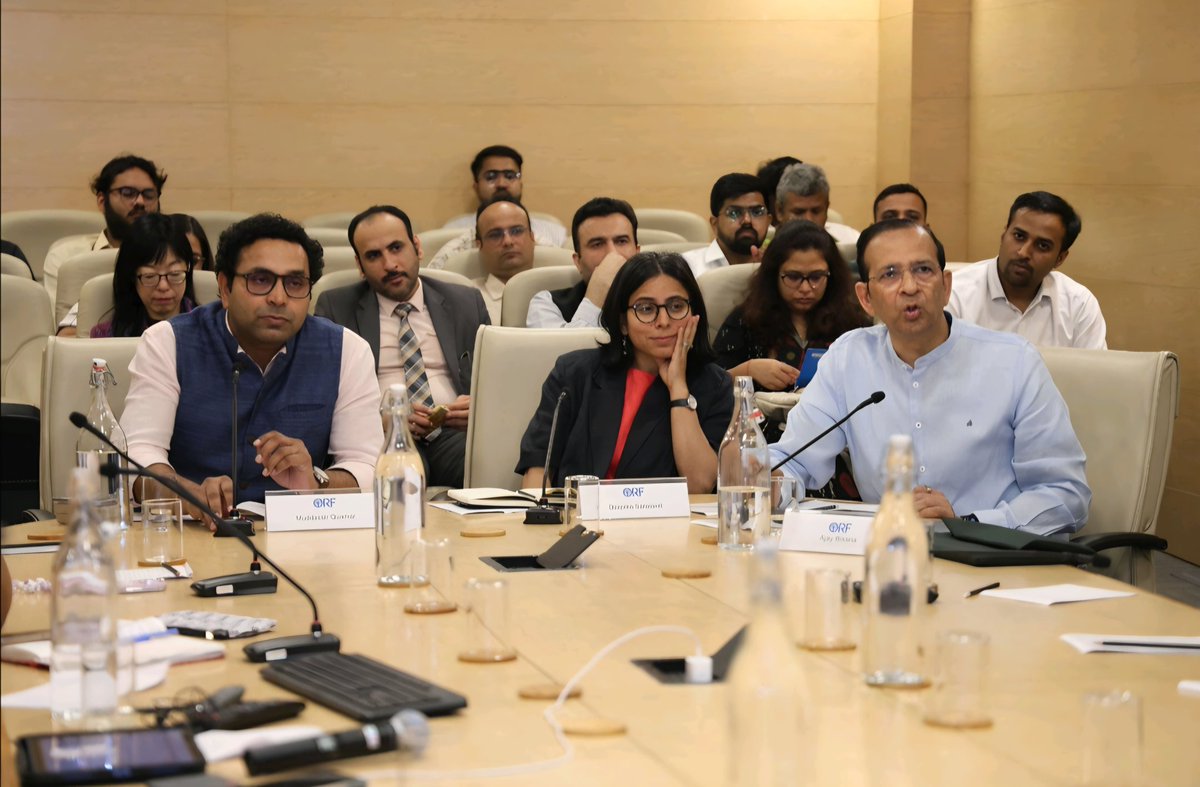
Had a interesting conversation in ORF on Russia-Iran partnership amidst the ongoing war in the Gulf and impacts on India. Thoroughly enjoyed it. Thanks Aleksei Zakharov for the invite.



English
Md. Muddassir Quamar retweetledi

"Saudi Arabias Transformation: Uncertainty and Sustainability" by Turki Faisal Al-Rasheed reviewed in @arabnews arabnews.pk/node/2640766/b…
English
A short bite to PTI on the developments in the #MiddleEast
Press Trust of India@PTI_News
VIDEO | Delhi: West Asia expert Muddassir Quamar on Israel launching strikes against Iran with the assistance of the US said, "The situation at this point is very critical. Israel, along with the United States, has announced that it has launched strikes against Iran, and several explosions have been heard in Iran, in Tehran and in other cities. It is a very early stage of the beginning of a war, a much-anticipated war. The US has been building up its military in the Persian Gulf region for quite some time. It is about negotiations on Iran’s nuclear programme, Iran’s support for non-state actors in the region, as well as Iran’s ballistic missile programme. Despite the fact that three rounds of negotiations have taken place between the US and Iran indirectly, the situation seems to be moving towards a major war in the region." (Full video available on ptivideos.com)
English
Md. Muddassir Quamar retweetledi

Ambassador Dr. Suhel Khan, accompanied by First Secretary Shri Vipul Bawa, attended the launch of the Ebrahim Al Kazi Chair of Research at the Saudi Centre for Research and Knowledge Intercommunication, supported by the Theatre and Performing Arts Commission of the Saudi Ministry of Culture @MOCPerformArt.
This initiative is a fitting tribute to Shri Ebrahim Al Kazi—a towering figure of modern Indian theatre, former Director of the National School of Drama @nsd_india, and mentor to generations of theatre and films artists. His work transcends cultures, and with family roots in Unaizah in Al Qassim Province of Saudi Arabia @EmarahAlQassim his life and legacy serves as an enduring cultural link between India and Saudi Arabia.
Mr. Mohammed Alwan, CEO @MOCPerformArt, Mr. Hamad bin Abdullah Al Kadi, former Member of the Majlis Al Shura and a senior member of the Al Kadi family, along with other cultural personalities and Saudi officials, attended the launch ceremony.
@MEAIndia
@IndianDiplomacy
@MinOfCultureGoI


English

Glad to have participated in this very important and timely panel discussion.
ICWA@ICWA_NewDelhi
ICWA held a panel discussion on "Weaponising Innovations: The Threat of Techno-Terrorism and the Future of Global Security" on 17 April 2026 at 1530 hrs IST at #SapruHouse. It was chaired by Lt. Gen. Raj Shukla @Gen_RajShukla, Retd. Indian Army Commander, Member, Union Public Service Commission; Group Captain (Dr.) Rajiv Kumar Narang, Senior Fellow, Manohar Parrikar Institute for Defence Studies and Analyses @IDSAIndia; Dr. Md. Muddassir Quamar, Associate Professor, Centre for West Asian Studies, School of International Studies @sisjnu_official, JNU @JNU_official_50 and Dr. Abhinav Pandya @abhinavpandya, Founder, Director and CEO of Usanas Foundation were the panelists. The discussion examined the evolving nature of terrorism in the context of rapid technological advancements, particularly in artificial intelligence, autonomous systems, cyber capabilities, and drone technologies, highlighting how these innovations are fundamentally reshaping the character of conflict. The discussion also stressed on urgent need for adaptive, forward-looking policy responses that prioritise inter-agency coordination, intelligence sharing and the development of indigenous technological capabilities, especially in areas such as counter-drone systems and real-time monitoring, to effectively address the increasingly complex and technology-driven nature of modern terrorism.
English
Md. Muddassir Quamar retweetledi

Delhi: When asked whether India can now emerge as a credible mediator in West Asia, JNU Professor at dept of West Asia studies, Md Muddassir Quamar says, "At this point, it would be very difficult to suggest that India can act as a mediator. Obviously, if the leadership decides that India should mediate between the warring parties, India has the capability to do so, as it maintains good relations with all regional actors and countries. However, in my personal view, India has done well to avoid getting involved or entangled in this conflict. This is not because India lacks diplomatic capability, but due to the complexity of the situation, the issues involved, and the rigidity of the actors currently engaged in the conflict..."
(09/04/2026)
English
Md. Muddassir Quamar retweetledi
Delhi: JNU Professor at dept of West Asia studies, Md Muddassir Quamar says, "Indian diplomacy has played a very significant role in the sense that it has kept itself away from the crisis in the region. It was a major crisis, and historically one of the most significant in recent times, affecting not only the region but the entire world, including India, especially due to the large Indian diaspora in the Gulf region and India’s energy security concerns. Because of these factors, India has maintained a neutral position. It has not taken sides with either Israel or Iran. It has also condemned attacks on the GCC countries, which are important partners of India..."
(09/04/2026)
English
Md. Muddassir Quamar retweetledi
Delhi: On the two-week US–Iran ceasefire, JNU Professor at dept of West Asia studies, Md Muddassir Quamar says, "At this point, it is very difficult to say whether the ceasefire will last long. So far, what we know is that there is a 15-day ceasefire, and in my opinion, it is a fragile one. It may not necessarily last, depending on the outcome of direct negotiations and talks between Iran and the United States, which are being mediated by Pakistan. There are also some signs that not everything is stable. For example, from the Iranian point of view, Lebanon was included in the ceasefire. However, since the announcement, Israel has continued and even intensified its attacks on Lebanon. So, it is unclear how the situation will develop. At this stage, it appears to be a very fragile ceasefire"
(09/04/2026)
English
Md. Muddassir Quamar retweetledi

A short writeup on non traditional security threats posed by Iran war in Raksha Anirveda... lnkd.in/gN3GxVqd
English
Md. Muddassir Quamar retweetledi
Glad to share my article on GCC soft power projection through cultural diplomacy published in Orient.
orient-online.com/orient-ii-2026/
English
Md. Muddassir Quamar retweetledi