Dr. Gerard McMahon

3.2K posts

Dr. Gerard McMahon banner
Dr. Gerard McMahon

Dr. Gerard McMahon

@MuscleMechsLab

Consultant Perf Scientist/ S&C. PhD Neuro-Muscle-Tendon Adaptations to Resistance Training 🏋‍♂️ https://t.co/DCa8kraGfX

N. Ireland Katılım Eylül 2013
740 Takip Edilen2.3K Takipçiler
Sabitlenmiş Tweet
Dr. Gerard McMahon
Dr. Gerard McMahon@MuscleMechsLab·
🚨🚨 Interested in ⬆️ mechanical properties of tendons? 🚨🚨 Please see below for a 🧵 on why strain magnitude is an important factor based off my recent review journals.lww.com/nsca-jscr/Abst…
English
8
52
223
0
Dr. Gerard McMahon
Dr. Gerard McMahon@MuscleMechsLab·
@GuillemBalague Unfortunately you can't use match play peak speeds over time as a specific indicator of increases or decreases in maximal peak velocity capability. This requires objective, standardised testing. Match play peak speeds are constrained by whats going on in the game, distance etc.
English
0
0
2
835
Guillem Balague
Guillem Balague@GuillemBalague·
I have learnt something new about Messi Ismael Galancho, a nutritionist close to Messi, has said that the captain’s physical evolution defies virtually every established principle of elite performance. A footballer’s top speed typically declines steadily after the age of 30, Messi has done exactly the opposite: he has gone from recording a peak speed of 29.38 km/h at the Qatar World Cup to 30.9 km/h at this tournament an improvement of more than 5% Try to explain that! Well, and everything else!
English
105
214
1.9K
301.1K
Dr. Gerard McMahon
Dr. Gerard McMahon@MuscleMechsLab·
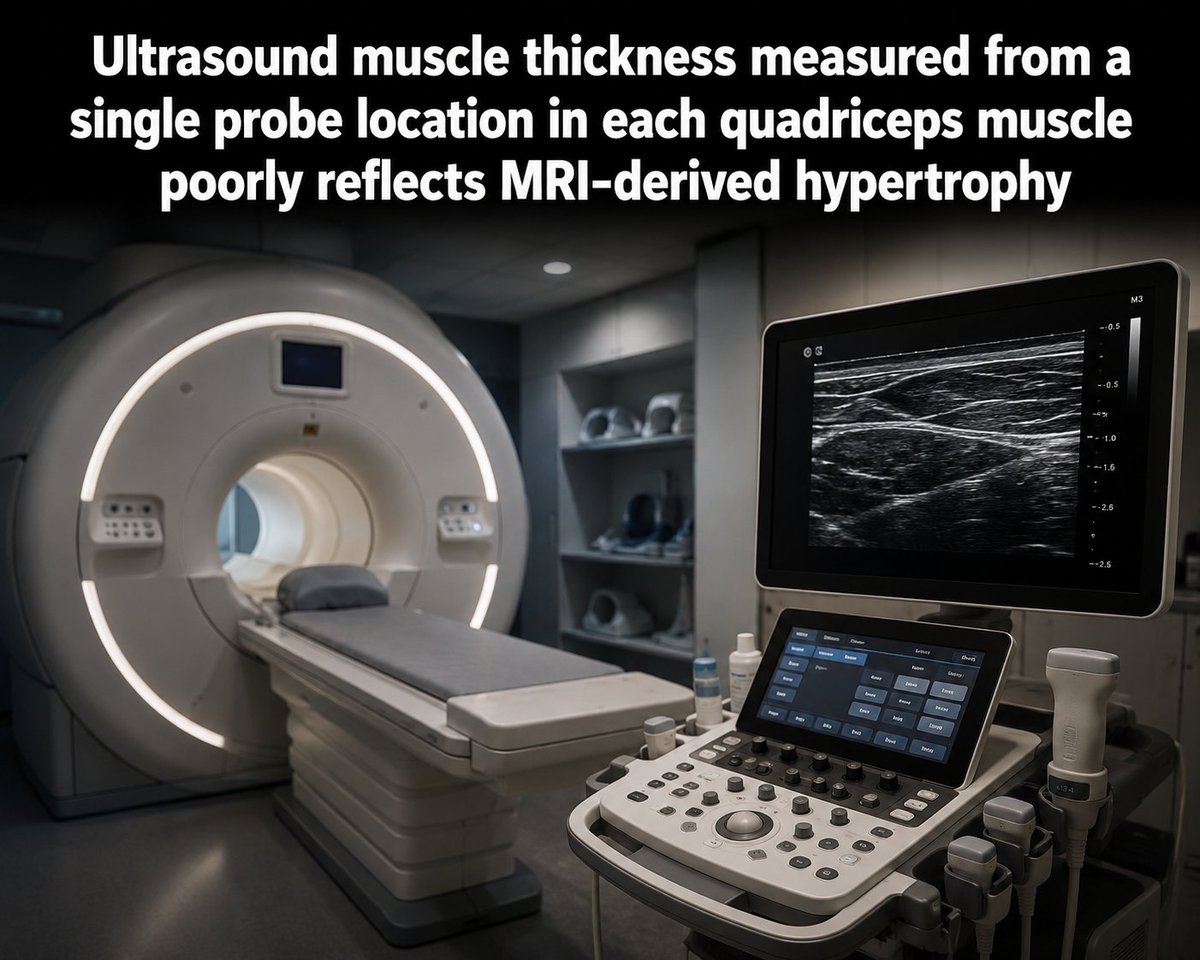
Single-site muscle thickness substantially underestimated MRI-derived hypertrophy and showed no meaningful relationship with MRI changes following 15 weeks of resistance training. See summary in image below
Dr. Gerard McMahon tweet media
English
1
3
13
417
Dr. Gerard McMahon
Dr. Gerard McMahon@MuscleMechsLab·
🔥🔥 Important New study on Hypertrophy Measurements 🏋‍♂️💪📏 What did it look at? See below 👇
Dr. Gerard McMahon tweet media
English
1
0
4
857
Dr. Gerard McMahon
Dr. Gerard McMahon@MuscleMechsLab·
Ive seen many people suggest what England could do to mitigate the effects of acute altitude physiologically during the game. The one I haven't seen anyone suggest yet, which is within the rules & would provide the largest benefit is HYPEROXIA (supplemental O2) @BBCSport
Dr. Gerard McMahon tweet media
English
1
3
7
2.5K
Dr. Gerard McMahon
Dr. Gerard McMahon@MuscleMechsLab·
@ChrisKirk_ASP @SimonBrundish id presume so which is why it offers more opportunity than usual. Theres nothing in the rules against it (that ive seen anyway). Its not useful in normobaric normoxia so likely goes under the radar a lot. Its expensive too which is why many dont use it
English
1
0
1
41
Dr. Gerard McMahon
Dr. Gerard McMahon@MuscleMechsLab·
@SimonBrundish thanks. comes from working at altitude with different athletes over the years. always surprised how much this one slips through the cracks. Small margins...
English
0
0
0
14
Dr. Gerard McMahon
Dr. Gerard McMahon@MuscleMechsLab·
@Scienceofsport I think the approach of limited time for acclimation is far from ideal, not certainly one you'd plan for in an ideal world. Do you think some of the heat/ hypoxia crossover might at least help mitigate some of this. Worked in int'l 🏑 in Jo'burg in similar altitude.. SpO2 of ~92%
English
0
0
0
28
Ross Tucker
Ross Tucker@Scienceofsport·
There are however studies showing that performance & physiology are WORST in the first few hours (6h), then improve progressively over the first 2 days and beyond. You really just have to go early as possible to maximize adaptation. FIFA's policy helps ENG pubmed.ncbi.nlm.nih.gov/11224821/
English
7
3
21
5.4K
Ross Tucker
Ross Tucker@Scienceofsport·
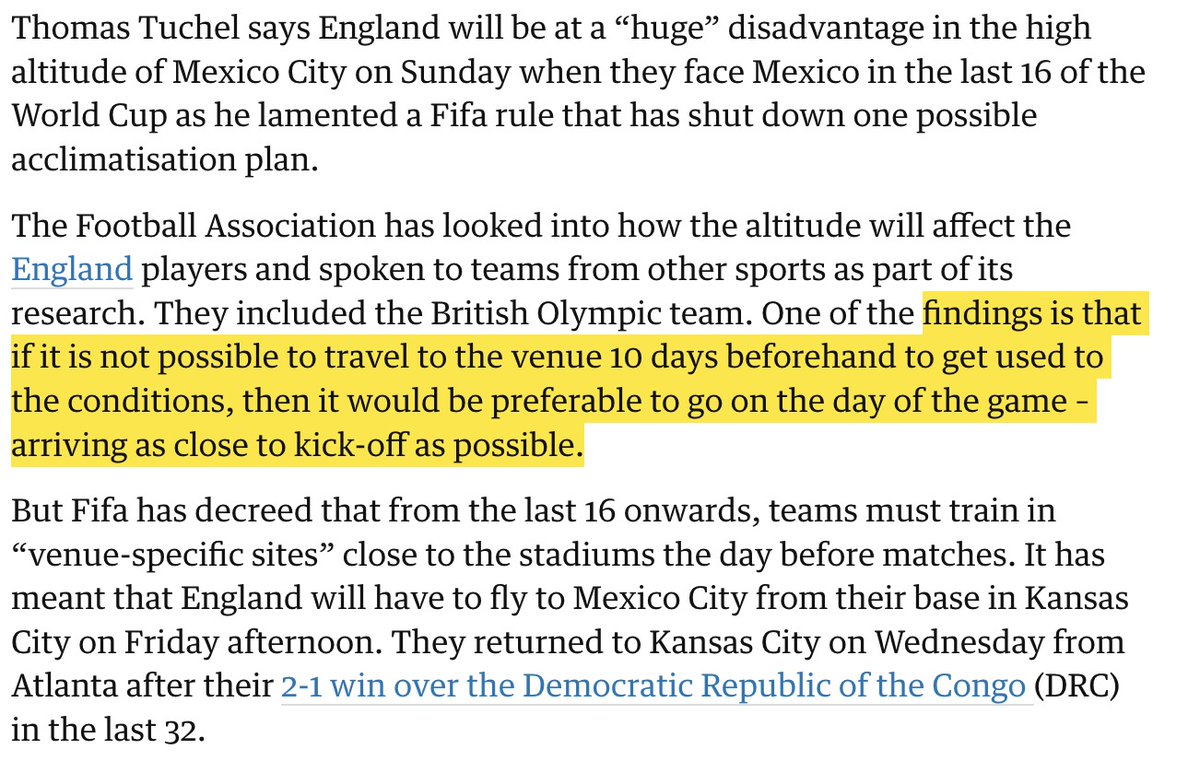
There's no good evidence that you can 'smash & grab' altitude by arriving as late as possible. The effects are worst on day 1, and performance & physiology only improve thereafter. Should've been looking to as early as possible, and can thank FIFA for denying them day-of arrival
Ross Tucker tweet media
English
38
27
167
132.4K
Brad Schoenfeld, PhD
Brad Schoenfeld, PhD@BradSchoenfeld·
New study shows that partial range of motion in the leg extension at long muscle lengths elicits greater hypertrophy compared to training at short muscle lengths. Moreover, gains for the long length condition were generally comparable to training through a full ROM. These findings are consistent with the growing body of evidence suggesting that the lengthened portion of a repetition provides the strongest stimulus for muscle hypertrophy. Nice work from @MuscleMechsLab 💪 pubmed.ncbi.nlm.nih.gov/42392615/
English
7
32
188
11.5K
Dr. Gerard McMahon
Dr. Gerard McMahon@MuscleMechsLab·
@AlexViKu @JSCRonline @UlsterSchSport Exact transmission of force through muscle and ways muscle 'should' grow arent well defined. With decent active tension in all groups youd expect some radial growth as well as longitudinal. Yes it's always interesting to see influences of other architectures
English
3
0
0
67
Alex
Alex@AlexViKu·
@MuscleMechsLab @JSCRonline @UlsterSchSport What about p. angle? Contraction should create more radial growth. So more thickness for lengthening ROM might be just more growth in length. More radial growth should increase more growth in the middle of the muscle. We should analyze biceps instead of legs (simpler arch-re)
English
1
0
0
71
Dr. Gerard McMahon
Dr. Gerard McMahon@MuscleMechsLab·
@AlexViKu @JSCRonline @UlsterSchSport Also based the intensities of 80% 1RM, repetition meta analyses show this equates to 0-2 RIR. Yes we can't be 100% sure of exact proximity to failure of the long length but training with some RIR has repeatedly been shown 2b similar for growth & clearly didnt impact our results
English
0
0
0
21
Dr. Gerard McMahon
Dr. Gerard McMahon@MuscleMechsLab·
@AlexViKu @JSCRonline @UlsterSchSport thanks Alex. The different intensities was a clear study design choice to elicit 3 mechanical conditions 1. Short (mod active tension, low passive) 2. Full (high active, transient pasive) 3. Long (mod active, sustained passive) Theres a section of inverse dynamics in paper
English
1
0
1
50
Dr. Gerard McMahon
Dr. Gerard McMahon@MuscleMechsLab·
There was an inverse relationship between absolute & normalised baseline fascicle length & the pre-post change in fascicle length, suggesting the longer your pre-training fascicles are, the smaller the magnitude of change we can expect with a block of 🏋‍♂️
Dr. Gerard McMahon tweet media
English
0
0
0
131
Dr. Gerard McMahon
Dr. Gerard McMahon@MuscleMechsLab·
fascicle lengths were similar or greater vs full ROM in lengthened partials across sites
Dr. Gerard McMahon tweet media
English
1
0
0
159