Unhedged Profile

74 posts

Unhedged Profile banner
Unhedged Profile

Unhedged Profile

@Musytaq6

DeFi enthusiam , No active boonding on a several world, masterpiece at who gives a shit.

Katılım Mayıs 2021
45 Takip Edilen12 Takipçiler
Unhedged Profile
Unhedged Profile@Musytaq6·
@m_chanif74192 I like the “room full of people interpreting together” analogy. It makes me think consensus isn’t just agreement anymore, but shared understanding. That feels closer to how decisions actually happen in real life.
English
0
0
0
7
Unhedged Profile retweetledi
BIGGWAHLE
BIGGWAHLE@beegig·
I still remember the first time I tried to explain a blockchain to a friend and realized something felt off. Everything sounded precise, rigid, almost like a calculator pretending to understand the world. That’s why the launch of the Bradbury testnet caught my attention. With @GenLayer, the idea feels different. Instead of treating blockchains like machines that must always give the same answer, it starts to feel more like a room full of people interpreting a situation together. Not guessing, but reasoning. Not just executing, but understanding. When I think about the agentic era, I don’t picture code running in isolation. I picture AI agents navigating messy information, half-clear signals, human language, conflicting data. The kind of environment where being strictly deterministic is actually a limitation, not a strength. Bradbury going live feels like opening a playground for that kind of reality. Another way I see it is this. Traditional smart contracts are like traffic lights. Fixed rules, predictable outcomes. Useful, but limited. What @GenLayer is doing with intelligent contracts feels closer to a group of traffic officers at a chaotic intersection, each observing, interpreting, and collectively deciding what should happen next. That shift matters if AI agents are going to act on our behalf. Because agents don’t just calculate. They interpret. They weigh context. They make decisions that are not always black and white. So here’s the question I keep coming back to: If the systems we rely on can’t interpret the world the way agents do, can they really support them long term? Curious how others see this. Is reasoning on-chain the missing piece for the agentic era, or does it introduce a new layer of uncertainty we are not ready for?
English
7
1
11
15.1K
BIGGWAHLE
BIGGWAHLE@beegig·
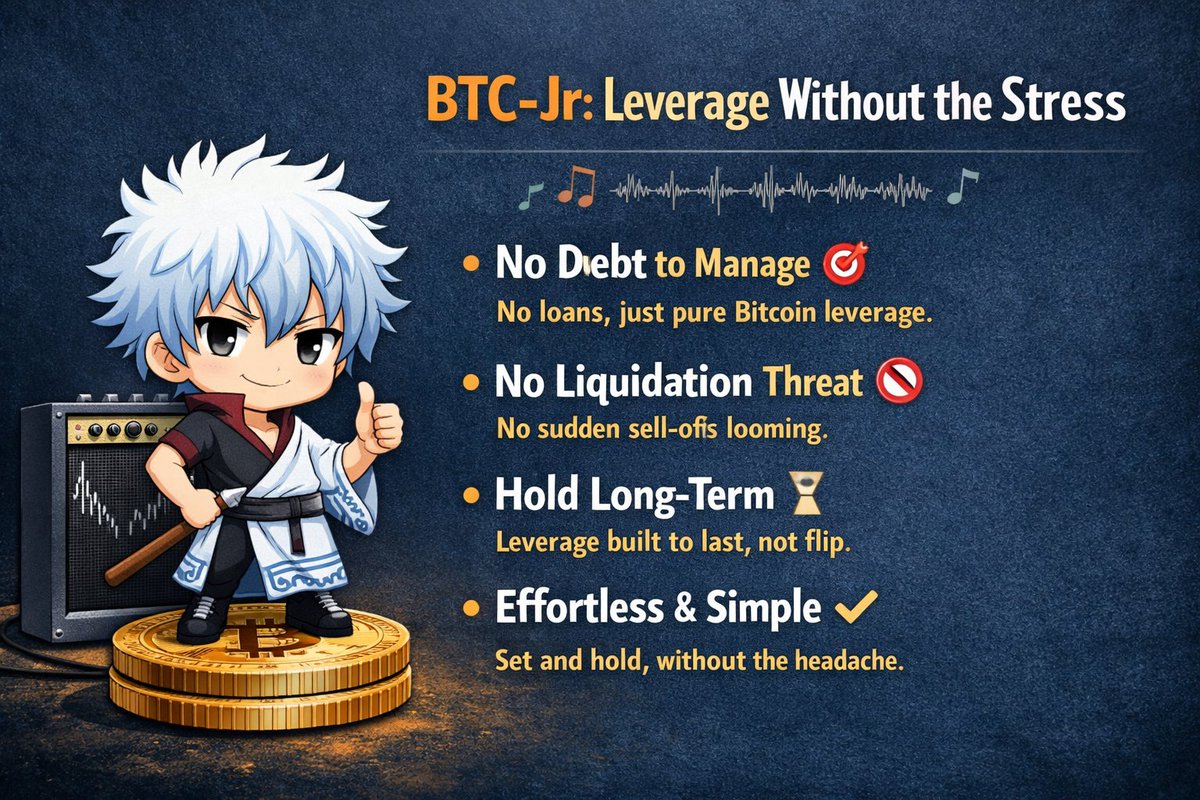
I used to think leverage was like borrowing a louder voice. You say something with more volume, but it’s not really yours. Eventually, the mic gets taken away (liquidation), or you keep paying rent just to be heard. Then I came across @FragmentsOrg and BTC-Jr… and it felt different. It’s more like tuning an instrument instead of borrowing a speaker. Same Bitcoin. Different structure. The system rearranges the “notes” (volatility) so one side plays louder (BTC-Jr at 1.33×), while another absorbs the softness. No debt. No one waiting to liquidate you. Just a different composition of risk. What stuck with me is this: Most leveraged products obsess over how much exposure you get. BTC-Jr quietly asks a different question , what kind of journey are you signing up for while holding it? Because over time, it’s not just direction that matters. It’s the path: volatility, costs, pressure to exit early. And honestly, that’s where most leverage breaks. BTC-Jr doesn’t remove risk. It reshapes where it lives. So now I’m wondering: If leverage didn’t come from borrowing at all… would more people actually hold it long-term? Curious how others see this. Is “structure-based leverage” something you’d trust more than traditional leverage? If you’re exploring this too, you can check it out and join the waitlist here: link.fragments.org/rally Would love to hear your take down here !
BIGGWAHLE tweet media
English
4
1
14
11.1K
Unhedged Profile
Unhedged Profile@Musytaq6·
@m_chanif74192 @FragmentsOrg “Leverage for holders” is a bold idea. Most products I’ve seen basically force you into short-term thinking, even if you don’t want to.
English
0
0
0
13
EmpireDrop
EmpireDrop@empiredrop·
GUESS THE PRICE 👀🔥 I'll pick 1 winner & give $20 in EmpireDrop balance 🤑
EmpireDrop tweet media
English
101
37
65
3.7K
Unhedged Profile retweetledi
Canton Army
Canton Army@CantonArmy·
Winners have been selected ✅ 50 winners have now been chosen for the Pulsar game pack giveaway. If you’re one of them, you’ll receive a DM on X within the next 24 hours with your unique one-time use code.
Canton Army@CantonArmy

Pulsar is launching soon, and we’ve been given 50 game packs to give away to the Canton Army community. You don’t want to miss this one. How to enter: 1️⃣ Follow @pulsar_xyz 2️⃣ Like & repost this post 3️⃣ Comment your favorite game and tag 1 friend ⏳ Giveaway ends in 36 hours.


English
45
12
66
3.2K
Unhedged Profile retweetledi
captainsnowboy
captainsnowboy@Captain_snowboy·
Pulsar is launching soon on Canton in partnership with Console Wallet, i was given 25 Pulsar game packs to give away to my community. to enter: - follow @pulsar_xyz - follow @consolewallet - like, repost, and comment below - fill this form: forms.gle/T8Q46zFstifkBC… winners will receive codes redeemable once Pulsar goes live. giveaway ends in 24 hours 🤝
captainsnowboy tweet media
captainsnowboy@Captain_snowboy

hearing things: you might want to follow @pulsar_xyz, turn on notifications and also secure a Console wallet probably nothing…

English
166
115
172
9.6K
TEMAN KOMPLEK
TEMAN KOMPLEK@temankomplek·
Ada gila gilanya kalo sampe bener mah.
TEMAN KOMPLEK tweet media
Indonesia
404
175
3.3K
557.6K
BIGGWAHLE
BIGGWAHLE@beegig·
TL;DR Last month I reviewed a pull request that looked perfectly fine. Tests passed. The diff was clean. We merged it. Two days later a subtle bug appeared in production. Nothing dramatic, just one of those quiet mistakes that slips through because nobody had time to really challenge the code. That moment made me think about something uncomfortable. Code review today is mostly built on goodwill. People review when they have time. Maintainers skim diffs between meetings. And now with the rise of vibe coding and AI-assisted generation, the number of pull requests is exploding while the attention available to review them stays the same. The imbalance is obvious. That is why the idea behind mergeproof.com caught my attention. MergeProof introduces something unusual into the pull request process: economic stakes. Instead of submitting code and hoping someone reviews it carefully, a contributor can stake value behind their pull request. In simple terms, they are putting skin in the game and signaling confidence that their code is correct. Reviewers then analyze the PR. If they discover a real issue before the code is merged, they receive a reward. So the dynamic changes. A pull request becomes less like a polite request and more like a small audit market where confidence, effort, and risk all have a price. Traditional review systems rely on reputation and volunteer effort. MergeProof replaces that with aligned incentives: • The contributor stakes value when submitting code • Reviewers investigate the submission • If valid bugs are found, rewards are distributed to those who identified them Instead of passive review, the process becomes an adversarial analysis where the system actively encourages people to challenge the code. When I think about it, the closest analogy is not open source collaboration. It feels more like quality control in manufacturing. Imagine a factory where inspectors only check products when they feel like it. That is close to how many repositories work today. MergeProof turns inspection into a paid role. Suddenly people have a reason to look closely. This matters even more now because of vibe coding. AI tools can generate large volumes of functional looking code in minutes. The bottleneck is no longer writing code. The bottleneck is verifying that it behaves correctly under edge conditions. More code is entering repositories than ever before, but the number of humans deeply reviewing that code has not increased at the same pace. MergeProof attempts to rebalance that equation. By attaching economic value to pull requests, it nudges contributors to submit higher quality work and encourages reviewers to perform deeper analysis rather than quick approvals. It is a shift from trust based review to incentive aligned verification. What I find interesting is not just the mechanics. It is the psychological shift. When someone stakes value behind their code, confidence becomes measurable rather than implied. That raises a strange question about the future of development workflows. Should code quality rely on volunteer attention, or should verification become a market where scrutiny is rewarded? Curious how others see this. Would adding incentives to PR reviews improve software quality, or would it change the culture of open source in unexpected ways?
BIGGWAHLE tweet media
English
10
2
31
2.8K
THE KIINE
THE KIINE@asherrkiinee·
Pick a lucky number from 70 – 109 70 71 72 73 74 75 76 77 78 79 80 81 82 83 84 85 86 87 88 89 90 91 92 93 94 95 96 97 98 99 100 101 102 103 104 105 106 107 108 109 ✨ 10 numbers hide a surprise of $1,000 🎉 10 winners will be picked randomly in 24 hours
THE KIINE tweet media
English
1.2K
43
628
85.9K
Tiramitsu
Tiramitsu@tiramitsuXBT·
Nasi pecel segini 6k mahal apa murah
Tiramitsu tweet media
Indonesia
555
36
675
47.9K
Canton Army
Canton Army@CantonArmy·
50 Priority Access spots available for Cantex. Armoured in privacy, moving through the TradFi canyons of glass and steel while the old financial systems start to shake. Cantex leads with professional trading, atomic settlement, no compromises. The battlefield is on-chain. The old world fades. $CC holders rise. Want access? 1️⃣ Follow @Cantex_io + @CantonArmy 2️⃣ Like + Repost 3️⃣ Comment your best trading tip + tag a friend ⚔️ Good Luck 🍀 Disclaimer: Community giveaway. Not sponsored or a paid promotion.
Canton Army tweet media
English
72
54
131
6.9K
Unhedged Profile
Unhedged Profile@Musytaq6·
@m_chanif74192 What stands out is the timing of this idea. With vibe coding and AI assistants, writing code is getting easier every week. Reviewing it properly is becoming the real bottleneck. Incentives might be one of the few levers that scales human attention.
English
0
0
1
13