Mutinta Mazoka

213 posts

Mutinta Mazoka banner
Mutinta Mazoka

Mutinta Mazoka

@MutintaMazoka

UPND Government National Management Committee | Here to serve. [email protected]

Lusaka, Zambia Katılım Ağustos 2020
51 Takip Edilen8.4K Takipçiler
Sabitlenmiş Tweet
Mutinta Mazoka
Mutinta Mazoka@MutintaMazoka·
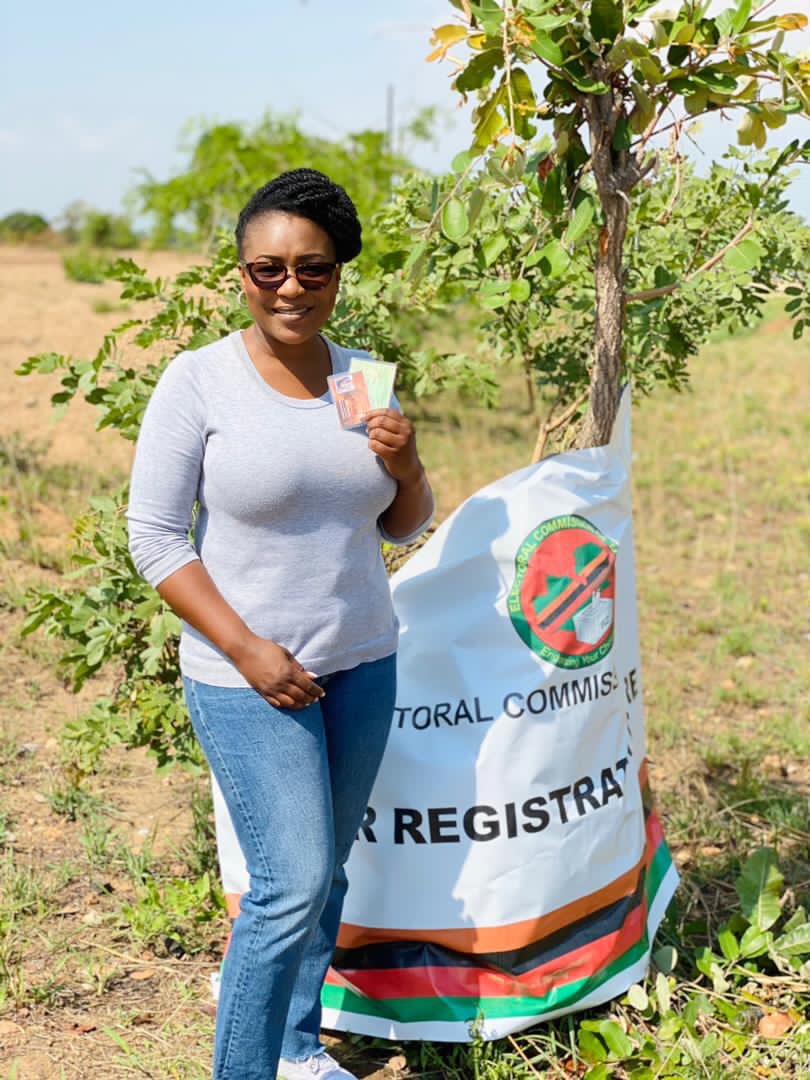
MISSION ACCOMPLISHED ✅ Officially a registered voter! Ready to exercise my civic duty on August 12, 2021. Make sure you do the same. #RegisterToVoteZambia 🇿🇲
Mutinta Mazoka tweet mediaMutinta Mazoka tweet media
English
16
21
432
0
Sishuwa Sishuwa
Sishuwa Sishuwa@ssishuwa·
Rodger Chongwe: who was he? By Sishuwa Sishuwa One of Zambia’s legal giants, Rodger Masauso Alivas Chongwe, died on Tuesday this week aged 86. Born on 2 October 1938, Chongwe attended primary school in the same district before he went to St Marks in Southern Province for his junior secondary school education. He then proceeded to Munali in Lusaka where he completed his secondary school education after which he secured a job as a court clerk in Kabwe. Afterwards, he was promoted and transferred to Lusaka as a native court assistant. Just before independence in February 1963, Chongwe was awarded a scholarship to study law in Australia where he met his future wife, Gwenda Fay Eaton (married in 1967), with whom he bore two children, a son named Njalikwa who is a ceramic artist and Wajipha, a daughter who specialises in hospitality or hotel management. Chongwe returned to Zambia in January 1969 as a qualified lawyer and went on to have a very successful legal career over the two decades. Initially, he worked as an assistant solicitor at Martin and Company, a legal firm where he rose to the position of Partner in late 1969. He left to establish with another lawyer named Mwisiya a firm named after the two lawyers, Mwisiya Chongwe and Company, in 1970, and remained there until 1977 when he set up his own firm, Rodger Chongwe and Company. Chongwe had a very successful private legal career under the one-party state and gained great recognition in the legal world. In Zambia, he was elected president of the Law Association of Zambia, which regularly held the government to account on governance and human rights concerns. But he was also highly regarded internationally. For instance, his peers on the continent elected him president of the African Bar Association. Beyond Africa, Chongwe was later in 1990 elected president of the Commonwealth Lawyers Association. So he was a real giant in the legal profession. It was because of his outstanding achievements and standing in the legal world that President Kaunda conferred on him the rank of State Counsel (SC). This was at a time when lawyers did not have to apply to the President to have the status of SC conferred on them, the way it is done today. One’s exemplary works in the legal field spoke for them and presidents simply confirmed what everyone else knew, unlike the way the case is today when that honour has lost its meaning since presidents confer it on partisan or political considerations. Chongwe’s career in the public service took off in earnest after the Movement for Multiparty Democracy (MMD) won the 1991 election. Chongwe was elected member of parliament for Mandevu in Lusaka. President Frederick Chiluba appointed him Minister of Legal Affairs at a time when he was still president of the African Bar Association. Chongwe was a good example of the many individuals in Chiluba’s first cabinet for whom joining politics or public service was truly a sacrifice. In recent years, those who have ended up in politics and as ministers are mainly individuals for whom that title is their main achievement and source of income. Not Chongwe’s generation. The individuals who filled up Chiluba’s first cabinet, to which Chongwe was a great example, were already successful in their fields before going into public service and had sufficient levels of formal education, leadership experience, distinguished track records, and proven competences or skills which they brought to the government. In addition to Chongwe, there were others such as vice-president Levy Mwanawasa, Guy Scott (Minister of Agriculture, Food and Fisheries), Ronald Penza (Commerce, Trade and Industry), Emmanuel Kasonde (Finance), Ben Mwila (Defence), Akashambwatwa Mbikusita Lewanika (Science and Technology), Vernon Mwaanga (Foreign Affairs), Gen Christon Tembo (Tourism), Arthur Wina (Education), Humphrey Mulemba (Mines), Newstead Zimba (Home Affairs), Baldwin Nkumbula (Sports), Godfrey Miyanda (Minister Without Portfolio), Ludwig Sondashi (Labour and Social security, Andrew Kashita (Transport and Communications), Boniface Kawimbe (Health), and Stan Kristofer, a Yugoslav-born Zambian who was appointed Minister of Information. Chongwe remained Minister of Legal Affairs until August 1993 when Chiluba transferred him to the Ministry of Local Government in the same capacity. He stayed in the role for about two years until 1995 when he resigned in protest against rampant corruption, undemocratic tendencies and human rights violations under the Chiluba regime. His resignation demonstrated his loyalty to principle as well as his refusal to be bound by the principle of collective responsibility on issues that he did not agree with. He was one of a number of senior Cabinet officials who resigned from cabinet on principle at different intervals during Chiluba’s presidency. Others included Mwanawasa, Sondashi, Akashambatwa Mbikusita Lewanika, Simon Zukas, Dipak Patel, and Baldwin Nkumbula. After he left government, Chongwe formed an opposition party, Liberal Progressive Front on whose ticket he hoped to challenge Chiluba in the 1996 election. After former president Kaunda, who had retired from politics after his defeat in 1991, made a political comeback in 1995, Chiluba panicked, fearing potential defeat to his predecessor. As a result, the MMD administration passed a constitutional amendment that effectively barred Kaunda from standing in the 1996 election. In response and in protest against Chiluba’s manoeuvres, Kaunda and the former governing party, the United National Independence Party, boycotted the election. In solidarity with the excluded Kaunda, Chongwe joined other opposition parties in boycotting the poll. Pitted against smaller opposition parties, such as the Zambia Democratic Congress under Dean Mung’omba, National Party under Humphrey Mulemba, Agenda for Zambia under Akashambatwa Mbikusita-Lewanika and the Movement for the Democratic Process under Chama Chakomboka, Chiluba easily retained power. After the election, Chongwe remained in opposition politics and became chairperson of a 13-party alliance of opposition parties that started working together more closely. On 23 August 1997, in a move that highlighted the government’s increasingly violent suppression of civil liberties, police opened fire on a mass rally called by Chongwe’s opposition alliance, nearly killing him and founding president, Kaunda. Chongwe needed emergency surgery after the same bullet that wounded Kaunda hit him. Chongwe successfully sued the Zambian government in Australian courts and also took the matter to the United Nations Human Rights Committee. He was awarded about US$2.5m in compensation but successive Zambian administrations refused to pay him. It is unclear if he was paid this money before his death. Three months after the attempted assassination on Chongwe and Kaunda, the government arrested several opposition leaders such as Kaunda, Mung’omba, and Princess Nakatindi Wina on allegations that they were connected to the unsuccessful military coup attempt against Chiluba in October 1997. The MMD falsely claimed that Chongwe had held two clandestine physical meetings with Kaunda at Sikota Wina’s home in Lusaka in October to plan for the coup, but evidence showed that Chongwe had left the country a month earlier and had not yet returned when the coup occurred. The government’s desperation to implicate him in the coup forced Chongwe to remain in exile in Australia from 1997 until March 2003 when he returned to Zambia under Mwanawasa’s presidency. Over the next 22 years, he kept out of public life though he occasionally took up public engagements such as in 2012 when President Michael Sata appointed him to chair the commission of inquiry that was appointed to investigate the Mongu 2011 deadly riots that happened over the Barotseland Agreement. Chongwe also participated in public discussion forums organised by News Diggers ahead of the 2021 elections on Zambia’s democratic backsliding. At a time when many Zambians are dying en masse at a relatively young age, Chongwe lived until 86, thanks to a disciplined and intentional lifestyle and choices. His public career teaches us several lessons such as the value of formal education, the importance of family and community, the need to always defend democracy, the constitution and to remain loyal to one’s principles, the benefit of leading a clean life when in government (he faced no legal challenges resulting from his time in power after leaving public office), and that, perhaps, politics is not for everyone. In a way, and for all that was good that he gave to politics, Chongwe was messed up by politics, for his professional career would have continued rising had he stayed away from it. Overall, Zambia is richer for his having been one of its citizens. Chongwe’s life teaches us to go to school; to find a job that give us a sense of purpose and satisfaction, ideally one that also makes the world a better place to live in; to find a partner whom we love, and who loves us back; to have children if both partners wish, who will grow into decent men and women because their parents are decent; and to make time for good friends – true, genuine friends rather than dozens of superficial acquittances. It also challenges us to ask ourselves two important questions: What do I need to do to be ultimately satisfied that I have lived a good life? How can I make the greatest differences in areas that matter most?
Sishuwa Sishuwa tweet media
English
19
40
159
8.8K
Mutinta Mazoka
Mutinta Mazoka@MutintaMazoka·
@ssishuwa Hmmmmm, unfortunately it seems the noose is tightening.
English
0
0
0
125
Trevor Simumba
Trevor Simumba@SimumbaTrevor·
@ssishuwa @EmbZambia @johanhallenborg This is a very critical discussion we must have as Africans. Tragic that even those that claim to be Democrats are at the forefront of propping up their favoured "pseudo Democrats"
English
5
2
27
2.3K
Mutinta Mazoka retweetledi
Sishuwa Sishuwa
Sishuwa Sishuwa@ssishuwa·
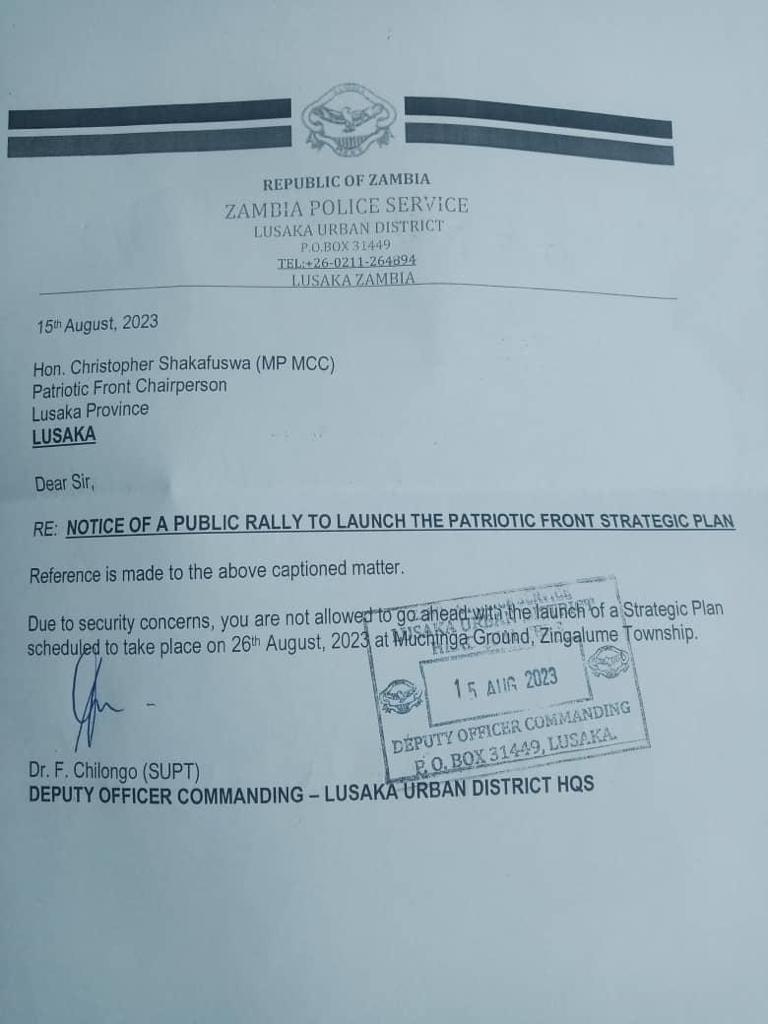
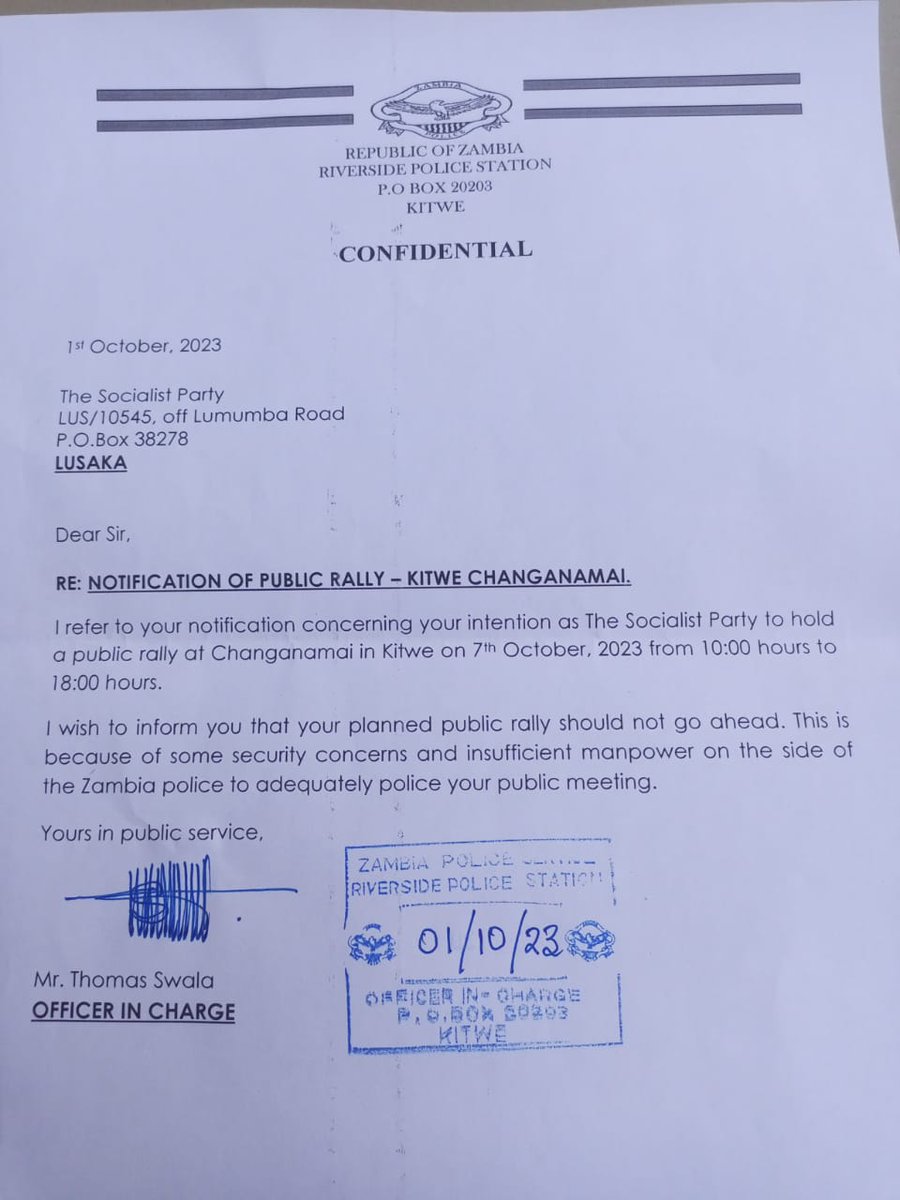
THE NARRATIVE: “The UPND government has enhanced human rights and improved the civic space during their two years in office - Swedish envoy @johanhallenborg.” THE REALITY: since the UPND came to power in August 2021, not a single public rally called by opposition parties has been allowed by the #Zambia Police.
Sishuwa Sishuwa tweet mediaSishuwa Sishuwa tweet mediaSishuwa Sishuwa tweet mediaSishuwa Sishuwa tweet media
English
36
35
117
24.8K
Mutinta Mazoka retweetledi
Sishuwa Sishuwa
Sishuwa Sishuwa@ssishuwa·
Thank you, Ambassador Wagner-Mitchell, for your opinion, which I will now proceed to engage. To start with, when you say “Things have moved a long way forward”, what is your reference point? They have got better in comparison to what? What is the measurement or starting point, and who set it? If the reference point is the record of Edgar Lungu, whom many agree was a failure, why should that failure be the standard against whom we measure progress? Shouldn’t the standard be the normal standard? Shouldn’t we evaluate the record of President Hakainde Hichilema based on the campaign promises he made when he was in opposition, one of which was to respect civil and political rights? Shouldn’t we evaluate Hichilema based on the mandate he received from voters? Surely that mandate was not for regressing democracy or maintaining the status quo, was it? If the reference point is not limited to Lungu’s stay in power, then don’t you think we, the locals, are better placed to tell you whether things have improved or not? Second, may I ask for specific examples of how human rights protection has been improved in Zambia? I am sure you have not forgotten the authorities’ disgraceful treatment of Sean Tembo, Fred M’membe, Emmanuel Mwamba, and several other opposition figures. The picture of Mwamba, disheveled and bloody after his incarceration, was particularly upsetting. This is not evidence of enhanced human rights. The point, Ambassador, is that arguments like the one you are making must be supported by evidence. I say this because I have many examples that suggest lack of progress. For instance, things have regressed in relation to the right to public assembly which is connected to the right to free speech – since people meet to talk – and the freedom of association, as those who meet are usually members associated with a specific organisation. In fact, there are many rights violations that have occurred in Zambia since the election of Hichilema in 2021. I will not itemise them here since you, unlike the recently arrived Swedish envoy, have been in Zambia for much longer. Not once have you or your colleagues from other Western countries – who have historically condemned attacks on democracy and human rights in Zambia – publicly expressed outrage or even mild criticism of these violations. Why? What are you waiting for? Is there a particular threshold of undemocratic behaviour and human rights violations that you and your Western colleagues are waiting for before you speak out? If there is none, then what explains your silence on the attacks on democracy and human rights by Hichilema’s administration? If there is a standard threshold of undemocratic behaviour and human rights violations that you are waiting for before publicly expressing outrage, what is that standard? And who established it? How does one explain your and your Western colleagues’ willingness to publicly praise the Hichilema administration for ‘enhancing civic space’, on the one hand, and your steadfast refusal to publicly condemn its undemocratic practices, on the other? One may claim that you and your colleagues are expressing outrage to the government privately, but we can only hold you to account for what you do or say in public. We are not privy to your private interactions and the undertakings of those in power. Of course, no one wants you to speak out every time the government does wrong, but it is equally unhelpful for you to remain silent on all violations. Power hates exposure of its wrongs and if you only deliver criticism privately, there would be little incentive for Hichilema to change for the better. Your decision to remain silent until a particular threshold is reached before speaking out in defence of democracy suggests that it is okay to violate the rights of assembly, association, and free speech as long as one does not reach the level of repression we witnessed under the Lungu years, however arbitrary that threshold may be decided. No, Ambassador, there should be no acceptable threshold for violations of human rights and attacks on democracy. Repression is repression, and must be condemned, not massaged with messages such as ‘Things have moved a long way forward’. We Zambians want a better Zambia, a truly functioning democracy, one which is built on the same standard of respect for democratic values and fundamental human rights as the ones that exists in your country and indeed other established democracies. I repeat. Please do not have different standards for us, as Africans, and for yourselves as Europeans or Americans. Such manner of proceeding might feed the racialised thinking that sees an African leader like Hichilema who resorts to low level repression as endurable because, in the viewpoint of that racialised thinking, ‘the situation can be worse; after all, these people are Africans, so a little bit of repression is ok.” If I ever were to encounter such thinking, I would say in response: ‘please do not have a low standard for us. We do not want a low standard imposed on us because we are Africans. Some of us (ordinary Zambians) want a higher standard for ourselves, for our institutions, for our elected public leaders, and indeed for our democracy.’ The reality, Ambassador, is that your – and your Western colleagues’ – continued silence against the violations of civil and political rights in Zambia today harms democracy and human rights by emboldening Hichilema’s nascent authoritarian behaviour, since he is secure in the knowledge that no one among those he respects will call him out. As you know, our President, for whatever reason, appears to pay greater attention to what you and your Western colleagues say to or about him – and I am not saying this with pride. As for the native Zambian, like me, who voted for and put him in office, he either ignores what we say or contemptuously dismisses our views or feedback on his leadership performance as nothing more than ‘noise’. You will therefore understand why I am embarrassingly appealing to you to help us by, occasionally, publicly calling out the attacks on human rights and democracy by the Hichilema administration. Trust me, mine is not a good position to be in, where I, a citizen, must appeal to you, an outsider, to help me make my president a better public leader who strengthens our democracy. If you cannot speak out in defence of democracy and human rights, then please do not make it worse by attempting to create an alternative reality, as the Swedish envoy did. Doing so undermines local struggles and efforts towards a truly democratic Zambia. I am focusing on you and your Western colleagues deliberately because African diplomats hardly criticise the democratic behaviour or record of their host governments. This is not because they don’t care. African envoys do not challenge violations of human rights largely because they have a misplaced sense of solidarity. Privately, democracies like Botswana, Mauritius, South Africa, and Ghana must be concerned about the shrinking civil liberties space in Zambia, but they will not issue public condemnation because this would undermine African unity. So when Western nations speak out in defence of democracy and human rights, they help fill the void created by this misplaced sense of solidarity. Unusually, you and your Western colleagues have now joined African envoys in silence. By refusing to condemn the attacks on democracy and human rights that are occurring under Hichilema, Western countries are, in effect, working against him in that their silence helps sustain the narrative that he is their ‘puppet’, and they consequently can’t condemn him publicly. The silence also feeds the perception that democracy promotion, for Western countries, is nothing but the entry point for securing their interests. They are prepared to look away from the wrongs of an African leader who is seen as faithful to their interests. It’s impossible to completely dismiss such perceptions when one considers the reality today. Take, for instance, the fact that Hichilema is holding public rallies while preventing the opposition from doing the same. Today, the opposition Socialist party were supposed to hold a public rally on the Copperbelt Province to discuss, among other things, the cost-of-living crisis. The police, who had earlier said thy could not manage this event due to lack of adequate manpower, sent over a hundred police officers to seal off the venue of the rally. This same number of officers would have been enough to police the opposition party’s rally. This is not the first time this has happened. Last month, a public rally called by the opposition Patriotic Front was stopped in similar circumstances in Lusaka. In the meantime, Hichilema, who has effectively launched his re-election campaign with a passionate appeal to Zambians to give him a second term, is busy conducting public rallies without any restrictions. Where is the fairness in this? What, for instance, stops you, or the UK High Commissioner, or the American Ambassador, or the recently arrived Swedish envoy, from publicly saying this continued curtailing of the activities of opposition parties is as wrong now as it was under president Edgar Lungu? These violations are what your predecessor and other Western diplomats commendably condemned when done by the PF. Why are they accepted today? If there is a homogeneous standard for democracy, what explains this selective application of democratic values in the same country? Why won’t you and your Western colleagues say a word publicly against these violations? Do you see why your continued silence on rights violations risks feeding the perception that Hichilema is your man?
English
30
36
155
45.2K
Mutinta Mazoka
Mutinta Mazoka@MutintaMazoka·
Wishing the beautiful people of Eastern Province a successful Nc’wala Traditional Ceremony! Thank you for contributing to the diversity of our beautiful country! Picture credit: Travel Zambia
Mutinta Mazoka tweet media
English
4
2
52
0
Mutinta Mazoka
Mutinta Mazoka@MutintaMazoka·
Something is in the African air tonight! First Malawi and now Burkina Faso. What’s cutting?!
English
2
0
10
0
Mutinta Mazoka retweetledi
Victor Blackwell CNN
Victor Blackwell CNN@VictorBlackwell·
Poet Maya Angelou becomes the first Black woman to appear on a US quarter
Victor Blackwell CNN tweet media
English
1K
14.6K
96.6K
0
Sishuwa Sishuwa
Sishuwa Sishuwa@ssishuwa·
Simon Zukas, one of #Zambia’s independence heroes and most admired figures, has died aged 96. Low-key and lacking in self-interest, Zukas embodied a genuine commitment to progress, democracy and equality. Funeral arrangements will be announced later… diggers.news/guest-diggers/…
English
41
73
251
0
Muchemwa Sichone
Muchemwa Sichone@MuchemwaS·
WHERE ARE THE WOMEN? 7,023,499 registered to vote for the 2021 elections. 3,751,040 were female (53.4%) and 3,272,459 male (46.6%).
Muchemwa Sichone tweet media
English
21
84
274
0
Mutinta Mazoka
Mutinta Mazoka@MutintaMazoka·
Reports that I have been nominated to Parliament as a lawmaker are incorrect! It is my mother, Hon. Mutinta C. Mazoka, who has been.
English
60
72
1K
0
Mutinta Mazoka
Mutinta Mazoka@MutintaMazoka·
REALITY NOW vs REALITY THEN: In ethnically diverse societies like Zambia, it’s important to promote diversity (ethnicity, gender, age, race, disability, etc.) & build social inclusion. Both are essential to nation building & inter-ethnic harmony since competence is found in all.
Mutinta Mazoka tweet media
English
2
8
48
0
Christopher Chaatila
Christopher Chaatila@CChaatila·
@MutintaMazoka Next time you are NOT adopted, please kindly relax, and support the adopted.Its not worthy making scenes...
English
1
0
3
0
Mutinta Mazoka
Mutinta Mazoka@MutintaMazoka·
We continue to congratulate and celebrate the UPND female Members of Parliament elected in 2021 as well as all other elected women from other parties. May you serve the electorate with diligence!
Mutinta Mazoka tweet media
English
16
24
406
0
Mutinta Mazoka
Mutinta Mazoka@MutintaMazoka·
OFFICIAL OPENING OF THE FIRST SESSION OF THE 13TH NATIONAL ASSEMBLY. What are your expectations from the speech from H.E President Hichilema?
English
7
1
46
0