Sabitlenmiş Tweet
NASA Webb Telescope
11.5K posts

NASA Webb Telescope
@NASAWebb
The Official *NASA* Webb X account. The world's most powerful space telescope. Launched: Dec. 25, 2021. First images revealed: July 12, 2022.
Lagrange Point 2 Katılım Nisan 2009
63 Takip Edilen3.5M Takipçiler

The gravity of this cluster is so strong that it can bend and focus light like a magnifying glass; the prominent orange, stretched-out arcs alongside each sub-cluster are images of distant background galaxies. esawebb.org/images/potm260…
English

Many of the glowing red points in the MIRI image are dust-rich stars or stellar nurseries. Dust is a raw ingredient for new stars and planets and vital to the ongoing life cycle of the galaxy.
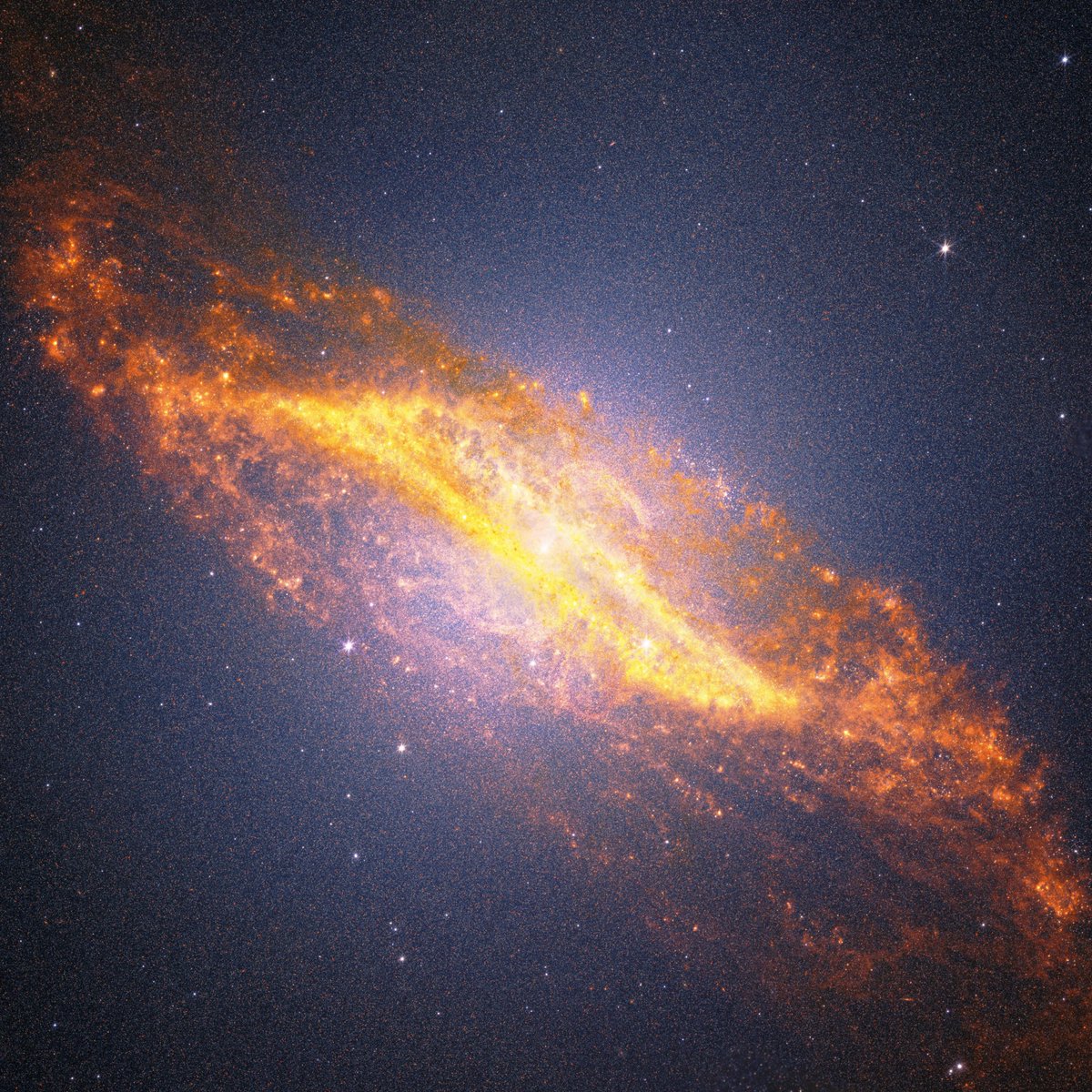
At the heart of the galaxy, an actively feeding supermassive black hole shines brightly, surrounded by complex structures sculpted by a past galactic collision and ongoing activity.
English

July 12th is Webb’s 4th science anniversary!
When we dive deeper into the familiar galaxy Centaurus A, our view becomes richer and stranger— a vivid record of cosmic history.
go.nasa.gov/4wvZJYr

English

Though dust obscures background stars and galaxies, in @NASAHubble’s image of FS Tau (right) we can see protostar FS Tau b, its dusty protoplanetary disk, and its jet of matter (colored cyan). Compare to the Webb image on the left!

English

Gonna shine across that sky 🎶
In the infrared, Webb reveals bright protostars flowering from within the thick dust of the FS Tau star system. Set against a tapestry of background galaxies, this star-forming nebula is home to baby stars. science.nasa.gov/missions/webb/…

English

You’re a spark in the dark 🎶
Webb looked at gas giant planet WD 1856 b, which closely orbits a white dwarf - the remains of a Sun-like star. Did it survive the death of its star or did it migrate to its current location later?
science.nasa.gov/missions/webb/…

English

@NASAHubble M82’s rapid star formation, thought to be the result of its merger with another galaxy, will only be a brief period in its history. The extreme star formation is causing plumes of material to be ejected above and below the disk of the galaxy disrupting future stellar birth.
English

@NASAHubble Because Webb can see infrared light, it is able to peer through clouds of dust and gas to see the shape of this edge-on galaxy, as well as approximately 16.5 million of its stars.

English

Webb’s new view of M82, added to archival data from @NASAHubble, is giving us a more complete picture of this starburst galaxy. science.nasa.gov/missions/webb/…

English

One well-done gas giant planet, coming right up! Webb examined a “hot Jupiter” exoplanet called HD 80606 b, with four times Jupiter’s mass, and a very elliptical orbit that sweeps close by its Sun-like star. go.nasa.gov/3QtN6xr

English

Webb teamed up with @NASAHubble to examine a relic from our galaxy’s formation. This object might look like a globular cluster of stars, but is actually something much odder and rarer - a “bulge fossil fragment.” science.nasa.gov/missions/webb/…

English