NASA Webb Telescope

11.5K posts

NASA Webb Telescope banner
NASA Webb Telescope

NASA Webb Telescope

@NASAWebb

The Official *NASA* Webb X account. The world's most powerful space telescope. Launched: Dec. 25, 2021. First images revealed: July 12, 2022.

Lagrange Point 2 Katılım Nisan 2009
63 Takip Edilen3.5M Takipçiler
Sabitlenmiş Tweet
NASA Webb Telescope
NASA Webb Telescope@NASAWebb·
A brain-new image from Webb! 🧠 What looks like a brain is actually a dying star blowing off a shell of gas, and within that shell, a cloud of various gases. The dark lane that divides its “hemispheres” may be related to an outflow from the central star. science.nasa.gov/missions/webb/…
NASA Webb Telescope tweet media
English
73
707
3.6K
426.6K
NASA Webb Telescope retweetledi
Chandra Observatory
Chandra Observatory@chandraxray·
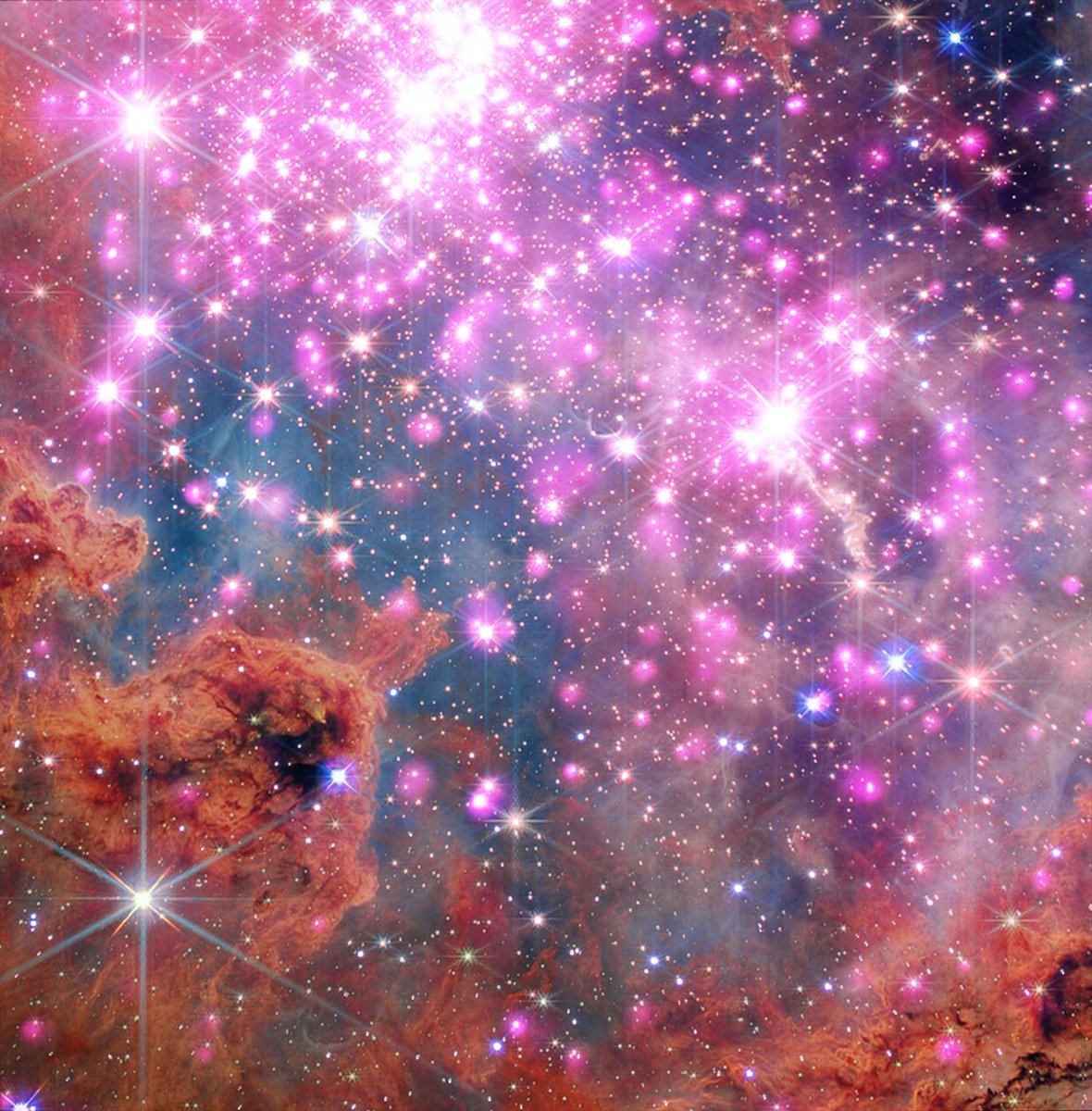
Spring into spring with this new image of the Cat's Paw Nebula from NASA's Chandra and @NASAWebb. We expect it to start knocking planets off the counter for sport any minute now. 🐾
Chandra Observatory tweet media
English
17
297
1.2K
54.1K
NASA Webb Telescope retweetledi
Hubble
Hubble@NASAHubble·
Let’s get to the heart of it. 🧡 This new image from Hubble and @NASAWebb takes a closer look at the core of Messier 101, also known as the Pinwheel Galaxy. At 25 million light-years away, M101 is one of the closest “face-on” spiral galaxies to us: go.nasa.gov/4lydce2
Hubble tweet media
English
34
251
1.4K
78.1K
NASA Webb Telescope retweetledi
National Air and Space Museum
National Air and Space Museum@airandspace·
Now on display at Air and Space: 🌌 James Webb Space Telescope Pathfinder, a full-scale engineering model used by @nasawebb for critical testing in development of the spacecraft ☀️ Parker Solar Probe full-scale model built primarily out of spare parts and back-ups from the spacecraft that has flown through the Sun’s corona
National Air and Space Museum tweet media
English
61
367
2.5K
361.4K
NASA Webb Telescope retweetledi
Space Telescope Science Institute
Space Telescope Science Institute@SpaceTelescope·
#NASAWebb has revolutionized our ability to study the formation and growth of new planetary systems, some with similarities to our own. On March 18, join us for a conversation on what we’ve learned about young planetary systems. youtube.com/live/Sz_i_4_fG…
YouTube video
YouTube
English
3
25
191
85.9K
NASA Webb Telescope
NASA Webb Telescope@NASAWebb·
Webb may showcase the beauty of deep space objects, but it also plays a strong role in planetary defense applications. Using Webb observations, experts accurately measured the size and orbit of asteroid 2024 YR4 and confirmed it will not impact our Moon in 2032. go.nasa.gov/3ORMC3c
NASA Webb Telescope tweet media
English
16
93
632
64.4K
NASA Webb Telescope
NASA Webb Telescope@NASAWebb·
Why does dark matter matter? Scientists think dark matter started clumping together first in the early universe, eventually pulling regular matter together, prompting galaxy and star formation to begin earlier than they might have otherwise.
English
7
25
282
40.6K
NASA Webb Telescope
NASA Webb Telescope@NASAWebb·
We can’t see dark matter. It doesn’t emit, reflect, absorb, or block light, but like everything with mass, it has gravity. If we observe how and where light is being warped by gravity, we can make a map of the matter warping it, even if that matter is invisible to us.
English
6
34
332
45.5K
NASA Webb Telescope
NASA Webb Telescope@NASAWebb·
If it’s invisible, how do you map it and why does it *matter*? Using Webb data, researchers mapped locations of dark matter (shown in blue) across a field of nearly 800,000 galaxies. nasa.gov/missions/webb/…
NASA Webb Telescope tweet media
English
41
195
1.2K
75.7K
NASA Webb Telescope
NASA Webb Telescope@NASAWebb·
What’s next for this star will depend on its mass, which is yet undetermined. If it is a high mass star it will explode in a supernova. If it’s less massive and more Sun-like, it’ll keep shedding layers until only its core remains as a dense white dwarf star.
English
4
22
239
43.1K
NASA Webb Telescope
NASA Webb Telescope@NASAWebb·
Webb has captured two views of this nebula. The near-infrared view shows more stars, as well as background galaxies. In the mid-infrared, the cosmic dust glows more prominently.
English
2
26
285
46.1K
NASA Webb Telescope
NASA Webb Telescope@NASAWebb·
A brain-new image from Webb! 🧠 What looks like a brain is actually a dying star blowing off a shell of gas, and within that shell, a cloud of various gases. The dark lane that divides its “hemispheres” may be related to an outflow from the central star. science.nasa.gov/missions/webb/…
NASA Webb Telescope tweet media
English
73
707
3.6K
426.6K
NASA Webb Telescope
NASA Webb Telescope@NASAWebb·
Perhaps the most massive & old stars are also the dustiest, and the dust could make them look less luminous and hard to see. This particular dusty supergiant seems to support that hypothesis. Next? Locate and study similar stars that have the potential to go supernova, but haven’t yet.
English
2
13
132
33.3K
NASA Webb Telescope
NASA Webb Telescope@NASAWebb·
@NASAHubble We would expect that the most massive stars (those that will end their lives as supernovas) to be among the brightest and most luminous, and thus easy to spot in pre-supernova imagery. But that hasn’t been the case.
English
3
13
125
33.6K
NASA Webb Telescope
NASA Webb Telescope@NASAWebb·
This image was not captured with Webb’s primary high-resolution camera (NIRCam) but rather, is the result of data from our spectrograph (NIRSpec). A spectrograph breaks light into components and gives scientists data about things like the chemical composition and/or motion of what is being observed. This data is usually represented by graphs, rather than images, but our NIRSpec has a special mode that can also capture spatial data. This allows scientists to build a map of their observations. For example here, being able to build a map of the planet via the locations of the atmospheric data, which also gives us the movement of the auroras through the planet’s atmosphere.
English
1
0
5
358
Goyim
Goyim@Kuntpunt1045·
@NASAWebb What a shitty ass camera
English
1
0
1
379
NASA Webb Telescope
NASA Webb Telescope@NASAWebb·
Hey, hey, it’s everyone’s favorite 7th planet from the Sun! Webb has provided us with the first vertical view of Uranus’s ionosphere, revealing auroras shaped by its tilted magnetic field. esawebb.org/news/weic2602/
GIF
English
55
486
3.1K
411.3K
NASA Webb Telescope
NASA Webb Telescope@NASAWebb·
This image was not captured with Webb’s primary high-resolution camera (NIRCam) but rather, is the result of data from our spectrograph (NIRSpec). A spectrograph breaks light into components and gives scientists data about things like the chemical composition and/or motion of what is being observed. This data is usually represented by graphs, rather than images, but our NIRSpec has a special mode that can also capture spatial data. This allows scientists to build a map of their observations. For example here, being able to build a map of the planet via the locations of the atmospheric data, which also gives us the movement of the auroras through the planet’s atmosphere.
English
1
0
14
420
Vincent Puliafico
Vincent Puliafico@Vpuliafico·
@NASAWebb This is the worst picture by JWST I've seen. No details at all. Or did they purposely defocus it.
English
1
0
0
640