NC 𐤊

7.2K posts

NC 𐤊 banner
NC 𐤊

NC 𐤊

@NC_Eth

Lover of Kaspa

Katılım Ekim 2016
29 Takip Edilen839 Takipçiler
NC 𐤊 retweetledi
Michael Sutton
Michael Sutton@michaelsuttonil·
Toccata consensus feature freeze is finally here after a heroic last-mile push by kas core devs. Aiming to reset TN12 tonight, or tomorrow at the latest. Genesis update: + 0x6b617370612d746573746e6574 // kaspa-testnet - 12, 2 // TN12, Launch 2 + 0x544f4343415441 // TOCCATA + 12, 3 // TN12, Launch 3
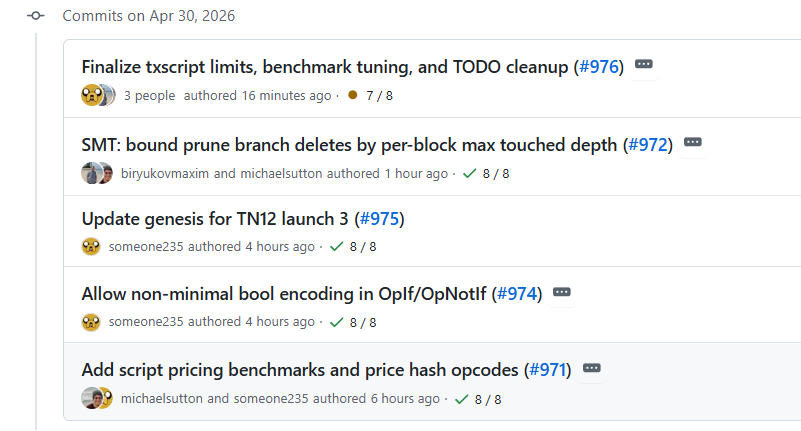
Michael Sutton tweet media
English
90
394
1.1K
75.1K
NC 𐤊 retweetledi
Shai (Deshe) Wyborski
Shai (Deshe) Wyborski@DesheShai·
Let's try this "engagement farming" thing. I was invited to a big YT channel to discuss the quantum threat. Inspired by the comments to the previous video (pinned), if this post gets 1k likes I'll wear a $kas Kaspa shirt.
English
69
205
1.1K
13.4K
NC 𐤊 retweetledi
Hans Moog
Hans Moog@hus_qy·
Okay, it's time for a little update: I just finished the work on the zero knowledge part of the vprogs framework, which introduces the ability to prove arbitrary computation. It consists of the following 8 PRs that gradually introduce the necessary features: 1. ZK-framework preparations (github.com/kaspanet/vprog…): This PR cleans up the scheduler and storage layers, extends the build tooling with workspace-wide dependency checking, adds the ability to publish artifacts for transactions and batches (which will later hold the proofs), renames some core types for clarity, and introduces lifecycle events on the Processor trait that allow a VM to hook into key scheduler events like batch creation, commit, shutdown, and rollback. 2. Core Codec (github.com/kaspanet/vprog…): This PR introduces a lightweight encoding library for ZK wire formats. In a zkVM guest, every byte operation contributes to the proof cost, so the codec is designed to reinterpret data in-place rather than copying it. It includes zero-copy binary decoding (Reader, Bits) and sorted-unique encoding for deterministic key ordering. It is built for no_std so it runs inside zkVM guests. 3. Core SMT (github.com/kaspanet/vprog…): To prove state transitions, we need cryptographic state commitments. This PR adds a versioned Sparse Merkle Tree that produces a single root hash representing the entire state. It includes all state-of-the-art optimizations: shortcut leaves at higher tree levels to avoid full-depth paths for sparse regions, multi-proof compression that shares sibling hashes across multiple keys, and compact topology bit-packing to minimize proof size. It integrates into the existing storage and scheduler layers so that every batch commit updates the authenticated state root, while rollback and pruning maintain tree consistency. 4. ZK ABI (github.com/kaspanet/vprog…): Defines the wire format for communication between the host and zkVM guest programs, establishing a universal language for proof composition. It specifies how inputs, outputs, and journals are structured for two levels of proving: the transaction processor, which proves individual transaction execution against a set of resources, and the batch processor, which aggregates transaction proofs and proves the resulting state root transition. Because the ABI is backend-agnostic and no_std compatible, any zkVM backend can directly use it (non-Rust zkVMs would need to reimplement the ABI in their language). 5. ZK Transaction Prover (github.com/kaspanet/vprog…): Introduces the transaction proving worker, which receives serialized execution contexts via the ABI wire format and submits them to a backend-specific prover on a dedicated thread. The Backend trait abstracts the actual proof generation, so different zkVM backends can be swapped without changing the pipeline. 6. ZK Batch Prover (github.com/kaspanet/vprog…): Introduces the batch proving worker, which collects the individual transaction proof artifacts, pairs them with an SMT proof covering the batch's resources, and submits the combined input to a backend-specific batch prover. The result is a single proof attesting to the entire batch's state root transition. Like the transaction prover, the Backend trait abstracts proof generation so different zkVM backends can be swapped without changing the pipeline. 7. ZK VM (github.com/kaspanet/vprog…): Wires everything together by implementing the scheduler's Processor trait with ZK proving support. The VM hooks into the lifecycle events introduced in PR 1 to feed executed transactions into the transaction prover and batches into the batch prover. Proving is optional and configurable - it can be disabled entirely, run at the transaction level only, or run the full batch proving pipeline. 8. ZK Backend RISC0 (github.com/kaspanet/vprog…): Provides the first concrete zkVM backend using risc0. It implements the transaction and batch Backend traits, includes two pre-compiled guest programs (one for transaction processing, one for batch aggregation), and ships with an integration test suite that verifies the full pipeline end-to-end - from transaction execution through batch proof generation to state root verification. TL;DR: While the early version of the framework focused on maximizing the parallelizability of execution, this feature focuses on extending this capability to maximizing the parallelizability of proof production. If you're a builder: this is the first version of the framework that lets you write guest programs with a Solana-like API (resources, instructions, program contexts) and have them proven in a zkVM. The current milestone uses a single hardcoded guest program - composability across multiple programs and bridging assets in and out of the L1 are part of the upcoming milestones, but if you're eager to start tinkering, the execution and proving pipeline is fully functional and provides a minimal environment to build and test guest logic today. Once we add user-deployed guests, they will move one logical layer down: the current transaction processor will become a hardcoded-circuit that handles invocation and access delegation to user programs, similar to how SUI handles programmable transactions (including linear type safety at the program boundary). In practice, this means guest programs will be invoked with a very similar API but scoped to a subset of resources, so the basic programming model won't change. Note that guests currently handle their own access authentication (e.g. signature checks) - the framework will eventually manage this automatically. If you want to contribute, two areas where community involvement would be especially impactful: - An Anchor-like DSL for writing guest programs -- the ABI is stable enough to build on, and a good developer experience layer would make this accessible to a much wider audience. - A second zkVM backend (e.g. SP1) - the Backend traits are designed for this, and a second implementation would prove out the abstraction. One thing I find particularly interesting in the context of PoW: the block hash provides an unpredictable, unbiasable random input that is revealed after transaction sequencing. This gives guest programs native access to on-chain randomness without oracles or additional infrastructure - something traditionally hard to achieve in smart contract platforms. PS: I am also planning to start with the promised regular hangouts but since I will visit my family over easter and want to get a better understanding of the open questions next week (it's good to have some problems to wrestle during that slower time 😅), I decided to start with that once I am back (12th of April). Generally speaking, is there a day that people would prefer for these hangouts? I guess monday would be bad as there is already another community event (write your preferences in the comments if you have a strong opinion).
English
54
314
890
56K
NC 𐤊 retweetledi
Hans Moog
Hans Moog@hus_qy·
Today there is a bigger update because there are 3 new PRs that are ready for review. The first one (github.com/kaspanet/vprog…) fixes some bugs and introduces the SchedulerState which unifies the way we expose shared state in our framework. The second one (github.com/kaspanet/vprog…) introduces the node-framework which builds on top of the first PR and introduces a generic platform for building L2 nodes that ingest data from the Kaspa L1 to produce state changes (and eventually proofs) of the L2-execution. The third one (github.com/kaspanet/vprog…) introduces the node-vprogs-cli - an actual binary that can be executed and that follows the L1 to execute transactions in a concrete VM. The binary is designed to support compile-time modularity, which means that by updating a single line in the backend.rs we can swap out both, the storage and the VM. A VM is defined by three functions: 1. A pre_process_block function which extracts the relevant L2 transactions from the L1 chainblock. 2. A process_transaction function which executes a single transaction (within its scope) and produces execution-results. 3. A post_process_block function which takes the execution results of the individual transactions and stitches them together into an aggegrated proof structure which can be settled on the L1. All steps are parallelized as much as the underlying causal structure permits. I still have a few chores on my todo-list and there are still a few missing parts (like syncing from state that we didn't actively witness) but this is pretty much as far as we get without re-integrating with the covenants on L1, so the next steps will be to actually design the concrete framework for settling state transitions on the L1 (and consequently syncing from it). I suspect that this will require a little bit of back and forth between the two development efforts but we are getting to the point where things start to get interesting.
Hans Moog tweet media
English
41
203
612
59.4K
NC 𐤊 retweetledi
Igra Labs
Igra Labs@Igra_Labs·
On March 26 2026 the first public protocol goes live on Igra Mainnet. ZealousSwap opens a seven-day continuous auction for up to 500 million $IGRA. $IGRA tokens power attester nodes that secure the network, and carry onchain voting rights over protocol parameters, fees, attester rules, and token distribution. A portion of auction proceeds will seed the initial $IGRA/iKAS liquidity pool at the final clearing price. The auction runs a single uniform clearing price per block with no barriers or hidden allocations. The person bidding 10 iKAS and the person bidding 1,000,000 iKAS get the same price per token. 15 teams are preparing to deploy on Igra Mainnet. ZealousSwap ZAP launches first. You'll need iKAS to participate. Participation guides coming early next week. Discord: discord.gg/igralabs Telegram: t.me/IgraCommunity
Igra Labs tweet media
English
14
75
257
34.2K
NC 𐤊 retweetledi
Yonatan Sompolinsky
Yonatan Sompolinsky@hashdag·
Kaspa is real-time bitcoin, solving scalability is great but not the core value prop. Real-time bitcoin means achieving in a few seconds the same security guarantees that nakamoto consensus / bitcoin achieves after an hour; decentralizing each consensus round rather than chain quality achieved through a coarse aggregate of rounds. A clean definition anchor for real-time decentralization (RTD): The ability to sample the honest majority in real-time. (Note that even fast leaderless VRF-based proof-of-stake cant sample honestly bc the selected nodes get to choose the content of their blocks after they've been selected; pos=select then write, pow=write then select) -- RTD affects: txn confirmation, censorship resistance, secure oracle finality, MEV resistance. Eg censorship resistance, bitcoin is the most censorship resistant chain, but if 60% of the miners are censoring you (point in reference: OFAC abiding tornado censoring eth miners), your txn will pend for 30-40 minutes. For shady business payments that's not prohibitive, but for a real economy, for an asset aspiring to be at least a king of collateral even if not an MoE, this is unacceptable, esp under economic stress. Beyond censorship, all things finance benefit tremendously from pow density, from sampling the majority in real-time in a secure and honest manner. I wont get into MEV resistance now, but having a "conscious" stream of oracle attestations (not price oracles) finalized in real-time qualitatively upgrades the ability to encode informed risk, collateral, liquidity management, which is the lifeblood of defi. In context of conf times, increasing from 1 to 10bps saturates the latency optimization. But for pow density we need dozens of blocks per second, with the endgame of 100 bps: Under 10bps a 37% attacker can fake the majority signal with probability 12%. With 100bps this drops to 0.3%. Today Kaspa can't accelerate to >10bps w/o harming conf times, but DAGKNIGHT will be implemented hopefully by Q3 at least on testnet, by which we will push for 25-40bps. The cherry on top: RTD also implies netsplit resistance, as per the partial synchrony framework. WWIII cyberwar resistance. Hypothetically speaking ofc. (elaborated- hashdag.medium.com/in-which-it-wa…)
VLAD HOSTS THE BEST PODCAST IN BITCOIN@Vladcostea

Zcash is private Bitcoin Litecoin is faster Bitcoin Kaspa is scalable Bitcoin Decred is governance Bitcoin Bitcoin Cash is big block Bitcoin Ethereum is smart contract Bitcoin Quantus is quantum resistant Bitcoin Monero is reactionary fungible Bitcoin “Bitcoin” is not just a ticker. “Bitcoin” is not just one network. Bitcoin is the name of a movement, the symbol of a revolution, and the ecash that actually changed the world.

English
77
651
1.6K
149.2K
NC 𐤊 retweetledi
KaspaCom ⚡️
KaspaCom ⚡️@KaspaCom·
🚀 Kaspa Live on National TV KaspaCom CEO @cryptosione was invited on Israel’s economic TV channel to talk Kaspa. As one of the strongest digital assets in the world, Kaspa is gaining mainstream attention. From national media to real adoption. ⚡️ Full subtitled segment 👇
English
61
274
757
53.5K
NC 𐤊 retweetledi
s c a p e ‎. 𐤊
s c a p e ‎. 𐤊@ScapeSquad·
When $KAS is pumping, the tech is suddenly more interesting? 🚀 Kaspa keeps building.
s c a p e ‎. 𐤊 tweet media
English
5
34
257
4.4K
NC 𐤊 retweetledi
Uncle Stayfun
Uncle Stayfun@unclestefan·
Dear #Kaspa holders, In my humble opinion, #Kaspa will find its way into the top 3 cryptocurrencies. In a time of manipulation and constant negativity, truly good things take time. Kaspa is an answer to the digital era that lies ahead. So buckle up, it’s going to be a wild ride. Happy New Year 2026. Love, and be loved. $kas
Uncle Stayfun tweet mediaUncle Stayfun tweet media
English
5
40
255
6.1K
NC 𐤊 retweetledi
BSCN
BSCN@BSCNews·
🚨 @kaspaunchained now has its very own social app... 'K Social', often referred to as 'K', launched on $KAS mainnet just days ago, and it's already turning heads. It boasts all the functionality of a Web2 social app, while adding the myriad advantages that blockchain technology has to offer. Get up to speed with the app that could take Kaspa mainstream ⬇️ bsc.news/post/kaspa-k-s…
English
13
79
310
12.4K
NC 𐤊 retweetledi
KaspaCom ⚡️
KaspaCom ⚡️@KaspaCom·
🚀 KaspaCom: Now Committed to Marketing Kaspa Globally We’re allocating a significant share of our resources to market Kaspa across the USA and EU. Global events. Global campaigns. Institutional visibility. Kaspa deserves the global stage. We’re making sure it gets there. ⚡️
KaspaCom ⚡️ tweet media
English
37
128
385
6.9K
NC 𐤊 retweetledi
Dan Gambardello
Dan Gambardello@dangambardello·
Kaspa community is no joke! I officially told my team to work on a $KAS risk model. Also wondering if I should buy some $KAS before the bull market gets out of hand. P.S. I apologize for calling you bots in previous polls.
English
402
305
1.6K
87.9K
Steve Will Do It
Steve Will Do It@stevewilldoit·
I turn 27 today. Sending someone 2.7k BTC cuz I love u. U changed my life. You aren’t fake demonic motherfuckers like everyone else in my life . I love u . Comment btc and like
English
39.6K
4.1K
77.6K
5.9M
NC 𐤊 retweetledi
Vijay 𐤊ailash, CFA, CFP®
Vijay 𐤊ailash, CFA, CFP®@realvijayk·
$KAS is literally better than $BTC, $ETH, & $SOL combined. Kaspa just needs more adoption. But it has the potential to displace the top 5 cryptocurrencies in the next few years.
Sapere Aude@5apere4ude

🤯 I tasked ChatGPT with doing a deep dive on #Kaspa and then creating a chart comparing the infrastructure to $BTC, $SOL, & $ETH. It was done under the premise that smart contracts will be running stably by August 31st on $KAS Here's what came out of it 👀 Thoughts?

English
29
140
580
14.9K
Summer
Summer@firehustle_net·
you can only pick one - which one are you picking? $KAS $HBAR $XRP $PENGU $SOL $ETH
English
351
16
321
30.2K