
Nehasrinivas

11 posts

Nehasrinivas banner
Nehasrinivas

Nehasrinivas

@Nehasrinivas07

DSA + Data Engineer. I’ll be sharing my journey here!

Katılım Ekim 2021
57 Takip Edilen137 Takipçiler
Nehasrinivas retweetledi
Reso
Reso@Resorcinolworks·
the checklist of companies i had while applying- Meta Microsoft Google LinkedIn Adobe Oracle Atlassian Confluent Uber Airbnb Expedia Agoda Grab Walmart Wayfair PayPal Coinbase Twilio ServiceNow Nutanix Rubrik UiPath Postman Harness Glean Rippling Moveworks HubSpot Freshworks Tekion Zeta PhonePe Razorpay Cashfree Juzpay Cred Groww Angel One Kotak Slice Acko CoinDCX ShareChat Swiggy Meesho Hotstar Games24x7 Headout Blink Health SenseHQ Eightfold AI Spotnana Tide Tesco GEP Eternal (Formerly Zomato)
English
12
42
461
38.9K
Nehasrinivas retweetledi
sankit
sankit@sankitdev·
Backend isn’t just APIs and CRUD. This is the roadmap companies like Google, Meta, Amazon expect you to know. DSA > Companies like Google don’t care about your projects if you fail here. > This is the real filter. > Conquer this, and every door in tech opens. > Struggle here, and those doors stay shut. 0. Ground Setup Before going crazy with topics, you need: > One main backend language (JavaScript/TypeScript, Go, Java, Rust — pick one and master it) > Git + GitHub: branching, PRs, rebases, conflict resolution > Linux basics: ls, cd, cat, grep, find, permissions, SSH > Editor mastery: VS Code or any solid setup First principles here: > What is a program? How does source code become a running process? > What is an OS process vs thread? > What does it mean to run a server on a port? You should be able to: > SSH into a Linux box, pull a repo, install deps, run a server on a port, view it via browser --- 1. Core Backend Fundamentals 1.1 Networking and HTTP You cannot be a strong backend engineer if HTTP is just “that thing Express uses”. Understand: > DNS → IP → TCP → HTTP > Difference between IP / TCP / UDP / HTTP / HTTPS > HTTP methods, status codes, headers, idempotency, safe methods > REST vs RPC vs GraphQL Practice: > Build a backend without any framework using native http > Parse JSON body manually > Implement basic rate limiting > Add API versioning (/v1, /v2) --- 1.2 API Design and Backend Architecture Basics First principles: > Resource modeling > Stateless vs stateful > Consistent naming, validation, clear errors > Pagination, filtering, sorting Layered architecture: > Controller → Service → Repository (DAO) You should be able to: > Design APIs for Task Manager or Expense Tracker > Keep error and response structure consistent everywhere --- 2. Databases and Data Modeling Big companies will grill you here. 2.1 Relational Databases SQL is non-negotiable. Understand: > Table, row, column, primary key, foreign key > Normalization: 1NF, 2NF, 3NF basics > Joins: inner, left, right, full > Transactions and ACID > Indexes and their impact You should be able to: > Instagram schema: users, posts, likes, comments, followers > Query top posts, mutual followers > Use migrations, not manual DB edits --- 2.2 NoSQL and When to Use It Understand: > Document DB vs relational DB > Denormalization > Event logs and analytics needs > CAP theorem basics > Collections, documents, indexes, aggregation pipeline Be able to decide: > When a feature needs SQL vs NoSQL --- 3. Authentication, Authorization and Security 3.1 Auth Basics Understand: > Authentication vs authorization > State vs stateless auth > Password hashing (bcrypt/argon2) > Cookies: HttpOnly, Secure, SameSite > Access vs refresh tokens > Token revocation and rotation > Basics of OAuth2 / OpenID Connect You should be able to: > Implement email/password auth with verification and forgot password > Explain cookies vs localStorage > Explain token invalidation strategies --- 3.2 Web Security Core Understand: > SQL injection, XSS, CSRF, IDOR (OWASP Top 10) > Input validation and output encoding > CORS and preflight You should be able to: > Identify common vulnerabilities in APIs > Configure CORS correctly --- 4. Concurrency, Performance and Scalability 4.1 Concurrency and Asynchrony Understand: > Event loop, callback queue, microtasks > Blocking vs non-blocking I/O > CPU-heavy work blocks Node You should be able to: > Explain when to use worker threads and offloading --- 4.2 Caching Concepts: > In-memory vs Redis caches > TTL, LRU, invalidation > HTTP caching: ETag, Last-Modified, Cache-Control You should be able to: > Use Redis to cache DB queries and rate limit > Plan cache keys well --- 4.3 Scaling and Architecture Patterns Understand: > Vertical vs horizontal scaling > Stateless services for scale-out > Load balancers > Monolith vs microservices > Sync vs async flows (queues) Patterns: > Circuit breaker > Retry with backoff > Idempotency keys for POST You should be able to: > Split a monolith into services and make them communicate --- 5. Messaging, Queues and Async Systems Understand: > RabbitMQ, Kafka, Redis streams > Producers, consumers, delivery semantics Use cases: > Emails, uploads, payment pipelines, logs You should be able to: > Offload heavy jobs to background workers > Build async workflows 6. Testing and Quality Understand: > Unit, integration, E2E tests > Test pyramid > Deterministic vs flaky tests You should be able to: > Test auth flows and business logic > Run tests in CI (GitHub Actions or similar) 7. DevOps Basics for Backend Engineers 7.1 Containers and Deployment Understand: > Dockerfile basics (FROM, COPY, RUN…) > Docker Compose for app + DB > Environment variables and config You should be able to: > Containerize backend and DB > Deploy to any cloud provider 7.2 CI/CD and Observability Understand: > CI pipelines: tests, lint, build > Auto deploy workflows > Logging and metrics You should be able to: > Add logging middleware with request IDs > Monitor latency, error rate, throughput 8. System Design This becomes crucial for big tech interviews. Understand: > Load balancer, app server, DB, cache, queue, file storage > Consistency models > API Gateway and BFF patterns > Unique ID generation (UUID, Snowflake) Practice on paper: > URL shortener > Instagram feed > E-commerce checkout > Notification systems Consider: > DB schema, caching, queue usage, failure handling 9. Domain-Specific Knowledge Depending on role and product: > Fintech: strong consistency, audit logs, idempotency > E-commerce: carts, pricing, orders, inventory > Real-time: WebSockets, SSE, backpressure Choose what aligns with your career direction and keep grinding.
English
101
485
3.4K
254.6K
Gagan Bansal
Gagan Bansal@bansalgagan2004·
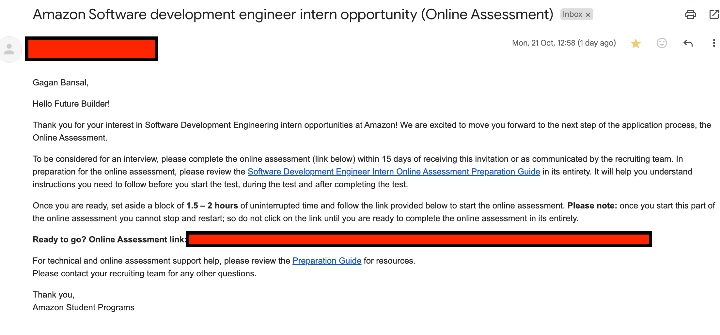
Got Amazon SDE Intern OA link. Hope so clear all the rounds.
Gagan Bansal tweet media
English
12
1
79
8.3K
Nehasrinivas retweetledi
Kritika K
Kritika K@kritika_k__·
Tips to solve any DSA question by understanding patterns If the input array is sorted then - Binary search - Two pointers If asked for all permutations/subsets then - Backtracking If given a tree then - DFS - BFS If given a graph then - DFS - BFS If given a linked list then - Two pointers If recursion is banned then - Stack If must solve in-place then - Swap corresponding values - Store one or more different values in the same pointer If asked for maximum/minimum subarray/ subset/options then - Dynamic programming If asked for top/least K items then - Heap - QuickSelect If asked for common strings then - Map - Trie Else - Map/Set for O(1) time & O(n) space - Sort input for O(nlogn) time and O(1) space (Source: whatsapp)
English
35
258
2.2K
169.4K
Nehasrinivas
Nehasrinivas@Nehasrinivas07·
Hi there, I'm looking to #Connect with people who are interested in: DSA Machine learning And who can code early mornings
English
125
4
202
21.4K