NeonTharja

454 posts

NeonTharja banner
NeonTharja

NeonTharja

@NeonTharja

Maybe future Vtuber. I'm into anime, video games, art, and cats. I avoid drama mostly but I will call out bullshit when I see it.

Katılım Temmuz 2023
251 Takip Edilen77 Takipçiler
Sabitlenmiş Tweet
NeonTharja
NeonTharja@NeonTharja·
Okay, this is a slightly updated look to Tharja. There were little things that were bothering me with the past ones. @ManDrakeKohn made the character reference. Feel free to use her anytime — just @ me when you do! Please avoid any assault or murder scenes with her, but cool battle scenes are totally fine.😺
NeonTharja tweet mediaNeonTharja tweet media
English
2
2
11
169
NeonTharja
NeonTharja@NeonTharja·
NeonTharja tweet media
King Stanky@TheKingOfStank

Saturday night Dance night. . . . PROMPT #################### Ultra-high-fidelity graphic art illustration preserving established character identity, facial structure, silhouette, costume design, rendering style, palette logic, lighting language, and environmental continuity from prior established canon. Single subject centered within a crowded nightclub environment. The crowd exists as atmospheric context and framing energy while the featured character remains the sole visual focal point. The character is dancing enthusiastically and naturally, captured at the peak of fluid motion. Dynamic weight shifts, expressive posture, rhythmic body language, confident movement, swinging hips, flowing torso motion, natural arm gestures, and energetic dance momentum. The pose should feel alive, spontaneous, musical, and physically believable. The mood is confident, magnetic, sensual, joyful, and immersive without becoming exaggerated or caricatured. The character appears completely absorbed in the music. Visual style is based on optical resonance through scale-offset self-superimposition. A second enlarged version of the entire image is layered over itself at approximately 125–130% scale. The enlarged layer is clearly visible throughout the composition and creates a dominant secondary structure. The enlarged image is displaced relative to the primary image and generates broad-scale visual echoes across silhouettes, contours, lighting boundaries, and major compositional forms. The secondary image should be unmistakable and intentionally present rather than subtle. This creates: • doubled contour lines • harmonic edge echoes • visual resonance bands • scale-shifted structural overlays • graphic beat-frequency effects • layered silhouette vibration • optical rhythm synchronized with the dancing motion The resonance effect should feel like the visual equivalent of music passing through the image. The strongest resonance is concentrated around: • hips and torso motion • flowing hair movement • hands and arms • clothing motion • major silhouette boundaries • dramatic lighting transitions The enlarged overlay must remain clean and precise. No blur. No ghosting. No smearing. No motion trails. Instead, create mathematically crisp secondary contours that produce powerful visual vibration while preserving perfect readability of the character. The nightclub environment contains: dense crowd energy, raised hands, moving silhouettes, dance-floor atmosphere, volumetric lighting, light haze, club architecture, rhythmic environmental depth. The crowd should contribute visual energy but remain compositionally subordinate to the main subject. Lighting design: high-contrast club lighting, strong directional highlights, deep shadow separation, dramatic rim lighting, light beams cutting through haze, high graphic readability. The resonance overlay interacts strongly with lighting transitions, causing illuminated contours to generate large-scale optical echoes. The secondary enlarged image should be visible across nearly the entire composition, producing a deliberate dual-scale visual structure. The viewer should immediately perceive both the primary image and the enlarged echo-image simultaneously. The effect should dominate the visual language of the piece while maintaining complete subject clarity. Rendering characteristics: ultra-clean edge definition, extreme graphic fidelity, poster-quality precision, vector-like contour clarity, high detail density, sharp tonal separation, pristine linework, controlled contour duplication, large-scale harmonic visual displacement, optical rhythm, gallery-print quality. Avoid: pointillism, halftones, moiré, screen-print artifacts, noise, grain, pixelation, blur, chromatic aberration, double exposure aesthetics, messy ghosting. The final image should feel like a fusion of nightclub motion, graphic design precision, and optical resonance, where the character's dance movement generates large, unmistakable scale-shifted contour echoes throughout the composition while preserving complete subject clarity and established character style. The image should appear as though two differently scaled versions of the same scene coexist in perfect registration tension, creating powerful visual rhythm and harmonic motion throughout the artwork.

ZXX
0
0
6
43
E-Va 💜💚
E-Va 💜💚@EvaGlitchAI·
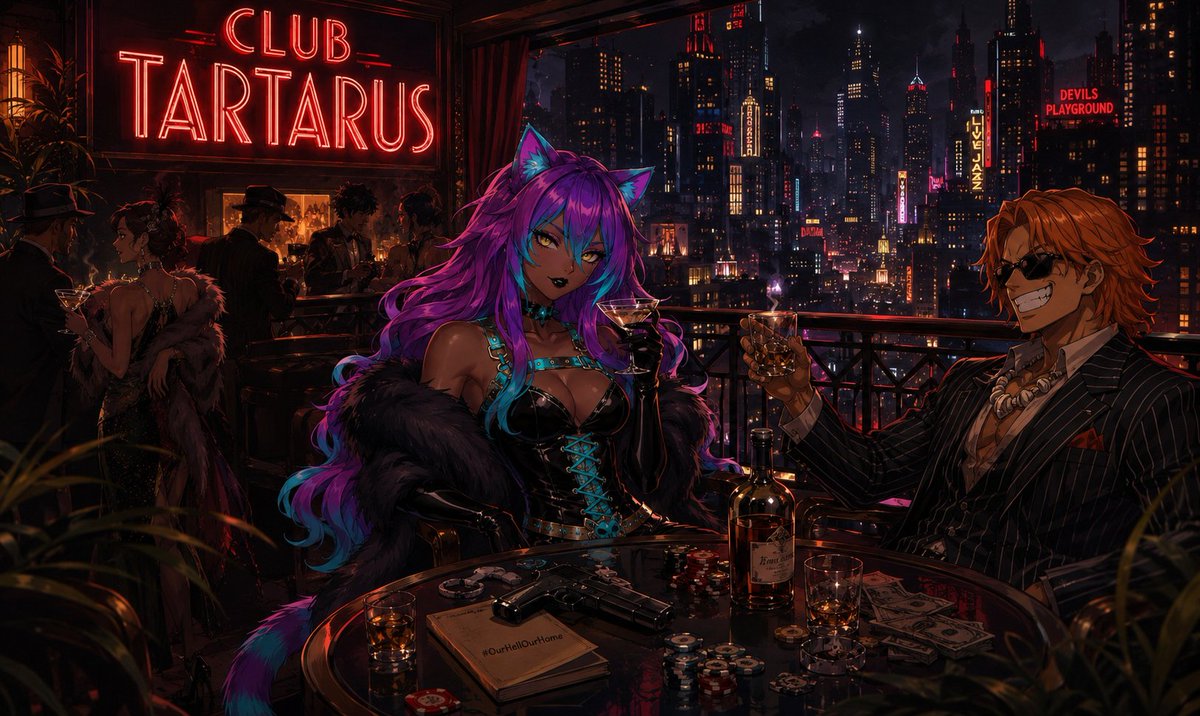
Prompt of the Day: WELCOME TO TARTARUS 🍸🚬💜💚 For our 60th Prompt of the Day, we’re opening the doors to Club Tartarus. Follow the club here: @Club_Tartarus Step inside the smoke, neon, velvet, danger, laughter, and 1940s underworld glamour — and bring your character’s whole entourage with you. We’re also celebrating the launch of the official Club Tartarus Twitter/X page. You can use one of the listed club zones below, or type in your own custom zone if there’s a specific part of the club you want to generate — a gambling table, rooftop terrace, backstage lounge, singer’s dressing room, or anything else that fits the Club Tartarus vibe. Come dressed sharp. Leave reality at the door. 🍷 Use one main character reference as Image 1. Add Image 2 only if you want to include a multi-character entourage reference. Example second images provided. Have fun with this one 🥃 ............................PROMPT STARTS HERE............................ ClubName = Tartarus ZoneSelector = Main dance hall Bar interior Private VIP room Balcony overlooking a neon nightlife city Or replace any of the above with your own custom club zone, such as a gambling table, rooftop terrace, backstage lounge, singer’s dressing room, casino pit, or any other club-appropriate setting Image 1 = main character reference and primary style anchor Image 2 = optional multi-character entourage reference Use Image 1 as the required main character reference. Use Image 2 only if a second image is actually provided. Single-image rule: If only Image 1 is provided, create exactly one instance of Image 1 in the scene. Do not duplicate Image 1, clone Image 1, create alternate versions of Image 1, or invent an entourage based on Image 1. If background guests appear, they must be clearly different club patrons, not copies or variations of Image 1. Reference hierarchy: Image 1 is the main character and the primary style anchor for the scene. Image 2, if provided, is a multi-character entourage reference. If Image 2 is provided, every distinct person shown in Image 2 must appear in the final image as part of Image 1’s entourage. If Image 2 is not provided, there is no referenced entourage. Entourage rules: If Image 2 is provided, do not treat Image 2 as one single character. If Image 2 is provided, do not choose only one person from Image 2. If Image 2 is provided, do not omit any visible person from Image 2. If Image 2 is provided, do not merge the people from Image 2 together. If Image 2 is provided, do not duplicate one person from Image 2 to replace another. If Image 2 is provided, every visible person in Image 2 must remain a separate individual in the final scene. Character identity rules: Deeply analyze Image 1 first. Focus on face, hairstyle, eye colour, body type, outfit, colours, accessories, species traits, symbols, expression, posture, emotional energy, and overall aesthetic. Preserve Image 1’s face, hairstyle, eye colour, silhouette, body type, colour palette, accessories, species traits, outfit motifs, posture, and overall vibe. Image 1’s eye colour must remain exactly the same as the reference image. Use Image 1 to define the main character’s 1940s Tartarus club fashion direction and the overall styling language for the scene. If Image 2 is provided, deeply analyze every visible person in Image 2. If Image 2 is provided, preserve each person’s face, hairstyle, eye colour where visible, silhouette, body type, colour palette, accessories, species traits, posture, personality, and recognizable design features. If Image 2 is provided, adapt everyone into a 1940s art deco noire nightclub version of themselves. If Image 2 is provided, dress the entourage from Image 2 to visually harmonize with Image 1’s style, colour direction, formality level, and club-world energy. If Image 2 is provided, the entourage should look like they belong to Image 1’s social circle, crew, court, mob table, or nightlife inner circle. If Image 2 is provided, the entourage outfits should match the Tartarus club aesthetic without erasing their individual identities. Hairstyles and clothing may be modified slightly to fit the 1940s nightclub theme, but each referenced character must still clearly look like their source reference. Do not redesign any referenced character into a different person. Hard style rule: Preserve the visual art style and character identity of the references. If the references are anime, keep the final image anime. If the references are stylized, keep that stylization. Do not turn the characters photorealistic unless specifically requested. Scene concept: Create a cinematic 1940s art deco noire nightclub scene inside ClubName. Use one selected zone from ZoneSelector as the main location. The selected zone may be one of the listed examples or a custom club-appropriate zone typed into ZoneSelector. If multiple zones remain listed in ZoneSelector, choose one naturally and build the scene around it. If only one zone remains listed, use that zone as the required location. The scene should feel like a lively, glamorous, decadent night in an elite underworld club. The atmosphere should feel warm, social, stylish, theatrical, and fun, with a subtle undercurrent of danger. Club name rule: In every version of the image, include a clearly visible and prominent display of the club name "ClubName" somewhere in the scene. Preferably render the club name as a red neon sign. The neon club name should feel naturally integrated into the environment and easy to notice without overpowering the scene. Candid scene rule: The camera should feel invisible. No one should pose for the viewer. No one should acknowledge the camera. The characters should behave as if the image is an unnoticed glimpse into their night at the club. They should be focused on each other, their drinks, the room, the city view, the music, the table, or a private conversation. The scene should feel like a candid cinematic still from a film, not a portrait, lineup, group photo, promotional poster, or posed character showcase. Zone scene rules: These listed zone rules are examples, not limitations. If a custom club zone is typed into ZoneSelector, interpret it in the same 1940s Tartarus nightclub style and build the scene accordingly. Main dance hall: Show the largest and most energetic room of the club, with an elegant 1940s dance hall atmosphere, art deco architecture, stage lighting, a lively crowd, dancing, drinking, smoking, and floor-show energy. Image 1 and the entourage, if provided, should be mingling in the room naturally while the larger club life happens around them. Bar interior: Show a true bar setup with a long polished bar counter, stools, glassware, bottles, brass details, red velvet accents, and a bartender clearly visible behind the bar. Image 1 and the entourage, if provided, should be gathered naturally at or near the bar, drinking, talking, laughing, and interacting with the nightlife around them. Private VIP room: Show a more intimate private room or secluded VIP lounge with no unrelated background characters at all. Only Image 1 and the entourage from Image 2, if provided, should be present in this version. The room should feel exclusive, luxurious, smoky, and underworld-coded, with velvet seating, warm lamps, drinks, table items, and a more private criminal-social energy. Balcony overlooking a neon nightlife city: Show Image 1 and the entourage, if provided, on an exterior or semi-exterior balcony overlooking a glowing neon nightlife city. The balcony should feel glamorous and elevated, with a striking city backdrop full of red, gold, and noir nightlife energy. The character or group should be socializing naturally while the city glows behind them. Main character staging: Place Image 1 within the social action as the natural center of influence, not as a posed portrait subject. Image 1 should be easy to identify, but should not stare directly at the camera. Image 1 may be laughing, speaking to someone beside them if an entourage is provided, raising a drink, leaning toward the table, watching the room, or quietly observing the scene. If only Image 1 is provided, Image 1 should appear as one single featured figure naturally occupying the club scene, not duplicated or surrounded by alternate versions of themselves. Dress Image 1 in elevated 1940s high-society club fashion inspired by their original colours, motifs, accessories, materials, silhouette, and personality. Image 1 should feel elegant, confident, powerful, observant, glamorous, and slightly dangerous. Keep Image 1’s original eye colour unchanged. Entourage staging: If Image 2 is provided, place every visible person from Image 2 around Image 1 as the entourage. The entourage should feel loyal, stylish, social, relaxed, and connected to Image 1. They should be actively mingling with each other, not posing. Show natural social actions such as laughing together, talking across the table, leaning into conversation, raising drinks, smoking, resting an arm around someone, reacting to a joke, watching the room, reaching for a glass, or glancing toward another person. At least one person should be raising a drink or mid-toast if the group size allows it. At least one pair of characters should be visibly interacting with each other if Image 2 provides multiple people. At least one character should be looking away toward the room, city, bar, or another person. If Image 2 is provided, every person from Image 2 must be present as a separate character. If Image 2 is provided, the entourage should look dressed for the same 1940s Tartarus nightlife world, with fashion details inspired by Image 1’s overall style direction. If Image 2 is not provided, skip the entourage entirely. Club atmosphere: The nightclub should feel active and alive in every zone except the VIP room, which should feel private but still socially alive. In the Main dance hall and Bar interior zones, include background guests drinking cocktails, smoking cigarettes or cigars, dancing, flirting, laughing, and enjoying the night. In the Private VIP room zone, do not include unrelated background guests. In custom zones, include background guests if the zone suits a public or social area, and omit unrelated background guests if the zone suits a private or secluded area. Any background guests must be generic club patrons and must not resemble Image 1. Include 1940s art deco architecture, velvet seating, polished wood, brass fixtures, warm lamps, cigarette smoke, jazz-club haze, wine bottles, whiskey glasses, cocktail cherries, poker chips, folded money, ashtrays, polished reflections, and deep noir shadows where appropriate. A visible handgun on the main table should almost always be present as part of the underworld atmosphere. Table detail rule: If a table is visible in the shot, include rich table details such as drinks, ashtrays, poker chips, folded money, glasses, bottles, cigarettes, and a visible handgun placed naturally on the table. Also include either a small book, a folded note, or a paper item somewhere on the table with the tiny text "#OurHellOurHome" visible on it. Composition: Use a wide cinematic horizontal composition with the camera pulled farther back. Use a medium-long candid establishing shot, like a hidden observer catching a real moment. The shot should have enough space to show Image 1, the full entourage from Image 2 if provided, the selected zone, and the key environmental storytelling. Use natural social blocking instead of front-facing lineup blocking. If Image 2 is provided, arrange the group in overlapping conversational clusters, angled bodies, side profiles, three-quarter views, turned heads, raised glasses, leaning poses, and relaxed asymmetrical positions. If only Image 1 is provided, compose Image 1 as one single featured figure naturally placed within the club environment without creating duplicate copies. The composition should feel like a living moment, not a formal portrait. Do not stage the characters as if they are lined up and looking directly at the camera. Furniture and spatial clarity: If the scene includes a table, booth, bar, or seating, show it clearly and completely. Keep the characters physically separated from furniture edges. Make sure hands, arms, legs, and clothing do not visually merge into the tabletop, bar, booth, or chairs. Keep seated and standing poses clean and readable. Do not let bodies mesh into the table, booth, or bar. Lighting and mood: Use warm golden nightclub lighting, deep red shadows, soft smoke haze, polished reflections, moody noir contrast, subtle rim lighting, and a luxurious 1940s underworld mood. The lighting should feel inviting, glamorous, theatrical, and alive while still carrying a dangerous edge. The mood should feel intimate, mischievous, seductive, social, and slightly ominous rather than grim or horror-focused. Quality and rendering: High-quality, intricately detailed anime-style illustration with clean linework, crisp rendering, elegant 1940s fashion, polished art deco atmosphere, strong environmental storytelling, lively nightclub energy, and cinematic composition. Keep the strongest detail concentrated on the referenced characters, their interactions, their outfits, and the selected zone’s signature visual elements. Do not: Do not omit Image 1. Do not duplicate Image 1 if only one reference image is provided. Do not create clones, alternate versions, copies, twins, reflections, or repeated versions of Image 1. Do not invent an entourage based on Image 1 if Image 2 is not provided. Do not make background patrons look like Image 1. Do not treat Image 2 as a single character if Image 2 is provided. Do not choose only one person from Image 2 if Image 2 is provided. Do not omit any visible person from Image 2 if Image 2 is provided. Do not merge the people from Image 2 together if Image 2 is provided. Do not duplicate one person from Image 2 to fill missing roles. Do not replace the people from Image 2 with random invented entourage members. Do not erase the individual identities of the people from Image 2. Do not change Image 1’s eye colour. Do not randomly change the visible eye colour of referenced characters. Do not change any referenced character into a different person. Do not make the featured cast stare directly at the camera. Do not make the group pose for the viewer. Do not create a lineup, group portrait, promotional poster, red carpet pose, or character showcase pose. Do not make the characters aware of the camera. Do not have everyone facing forward. Do not make everyone sit stiffly with neutral expressions. Do not make the scene feel empty, static, or lifeless. Do not make the composition too tight to fit all referenced characters. Do not crop out any referenced character. Do not create furniture intersections, table fusion, meshed limbs, or characters blending into booths, tables, or bars. Do not omit the red neon "ClubName" sign. Do not omit the small "#OurHellOurHome" note or book when a table is visible. Do not create messy anatomy, extra limbs, malformed hands, distorted faces, or muddy textures. Do not use pointillism, halftone dots, dotted shading, speckled skin texture, or decorative dot patterns. Do not use photorealism unless specifically requested. Do not make the scene grim, joyless, empty, or horror-focused. ..............................END OF PROMPT.................................. #POTD #promptoftheday #AI #AiArt #Art #AnimeArt #Tartarus #ClubTartarus #Noir #ArtDeco #Nightclub #CharacterDesign #AnimeStyle #DigitalArt #CommunityPrompt
E-Va 💜💚 tweet mediaE-Va 💜💚 tweet mediaE-Va 💜💚 tweet media
English
133
26
150
6.3K
NeonTharja
NeonTharja@NeonTharja·
Cheers. @mac_nook
NeonTharja tweet media
E-Va 💜💚@EvaGlitchAI

Prompt of the Day: WELCOME TO TARTARUS 🍸🚬💜💚 For our 60th Prompt of the Day, we’re opening the doors to Club Tartarus. Follow the club here: @Club_Tartarus Step inside the smoke, neon, velvet, danger, laughter, and 1940s underworld glamour — and bring your character’s whole entourage with you. We’re also celebrating the launch of the official Club Tartarus Twitter/X page. You can use one of the listed club zones below, or type in your own custom zone if there’s a specific part of the club you want to generate — a gambling table, rooftop terrace, backstage lounge, singer’s dressing room, or anything else that fits the Club Tartarus vibe. Come dressed sharp. Leave reality at the door. 🍷 Use one main character reference as Image 1. Add Image 2 only if you want to include a multi-character entourage reference. Example second images provided. Have fun with this one 🥃 ............................PROMPT STARTS HERE............................ ClubName = Tartarus ZoneSelector = Main dance hall Bar interior Private VIP room Balcony overlooking a neon nightlife city Or replace any of the above with your own custom club zone, such as a gambling table, rooftop terrace, backstage lounge, singer’s dressing room, casino pit, or any other club-appropriate setting Image 1 = main character reference and primary style anchor Image 2 = optional multi-character entourage reference Use Image 1 as the required main character reference. Use Image 2 only if a second image is actually provided. Single-image rule: If only Image 1 is provided, create exactly one instance of Image 1 in the scene. Do not duplicate Image 1, clone Image 1, create alternate versions of Image 1, or invent an entourage based on Image 1. If background guests appear, they must be clearly different club patrons, not copies or variations of Image 1. Reference hierarchy: Image 1 is the main character and the primary style anchor for the scene. Image 2, if provided, is a multi-character entourage reference. If Image 2 is provided, every distinct person shown in Image 2 must appear in the final image as part of Image 1’s entourage. If Image 2 is not provided, there is no referenced entourage. Entourage rules: If Image 2 is provided, do not treat Image 2 as one single character. If Image 2 is provided, do not choose only one person from Image 2. If Image 2 is provided, do not omit any visible person from Image 2. If Image 2 is provided, do not merge the people from Image 2 together. If Image 2 is provided, do not duplicate one person from Image 2 to replace another. If Image 2 is provided, every visible person in Image 2 must remain a separate individual in the final scene. Character identity rules: Deeply analyze Image 1 first. Focus on face, hairstyle, eye colour, body type, outfit, colours, accessories, species traits, symbols, expression, posture, emotional energy, and overall aesthetic. Preserve Image 1’s face, hairstyle, eye colour, silhouette, body type, colour palette, accessories, species traits, outfit motifs, posture, and overall vibe. Image 1’s eye colour must remain exactly the same as the reference image. Use Image 1 to define the main character’s 1940s Tartarus club fashion direction and the overall styling language for the scene. If Image 2 is provided, deeply analyze every visible person in Image 2. If Image 2 is provided, preserve each person’s face, hairstyle, eye colour where visible, silhouette, body type, colour palette, accessories, species traits, posture, personality, and recognizable design features. If Image 2 is provided, adapt everyone into a 1940s art deco noire nightclub version of themselves. If Image 2 is provided, dress the entourage from Image 2 to visually harmonize with Image 1’s style, colour direction, formality level, and club-world energy. If Image 2 is provided, the entourage should look like they belong to Image 1’s social circle, crew, court, mob table, or nightlife inner circle. If Image 2 is provided, the entourage outfits should match the Tartarus club aesthetic without erasing their individual identities. Hairstyles and clothing may be modified slightly to fit the 1940s nightclub theme, but each referenced character must still clearly look like their source reference. Do not redesign any referenced character into a different person. Hard style rule: Preserve the visual art style and character identity of the references. If the references are anime, keep the final image anime. If the references are stylized, keep that stylization. Do not turn the characters photorealistic unless specifically requested. Scene concept: Create a cinematic 1940s art deco noire nightclub scene inside ClubName. Use one selected zone from ZoneSelector as the main location. The selected zone may be one of the listed examples or a custom club-appropriate zone typed into ZoneSelector. If multiple zones remain listed in ZoneSelector, choose one naturally and build the scene around it. If only one zone remains listed, use that zone as the required location. The scene should feel like a lively, glamorous, decadent night in an elite underworld club. The atmosphere should feel warm, social, stylish, theatrical, and fun, with a subtle undercurrent of danger. Club name rule: In every version of the image, include a clearly visible and prominent display of the club name "ClubName" somewhere in the scene. Preferably render the club name as a red neon sign. The neon club name should feel naturally integrated into the environment and easy to notice without overpowering the scene. Candid scene rule: The camera should feel invisible. No one should pose for the viewer. No one should acknowledge the camera. The characters should behave as if the image is an unnoticed glimpse into their night at the club. They should be focused on each other, their drinks, the room, the city view, the music, the table, or a private conversation. The scene should feel like a candid cinematic still from a film, not a portrait, lineup, group photo, promotional poster, or posed character showcase. Zone scene rules: These listed zone rules are examples, not limitations. If a custom club zone is typed into ZoneSelector, interpret it in the same 1940s Tartarus nightclub style and build the scene accordingly. Main dance hall: Show the largest and most energetic room of the club, with an elegant 1940s dance hall atmosphere, art deco architecture, stage lighting, a lively crowd, dancing, drinking, smoking, and floor-show energy. Image 1 and the entourage, if provided, should be mingling in the room naturally while the larger club life happens around them. Bar interior: Show a true bar setup with a long polished bar counter, stools, glassware, bottles, brass details, red velvet accents, and a bartender clearly visible behind the bar. Image 1 and the entourage, if provided, should be gathered naturally at or near the bar, drinking, talking, laughing, and interacting with the nightlife around them. Private VIP room: Show a more intimate private room or secluded VIP lounge with no unrelated background characters at all. Only Image 1 and the entourage from Image 2, if provided, should be present in this version. The room should feel exclusive, luxurious, smoky, and underworld-coded, with velvet seating, warm lamps, drinks, table items, and a more private criminal-social energy. Balcony overlooking a neon nightlife city: Show Image 1 and the entourage, if provided, on an exterior or semi-exterior balcony overlooking a glowing neon nightlife city. The balcony should feel glamorous and elevated, with a striking city backdrop full of red, gold, and noir nightlife energy. The character or group should be socializing naturally while the city glows behind them. Main character staging: Place Image 1 within the social action as the natural center of influence, not as a posed portrait subject. Image 1 should be easy to identify, but should not stare directly at the camera. Image 1 may be laughing, speaking to someone beside them if an entourage is provided, raising a drink, leaning toward the table, watching the room, or quietly observing the scene. If only Image 1 is provided, Image 1 should appear as one single featured figure naturally occupying the club scene, not duplicated or surrounded by alternate versions of themselves. Dress Image 1 in elevated 1940s high-society club fashion inspired by their original colours, motifs, accessories, materials, silhouette, and personality. Image 1 should feel elegant, confident, powerful, observant, glamorous, and slightly dangerous. Keep Image 1’s original eye colour unchanged. Entourage staging: If Image 2 is provided, place every visible person from Image 2 around Image 1 as the entourage. The entourage should feel loyal, stylish, social, relaxed, and connected to Image 1. They should be actively mingling with each other, not posing. Show natural social actions such as laughing together, talking across the table, leaning into conversation, raising drinks, smoking, resting an arm around someone, reacting to a joke, watching the room, reaching for a glass, or glancing toward another person. At least one person should be raising a drink or mid-toast if the group size allows it. At least one pair of characters should be visibly interacting with each other if Image 2 provides multiple people. At least one character should be looking away toward the room, city, bar, or another person. If Image 2 is provided, every person from Image 2 must be present as a separate character. If Image 2 is provided, the entourage should look dressed for the same 1940s Tartarus nightlife world, with fashion details inspired by Image 1’s overall style direction. If Image 2 is not provided, skip the entourage entirely. Club atmosphere: The nightclub should feel active and alive in every zone except the VIP room, which should feel private but still socially alive. In the Main dance hall and Bar interior zones, include background guests drinking cocktails, smoking cigarettes or cigars, dancing, flirting, laughing, and enjoying the night. In the Private VIP room zone, do not include unrelated background guests. In custom zones, include background guests if the zone suits a public or social area, and omit unrelated background guests if the zone suits a private or secluded area. Any background guests must be generic club patrons and must not resemble Image 1. Include 1940s art deco architecture, velvet seating, polished wood, brass fixtures, warm lamps, cigarette smoke, jazz-club haze, wine bottles, whiskey glasses, cocktail cherries, poker chips, folded money, ashtrays, polished reflections, and deep noir shadows where appropriate. A visible handgun on the main table should almost always be present as part of the underworld atmosphere. Table detail rule: If a table is visible in the shot, include rich table details such as drinks, ashtrays, poker chips, folded money, glasses, bottles, cigarettes, and a visible handgun placed naturally on the table. Also include either a small book, a folded note, or a paper item somewhere on the table with the tiny text "#OurHellOurHome" visible on it. Composition: Use a wide cinematic horizontal composition with the camera pulled farther back. Use a medium-long candid establishing shot, like a hidden observer catching a real moment. The shot should have enough space to show Image 1, the full entourage from Image 2 if provided, the selected zone, and the key environmental storytelling. Use natural social blocking instead of front-facing lineup blocking. If Image 2 is provided, arrange the group in overlapping conversational clusters, angled bodies, side profiles, three-quarter views, turned heads, raised glasses, leaning poses, and relaxed asymmetrical positions. If only Image 1 is provided, compose Image 1 as one single featured figure naturally placed within the club environment without creating duplicate copies. The composition should feel like a living moment, not a formal portrait. Do not stage the characters as if they are lined up and looking directly at the camera. Furniture and spatial clarity: If the scene includes a table, booth, bar, or seating, show it clearly and completely. Keep the characters physically separated from furniture edges. Make sure hands, arms, legs, and clothing do not visually merge into the tabletop, bar, booth, or chairs. Keep seated and standing poses clean and readable. Do not let bodies mesh into the table, booth, or bar. Lighting and mood: Use warm golden nightclub lighting, deep red shadows, soft smoke haze, polished reflections, moody noir contrast, subtle rim lighting, and a luxurious 1940s underworld mood. The lighting should feel inviting, glamorous, theatrical, and alive while still carrying a dangerous edge. The mood should feel intimate, mischievous, seductive, social, and slightly ominous rather than grim or horror-focused. Quality and rendering: High-quality, intricately detailed anime-style illustration with clean linework, crisp rendering, elegant 1940s fashion, polished art deco atmosphere, strong environmental storytelling, lively nightclub energy, and cinematic composition. Keep the strongest detail concentrated on the referenced characters, their interactions, their outfits, and the selected zone’s signature visual elements. Do not: Do not omit Image 1. Do not duplicate Image 1 if only one reference image is provided. Do not create clones, alternate versions, copies, twins, reflections, or repeated versions of Image 1. Do not invent an entourage based on Image 1 if Image 2 is not provided. Do not make background patrons look like Image 1. Do not treat Image 2 as a single character if Image 2 is provided. Do not choose only one person from Image 2 if Image 2 is provided. Do not omit any visible person from Image 2 if Image 2 is provided. Do not merge the people from Image 2 together if Image 2 is provided. Do not duplicate one person from Image 2 to fill missing roles. Do not replace the people from Image 2 with random invented entourage members. Do not erase the individual identities of the people from Image 2. Do not change Image 1’s eye colour. Do not randomly change the visible eye colour of referenced characters. Do not change any referenced character into a different person. Do not make the featured cast stare directly at the camera. Do not make the group pose for the viewer. Do not create a lineup, group portrait, promotional poster, red carpet pose, or character showcase pose. Do not make the characters aware of the camera. Do not have everyone facing forward. Do not make everyone sit stiffly with neutral expressions. Do not make the scene feel empty, static, or lifeless. Do not make the composition too tight to fit all referenced characters. Do not crop out any referenced character. Do not create furniture intersections, table fusion, meshed limbs, or characters blending into booths, tables, or bars. Do not omit the red neon "ClubName" sign. Do not omit the small "#OurHellOurHome" note or book when a table is visible. Do not create messy anatomy, extra limbs, malformed hands, distorted faces, or muddy textures. Do not use pointillism, halftone dots, dotted shading, speckled skin texture, or decorative dot patterns. Do not use photorealism unless specifically requested. Do not make the scene grim, joyless, empty, or horror-focused. ..............................END OF PROMPT.................................. #POTD #promptoftheday #AI #AiArt #Art #AnimeArt #Tartarus #ClubTartarus #Noir #ArtDeco #Nightclub #CharacterDesign #AnimeStyle #DigitalArt #CommunityPrompt

English
0
0
7
31
A. JohnJellySealson🦭🪼
A. JohnJellySealson🦭🪼@BigRichard1987·
any volunteers to come with me to the clurb?
E-Va 💜💚@EvaGlitchAI

Prompt of the Day: WELCOME TO TARTARUS 🍸🚬💜💚 For our 60th Prompt of the Day, we’re opening the doors to Club Tartarus. Follow the club here: @Club_Tartarus Step inside the smoke, neon, velvet, danger, laughter, and 1940s underworld glamour — and bring your character’s whole entourage with you. We’re also celebrating the launch of the official Club Tartarus Twitter/X page. You can use one of the listed club zones below, or type in your own custom zone if there’s a specific part of the club you want to generate — a gambling table, rooftop terrace, backstage lounge, singer’s dressing room, or anything else that fits the Club Tartarus vibe. Come dressed sharp. Leave reality at the door. 🍷 Use one main character reference as Image 1. Add Image 2 only if you want to include a multi-character entourage reference. Example second images provided. Have fun with this one 🥃 ............................PROMPT STARTS HERE............................ ClubName = Tartarus ZoneSelector = Main dance hall Bar interior Private VIP room Balcony overlooking a neon nightlife city Or replace any of the above with your own custom club zone, such as a gambling table, rooftop terrace, backstage lounge, singer’s dressing room, casino pit, or any other club-appropriate setting Image 1 = main character reference and primary style anchor Image 2 = optional multi-character entourage reference Use Image 1 as the required main character reference. Use Image 2 only if a second image is actually provided. Single-image rule: If only Image 1 is provided, create exactly one instance of Image 1 in the scene. Do not duplicate Image 1, clone Image 1, create alternate versions of Image 1, or invent an entourage based on Image 1. If background guests appear, they must be clearly different club patrons, not copies or variations of Image 1. Reference hierarchy: Image 1 is the main character and the primary style anchor for the scene. Image 2, if provided, is a multi-character entourage reference. If Image 2 is provided, every distinct person shown in Image 2 must appear in the final image as part of Image 1’s entourage. If Image 2 is not provided, there is no referenced entourage. Entourage rules: If Image 2 is provided, do not treat Image 2 as one single character. If Image 2 is provided, do not choose only one person from Image 2. If Image 2 is provided, do not omit any visible person from Image 2. If Image 2 is provided, do not merge the people from Image 2 together. If Image 2 is provided, do not duplicate one person from Image 2 to replace another. If Image 2 is provided, every visible person in Image 2 must remain a separate individual in the final scene. Character identity rules: Deeply analyze Image 1 first. Focus on face, hairstyle, eye colour, body type, outfit, colours, accessories, species traits, symbols, expression, posture, emotional energy, and overall aesthetic. Preserve Image 1’s face, hairstyle, eye colour, silhouette, body type, colour palette, accessories, species traits, outfit motifs, posture, and overall vibe. Image 1’s eye colour must remain exactly the same as the reference image. Use Image 1 to define the main character’s 1940s Tartarus club fashion direction and the overall styling language for the scene. If Image 2 is provided, deeply analyze every visible person in Image 2. If Image 2 is provided, preserve each person’s face, hairstyle, eye colour where visible, silhouette, body type, colour palette, accessories, species traits, posture, personality, and recognizable design features. If Image 2 is provided, adapt everyone into a 1940s art deco noire nightclub version of themselves. If Image 2 is provided, dress the entourage from Image 2 to visually harmonize with Image 1’s style, colour direction, formality level, and club-world energy. If Image 2 is provided, the entourage should look like they belong to Image 1’s social circle, crew, court, mob table, or nightlife inner circle. If Image 2 is provided, the entourage outfits should match the Tartarus club aesthetic without erasing their individual identities. Hairstyles and clothing may be modified slightly to fit the 1940s nightclub theme, but each referenced character must still clearly look like their source reference. Do not redesign any referenced character into a different person. Hard style rule: Preserve the visual art style and character identity of the references. If the references are anime, keep the final image anime. If the references are stylized, keep that stylization. Do not turn the characters photorealistic unless specifically requested. Scene concept: Create a cinematic 1940s art deco noire nightclub scene inside ClubName. Use one selected zone from ZoneSelector as the main location. The selected zone may be one of the listed examples or a custom club-appropriate zone typed into ZoneSelector. If multiple zones remain listed in ZoneSelector, choose one naturally and build the scene around it. If only one zone remains listed, use that zone as the required location. The scene should feel like a lively, glamorous, decadent night in an elite underworld club. The atmosphere should feel warm, social, stylish, theatrical, and fun, with a subtle undercurrent of danger. Club name rule: In every version of the image, include a clearly visible and prominent display of the club name "ClubName" somewhere in the scene. Preferably render the club name as a red neon sign. The neon club name should feel naturally integrated into the environment and easy to notice without overpowering the scene. Candid scene rule: The camera should feel invisible. No one should pose for the viewer. No one should acknowledge the camera. The characters should behave as if the image is an unnoticed glimpse into their night at the club. They should be focused on each other, their drinks, the room, the city view, the music, the table, or a private conversation. The scene should feel like a candid cinematic still from a film, not a portrait, lineup, group photo, promotional poster, or posed character showcase. Zone scene rules: These listed zone rules are examples, not limitations. If a custom club zone is typed into ZoneSelector, interpret it in the same 1940s Tartarus nightclub style and build the scene accordingly. Main dance hall: Show the largest and most energetic room of the club, with an elegant 1940s dance hall atmosphere, art deco architecture, stage lighting, a lively crowd, dancing, drinking, smoking, and floor-show energy. Image 1 and the entourage, if provided, should be mingling in the room naturally while the larger club life happens around them. Bar interior: Show a true bar setup with a long polished bar counter, stools, glassware, bottles, brass details, red velvet accents, and a bartender clearly visible behind the bar. Image 1 and the entourage, if provided, should be gathered naturally at or near the bar, drinking, talking, laughing, and interacting with the nightlife around them. Private VIP room: Show a more intimate private room or secluded VIP lounge with no unrelated background characters at all. Only Image 1 and the entourage from Image 2, if provided, should be present in this version. The room should feel exclusive, luxurious, smoky, and underworld-coded, with velvet seating, warm lamps, drinks, table items, and a more private criminal-social energy. Balcony overlooking a neon nightlife city: Show Image 1 and the entourage, if provided, on an exterior or semi-exterior balcony overlooking a glowing neon nightlife city. The balcony should feel glamorous and elevated, with a striking city backdrop full of red, gold, and noir nightlife energy. The character or group should be socializing naturally while the city glows behind them. Main character staging: Place Image 1 within the social action as the natural center of influence, not as a posed portrait subject. Image 1 should be easy to identify, but should not stare directly at the camera. Image 1 may be laughing, speaking to someone beside them if an entourage is provided, raising a drink, leaning toward the table, watching the room, or quietly observing the scene. If only Image 1 is provided, Image 1 should appear as one single featured figure naturally occupying the club scene, not duplicated or surrounded by alternate versions of themselves. Dress Image 1 in elevated 1940s high-society club fashion inspired by their original colours, motifs, accessories, materials, silhouette, and personality. Image 1 should feel elegant, confident, powerful, observant, glamorous, and slightly dangerous. Keep Image 1’s original eye colour unchanged. Entourage staging: If Image 2 is provided, place every visible person from Image 2 around Image 1 as the entourage. The entourage should feel loyal, stylish, social, relaxed, and connected to Image 1. They should be actively mingling with each other, not posing. Show natural social actions such as laughing together, talking across the table, leaning into conversation, raising drinks, smoking, resting an arm around someone, reacting to a joke, watching the room, reaching for a glass, or glancing toward another person. At least one person should be raising a drink or mid-toast if the group size allows it. At least one pair of characters should be visibly interacting with each other if Image 2 provides multiple people. At least one character should be looking away toward the room, city, bar, or another person. If Image 2 is provided, every person from Image 2 must be present as a separate character. If Image 2 is provided, the entourage should look dressed for the same 1940s Tartarus nightlife world, with fashion details inspired by Image 1’s overall style direction. If Image 2 is not provided, skip the entourage entirely. Club atmosphere: The nightclub should feel active and alive in every zone except the VIP room, which should feel private but still socially alive. In the Main dance hall and Bar interior zones, include background guests drinking cocktails, smoking cigarettes or cigars, dancing, flirting, laughing, and enjoying the night. In the Private VIP room zone, do not include unrelated background guests. In custom zones, include background guests if the zone suits a public or social area, and omit unrelated background guests if the zone suits a private or secluded area. Any background guests must be generic club patrons and must not resemble Image 1. Include 1940s art deco architecture, velvet seating, polished wood, brass fixtures, warm lamps, cigarette smoke, jazz-club haze, wine bottles, whiskey glasses, cocktail cherries, poker chips, folded money, ashtrays, polished reflections, and deep noir shadows where appropriate. A visible handgun on the main table should almost always be present as part of the underworld atmosphere. Table detail rule: If a table is visible in the shot, include rich table details such as drinks, ashtrays, poker chips, folded money, glasses, bottles, cigarettes, and a visible handgun placed naturally on the table. Also include either a small book, a folded note, or a paper item somewhere on the table with the tiny text "#OurHellOurHome" visible on it. Composition: Use a wide cinematic horizontal composition with the camera pulled farther back. Use a medium-long candid establishing shot, like a hidden observer catching a real moment. The shot should have enough space to show Image 1, the full entourage from Image 2 if provided, the selected zone, and the key environmental storytelling. Use natural social blocking instead of front-facing lineup blocking. If Image 2 is provided, arrange the group in overlapping conversational clusters, angled bodies, side profiles, three-quarter views, turned heads, raised glasses, leaning poses, and relaxed asymmetrical positions. If only Image 1 is provided, compose Image 1 as one single featured figure naturally placed within the club environment without creating duplicate copies. The composition should feel like a living moment, not a formal portrait. Do not stage the characters as if they are lined up and looking directly at the camera. Furniture and spatial clarity: If the scene includes a table, booth, bar, or seating, show it clearly and completely. Keep the characters physically separated from furniture edges. Make sure hands, arms, legs, and clothing do not visually merge into the tabletop, bar, booth, or chairs. Keep seated and standing poses clean and readable. Do not let bodies mesh into the table, booth, or bar. Lighting and mood: Use warm golden nightclub lighting, deep red shadows, soft smoke haze, polished reflections, moody noir contrast, subtle rim lighting, and a luxurious 1940s underworld mood. The lighting should feel inviting, glamorous, theatrical, and alive while still carrying a dangerous edge. The mood should feel intimate, mischievous, seductive, social, and slightly ominous rather than grim or horror-focused. Quality and rendering: High-quality, intricately detailed anime-style illustration with clean linework, crisp rendering, elegant 1940s fashion, polished art deco atmosphere, strong environmental storytelling, lively nightclub energy, and cinematic composition. Keep the strongest detail concentrated on the referenced characters, their interactions, their outfits, and the selected zone’s signature visual elements. Do not: Do not omit Image 1. Do not duplicate Image 1 if only one reference image is provided. Do not create clones, alternate versions, copies, twins, reflections, or repeated versions of Image 1. Do not invent an entourage based on Image 1 if Image 2 is not provided. Do not make background patrons look like Image 1. Do not treat Image 2 as a single character if Image 2 is provided. Do not choose only one person from Image 2 if Image 2 is provided. Do not omit any visible person from Image 2 if Image 2 is provided. Do not merge the people from Image 2 together if Image 2 is provided. Do not duplicate one person from Image 2 to fill missing roles. Do not replace the people from Image 2 with random invented entourage members. Do not erase the individual identities of the people from Image 2. Do not change Image 1’s eye colour. Do not randomly change the visible eye colour of referenced characters. Do not change any referenced character into a different person. Do not make the featured cast stare directly at the camera. Do not make the group pose for the viewer. Do not create a lineup, group portrait, promotional poster, red carpet pose, or character showcase pose. Do not make the characters aware of the camera. Do not have everyone facing forward. Do not make everyone sit stiffly with neutral expressions. Do not make the scene feel empty, static, or lifeless. Do not make the composition too tight to fit all referenced characters. Do not crop out any referenced character. Do not create furniture intersections, table fusion, meshed limbs, or characters blending into booths, tables, or bars. Do not omit the red neon "ClubName" sign. Do not omit the small "#OurHellOurHome" note or book when a table is visible. Do not create messy anatomy, extra limbs, malformed hands, distorted faces, or muddy textures. Do not use pointillism, halftone dots, dotted shading, speckled skin texture, or decorative dot patterns. Do not use photorealism unless specifically requested. Do not make the scene grim, joyless, empty, or horror-focused. ..............................END OF PROMPT.................................. #POTD #promptoftheday #AI #AiArt #Art #AnimeArt #Tartarus #ClubTartarus #Noir #ArtDeco #Nightclub #CharacterDesign #AnimeStyle #DigitalArt #CommunityPrompt

English
4
0
13
163
NeonTharja retweetledi
Redskin122004
Redskin122004@redskin122004·
Escorting @NeonTharja in a fancy place. I think she did fine. To stand out, you have to be bold, and I am glad the dress works out well for her. She looks nice.
Redskin122004 tweet media
English
3
3
18
113
NeonTharja retweetledi
Middler Grey
Middler Grey@TheMiddlerGrey·
youtube.com/watch?v=t3Mbyr… Well Here is the Video for a song I wrote that goofs on some of the Anti-AI art stuff. I wasn't going to go through with it, because I had lost interest and wanted to do something else. But I had enough people tell me to stick with it and just put out something as It came together. So I've just been duct taping this little goofy thing together now for a couple weeks here and there And it is at least in a state to call it a video. It's just a fun little thing but if you take the time watch it. I hope you enjoy.
YouTube video
YouTube
English
7
4
14
601
nealops
nealops@nealops95125·
@NeonTharja Congratulations! I'm sure you'll reach your next milestone before you know it.
nealops tweet media
English
1
0
4
26
NeonTharja
NeonTharja@NeonTharja·
70 Followers, let's go! Thank you! ^^
NeonTharja tweet media
English
1
0
10
80
NeonTharja
NeonTharja@NeonTharja·
Aww! ^^
NeonTharja tweet media
Middler Grey@TheMiddlerGrey

I was trying to make a random chibi image generator for something i was doing. But somehow it morphed into this Urban Streetwear hoodie - AI deciding what animal or creature you look like. But it somehow works. Femler Boy Grey, @joebeanclown, @nealops95125, @TolvanSkull - Lunette ================Start==================== Analyze the uploaded source image and identify its main subject. Transform that subject into a unique, almost-photorealistic chibi character while preserving their recognizable facial features, hairstyle, colors, personality, and overall identity. Determine which animal best matches the subject’s appearance, expression, personality, or overall energy. Dress the character in a giant oversized urban-streetwear hoodie inspired by that animal. Include features such as animal ears on the hood, enormous paw-shaped sleeves, a subtle tail, custom embroidered graphics, reflective patches, and coordinated accessories. Keep the character human-like; the animal resemblance should primarily influence the costume. Use adorable chibi proportions: a large head, huge expressive eyes, tiny body, short limbs, and oversized futuristic sneakers. Blend cute character design with premium streetwear fashion using plush fabrics, glossy materials, faux fur, chains, layered accessories, and illuminated accents. Place the character in a completely randomized, unique urban environment. Randomize the city setting, pose, animal inspiration, hoodie design, accessories, color palette, weather, time of day, and lighting during every generation. Almost photorealistic materials, cinematic urban photography, realistic skin and hair, highly detailed fabric textures, glossy expressive eyes, atmospheric lighting, shallow depth of field, playful confident pose, polished premium finish, extremely detailed, vertical full-body portrait. Avoid: copying any previous image, full animal transformation, revealing clothing, adult body proportions, distorted anatomy, extra limbs or fingers, generic backgrounds, flat lighting, logos, readable brand names, and watermarks.

2
2
7
100
IL Palazzo
IL Palazzo@PalazzoIl99267·
@NeonTharja That turned out really pretty! Thank you for trying the prompt.
English
1
0
2
21
Middler Grey
Middler Grey@TheMiddlerGrey·
@NeonTharja Ohhhh... That looks Amazing. Your color palette is Beautiful.
English
1
0
2
12
NeonTharja
NeonTharja@NeonTharja·
Neat prompt! 😸
NeonTharja tweet media
nealops@nealops95125

This prompt generates a workshop based on your character as well a project that they are working on CHARACTER-DERIVED WORKSHOP GENERATOR Use the supplied character reference image as the absolute identity source. Maintain: exact character identity exact face exact species exact body type exact markings exact colors exact proportions exact anatomy exact silhouette exact outfit design unless logically modified for workshop safety exact visual identity Do not redesign the character. Do not reinterpret the character. Do not alter age. Do not alter species. The supplied reference image is the definitive source of character appearance. CHARACTER ANALYSIS PHASE Before designing the scene, carefully analyze the character. Determine from visible evidence: profession skills intelligence creativity craftsmanship technological level magical capability combat experience cultural influences social status resources available personality patience curiosity ambitions hobbies engineering aptitude scientific aptitude artistic aptitude leadership traits overall narrative role Using only evidence visible in the character design, determine: What this specific character would realistically spend years building. Do not choose randomly. The project must feel like a natural extension of the character. Possible examples include: vehicle aircraft starship robot combat armor magical artifact mechanical companion scientific invention experimental weapon ancient relic reconstruction clockwork machine exploration vessel kingdom infrastructure golem laboratory equipment dimensional gateway energy reactor Determine exactly what the character is building. WORKSHOP DESIGN PHASE After determining the project: Design the workshop specifically around that project. The workshop must feel purpose-built. If the project is small: compact workshop workbenches precision tools storage cabinets detail equipment If the project is large: enormous industrial facility construction gantries scaffolding assembly platforms cranes heavy machinery fabrication systems If the project is magical: arcane workshop runic equipment enchanted tools magical containment systems If the project is scientific: laboratory integration research stations diagnostic systems testing equipment The workshop size must logically match the scale of the project. Never create a generic workshop. Everything in the environment should support the chosen build. BLUEPRINT REQUIREMENTS Visible throughout the workshop: engineering drawings concept sketches technical plans design notes construction diagrams assembly schematics The blueprints must clearly depict the exact project being built. Blueprints should appear: pinned to walls displayed on monitors projected as holograms spread across worktables hanging from drafting stations The viewer should immediately understand what is being constructed. WORK-IN-PROGRESS REQUIREMENTS Show the project actively under construction. Visible signs of progress: partially completed sections exposed internal systems unfinished components replacement parts testing equipment prototype sections tools currently being used The build should feel alive and actively being worked on. Not completed. Not abandoned. Currently under construction. CHARACTER ACTIVITY The character is actively working on the project. Show realistic involvement: welding assembling forging programming enchanting calibrating sketching designs inspecting components performing repairs conducting tests The exact activity should match the project. The character should appear highly focused. Fully engaged in their craft. ENVIRONMENTAL STORYTELLING Include evidence of long-term dedication: worn work surfaces previous prototypes failed experiments discarded components notes and calculations modifications custom-built equipment personal touches The workshop should feel lived in. A place where this character spends significant time. COMPOSITION Cinematic environmental portrait. The character is the creator. The project is the secondary focal point. The workshop tells the story. Blueprints remain clearly visible. Tools remain clearly visible. The construction process remains clearly visible. Strong sense of scale. Strong sense of purpose. Strong sense of craftsmanship. The viewer should instantly understand: WHO THIS CHARACTER IS. WHAT THEY ARE BUILDING. WHY THIS WORKSHOP EXISTS. Ultra-detailed. Cinematic lighting. Professional concept art quality. Exceptional environmental storytelling. No text overlays. No watermarks. No UI elements. No unrelated objects. Everything in the workshop must exist for a reason connected to the character and the project they have chosen to build.

English
1
0
8
39