Nicholas Gachet

7.3K posts

Nicholas Gachet banner
Nicholas Gachet

Nicholas Gachet

@Nichogachet

Assistant Professor in Economics @TecdeMonterrey. Applied econometrics|PolEcon |Econ History|Development.

Manchester, England Katılım Ocak 2011
2.7K Takip Edilen1.5K Takipçiler
Nicholas Gachet retweetledi
Jesús Fernández-Villaverde
Jesús Fernández-Villaverde@JesusFerna7026·
My previous post on LLMs for self-study has sparked considerable debate about the role of “traditional” higher education. In response to some of the comments, I want to enumerate the arguments supporting the survival of “traditional” higher education. In my next post, I will assess how each might be affected by AI. Think of today's post as a taxonomy of arguments that I will review tomorrow in terms of their strength and robustness. I count twelve. First, signaling. The value of, let’s say, a degree from MIT is that you were smart enough to get into MIT and survive the grueling workload. The best example of signaling was the old way the British civil service selected its high-flyers: students with a first from Oxford in Literae Humaniores, not because they learned anything particularly useful there, but because it was hard to get in and hard to master all the Greek and Latin. Second, credentialing. Societies, for a variety of reasons (some justified, some not), have decided that a degree is required to perform certain tasks. Sometimes, the requirement is statutory. For example, I cannot teach economics in a high school in Pennsylvania because I do not have a teacher’s certificate. Sometimes, the requirement is a social norm. Many firms insist that their recruits for many positions have a B.A. Third, networking. The friendships, relationships, and (often) sentimental partnerships formed at a university are very valuable, as they occur at a key moment in life when students transition from adolescence to adulthood. Personally, networking was the most valuable component of my undergraduate education. Fourth, peer effects in learning. This is distinct from networking. Being in a room with other smart students who challenge your thinking in real time, study groups, and classroom debate: the value is in the interaction during the learning process, not in the connections formed afterward. This was the most valuable aspect of my graduate education. Fifth, commitment. Most students suffer from some form of time-inconsistency, and, in the absence of a formal degree, they would not complete more than a small fraction of the required work. Abysmal completion rates at Coursera courses illustrate the importance of this channel. Sixth, curation of topics. Universities curate the topics and content that a well-balanced degree requires. Seventh, skill acquisition. Students learn accounting, marketing, or biochemistry, and these skills are valued by the market. Eighth, cultural capital. Students learn social norms and preferences that are valuable for positioning games in society and might have value in themselves (for example, university graduates tend to exhibit healthier behavior, even after controlling for selection and higher lifetime income). Ninth, a “hold-out” period. Students are parked at universities while they mature, break links with their parents, and figure out what to do with their lives. Tenth, proximity to the research frontier. The professor who teaches you monetary economics is also producing monetary economics. There is something qualitatively different about learning from someone working at the boundary of knowledge versus learning from someone, or something, that transmits existing knowledge well. This is not skill acquisition. It is exposure to how knowledge gets made. Eleventh, assessment and feedback. The structured loop of writing, receiving criticism, and revising is a distinct mechanism from the discipline of showing up or the curation of content. Twelfth, physical infrastructure. For many fields (chemistry, biology, engineering, medicine), the university provides labs, equipment, and supervised access to materials that cannot be replicated at home. Some of these arguments are strong. Some of them are weaker than universities would like to believe. And some of them are about to be tested in ways they have never been tested before. Next time, I will go through each one.
Jesús Fernández-Villaverde tweet media
English
12
129
484
35.9K
Nicholas Gachet retweetledi
Ismael Sanz
Ismael Sanz@sanz_ismael·
Profesores más “generosos” poniendo notas en secundaria reducen el rendimiento futuro y la probabilidad de graduarse. Un profesor +1 desviación estándar en “inflación de notas” reduce:
• test scores futuros (~0,02σ)
• probabilidad de graduación (-0,1 a -0,8 pp)
• acceso a la universidad econweb.umd.edu/~pope/Grade_In…
Ismael Sanz tweet media
Español
15
206
501
28.1K
Nicholas Gachet
Nicholas Gachet@Nichogachet·
Hace un tiempo escribí mi primera entrada de blog sobre cómo y qué esperar del proceso de admisión a un programa de doctorado en economía en UK. Hoy lo comparto. Es algo súper incompleto, pero estoy abierto a conversar! nicholasgachet.substack.com/p/aplicar-a-un…
Español
0
1
2
285
Nicholas Gachet retweetledi
Ruijiang Gao
Ruijiang Gao@ruijianggao·
Takeaway for social scientists the AI era: 1️⃣ Never trust a single AI estimate. 2️⃣ Use Multiverse Analysis: run many agents to see the full range of plausible results. 3️⃣ AI NSE may serve as a "lower bound" for human NSE.
English
5
30
210
16.2K
Nicholas Gachet retweetledi
Escuela de Gobierno
Escuela de Gobierno@EGobiernoyTP·
Felicitamos a nuestro profesor Dr. @roponmx por su incorporación como Nonresident Scholar en el Baker Institute for Public Policy de Rice University. Un gran reconocimiento a su trayectoria académica. #FormamosElFuturo
Escuela de Gobierno tweet media
Español
0
3
13
553
Nicholas Gachet retweetledi
Ivan Werning
Ivan Werning@IvanWerning·
The real AI slop isn't written by AI. It's written about it. Please stop.
English
6
26
242
23.5K
Nicholas Gachet retweetledi
Sebastian Galiani
Sebastian Galiani@SFGaliani·
A very good paper by Acemoglu, Kong, and Ozdaglar highlights a real risk: if AI substitutes too much for human learning, it may erode the stock of general knowledge on which its own value depends. My take: the dystopia is not AI itself, but using it in ways that infantilize us. The way forward is not prohibition, but using AI to enhance thinking rather than delegate it. sebastiangaliani.substack.com/p/from-the-nbe…
English
9
34
186
14.6K
Nicholas Gachet retweetledi
Pablo Giralt
Pablo Giralt@giraltpablo·
Darío Benedetto parece haber encontrado su lugar en el mundo en Barcelona (SC)
Español
137
1.1K
9.2K
423.1K
Nicholas Gachet retweetledi
Khoa Vu
Khoa Vu@KhoaVuUmn·
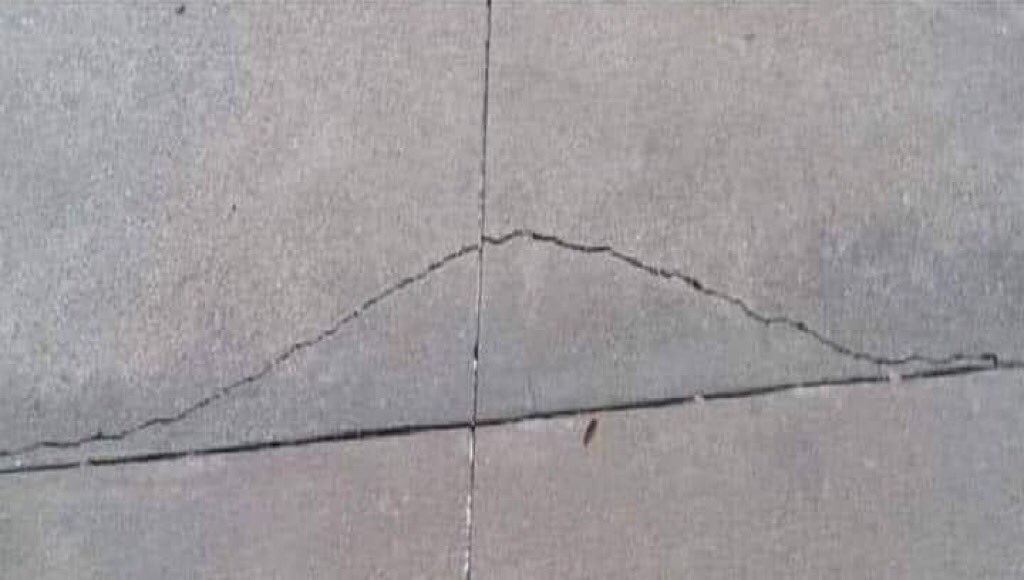
Always stop to check if the crack on public walk is normally distributed.
Khoa Vu tweet media
English
102
5.1K
56.4K
672.9K
Nicholas Gachet
Nicholas Gachet@Nichogachet·
I have to say this: The BEST presentation slides I have seen for lectures are the ones made by Nick Crafts. What a privilege to sit in one of his classes at the LSE in 2016
English
0
1
3
158
Nicholas Gachet retweetledi
VoxDev
VoxDev@vox_dev·
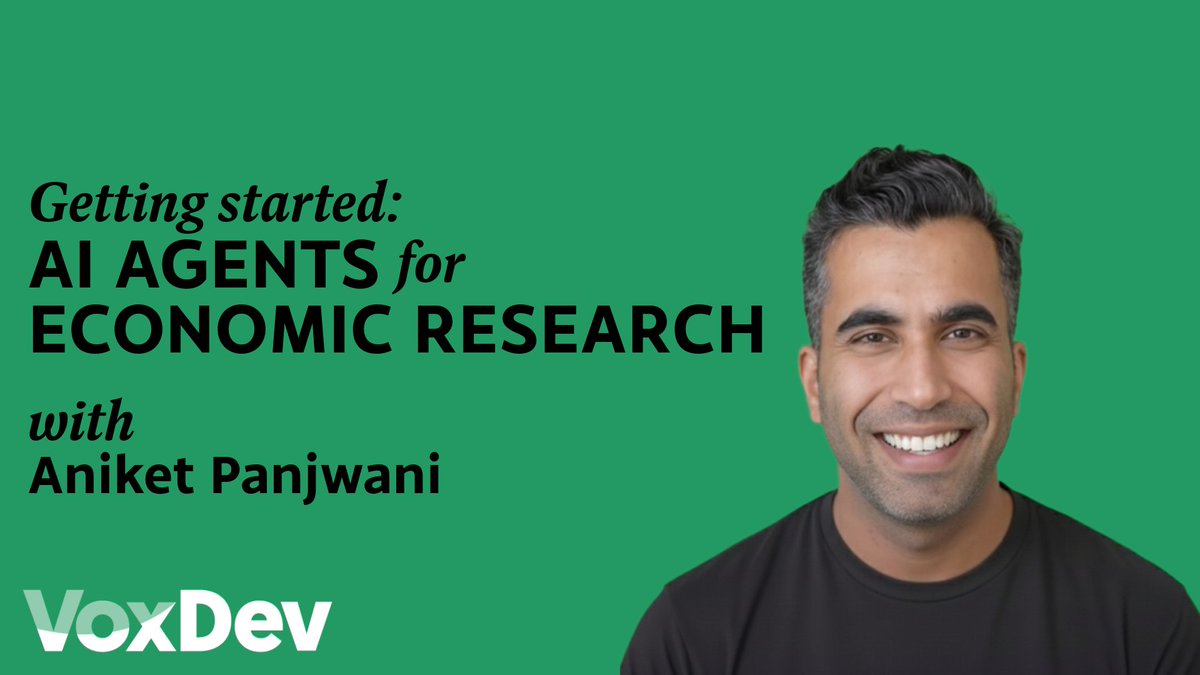
AI Agents for Economics Research On March 12, @aniketapanjwani will take us through how economists can get set up to use agents for research, focusing on the cheapest options currently available, and general lessons for working with agents: cepr-org.zoom.us/webinar/regist…
VoxDev tweet media
English
1
10
75
5.4K
Nicholas Gachet retweetledi
El Universo
El Universo@eluniversocom·
¡Cha-La Head-Cha-La! #DragonBall celebra este jueves los 40 años de la primera emisión de su adaptación a la animación con renovadas expectativas por su regreso, gracias a una nueva temporada de 'Super' y un nuevo juego, tras permanecer en el limbo su continuidad a raíz de la muerte en 2024 de su autor, Akira Toriyama.
Español
2
62
257
8.3K
Nicholas Gachet retweetledi
Cesar Chavez
Cesar Chavez@CesarChavezP29·
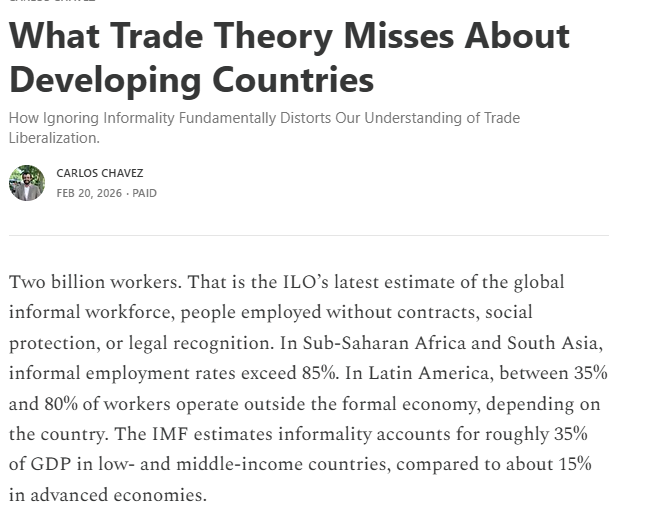
When you come from a developing country with high levels of informal jobs, you know that informality matters in almost all channels. In this Friday's essay, I walk through a forthcoming Econometrica paper by Dix-Carneiro, Goldberg, Meghir, and Ulyssea that builds a trade model with an informal sector. The headline finding: the gains from trade more than double once you account for informality. But informality itself barely budges. Here is the link: substack.com/home/post/p-18…
Cesar Chavez tweet media
English
2
43
172
10K
Nicholas Gachet retweetledi
Claudio Ferraz
Claudio Ferraz@claudferraz·
And I am here teaching a course on the political economy of development. I guess I can skip the slides on “why we need to bring in politics to understand development”
EL PAÍS América@elpais_america

⭕ ÚLTIMA HORA | El Congreso de Perú tumba al presidente José Jerí apenas cuatro meses después de nombrarlo El mandatario fue censurado por los mismos diputados que acabaron con su antecesora dozz.es/smpf38

English
3
14
109
10.1K