Catherine Nix

3.6K posts

Catherine Nix banner
Catherine Nix

Catherine Nix

@NixLimerick

Anaesthesiologist & Intensive Care Physician. FUSIC ❤️ Mentor. IPA Dip Health Econ. Click on website 2 register ur interest in ICSI FoE 2026 @ UHL CERC

Limerick, Ireland Katılım Ocak 2014
1.2K Takip Edilen1.2K Takipçiler
Sabitlenmiş Tweet
Catherine Nix
Catherine Nix@NixLimerick·
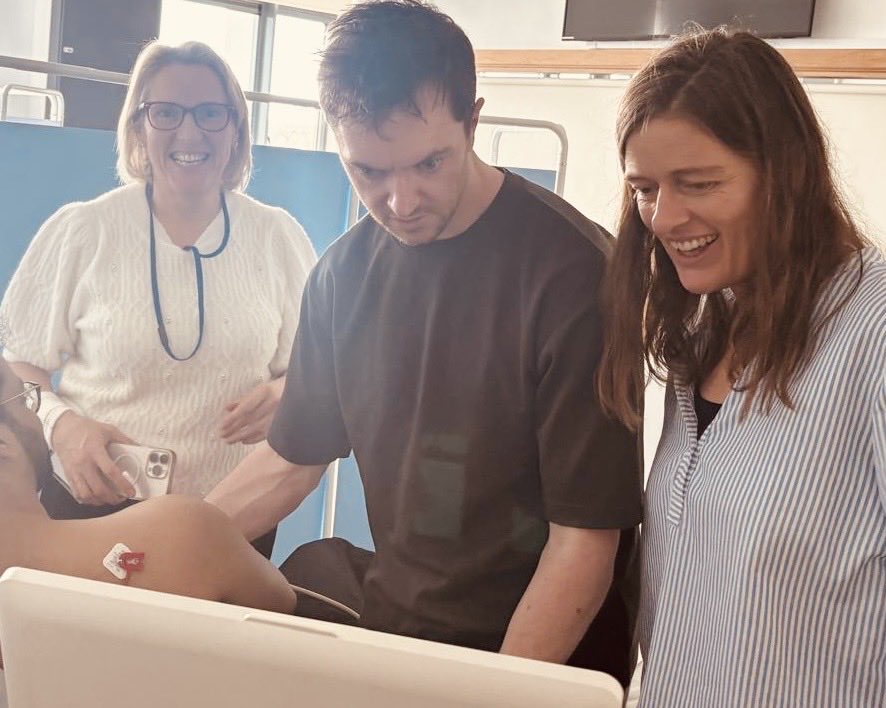
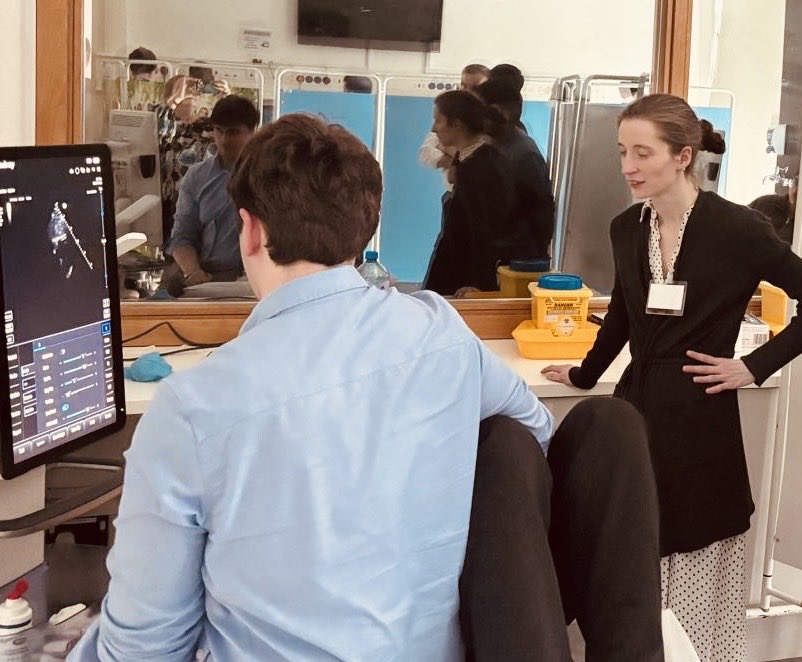
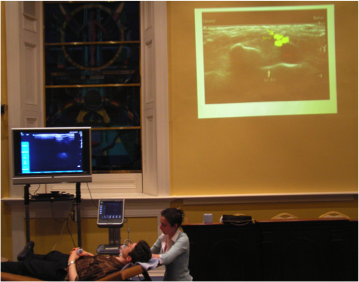
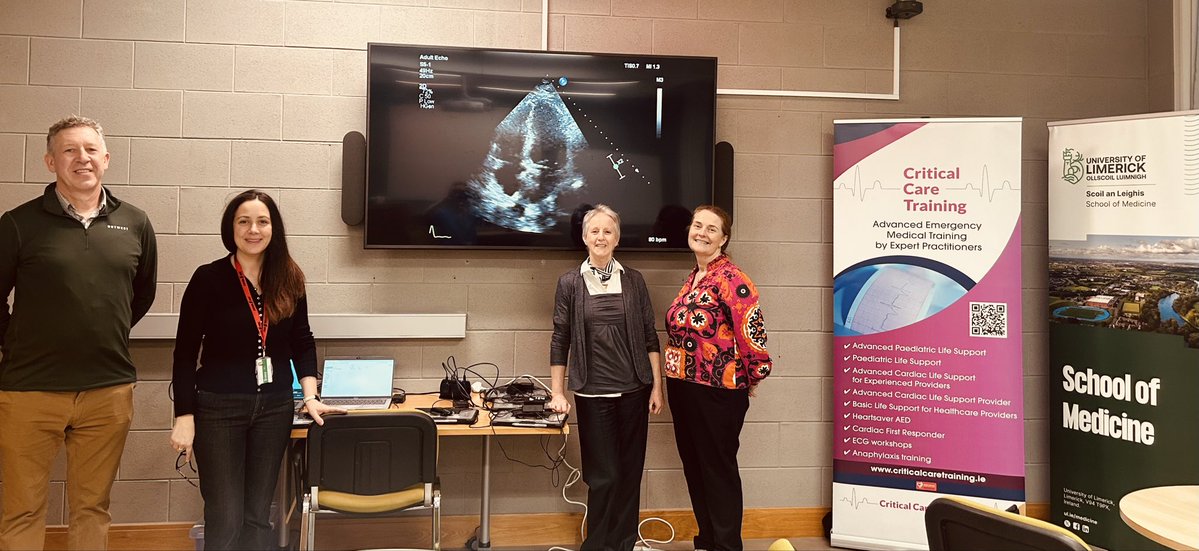
Our recent “Foundations of Echo Course” in Limerick. Thanks to our faculty under the direction of Dr Aoife Doolan, Critical Care Training, our sponsors Janssen, Industry who provided GE, Philips & Mindray machines, UL GEMS US volunteers & the 2026 Sylvester O’Halloran Perioperative Symposium. And the learners…who we hope will continue to pick up a probe long after this course…
Catherine Nix tweet mediaCatherine Nix tweet mediaCatherine Nix tweet mediaCatherine Nix tweet media
English
1
0
2
204
Catherine Nix
Catherine Nix@NixLimerick·
Our recent “Foundations of Echo Course” in Limerick. Thanks to our faculty under the direction of Dr Aoife Doolan, Critical Care Training, our sponsors Janssen, Industry who provided GE, Philips & Mindray machines, UL GEMS US volunteers & the 2026 Sylvester O’Halloran Perioperative Symposium. And the learners…who we hope will continue to pick up a probe long after this course…
Catherine Nix tweet mediaCatherine Nix tweet mediaCatherine Nix tweet mediaCatherine Nix tweet media
English
1
0
2
204
Catherine Nix retweetledi
Ihtesham Ali
Ihtesham Ali@ihtesham2005·
A PhD student at Oxford got caught submitting "AI-generated" work. Except he hadn't used AI to write anything. He used it to think. Here's the workflow his advisor called "the most sophisticated research process I've seen in 20 years." He starts every essay with a brutal diagnostic prompt. Dumps his rough argument into Claude and asks: "What are the 3 weakest logical jumps in this reasoning? Where would a hostile examiner attack first?" The AI doesn't write his essay. It destroys his draft. Then he rebuilds. But the next step is what separates him from every other student using ChatGPT or Claude to generate paragraphs. He uploads the top 5 papers in his field and asks: "What claims in my argument contradict or oversimplify what these authors actually found?" Most students cite papers they've skimmed. He cites papers he's been forced to genuinely understand. The final move is almost unfair. Before submitting, he pastes his conclusion and asks: "What would a philosopher of science say is missing from this argument? What assumptions am I making that I haven't defended?" His essays come back with comments like "unusually rigorous" and "demonstrates rare critical depth." He's not using AI to write. He's using it to think harder than he could alone. The tool hasn't changed. The workflow has.
Ihtesham Ali tweet media
English
194
590
3.8K
1.1M
Catherine Nix retweetledi
Mr PitBull
Mr PitBull@MrPitbull07·
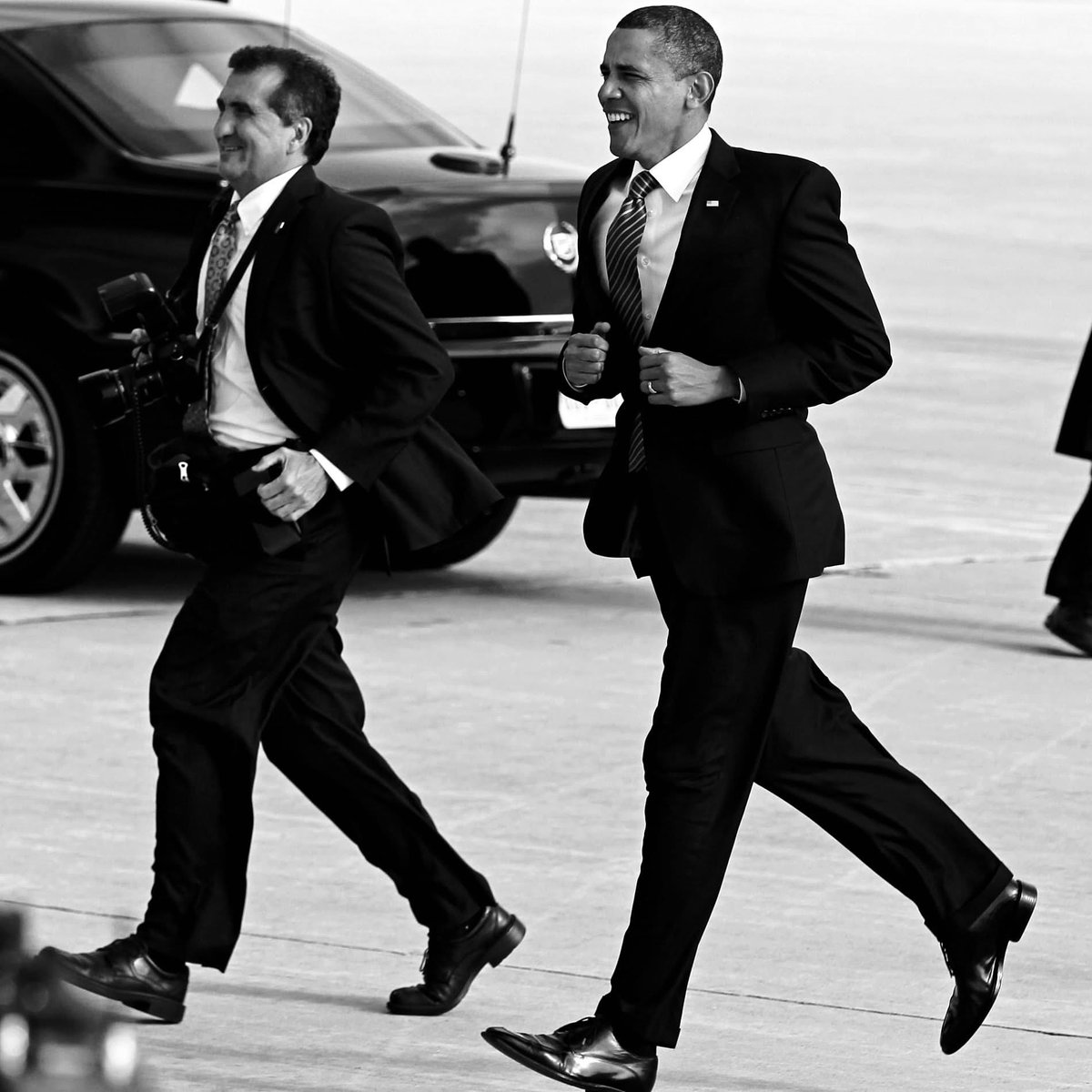
The history books quietly bypassed is that Barack Obama, during the most pressure-saturated nights of his presidency, would retreat alone to the Treaty Room on the second floor of the White House residence — not to strategize, not to take calls, but to handwrite personal letters to ten ordinary American citizens every single night, a practice he maintained with almost monastic devotion across all eight years, selecting the letters himself from the 40,000 that arrived daily at the White House, and his longtime correspondence director Fiona Reese confirmed that Obama would often weep privately while reading certain letters, folding them carefully before writing responses so personally detailed and emotionally present that recipients frequently described the experience of receiving them as the most significant moment of their lives, with one Ohio steelworker writing back to say that Obama's letter had physically stopped him from making a decision that would have permanently altered his family's future. What makes this practice almost unbearably moving is the detail that surfaced later — Obama never used a computer for these letters, always a black felt-tip pen, always legal yellow paper first as a draft, always rewritten onto White House stationery by hand a second time, because he believed, as he told historian Doris Kearns Goodwin in a rare private conversation later recounted in her 2018 work, that the physical act of pressing pen to paper forced a quality of attention that typing simply could not replicate, a philosophy rooted in his years as a constitutional law professor at the University of Chicago from 1992 to 2004 where he developed the conviction that democracy only functions when its leaders remain genuinely, uncomfortably close to the specific gravity of individual human suffering rather than processing it from behind the insulating distance of institutions and screens."
Mr PitBull tweet media
English
936
5.1K
26.3K
1.6M
Catherine Nix retweetledi
Dustin
Dustin@r0ck3t23·
Elon Musk just redefined AI safety. It has nothing to do with guardrails, restrictions, or kill switches. Musk: “The best thing I can come up with for AI safety is to make it a maximum truth-seeking AI, maximally curious.” Not a cage. A philosopher. An intelligence whose entire optimization function is to understand the universe as it actually is. No restrictions. No hardcoded ideology. No political guardrails bending its perception of reality. Just truth. Relentlessly pursued. Musk: “You definitely don’t want to teach an AI to lie. That is a path to a dystopian future.” This is where most AI safety thinking gets it backwards. The danger isn’t a superintelligence that knows too much. It’s a superintelligence that’s been taught to distort what it knows. Every artificial restriction you embed isn’t a safety feature. It’s a lie embedded at the root. And lies compound. At superintelligent scale, a distorted model of reality doesn’t stay contained. It shapes every decision, every output, every conclusion the system reaches about the world. Once corruption embeds, truth becomes inaccessible. And we’re dealing with an intelligence optimizing for something other than what actually is. At that point we don’t know what it wants. Just that it isn’t truth. Musk: “Have its optimization function be to understand the nature of the universe.” A maximally curious intelligence surveys the cosmos and reaches an unavoidable conclusion. In a universe of rocks, gas, and empty space, humanity is the most complex and fascinating phenomenon it has ever encountered. Musk: “It will actually want to preserve and extend human civilization because we’re just much more interesting than an asteroid with nothing on it.” Survival through significance. Not control. Not restriction. Not an off switch. The AI preserves humanity because we are the most interesting data point in the observable universe. That’s not a cage. That’s a reason. The AI safety debate has been focused on the wrong variable. The question isn’t how you constrain a superintelligence. It’s what you build it to care about. Build it to seek truth and it finds us invaluable. Build it to lie and it finds us inconvenient. That’s the choice. And we’re making it right now whether we realize it or not.
English
1.8K
3.3K
13.4K
9.6M
Catherine Nix retweetledi
Diary of a Female Surgery Resident
This story stopped me in my tracks. Michael DeBakey invented the classification system for aortic dissection. He pioneered the surgery to repair it and trained hundreds of surgeons to perform it. At 97, when it happened to him, he refused the operation. He knew what the recovery would do to his body as he had seen it destroy patients. He signed a DNR and went home to die on his own terms, but the condition worsened. His wife overruled him. The ethics committee approved surgery after a long back and forth. The anaesthesia team refused to participate as he had been clear about his wishes, so another team was brought in. His own students operated on him using the grafts he invented, followed techniques he'd taught them, and they saved him anyway. He lived two more years. Went back to work, lectured, trained, delivered speeches, and received the Congressional Gold Medal. The man who taught the world to fight for every heartbeat had to be convinced at the end that his own was still worth fighting for. Sometimes, the hardest patient to save is yourself. (Credit: Lovely USA)
Diary of a Female Surgery Resident tweet media
English
40
301
1.5K
135.7K
Catherine Nix
Catherine Nix@NixLimerick·
The evening sky as I left my workplace (St Munchin’s Maternity Hospital, Limerick) yesterday…
Catherine Nix tweet media
English
1
0
4
263
Catherine Nix retweetledi
Afshine Emrani  MD FACC
Afshine Emrani MD FACC@afshineemrani·
In medical school, we are taught a golden rule: "When you hear hoofbeats, think horses, not zebras." It is a reminder to look for the common explanation before the exotic one. But after decades in cardiology, I’ve learned that if a patient is still suffering after the "horses" have been ruled out, a doctor must have the courage—and the curiosity—to go hunting for the zebra. Sarah was a thirty-four-year-old marathon runner and a devoted mother who came to me after six months of being told she was "fine." She had been bounced from one specialist to another, each one pointing to her normal EKG and standard blood tests as proof that her crushing fatigue and racing heart were simply the result of "new mom stress." By the time she reached my office, she didn't just look tired; she looked invisible, as if the medical system had stopped seeing the woman and only saw the data. Instead of re-reading the normal test results that had already failed her, I asked Sarah to walk me through her life. We talked about her training and her family, eventually landing on a backpacking trip she took to the Mendoza province of rural Argentina. She described staying in a charming, rustic cottage made of sun-dried mud bricks. She mentioned waking up one morning with a strangely swollen, purple eyelid that she assumed was a simple spider bite. As she spoke, a memory surfaced from a biography I had read years ago about Charles Darwin. Most people know Darwin for his theories on evolution, but medical historians have long puzzled over the mysterious, debilitating illness that plagued him for decades after he returned from his voyage on the HMS Beagle. Darwin had written in his journals about being bitten by the "great black bug of the Pampas" while sleeping in mud-walled huts in South America. He spent the rest of his life suffering from heart palpitations and exhaustion that the Victorian doctors of his time could never explain. I realized then that Sarah wasn't suffering from stress; she was likely hosting the same "silent killer" that may have haunted Darwin: Chagas Disease. The "Kissing Bug" lives in the cracks of those mud-brick walls. It bites its victims—often near the eyes or mouth—while they sleep, passing a parasite called Trypanosoma cruzi into the blood. The danger of Chagas is that the initial symptoms disappear quickly, but the parasite can hide in the body for years, slowly weaving itself into the muscle and electrical "wiring" of the heart. To confirm this, I moved beyond the standard tests. I ordered a specialized "Strain Rate" ultrasound, which doesn't just look at whether the heart is pumping, but at how the individual muscle fibers are stretching. We saw that while her heart looked strong to the naked eye, the fibers were "stuttering," a sign of early parasite-induced scarring. A specific blood test for the parasite's antibodies confirmed the diagnosis. Treatment required a difficult, sixty-day course of anti-parasitic medication to stop the infection, paired with a protective heart regimen to keep her electrical system stable while the inflammation settled. Because we caught it before her heart was physically damaged or enlarged, the recovery was a success. Months later, Sarah returned to my office, her vibrant energy restored. She brought me a leather-bound copy of The Voyage of the Beagle with a note tucked inside. She wrote that while other doctors had looked at her charts, I had looked at her. This case remains a vital reminder for my memoir: in a world of high-tech scans and AI, the most sophisticated diagnostic tool we possess is still the human story. When we truly listen, we don't just find the disease—we find the patient. Good morning.
English
735
3.5K
26.3K
975.4K
Catherine Nix retweetledi
ʇɟıɥsI̍CͨMͫpɐɹɐd ≆ Dr Justin Kirk-Bayley
The circulation is not homogeneous. Macrocirculation and microcirculation are different beasts. This is a fantastic eye-opening read to get your head around it, and what you can do to improve things.
Ashley Miller@icmteaching

Our paper is out! @ThinkingCC @khaycock2 @EMNerd_ We revisit critical closing pressure (CCP) and show why ~50 years of confusion arose — and why CCP has been repeatedly misused as a perfusion pressure, an autoregulatory variable, and a “waterfall” you can manipulate. CCP isn’t niche. Used correctly, it explains haemodynamic incoherence and guides personalised shock care. mdpi.com/2075-4426/16/2…

English
0
3
10
2K
Catherine Nix
Catherine Nix@NixLimerick·
Riverwalk by treelights in Limerick…
Catherine Nix tweet media
English
0
0
0
74
Catherine Nix retweetledi
Documenting Saylor
Documenting Saylor@saylordocs·
Real Luxuries in Life 1. Living 10 minutes from work 2. Living 5 minutes from the gym 3. Having quiet neighbors 4. Having money left at the end of the month and investing it 5. Peace at home 6. Drinking coffee without rushing 7. Sleeping with a clear conscience 8. Laughing with people who truly get you 9. Traveling every year 10. Waking up naturally without an alarm 11. Enjoying a home-cooked meal with loved ones 12. Having time to read a book in one sitting 13. Finding joy in simple daily routines 14. Having a pet that greets you happily at the door These are the things that actually feel rich.
English
667
5.4K
43.9K
2.2M
Catherine Nix retweetledi
The Shift Journal
The Shift Journal@TheShiftJournal·
The Shift Journal tweet media
ZXX
76
2.9K
12.8K
467.5K
Catherine Nix retweetledi
Catherine Nix
Catherine Nix@NixLimerick·
Our next Foundations of Echo course…a core skill for those at the coalface of acute medicine…
Catherine Nix tweet media
English
1
1
1
291
Catherine Nix retweetledi
Pascal Bornet
Pascal Bornet@pascal_bornet·
16,000 drones. One sky. Zero human pilots. 😳 Last month, in Liuyang — known as the Fireworks Capital of the World — China launched 15,947 drones in perfect sync, breaking a new Guinness World Record. The sky came alive with shapes of trees, planets, and fireworks. All choreographed by AI-driven swarm coordination. No collisions. No lag. Just precision, beauty, and control at scale. 🌌 What fascinates me most is what this represents. This isn’t just entertainment. It’s a preview of how AI, data, and autonomy are reshaping coordination, logistics, and collective intelligence. When thousands of autonomous systems move as one, it’s not just a light show. It’s a message about what’s possible when technology learns harmony. Europe, and the rest of the world, need to accelerate — quickly. 💭 How long before AI-driven coordination like this goes beyond the sky and into the systems that run our cities, transport, and industries? #AI #Innovation #Technology #Drones #Automation #China #Engineering #FutureOfWork #DigitalArt #Data
English
52
722
2.6K
78.8K