

Phil Chen
390 posts

Phil Chen
@NoRePhils
Sisu. Building mindful connections through radical presence, coaching, yoga, and marketing.
San Francisco, CA Katılım Mayıs 2011
154 Takip Edilen126 Takipçiler

@NoRePhils @composio The dashboard is up. We just enabled the ability to creating a new access token and APIs. You should be able to do everything programatically, just not in the platform. Will keep updates flowing
English

Robin Guldener@rguldener
If your team has been affected by the recent @composio security incident, and your integrations are currently down, I wanted to let you know: we're here to help. At @nangohq, we opened up more call slots this week to help affected teams migrate to Nango and get back online. Reach out any time: nango.dev/demo I also want to acknowledge the Composio team. Working through something like this under public scrutiny is incredibly tough. I hope they get to a full resolution soon.
English

@NoRePhils Hey Phil! Stock is too new to have monthly bx unfortunately
English
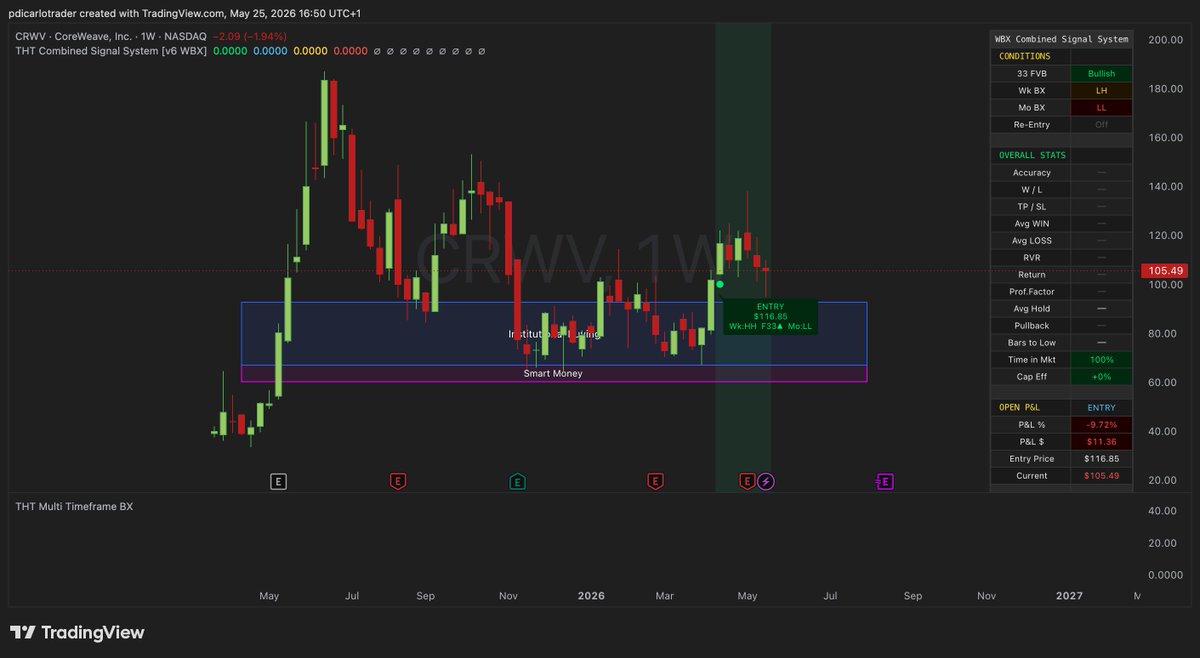
$CRWV still compressing in this range, outlook unchanged.
New bull cycle is being tested. This is the zone where we often see 50% pushes over the next 60–120 days in this pattern.
Peter DiCarlo@pdicarlotrader
$CRWV pulling back as the next expansion phase starts. Price just tagged point of control and smart money zone. From here I am watching for a push back toward the 180 area over the next 6 to 12 months if this structure holds.
English
@sukh_saroy Has not been as easy to set up as composio or arcade for Claude code as I thought. Any suggestions ? Is it practically the same or something different ?
English

SOMEONE OPEN SOURCED THE INTEGRATIONS LAYER EVERY SAAS COMPANY HAS BEEN PAYING $50,000 A YEAR TO RENT.
It's called Nango. And it just made the entire "unified API" industry look like a tax on developers.
700+ APIs. Salesforce, HubSpot, Slack, Notion, Gmail, GitHub, Stripe, Jira, Linear. Every OAuth flow, every token refresh, every rate limit, every retry. Handled.
The thing companies like Merge.dev charge $40K-$100K/year to manage? Sitting on GitHub. 7.4K stars. 726 forks. 6,418 commits. Already used in production by Replit, Ramp, and Mercor.
Here's what it actually does:
→ Managed OAuth for 700+ APIs out of the box
→ One proxy call to authenticate to any API
→ Write TypeScript integration functions, deploy to their runtime
→ AI builder generates the integration code from a natural language prompt
→ Built-in retries, rate limit handling, per-tenant isolation
→ Works with Claude Code, Cursor, Codex, MCP, LangChain
→ Self-hostable for free
→ SOC 2 Type II, HIPAA, GDPR compliant
The pitch that should make every founder uncomfortable:
You give it a description like "sync GitHub issues to my database every 5 minutes." It writes the TypeScript. You read it. You edit it. You ship it.
It is not a black box. It is not a wrapper. It is readable code you own and version control.
Here's the wildest part:
The "unified API" startups raised hundreds of millions of dollars selling exactly this. Closed source. Per-API pricing. Per-customer pricing. Limits on calls. Limits on integrations.
Nango ships the same primitive under the Elastic License. Self-host the core for $0. Pay them only if you want their cloud and enterprise features.
189 releases. Latest one on May 15, 2026. Still shipping aggressively.
One honest note: the license is Elastic, not MIT. You can self-host and use it commercially, but you cannot resell it as a competing service. For 99% of teams building integrations into their product, that restriction does not matter.
Every B2B SaaS company in the world has a Jira-style "we connect to your tools" page. Most of them paid an "integration platform" half a million dollars to build it.
This repo is the thing those platforms are quietly running underneath.
Link in the first comment.

English
@aurumfinancial @milesdeutscher Consider Hazel.ai — full discolor I work for them, and know of the zero data retention policy — your information won’t be used to train models.
English

@milesdeutscher LOVE this idea. The BotFather step is the part I'd think hardest about - that's your full financial picture on a third-party bot.
Also Anthropic has your data. Once it's out, it's under their discretion, not yours. Worth considering before you set it up.
English

I replaced my financial advisor with Claude - and no, that's not clickbait.
Claude now operates as my personal CFO - and it's the best thing I've done for my finances in years.
It's trained like a McKinsey-level analyst, using all my financial data.
Steal the full setup:
Miles Deutscher@milesdeutscher
English

Finished my last MBA final last night.
8:30pm start time for a final is brutal.
Completed the MBA in 2 years as a full time student, no part time enrollment.
Finished the TPCP during it.
The Great Lock In of 2024/2025 carried well into 2026.
I am tired.
English

Cashier: “Guac is extra. How would you like to pay?
Me: “Half cash, half stock.”
English
@mcnair @SJCapitalInvest I missed chance to download his articles, any chance you have a repo to share of your add or md files? Thank you
English

Since hearing that @SJCapitalInvest is leaving us I coded a desktop app that read all of this articles. So far it has an asymmetric stock screener, a matrix visualizer and built in gemini pro research prompts.

English

$OSCR has decided to back-test the bottom of the immature monthly Ichimoku cloud (Leading Span A) and is still holding support, although it's been MARAizing everyone who owns the stock.

English

Honest question deserves an honest answer . those Mon-Wed green candles that gave back by Friday aren't real bounces. They're exactly what I was describing: liquidity windows where institutions distribute into retail buying.
A real bounce is when price reclaims a level and holds it on a retest. What you've seen is more like a cat bouncing off a trampoline that someone keeps lowering.
The tell is volume. If those midweek rallies happened on declining volume and then sold off on expanding volume, that's distribution, not accumulation. Institutions aren't buying . they're using your bid to exit.
Here's the framework I'd use: don't ask "is this the bounce?" Ask "what would prove this ISN'T just another sell-the-rip?" For me that means price needs to reclaim the 200 DMA and hold it for multiple sessions with expanding breadth . not just the mega caps dragging the index green while the average stock bleeds.
$VIX closed Friday at 31.1. That's still elevated. Real bottoms typically see a $VIX spike above 35-40 followed by a sharp reversal. We haven't gotten that capitulation flush yet.
Being self-aware about your experience level is actually an edge . means you're less likely to convince yourself a losing position is "just shaking out weak hands." Watch what price does at key levels, not what you hope it does.
English
The first bounce after a five-week selloff is the most expensive trade in markets.
Every technical signal will look perfect. RSI resetting from oversold. MACD crossing up. "Support held."
Retail sees a textbook buy. Institutions see a liquidity window to sell into.
This has played out the same way in every major drawdown I've traded through. 2018 Q4, March 2020, every bear rally in 2022.
The first bounce averages 3 to 5 days before rolling over to retest or break the lows.
It's not random. It's structural. Buyback blackouts mean no corporate bid. Negative gamma means dealers aren't reinforcing the move higher. CTA rebalancing is mechanical, not emotional. They need sustained price above trigger levels before they flip.
So the first bounce runs on short covering and retail enthusiasm. That's it. And that fuel burns in days, not weeks.
The hardest trade right now isn't buying the dip. It isn't staying short. It's doing absolutely nothing when the first green candle shows up.
Sitting on your hands while fintwit screams "bottom is in" takes more discipline than any entry you'll ever make.
The real setup comes on the second test. When the tourists are gone and only real buyers remain.
If you survived this drawdown with capital intact, don't give it back chasing the relief rally. What's your rule for re-entry after a prolonged flush?
English
@adamtaggart @NorthmanTrader Hi Adam, is Sven physically ok? Website down and all socials were erased. Thanks!
English

"It's do or die time for bears" says technical analyst Sven Henrich of @NorthmanTrader
If they can't force a rollover soon, stocks look set to rise to new all-time highs
WATCH: youtu.be/_ZsHI5Iv57E

YouTube

English
Phil Chen retweetledi

$LMND
LMND Anatomy of the Post–Q4 2025 Earnings Crash
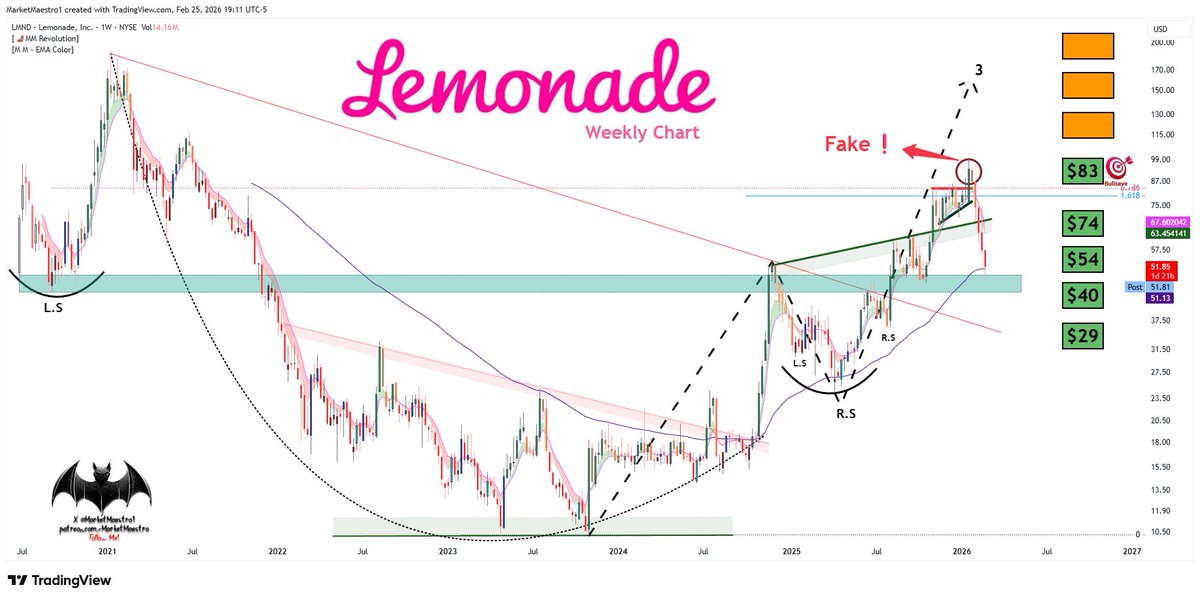
It became one of the most dramatic and complex price moves of 2026. After a rally that started in January 2026 with autonomous vehicle insurance integration headlines and was fueled by speculative euphoria in the options market, the stock climbed as high as $99.90 per share. But that “rocket phase” turned into a violent crash after the Q4 2025 earnings report released on February 19, 2026, and the stock quickly slid down toward the $50 support band.
These kinds of sharp swings, which are rare in financial markets, are usually the result of multiple micro and macro market mechanisms working at the same time, not a single catalyst. LMND’s drop from $100 to $50 may be directly linked to valuation multiples reaching unsustainable levels, massive stock selling by institutions and insiders absorbing liquidity, and most importantly a Gamma Trap triggered by market makers’ algorithmic risk management protocols.
The core spark of the parabolic upside was Lemonade Autonomous Car Insurance, launched on January 21, 2026 in Arizona and then in Oregon in February. This product works directly integrated with Tesla’s in vehicle telemetry data, offering drivers a 50% per mile discount when Full Self Driving (FSD) or autopilot is engaged.
That development created a perception across Wall Street and retail investors that LMND was no longer “just” a company that handles claims with AI bots (systems like Blender and AI Maya), but was transforming into a data company integrated directly into the Internet of Things (IoT) and the autonomous vehicle ecosystem. The company’s president, Shai Wininger, saying that “as autonomous driving becomes widespread, prices will fall transparently and dynamically,” led the market to price this initiative as a massive long term growth engine.
But the key reality the market ignored was that it was still extremely early for this product to show up meaningfully in the financials. The fact that the product had only been approved by regulators in certain states, and Tesla’s niche position in the broader P&C insurance market, did not match the $100 valuation narrative. Still, markets discounted future potential cash flows into the present with excessive enthusiasm and pushed the stock into a speculative rally.
Another critical factor that accelerated the upside momentum is that LMND has historically been one of the market’s most shorted stocks. In the final months of 2025 and the start of 2026, between 18.3% and 21.1% of the float was sold short by investors expecting downside. While the short interest share count was 13,003,160 at the end of December 2025, it fell to 12,367,461 in mid January 2026 and to 11,963,648 by the end of January.
This data clearly shows that as the stock began to rise on Tesla related news and positive sentiment, short selling funds covered to limit losses. Those forced buys pushed price even higher, creating a classic short squeeze and setting the stage for the stock to test the $99.90 peak, fully detached from fundamental multiples.
The Q4 2025 earnings report released on February 19, 2026 went down as the catalyst event that triggered the crash. Shortly after the report, the stock sharply reversed lower and closed the day down 5.5%. To understand this dramatic intraday reversal, you need to analyze the gap between what the financial statements contained and what the market “needed” those statements to mean.
It is an undeniable fact that the company delivered the strongest financial statements in its history. I’m skipping this section, otherwise it will get too long.
Despite such a flawless ER package, the first answer to why the stock crashed lies in valuation. The “buy the rumor, sell the news” principle often referenced in finance theory combined in LMND’s case with extreme valuation multiples.
Before the February 19 ER, the stock was trading at 8.9x trailing twelve month sales (P/S Ratio). The property & casualty (P&C) insurance sector is traditionally value oriented, slow growing, and composed of dividend paying companies. Across the sector’s 45 main companies, the average price to sales ratio is only 1.4. Even Kinsale Capital Group, one of the sector’s fastest growing and most premium priced peers, traded at only 4.7x, while Lemonade at 8.9x signaled the market was demanding absolute perfection.
The market had already priced the 53% growth in growth metrics and the improvement in loss ratios in the run up to $100. The one thing investors needed to justify that valuation was a definitive timeline for the company to reach near term net operating profitability (GAAP profitability or consistently positive EBITDA).
The 2026 Guidance Miss The real factor that dampened the sharp opening pop and started the massive sell wave was management’s 2026 guidance. The board kept the full year 2026 growth targets above analyst expectations, but pushed profitability targets out in a way that tested the market’s patience.
I’m skipping this section too.
Management announced it plans roughly $225M of growth spending for 2026. Even though keeping the LTV to CAC ratio above 3 shows each marketing dollar can generate profitable long term returns, in a high rate environment (or when rates have not fallen enough), markets prefer short term profit over long term growth. LMND pushing profitability to 2027 caused the stock to experience a sharp reset from growth multiples toward value multiples.
Gamma Squeeze and Gamma Trap Even if the profitability delay in the fundamental story was the spark that started selling, the 50% melt from $100 to $50 was structurally driven by options market market makers’ hedging algorithms a Gamma Trap or an inverse gamma squeeze event.
In January and early February, retail and speculative institutional demand for LMND options reached extreme levels. As price climbed toward $100, investors kept buying call options expecting more upside. By mid February, options volume analysis showed the put/call volume ratio had fallen to an unusual 0.10 level meaning for every 1 put trade, there were 10 call trades.
The party selling those calls is the liquidity providing “market makers” (dealers). Dealers do not want to take directional risk and must keep their books delta neutral.
As the stock rises, the delta of the calls they sold increases. That change in delta is called “gamma.” When gamma is in positive territory, as the stock rises market makers must buy LMND shares in the market to stay hedged.
In early February, as the stock moved toward $80, $90, and ultimately $100, this continuous, algorithmic dealer buying pushed price higher like a self feeding loop this phenomenon is known as a gamma squeeze.
Gamma Flip and the De Hedging Spiral Right after the February 19 earnings report, as the profitability delay in guidance spread, the first selling wave started and the stock turned down from around $73. The real disaster began when the stock fell below a critical threshold: the Gamma Flip Point.
The Gamma Flip Point is the theoretical price level where the dealer options book transitions from net long gamma to net short gamma. When price falls below that point, the market dynamics reverse completely:
As price falls, the delta of the high strike calls that had been bought for upside quickly collapses toward zero. Dealers no longer need the millions of LMND shares they previously bought at higher prices to stay delta neutral, and they begin selling those shares aggressively in the open market.
Once dealers become net short gamma, every drop forces them to sell more stock to remain hedged. This causes volatility to explode. The decline turns into a self feeding sell wave.
When price slipped below $70, the value of put options began to rise. Dealers who sold those puts must short the stock to hedge their risk.
Looking at open interest data, for the February 20, 2026 expiration there were 34,229 total open contracts, and 21,940 of those were calls. A large portion of call OI was clustered at high strikes like $80, $85, $93, and $110. Driving the stock down quickly and leaving those calls to expire out of the money translated into massive profits for option writers.
Institutional Exits and Insider Sales In LMND’s case, SoftBank one of the company’s biggest backers and the CEO himself using the rally to unload stock created irreparable damage to investor confidence.
SoftBank Group Corp., which owned more than 25% of the company at LMND’s 2020 IPO and financed its early stage growth, sold shares aggressively in late 2025 and early 2026.
Markets interpreted one of the founders’ visionary early supporters liquidating so aggressively while price was rising as a clear signal the company had reached peak valuation. That perception fundamentally shook belief in the rally’s sustainability.
Insider Sales In addition to SoftBank’s institutional selling, the actions of company executives created a full liquidity and confidence shock in the market. Weeks before the Q4 earnings and while the stock’s parabolic rise continued, top decision makers began selling their own shares.
Analyst Price Target Revisions Some analysts raised price targets after getting caught in the pre earnings upside wind, while post earnings analysts who faced reality made serious cuts. Oh, those analysts 😊
In the end, this sharp move LMND investors experienced is a reality of modern financial markets!
So what now? Valuation has returned to more reasonable levels. The company’s fundamentals are actually strong. The market maker gamma traps are over.
Technical Analysis: ..
Normally, I share analyses like this on Patreon and X-Subscribe. But I wanted you to see my analyses. If you like it and repost it, you’ll make me happy. I share similar analyses for the whole market every morning
patreon.com/MarketMaestro
English
@MovesInShadows @eCom_Amin Agreed. Not a lot of real information here, regurgitation without depth.
English

@eCom_Amin unfortunately this popped in my feed & now i have an unbeatable urge to call out bs. no millions were made, there's no sauce here & you're suffering from an uncurable imposter syndrome. try doing some real work instead of lying to noobs on social media to sell your 3k service
English

@jaminball Great line explaining that earnings estimates continued to rise for 5 straight years
English

@mabrrramsky Came back to look at your tracker!! So awesome thank you
English
@nikoliasgoninus Yes! Let’s see what happens ! And the Super Bowl is coming too :)
English

@NoRePhils Goes to show you how differently people perceive what they see. Let’s see what happens! Ro only covered weight loss based on what I saw so it was a completely different commercial
English
The disparity between the $HIMS and Ro Super Bowl Ads is striking. The personalized health platform for all versus the weight loss company for elites. Hims will probably buy Ro one day.
English