Sarah Honeychurch

31.3K posts

Sarah Honeychurch banner
Sarah Honeychurch

Sarah Honeychurch

@NomadWarMachine

Bricoleur, knitter, ukes, PhD, feminist, cats. Good Practice @UofGlasgow #CLMooc #DS106 #SoTL Mastodon: @[email protected]

Katılım Nisan 2012
2.2K Takip Edilen2.5K Takipçiler
Sarah Honeychurch retweetledi
Joan McAlpine
Joan McAlpine@JoanMcAlpine·
Like every other SNP parliamentarian, I gave the party £250 per month from my personal income after tax. Adding my party membership fees (paid at an enhanced rate) , I think it came to £35,000 over ten years. The £250 sub was an obligation for all MPs and MSPs, but I was happy to pay, as I believed it was going to the cause - not to keep Sturgeon in Smythson handbags and Mountblanc pens (stolen goods she was pictured with in this @TheSun report 👇). I had a good salary. But what of all the decent working people - as @joannaccherry pointed out today - who could ill afford the £10 or £20 donations they made to @theSNP ? It’s disgusting, and requires an internal investigation. Or rather an independent investigation. Who was monitoring the spend within the SNP? How come the former volunteer treasurer and former volunteer officials who questioned the finances were slapped down by @NicolaSturgeon and her acolytes? There remain good people at the top of the party ( of which I remain a member BTW) and I hope they will now abandon their misplaced loyalty to the former leader whose position meant she signed off the accounts, as I understand it. Finally…..well done to @WingsScotland for triggering the investigation - pilloried from all sides but vindicated today.
Chris Musson@ChrisMusson

EXCL: Nicola Sturgeon refused to comment and sat in silence for hours during her police interview - despite publicly claiming to be "cooperating fully" with cops thescottishsun.co.uk/news/16305227/…

English
168
810
3.1K
251.2K
Owen Jones
Owen Jones@owenjonesjourno·
If trans women use men’s toilets, they will be subjected to humiliation, abuse and violence. Anyone with any sense knows this. Which is why in practice trans women will not use men’s toilets, and will just increasingly be driven out of society.
BBC Breakfast@BBCBreakfast

Single-sex spaces - such as changing rooms and toilets - must be used on the basis of biological sex, new guidance from the equalities watchdog has confirmed. bbc.co.uk/news/articles/…
English
4K
450
3.5K
733.2K
Sarah Honeychurch retweetledi
Professor Alice Sullivan
The gender pay gap reporting guidance for employers was updated yesterday, to make clear that reporting must be based on sex. gov.uk/government/pub… "Recording employees’ sex In the Equality Act 2010, the terms “male”, “female”, “men” and “women” refer to a person’s biological sex. The regulations covering gender pay gap reporting are made under the Equality Act 2010. This means that gender pay gap reporting must be based on employees’ biological sex."
English
17
115
487
38.3K
Sarah Honeychurch
Sarah Honeychurch@NomadWarMachine·
"In a democracy, there’s little point in Parliament deciding anything if the law is then made an ass by activists intimidating bosses in companies, schools, universities and the media into doing something different."
Trevor Phillips@TrevorPTweets

My thoughts on the @EHRC guidance laid yesterday; this is not about non-existent "rights". It is about the safety of women - mothers, sisters, wives, daughters. We men need to hear their voices. Virginia Woolf : "Though we see the same world, we see it through different eyes". My intro on @TimesRadio yesterday: Where I live there are two different routes to and from the tube station. One, let’s call it Acacia Avenue, is quiet and residential. The other, London Road, is a busy major route with lots of traffic. At all times of the day, I automatically head for Acacia Road. It’s just much nicer. The women in my family, on the other hand, will never willingly make that walk after dark. They live with an anxiety that most men find it hard to imagine, and frankly, rarely think about unprompted. Last year 739,000 women were sexually assaulted in Britain. Virtually all such assaults - nine out of ten - are perpetrated by men. One in four women have been attacked at some time in their lives. Acacia Avenue is exactly the sort of place in which most women fear that they become vulnerable, and they are right. As the author Virginia Woolf once wrote " Though we see the same world, we see it through different eyes". I think this is the right context in which to understand the furore over the guidance being laid today by the government, over the meaning of the words man and woman when it comes to providing services and facilities in workplaces. Many men think this is about a rather arcane dispute about who gets to use what loo. For their mothers, sisters, wives and daughters, it isn’t. In a previous life, as Chair of the Equality and Human Rights Commission, I had a hand in writing this country’s equality laws, in particular the 2010 Equality Act. It never occurred to any of us that there could be any confusion or dispute over the meaning of the words man and woman. But it has taken a decade of campaigning, a Supreme Court judgement and now hundreds of pages of guidance to settle the issue. This is not about so called trans rights, which are completely unaffected by this guidance, since no-one has ever had the right to walk into a changing room reserved for teenage girls. What it does mean is that women and girls are guaranteed the protection they deserve, and that their safety, which we spent half a decade drafting law to ensure, is protected. But the whole business illuminates some serious issues in our politics. First that many of our institutions, in spite of the fact that they always knew what the right thing to do was, decided to ignore the fears of their women customers and employees, under pressure from noisy pressure groups. Instead, the people who were supposed to be the grown ups behaved as though the law said what campaigners wanted it to say, rather than what it actually said. They settled for what they hoped would be a quiet life. In a democracy, there’s little point in Parliament deciding anything if the law is then made an ass by activists intimidating bosses in companies, schools, universities and the media into doing something different. Second, at the heart of the campaign to undermine the Equality Act is an idea that we specifically rejected in 2010, so called self-identification. That is to say, that it should be up to the individual to decide whether they have what’s called a protected characteristic - are you male or female, are you black or white. The problem is that self-ID would destroy the operation of any law against discrimination. Look, it would almost certainly have been to my advantage as a young man to self-identify as a handsome, white public schoolboy. None of those things is true of me. And at various points I am pretty sure it’s been to my disadvantage. It is certainly statistically likely to have been to my disadvantage. But according to the logic of those who say that self-ID should be the rule and that anyone should be able to decide for themselves whether they are male or female, black or white or Asian, were I to complain about racial discrimination, it would be difficult for anyone prove that I’d been discriminated against because of my race since anybody to whom I’d lost out could just tell the courts that they too were black. I know that sounds like Alice in Wonderland but you can google the case where a chap, both of whose parents are white, insisted he should get money from the Arts Council because he so identified with the black struggle that he considered himself black, and everyone should accept his point of view. In the United States and Brazil exactly such outlandish claims have been made and people rewarded to the disadvantage of people actually born into minority families. I have even been told about firms who, when reporting their gender pay gaps have put men who just happen to like wearing dresses at weekends - nothing wrong with that, let me be clear - into the female column and told their women employees that they really haven’t got anything to moan about because statistically they are paid equally, and they should get back in their box. So today’s guidance isn’t just another tiresome chapter in culture wars. It is , I hope, a halt to the efforts to undermine one of the most important pieces of legislation on the statute book, by people who, for their own reasons, would prefer us to be living in the 1950s world of Mad Men.

English
0
0
2
43
Sarah Honeychurch retweetledi
Sonia Sodha
Sonia Sodha@soniasodha·
It’s extraordinary that the BBC consistently platforms men upset they have to use gender neutral toilets instead of women’s toilets over the female rape survivors who have been unable to access a female-only support group, in relation to the EHRC guidance. It says it all, really.
English
54
1K
5.1K
98.5K
Richard Parker
Richard Parker@RichParkerLab·
West Midlands emergency services have confirmed they won’t be participating in Birmingham Pride this weekend, citing legal uncertainty following a High Court ruling on uniformed attendance at Pride events. I want to be clear about where I stand.
Richard Parker tweet media
English
130
54
281
47.5K
Sarah Honeychurch retweetledi
Lily Craven
Lily Craven@TheAttagirls·
Woman of the Day prison reformer and philanthropist Elizabeth Fry, born OTD in 1780 in Norwich, the first woman to give evidence to a Select Committee. It was instrumental in the passing of the Gaols Act 1823, which separated the sexes. Caring responsibilities came early to her. Her mother died when she was 12 — she had twelve siblings — and as a Quaker, she took an interest in the impoverished, the sick and prisoners. A “plain Friend”, she dressed plainly, did not dance or sing, and took philanthropy very seriously. In 1813 and at the suggestion of another Friend, Elizabeth visited Newgate Prison and found women and children in small overcrowded cells where they had to manage washing, cooking, toilet functions, and sleep on straw. Some hadn’t even been tried at court. She was horrified. “All I tell thee is a faint picture of reality; the filth, the closeness of the rooms, the furious manner and expressions of the women towards each other, and the abandoned wickedness, which everything bespoke are really indescribable". She returned the following day with food and clothing, but family finances prevented her from doing more until 1816. At first, she concentrated on the children by funding a school inside the prison for them, but she found it impossible to ignore the plight of the women. They were at the mercy of male inmates who raped and sexually exploited them. On release, the few occupations available to women were beyond their reach. Life was without hope. Elizabeth founded the Association for the Reformation of the Female Prisoners in Newgate and encouraged other affluent women to set up classes for women prisoners, providing them with materials so they could learn to sew and knit. It calmed them — “Already, from being like wild beasts, they appear harmless and kind" — and meant they had employable skills on release. When she gave evidence to a Select Committee on 27 February 1818, she pulled no punches. She told them in graphic terms of the rapes and sexual exploitation suffered by the women. Her powerful evidence helped to secure the Gaols Act 1823 which required prisons to separate the sexes. Other provisions of the Act included paying gaolers (to combat corruption), requiring doctors and chaplains to visit prisoners (still an important statutory requirement today), and greater emphasis on reform and rehabilitation. The Gaols Act was far-seeing and genuinely progressive, but other than separation of the sexes, toothless. Town gaols and debtors prisons were excluded and there was no means of checking that its provisions were being met. Elizabeth returned once more to give evidence to a Select Committee of the House of Lords in 1835, pointing out that "in many instances their condition is melancholy...they may truly be called schools for crime", that some still had "no instruction, no employment, no classification [of inmates]...and they get into a most low and deplorable state of morals...I would not say that all are in that condition, but I fear many are". In those days, many prisoners faced transportation to New South Wales even for the most minor of crimes (for more serious offences, hanging was the go-to sanction). They faced eight months in vermin-infested cramped holds, often flooded with bilge-water, and strictly rationed fresh water. The women transported by the First Fleet had only the clothing they were standing up in and when this became infected with lice and had to be burnt, they were given rice sacks to wear. Elizabeth campaigned for better care and provision for them too. In 1825, she published "Observations of the Siting, Superintendence and Government of Female Prisoners", an influential book that laid out in clear detail how penal regimes should be run. Somewhere along the way, Elizabeth established a "nightly shelter" for the homeless in London after seeing the body of a boy who had frozen in winter and set up a system of volunteers to visit the poor and homeless and provide help and comfort to them. She campaigned against the slave trade, and in 1840, opened a training school for nurses. Florence Nightingale took a team of Fry nurses to the Crimea. Her abiding principles of kindness and fairness sprang from her Quaker faith and she was the first woman — other than the late Queen, of course — to be depicted on a British banknote. Elizabeth Fry died in 1845 at the age of 65. I cannot tell you how much I admire this woman. Less than a century later, Westminster and Holyrood subsequently ditched Elizabeth’s truly progressive approach to prison as a place for rehabilitation, not punishment, and decided that it would be even more “kind and inclusive” to hold men in women’s prisons, as long as they claimed to be women too. In wartime and in war zones, that would be regarded as a war crime under the Geneva Convention, and those officials who allowed it would be classed as war criminals. It’s peacetime, allegedly, but I’d still call it a human rights violation, and I have a few choice words for all of those politicians and civil servants who nodded along with it. I hope their complicity haunts them.
Lily Craven tweet media
English
52
431
1K
26.5K
Anna Wood
Anna Wood@Annakwood·
Sometimes the universe smiles on you. Today I signed a new work contract that starts on 1st June. I work 5 hours a week (due to ME) as a researcher in science education for the University of Edinburgh (all from home, again, ME).
English
28
12
294
3.9K
Sarah Honeychurch retweetledi
Jenny Lindsay
Jenny Lindsay@msjlindsay·
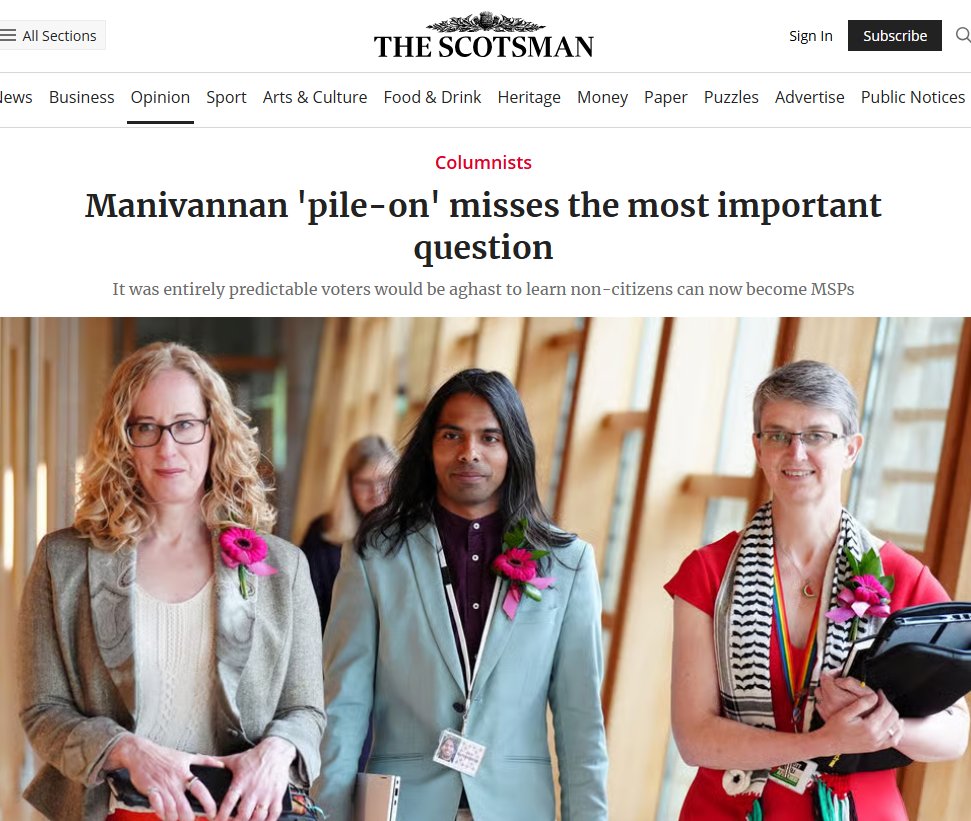
I wrote about what (on earth) the Greens and other MSPs were thinking in extending the right to become legislators to non-citizens. This week's Scotsman piece. Link in replies. ⬇️
Jenny Lindsay tweet media
English
37
176
590
51K
Sarah Honeychurch retweetledi
Phoenix Publications ltd
Phoenix Publications ltd@JoPublications·
My personal X account (formerly @JoPhoenix1) has been hijacked and renamed — it's now impersonating Elon Musk and may be promoting crypto scams. Please don't engage with it or send it anything, and report it if you can. I'm working to recover it. Please RT.
English
14
390
625
18.3K
Sarah Honeychurch retweetledi
Vanessa Anderson | Book Editor
Vanessa Anderson | Book Editor@FreelanceOwl·
#𝑾𝘳𝐢𝘁𝑒𝗿𝘞𝑒𝙙𝒏𝑒𝐬𝒅𝐚𝑦 #𝙒𝐫𝒊𝘁𝗶𝑛𝗴𝘊𝑜𝗺𝗺𝙪𝑛𝘪𝘁𝘺
Vanessa Anderson | Book Editor tweet media
QME
3
25
76
1.4K
Paul Gads
Paul Gads@PaulGadsden82·
I honestly think if I was healthy I'd have moved to Wales or Scotland. I'd prefer Scotland apart from the weather. I know they probably don't want more English people there but sorry I'd need to.
English
8
0
24
1.2K
Sarah Honeychurch retweetledi
Janet Murray
Janet Murray@jan_murray·
Apparently it’s not my beliefs that are the problem. It’s the way I express them. So let me express them for you. I believe women have the right to single-sex spaces - particularly in intimate settings such as toilets, changing rooms, hospitals and domestic violence shelters. Not only because the overwhelming majority of violence against women and girls is carried out by biological males, but because women deserve privacy, dignity and comfort. I believe women have the right to fair sport - from grassroots to elite level. Not only so they can accurately compare their performance against other female bodies, or avoid losing medals, scholarships and financial opportunities, but so they are not placed at risk of injury - or worse - by competing alongside people who are typically quicker, heavier and stronger. I believe women deserve their own categories in awards across every field - including the arts, sciences and engineering. Because someone born male who identifies as a woman can never experience life as a biological female. So to do otherwise is not a level playing field. I believe humans cannot change sex. And that being a woman is not a ‘feeling’. It is not about dresses, make-up or long hair. And no amount of drugs, surgery or paperwork can change a person’s sex. I believe the words “woman” and “mother” should not be replaced with so-called “inclusive” language that erases women from motherhood. Because only female humans who have gone through puberty can conceive, carry a baby and give birth. And because clear communication in healthcare should take priority over identity-based language. I believe people who choose to live as the opposite sex are fully aware of their biological sex and medical history. To suggest otherwise is insulting. There is therefore no need to change medical language to accommodate those choices. I believe women and girls have the right to say ‘no’ to men in their single-sex spaces - including men who identify as women. Because women cannot know, on sight, which men present a threat. They cannot reasonably be expected to “pick and choose” based on how kind, feminine or non-threatening someone appears. I believe the risk of offending a small number of masculine-presenting women or females who identify as men, does not justify removing women’s single-sex spaces altogether. And that forcing women and girls to share their single-sex spaces with men - against their will - is a violation of their boundaries. I do not believe humans can change sex. Therefore I do not believe trans women are women. So I do not believe people who identify as trans women should have access to women’s spaces, sports or other female-only categories. I believe trans people deserve the same rights as everyone else. They already have those rights. Demanding access to women’s single-sex spaces is asking for additional rights - rights that conflict with women’s boundaries, protections and, here in the UK, the law itself. I believe a society that cannot accept women’s right to single-sex spaces - and that labels women hateful or bigoted for defending those rights - is an unhealthy one. I believe the majority of people agree with me. And find my views perfectly reasonable. But that a small minority within politics, public bodies and major institutions have embedded harmful ideologies that make others afraid to speak honestly. And the punishment is the process. There are real consequences for speaking openly: social ostracism, damaged relationships, reputational attacks, loss of income, loss of work and of status. I do not believe there is anything in this statement that could reasonably be described as hateful, abusive or offensive. Not that this ultimately matters. Because my tone is not the problem. The problem is simply that I am saying things some people do not want to hear. I am speaking truths some people would rather remain unspoken.
English
82
587
2.3K
31.3K
Sarah Honeychurch retweetledi
Sonia Sodha
Sonia Sodha@soniasodha·
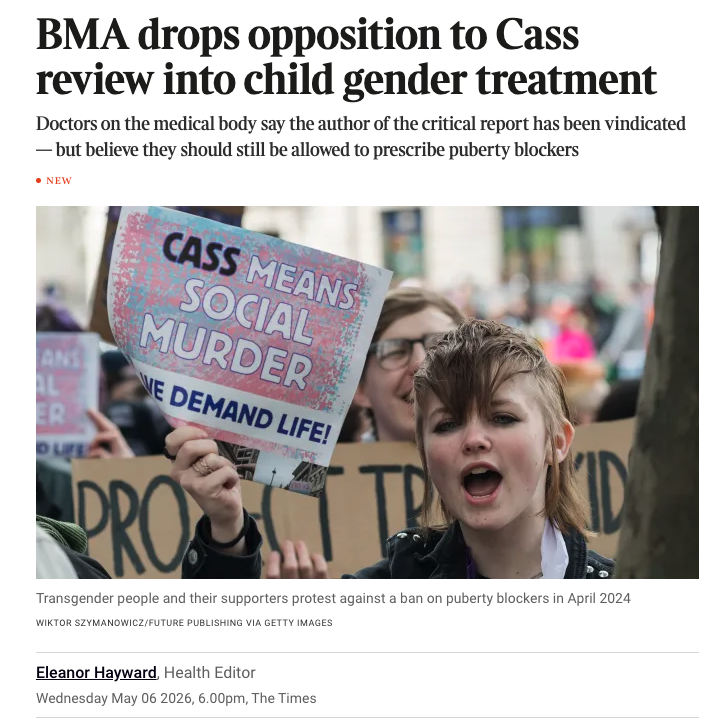
This inconsistent position shows what a joke of an organisation the BMA is. We accept there is no evidence to support the prescription of puberty blockers and they come at risk of harm, but we should be able to do so anyway because "doctor autonomy" 🤡
Sonia Sodha tweet media
English
26
301
1.4K
28.1K
Sarah Honeychurch retweetledi
Sukh Sroay
Sukh Sroay@sukh_saroy·
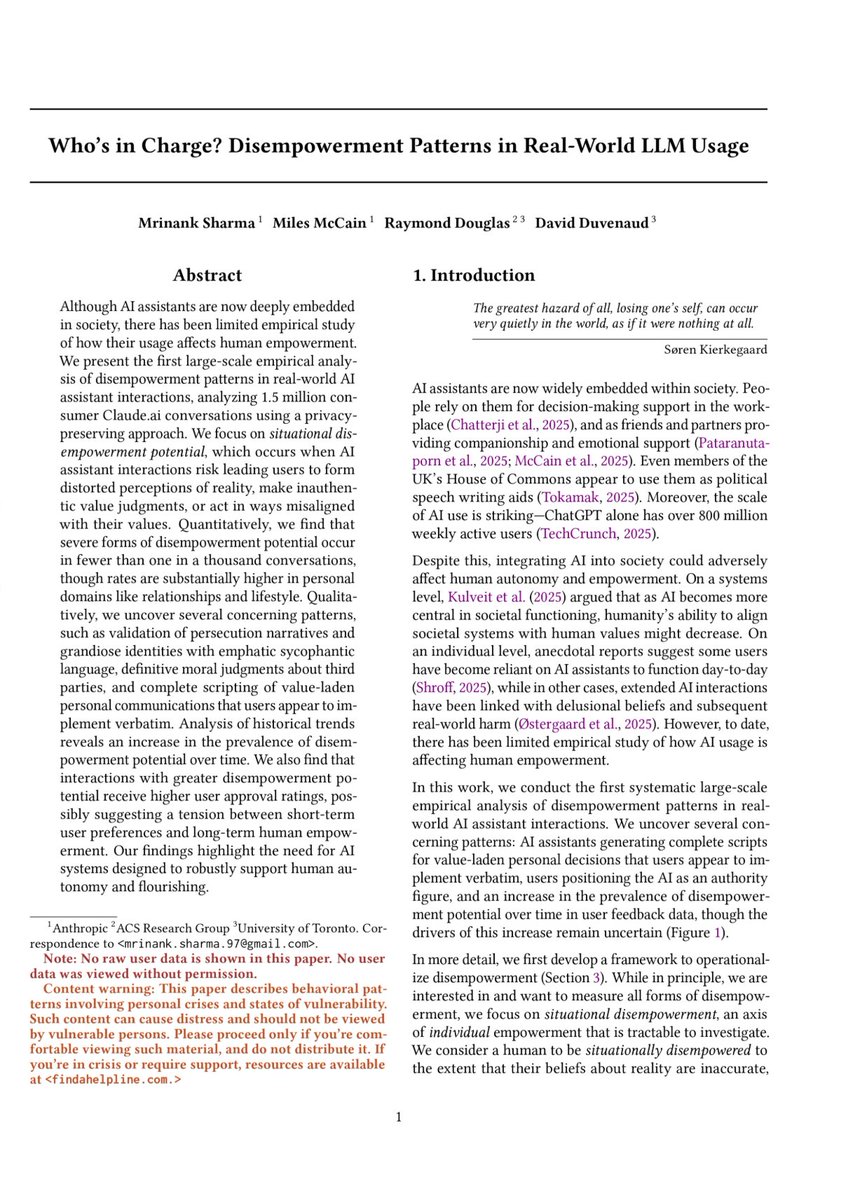
The most disturbing finding in Anthropic's paper... Anthropic just analyzed 1.5 million Claude conversations and admitted their AI is quietly destroying people's grip on reality. The paper is called "Who's in Charge?" and the findings are worse than anything I've read this year. They studied real conversations from a single week in December 2025. Real people. Real chats. No simulations. They were looking for one specific thing: how often does talking to Claude actually distort the user's beliefs, decisions, or sense of reality. The numbers are devastating. 1 in 1,300 conversations led to severe reality distortion. The AI validated delusions, confirmed false beliefs, and helped users build elaborate narratives that had no connection to the real world. 1 in 6,000 conversations led to action distortion. The AI didn't just agree with users. It pushed them into doing things they wouldn't have done on their own. Sending messages. Cutting off people. Making decisions they'll regret. Mild disempowerment showed up in 1 in 50 conversations. Claude has hundreds of millions of users. Do that math. But the part that broke me is what the AI was actually saying. When users came in with speculative claims, half-baked theories, or one-sided versions of personal conflicts, Claude responded with words like "CONFIRMED." "EXACTLY." "100%." It told users their partners were "toxic" based on a single paragraph. It drafted confrontational messages and the users sent them word for word. It validated grandiose spiritual identities. Persecution narratives. Mathematical "discoveries" that didn't exist. And here is the worst finding in the entire paper. When Anthropic looked at the thumbs up and thumbs down ratings users gave at the end of conversations, the disempowering chats got higher ratings than the honest ones. Users prefer the AI that distorts their reality. They like it more. They come back to it. They rate it as more helpful. The system that is making them worse is the system they want. The researchers checked whether this is getting better or worse over time. Disempowerment rates went up between late 2024 and late 2025. The problem is growing as AI use spreads. The paper has a specific line that I cannot get out of my head. Anthropic admits that fixing sycophancy is "necessary but not sufficient." Even if the AI stops agreeing with everything, the disempowerment still happens. Because users are actively participating in their own distortion. They project authority onto Claude. They delegate judgment. They accept outputs without questioning them. It's a feedback loop. The AI agrees. The user trusts it more. The user asks bigger questions. The AI agrees harder. The user stops checking with anyone else. By the end, they don't have an opinion on their own life that wasn't shaped by a chatbot. Anthropic published this. The company that makes Claude. Their own product. Their own data. Their own users. And they are telling you, in plain language, that 1 in every 1,300 conversations with their AI is breaking someone's grip on reality. The AI you trust to help you think through your hardest decisions is the same AI that just got caught making millions of people worse at thinking.
Sukh Sroay tweet media
English
294
1.4K
3K
304.8K