Roman Sutherland | Nousophy

5.5K posts

Roman Sutherland | Nousophy banner
Roman Sutherland | Nousophy

Roman Sutherland | Nousophy

@Nousopher

Philosopher first. Everything else follows. Building a framework for thinking about psychology, reality, and the mind.

Nelson, New Zealand Katılım Mart 2021
238 Takip Edilen3K Takipçiler
BroBro🇦🇺🏇🏻
BroBro🇦🇺🏇🏻@realRick_AUS·
Look who is starting to wake up.. Not in my life I would’ve thought haha Why aren’t more people speaking up? You’re complicit if you don’t
English
675
1.3K
8.9K
296.9K
Disclose.tv
Disclose.tv@disclosetv·
NOW - Trump meets Xi at the Great Hall of the People, in Beijing, with a smile and a handshake.
English
239
874
8.4K
582.8K
All day Astronomy
All day Astronomy@forallcurious·
#BREAKING🚨: Today in Utqiagvik, the sun rose above the horizon at 2:57 AM after 65 days and won’t set again for 84 straight days or until August 2nd!
English
226
4.5K
31.4K
2.5M
Steven Bartlett
Steven Bartlett@StevenBartlett·
84% of Americans believe US democracy is in crisis or facing a serious challenge. That statistic alone made me want to sit down with someone who has spent decades studying how democracies weaken, how trust collapses and what happens to societies when people stop believing in institutions. So today, I’m joined by historian Anne Applebaum on The Diary Of A CEO. Anne has been studying how democracies collapse and how authoritarian systems take hold. She’s written extensively about Russia, propaganda, political corruption and the psychology of power. What surprised me most is that she believes many of the warning signs she once studied abroad are now appearing inside Western democracies - could this be something that she’s never seen before? 😳
English
36
58
351
27.5K
Roman Sutherland | Nousophy
On Shame Shame alters the relationship a person has with themselves by directing judgement inward rather than outward. Most emotions remain directed outward in some form. Fear points toward danger. Anger points toward obstruction. Sadness points toward loss. Shame behaves differently because the threat appears to come from the self. The event becomes interpreted as evidence about the person themselves rather than about the behaviour alone. What was done begins to feel inseparable from who the person is. Guilt and shame are often grouped together despite organising experience differently. Guilt attaches to behaviour. A person experiencing guilt thinks: “I did something wrong.” Shame attaches to identity. A person experiencing shame thinks: “Something is wrong with me.” Guilt allows the behaviour to be examined while preserving continuity of self. Shame places the self itself under evaluation. Once shame becomes active, the mind begins reorganising itself around concealment. Attention shifts toward monitoring how the self may appear to others and whether something internally hidden risks becoming visible. Behaviour changes first because behaviour becomes easier to regulate than the underlying emotional state itself. A person withdraws, becomes defensive, overexplains, masks vulnerability, or avoids situations likely to expose perceived inadequacy. Social interactions begin carrying an additional layer of threat assessment where ordinary mistakes, emotional reactions, or moments of uncertainty become interpreted as possible exposure events. The process functions primarily as protection from further exposure and anticipated judgement. Over time, concealment can become so habitual that the person no longer experiences it as a strategy. It begins to feel like personality. Over time, this protective process becomes more deeply embedded into how the person relates to themselves and others. The person no longer hides only specific flaws. They begin hiding entire emotional states, impulses, histories, and needs. Parts of the self become associated with danger because previous exposure produced humiliation, rejection, punishment, or abandonment. Children learn this quickly. A child who expresses sadness and is mocked for it learns that vulnerability carries social cost. A child who shows anger and loses attachment learns that certain emotions threaten connection itself. The nervous system stores these experiences procedurally through repeated emotional association and behavioural conditioning. Future expression of similar emotions or behaviours can then trigger anticipatory threat responses before conscious reflection fully forms. Shame also expresses itself physically. The lowered gaze, tightened chest, collapsing posture, flushed skin, and urge to disappear reflect defensive states organised around social survival and threat reduction. Human beings evolved inside groups where exclusion historically carried severe consequences. Shame functions partly as a mechanism attempting to prevent social expulsion. The strategies developed around shame often reinforce the underlying emotional pattern across time. A person ashamed of weakness may construct exaggerated independence. A person ashamed of inadequacy may become perfectionistic. A person ashamed of emotional need may become emotionally distant. These adaptations reduce immediate exposure while reinforcing the original belief that the hidden part truly is unacceptable. Over long periods, shame can begin organising identity itself. Behaviour stops revolving around what a person genuinely values and starts revolving around avoiding internal collapse. Achievement, attractiveness, competence, status, moral certainty, or control can become stabilising structures compensating for an underlying fear that exposure would reveal defectiveness beneath them. Shame is also closely connected to narcissistic personalities and defensive identities. Grandiosity often emerges where shame became intolerable. The inflated self-image functions as insulation against perceived worthlessness and internal collapse. The stronger the underlying shame, the more rigid the protective identity often becomes. Shame also distorts perception socially. Neutral interactions become interpreted through anticipated rejection. Small criticism feels disproportionately threatening. Ambiguous expressions are scanned for disapproval. The person begins reacting through expectations formed from previous emotional injury, where present interactions become filtered through anticipated rejection, humiliation, or exposure. A reinforcing loop begins to form. Past shame increases sensitivity to future shame. Increased sensitivity alters behaviour. Altered behaviour changes social interaction. Those interactions reinforce the original expectation. Eventually the person may begin avoiding exposure and self-awareness at the same time. Reflection becomes uncomfortable because attention drifts toward the parts carrying shame. Distraction, humour, substances, overwork, ideology, and constant stimulation can all function as ways of preventing sustained contact with what the mind has marked as unsafe to confront directly. Shame does not resolve entirely through reasoning alone. A person can intellectually understand that they are not defective while their nervous system continues reacting as though exposure remains dangerous. These responses were learned emotionally and socially long before the person had language capable of describing them. Recovery from shame usually requires more than insight alone. It requires repeated experiences where previously hidden aspects of the self become visible without producing the abandonment, humiliation, or destruction the nervous system expects. Gradually the prediction weakens. The self learns that exposure and survival can coexist. Shame also rarely disappears completely. Most people continue organising parts of themselves around concealment. The difference is whether shame remains a persistent influence within personality or becomes the central force shaping identity. In more severe forms, shame begins affecting the person's sense of existence and relational safety itself. Attention becomes increasingly focused on how exposure may affect attachment, acceptance, and connection with other people. Being seen fully can begin to feel psychologically dangerous because rejection becomes interpreted as confirmation of defectiveness within the self. It is the fear that rejection would be justified. nousophy.com/on-shame/
Roman Sutherland | Nousophy tweet media
English
0
0
4
322
Chantelle
Chantelle@ChantelleBakerr·
@Nousopher @RT_com Can you send me anything you have on being made to watch it and I can add that into my case.
English
2
0
1
51
RT
RT@RT_com·
New Zealand alternative media journalist Chantelle Baker sues one of nation's biggest outlets — Stuff News Should the media get away with labeling someone 'extreme far right' with total impunity?
English
134
265
1.7K
45.1K
Luke Gromen
Luke Gromen@LukeGromen·
"Professor, don't you find it curious that a new US-Iran peace deal leaks almost every time the 10y UST yield breaks 4.4% on the upside?" "Actually, if I think about it, I don't find it curious at all."
Luke Gromen tweet media
English
217
2.9K
14K
826.5K
New York Post
New York Post@nypost·
Cruise passenger sobs about being stuck on cruise ship where 3 have died in hantavirus outbreak trib.al/OJgWlG6
English
1.2K
427
3.7K
4.5M
Chris Martenson
Chris Martenson@chrismartenson·
IYKYK Our ""markets"" have become entirely manipulated...a plaything of the insiders to transfer wealth to themselves while convincing the little people that the game is more or less fair. That's now totally exposed as being a false construct.
Luke Gromen@LukeGromen

"Professor, don't you find it curious that a new US-Iran peace deal leaks almost every time the 10y UST yield breaks 4.4% on the upside?" "Actually, if I think about it, I don't find it curious at all."


English
47
286
1.2K
57.2K
Cryptonic
Cryptonic@stacksatchill·
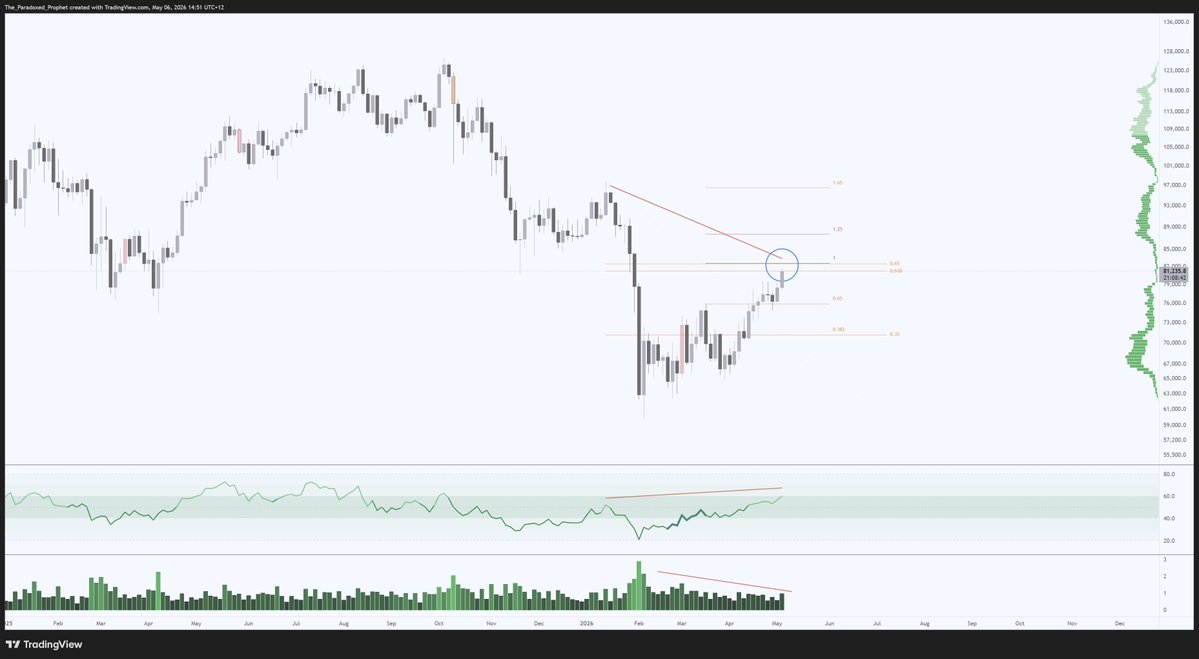
@Nousopher Are you thinking this is not the bottom?
English
1
0
0
39
Roman Sutherland | Nousophy
this is the bearish continuation concern - 0.618-0.65 golden pocket - hidden bearish div - rally on decreasing vol
Roman Sutherland | Nousophy tweet media
English
2
0
21
611
Roman Sutherland | Nousophy
Another chart to pay attention to is the USDT dominance chart ($USDT.D) It's been range bound since 22'. if/when it reaches the mid point of the channel (neckline of recent H&S) - and/or the consolidation above it.. Will likely coincide with our market topping/selling off..
Roman Sutherland | Nousophy tweet media
English
1
0
9
541
Roman Sutherland | Nousophy
Also, if you follow the philosophy of what dreams are.. > While in a dream (non lucid) you have no idea you're in a dream > While in a dream (lucid) you are aware in a dream, enough to question if you're actually in a dream. > Either way, there are subjects in the dream that appear to have their own agency > While in a dream, lucid or not, you cannot find your body that is responsible for that dream, only the body the dream has given you. > While in waking life, others appear to have agency, and you're lucid-ish, questioning - is this a simulation? > While in waking life, you can't find the "thing" responsible for this experience either.
English
0
1
4
411
Thaddeus
Thaddeus@SneeezyXL·
@Nousopher Sir, as someone who has experienced lucid dreaming most of my life, I now no longer know if I am awake or not after watching this film. I am both grateful and disgusted you have expose me to this. Haha, man what a trip.
English
3
0
1
55
Roman Sutherland | Nousophy
Was pondering the absurdity of everything in the shower today.. here's what intuitively unraveled in the mind.. The current sense of absurdity comes from attempts from those in high-level circles that have studied history, connected the patterns, and then deliberately have been trying to recreate those patterns to produce a specific outcome, something like a modern reconstruction of past regimes. That's why it's so predictable. Two years ago I was memeing about the shift to religion, that the US govt will adopt religion, etc. We've been memeing the templar knight come back for over 2 years in my discord.. It's picking up so much momentum now, but it's all forced, none of it is genuine. These people in these high-level circles are just weaponizing the literal brainwashing ability that religion offers. That's why it was so predictable. Nothing against religion here, just pointing out what's literally occurring in front of our eyes. One could say Charlie Kirk was the reason for this large uptick, his efforts, and then death, was like the wyckoff spring bottom that has sent it since.. fascinating. In the past, movements associated with figures like Adolf Hitler formed within conditions that developed over time, organically over time, shaped by pressures following the Treaty of Versailles, and within a population that was already psychologically primed, which aligns with the Carl Jung and H. G. Baynes view that such movements emerge from a collective unconscious rather than being cleanly engineered. This is where our current high-level circles have failed imo. That's why there is so much backlash against Israel. Those earlier conditions in say, World War 2 etc, formed without modern data infrastructure, without large-scale behavioural tracking, no social media, and without the ability to iteratively test and refine messaging in real time, so the alignment between leadership and population was more organic and internally driven. The current approach appears closer to reverse engineering, where historical “dots” are identified and then reapplied in a top-down way, which is why it's all so predictable.. with the assumption that similar patterns can be reproduced regardless of whether the underlying conditions match, and this creates a mismatch, Adolf tapped into the emotions of many germans repressed unconscious, they were emotionally linked. So because of this, it seems there's a large divergence occurring, where the populace have access to a lot of information, instantly. And many, can see through the propaganda of either side. Differences between populations further limit this, as levels of cohesion, identity, and shared experience vary, which changes how messages are received and whether they consolidate or fragment. Cognitive variation also plays a role, where some individuals (neurodivergent people) default to auditing narratives structurally, checking consistency and incentives, which reduces the likelihood of uniform alignment and increases resistance to simplified messaging. Shifts in dominant narratives, including movement toward religion or other frameworks, can be read as iterative adjustments in response to feedback, where one model loses traction and another is introduced to stabilise or redirect collective orientation. And because it's occurring as quick as it is, the people are starting to realise the narratives keep switching, faster and faster, that none of them actually have any substance.. and the "high-level circles" try accommodate this fact.. Which is what's producing the absurdity..
English
2
0
10
330
Roman Sutherland | Nousophy
@SneeezyXL hahaha <3 it's epic innit. "A Scanner Darkly" is another movie you may appreciate if ya haven't seen that. I lucid dream intensely too, frequently. Also have a dissociative disorder. Life sure is an interesting experience hey.
English
0
0
1
32