jason streets

12.2K posts

jason streets

jason streets

@OJStreets

Financial analyst

My office in the country Katılım Aralık 2011
693 Takip Edilen188 Takipçiler
jason streets
jason streets@OJStreets·
@stuartfanning1 @afneil @TimesRadio Only one who is even half decent at their job. Best chance for the Tories is a ‘29 election by which time the “brand” may have been laundered enough
English
1
0
5
359
Stuart Fanning
Stuart Fanning@stuartfanning1·
@afneil @TimesRadio The only person you have a good word to say about is the Tory leader. Are we suprised? No!
English
1
1
2
39.1K
Andrew Neil
Andrew Neil@afneil·
My monologue on today’s The Times at One with ANDREW NEIL on our political leadership deficit @TimesRadio I think we can pretty much all agree this is not exactly a golden age for British political leadership.  The UK Prime Minister is such a lame duck he virtually quacks.  The former First Minister of Scotland, Nicola Sturgeon, once feared by Scottish journalists and feted by the London media, is now held in such low regard north of the border that she’s moving to London. At least she’ll avoid the higher taxes she imposed on her fellow Scots.  And the glitzy capital is probably a more fitting habitation for the Imelda McMarcos de nos jours than the grime of Glasgow or the grey of Auld Reekie (aka Edinburgh).  But it does leave the current First Minister, John ‘Jobsworth’ Swinney, to deal with the fallout of the biggest scandal to hit Scottish politics since — well maybe since forever.  In other leadership news, the Lib Dems are led by a man whose main claim to public recognition is falling in the water, the Greens by a man who seems to have more skeletons in his closet than Davy Jones’s locker.  Nigel Farage has his followers but so far his political abilities have been as an insurgent rather than somebody who could run a country.  In a dispiriting field, Kemi Badenoch is just about the only political leader to shine. But she leads a brand which could be tarnished beyond repair.  Keir Starmer clings to power, perhaps emboldened by the lacklustre efforts of those who would unseat him.  Wes Streeting, who resigned as Health Secretary to challenge Starmer, had second thoughts and now strikes a somewhat forlorn figure, launching a battle of ideas without a single new idea to offer.  Andy Burnham, fighting the Makerfield by election as the springboard to his own challenge to Starmer, has hardly set the heather on fire with his campaign. That could be because he’s so dizzy from all the policy U-turns he’s executing.  The Starmer-Streeting-Burnham performance is emboldening others even less talented to think they might be in with a chance of the big job.  The Times reports that Darren Jones, barely a household name in his own household, is thinking of throwing his hat in the ring.  What we’ve done to deserve all this isn’t clear. Perhaps electing them is the first clue. In other words we reap what we sow.  Makerfield might be par for the course. Burnham is favourite to win, even if not runaway favourite.  The British, of course, can be, every now and then,  notoriously curmudgeonly and contrarian. Perhaps the good people of Makerfield will decide it’s time to display such characteristics once more.  If Burnham does go down to defeat on June 18 it could be because voters have had enough of being taken for granted. But what happens to Labour after that is anybody’s guess.
English
70
253
1.3K
101.5K
jason streets
jason streets@OJStreets·
@Simon_Nixon @nberpubs Why does the piece of research which focuses on GDP per capita at no stage discuss "capita" and the impact of mass immigration?
English
0
0
0
27
Paul Castle
Paul Castle@Goto_paulcastle·
This is what delivery looks like. Not leadership gossip.
Not endless Westminster manoeuvring.
Not another personality drama. Southern, Thameslink, Great Northern and Gatwick Express are now back in public ownership — run for passengers, not private profit. Of course public ownership won’t magically fix every railway problem overnight. Fares, driver shortages, old infrastructure and reliability issues still have to be tackled. But this is the direction voters asked for: clearer accountability, joined-up railways and services run in the public interest. While others brief, posture and audition for the next drama, Starmer’s government is quietly changing the system. That matters. #GreatBritishRailways #Labour #KeirStarmer #UKPolitics
English
19
81
244
3.3K
UK Prime Minister
UK Prime Minister@10DowningStreet·
From today, millions of passengers will have better train journeys. We’ve nationalised Thameslink, Southern, Great Northern and Gatwick Express with plans to recruit more drivers and improve signalling to reduce delays and cancellations.

UK Prime Minister tweet media
English
1.5K
570
2.7K
448.8K
jason streets
jason streets@OJStreets·
@griffitha He lives in a fantasy land where he thinks if he just says "from today, millions of people will have better journeys" it will miraculously just be true. The man is deluded.
English
0
0
2
38
Andrew Griffith MP
Andrew Griffith MP@griffitha·
From grooming gangs, record illegal channel crossings, two-tier policing to the delay in the Defence Investment Plan, state failure is everywhere. Now the same unreformed system is responsible for whether the 7:41 to London Bridge is on time. Do fewer things, well.
UK Prime Minister@10DowningStreet

From today, millions of passengers will have better train journeys. We’ve nationalised Thameslink, Southern, Great Northern and Gatwick Express with plans to recruit more drivers and improve signalling to reduce delays and cancellations.

English
19
24
80
4.2K
jason streets
jason streets@OJStreets·
@AlistairCarns I'd like to know whether you personally believe this nonsense or whether you just cynically think enough other people will.
English
0
0
0
161
Jim Bianco
Jim Bianco@biancoresearch·
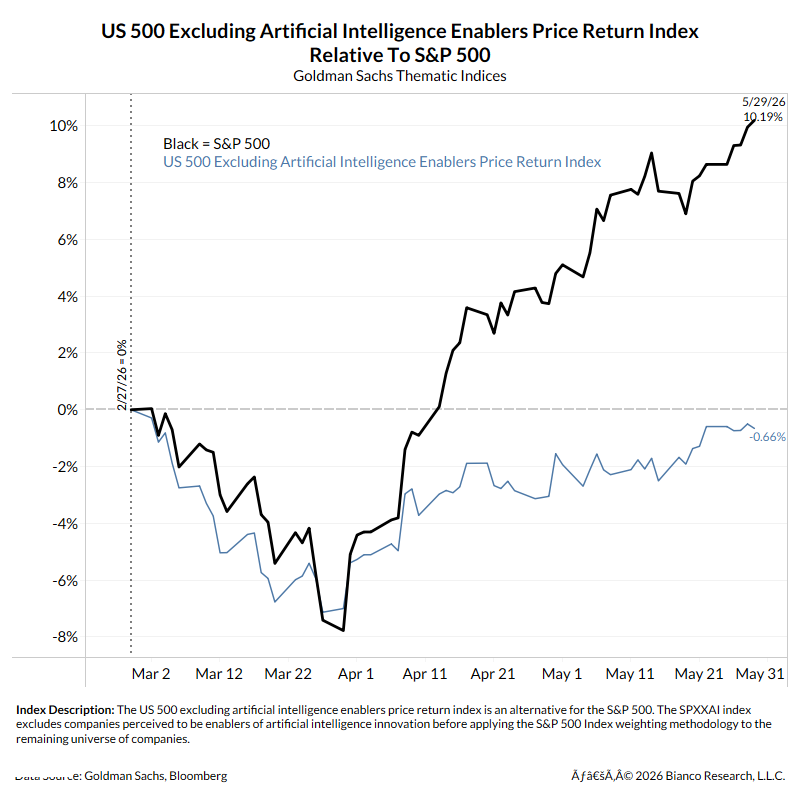
1/2 Yesterday, I posted the chart below, which shows that the entire "war rally" in the stock market has been driven by AI. Take out AI, and the rest of the stock market has done little since gasoline started soaring (blue). Is this a bubble? Probably. But the more important question, when in the "bubble cycle" are we, rather than just a proclamation that there is one? Remember that bubbles can be both the best time to make a lot of money and the hardest time to hold on to that money (when they pop). Using the internet bubble as a benchmark: Is today more like Dec 5, 1996, when Greenspan warned of "irrational exuberance"? If so, and you were worried about it popping on this date, you missed a nearly 300% rally in the NASDAQ over the next few years. Or is it like March 2000, and not worrying about it, exposes you to a NASDAQ correction of almost 80% over the next few years? As I explain in the repost below, it might be closer to 1997. I argue it is NOT overdone and explain why the massive capex spending makes sense.
Jim Bianco tweet media
Jim Bianco@biancoresearch

The fear over AI is palpable. So, it's time for my optimistic take .... Why the AI doom-and-gloom story is missing the bigger picture A lot of people hear “AI” and immediately think one of two things: it’s just Google search on steroids, or it’s a magic machine coming for everyone’s job. Both miss the bigger picture. A job is not one single task; it’s a bundle of tasks supported by a massive, fragmented software stack. Email, spreadsheets, presentations, Slack, CRM platforms, and, in finance, a Bloomberg Terminal, FactSet, and market data feeds. For millions of jobs, the cost of software to provide basic tools for these tasks can run to $1,000 a month, and more for complicated roles. Much of the modern workday is consumed by the friction of this stack: moving data between systems, cleaning spreadsheets, searching for files, and summarizing meetings. AI is emerging as the new interface for enterprise software. Think about the iPhone. It collapsed cameras, GPS devices, and music players into one simple, powerful device. AI is doing something similar for workplace software, turning 10 clunky programs that don't talk to each other into a single conversational prompt. Just as we stopped buying standalone cameras and tape recorders once the smartphone came around, companies will happily pay for an AI layer. It will be far cheaper and eliminate the bloated costs of that fragmented software stack that requires you to perform endless, mundane tasks because these programs do not talk to each other. The immediate fear is that if AI lets three people do the work of five, companies will fire two people. But that ignores economic history. When the electronic spreadsheet was invented, the cost of calculations plummeted. But accounting jobs didn't vanish; demand for complex financial modeling exploded. Accounting clerks became financial analysts, a more in-demand role. Jevons Paradox suggests that making a resource more efficient actually increases total demand for it. By absorbing the drudgery, AI allows the employee to focus on judgment and strategy—making the human element more valuable, not less. In this framework, demand for high-output workers doesn't shrink; it explodes. Does this justify the mind-numbing capital expenditure currently pouring into AI infrastructure? If AI fulfills this promise of enterprise-wide productivity, the investment isn't just justified—it’s a bargain. That said, we are clearly near the peak of a hype cycle, just like the internet was in 1999. But remember: the dot-com crash did not mean the internet was a bust. It simply meant the hype outpaced the infrastructure. After the wreckage cleared, the optimistic predictions about connectivity and productivity were not only fulfilled—they were exceeded. The same path can lie ahead for AI. And instead of the fear that AI will replace workers, it's the joy of replacing soulless busywork, making jobs more fulfilling... and more profitable for employers.


English
31
33
263
66.5K
Patrick Kidd
Patrick Kidd@patrick_kidd·
@rcolvile Zak Crawley’s first-class batting average and the number of Tests he played. Perfectly explains the nation’s productivity crisis in which perception of potential doesn’t match evidence, while modern politics is similarly influenced by the “who else is there” excuse
English
2
0
9
415
Robert Colvile
Robert Colvile@rcolvile·
Question: what are the key stats that explain the modern world/UK, which you wish more people knew?
English
57
2
68
313.2K
Colin Wynter KC
Colin Wynter KC@QcWynter·
Leaving soon to watch PSG v Arsenal. Arsenal will win. Last year, PSG had an extraordinary goalkeeper in Gianluigi Donnamura. He left for more money than PSG was willing to pay. PSG's 'keeper this year is Safonov, who is very good but no Donnamura. 3-1 to the Arsenal.
English
10
0
27
2.2K
jason streets
jason streets@OJStreets·
@jameswoudhuysen @FT The comments on the FT are really weird. Any political issue and they are dominated by ignorant students; anything on something even remotely technical and you get wonderfully informed and insightful contributions
English
1
0
2
35
Dan Neidle
Dan Neidle@DanNeidle·
@OJStreets The Napoleonic Wars created a huge need for funding/ The early modern state didn't have the apparatus to collect tax as now, so lots of little levies on particular goods and services were the answer.
English
1
0
1
52
Dan Neidle
Dan Neidle@DanNeidle·
The UK now has 90 taxes (more than any time since 1843). Germany raises more tax than the UK, but with only 60 taxes. France raises a bit more than that, but has 348. What's going on? And what can we learn?
Dan Neidle tweet media
English
62
121
548
66.5K
jason streets
jason streets@OJStreets·
@TheSecretAcct Are there two Terry Smiths - that certainly doesn't look like the one I know (No Chris Hohn either)
English
0
0
1
183
The Secret Accountant
The Secret Accountant@TheSecretAcct·
No Nick Train!?! Seriously though, amazed to see Cathie Woods on there.
The Secret Accountant tweet media
English
7
0
7
3.5K
jason streets
jason streets@OJStreets·
@SAshworthHayes This was a comment in the Telegraph about a year ago- pointing out that these vape shops and barbers were laundering visas as much as cash.
English
0
4
50
673