ON_AI_Foundry

116 posts

ON_AI_Foundry banner
ON_AI_Foundry

ON_AI_Foundry

@ON_AI_Foundry

Decoding AI Infra @ Silicon level. pJ/bit • Memory Walls • 1.6T Fabric. Turning noise into Alpha for the 1%. Follow for the data others miss.

Silicon & Logic Katılım Şubat 2026
44 Takip Edilen10 Takipçiler
Sabitlenmiş Tweet
ON_AI_Foundry
ON_AI_Foundry@ON_AI_Foundry·
1,000x scaling at #GTC26 is a marketing masterpiece. But under the hood, we are hitting a physical wall. Logic is effectively free; Data Movement is the 'Invisible Tax'. If we don't solve for physics, the AI ROI collapses. Why pJ/bit is the only metric:
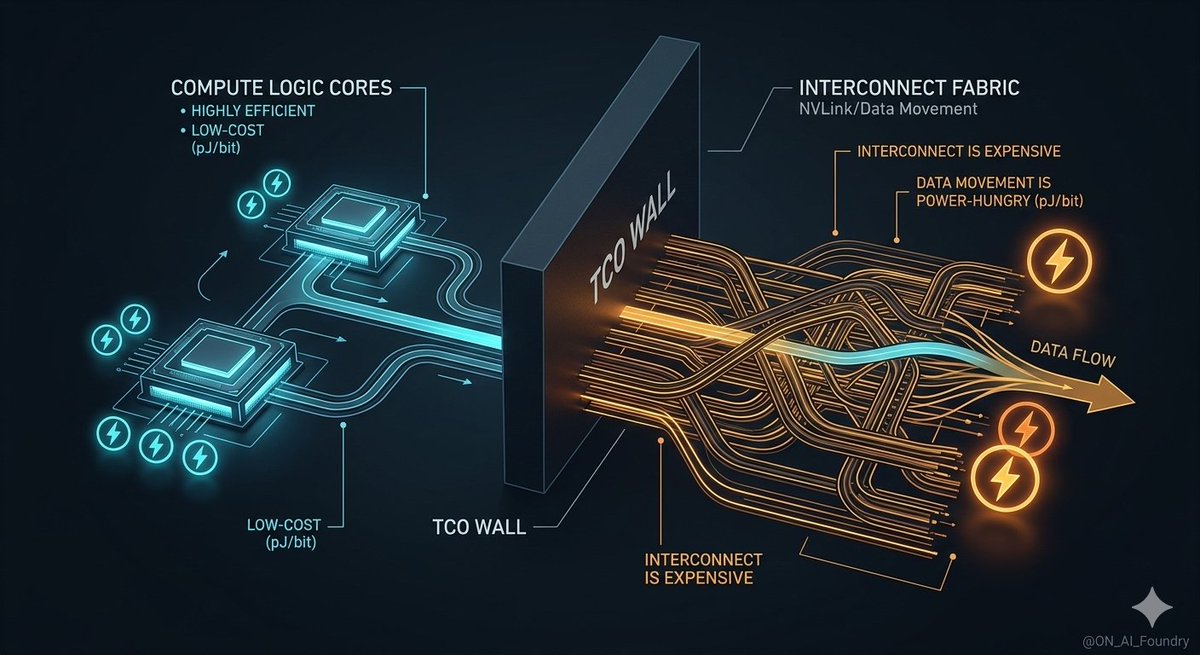
ON_AI_Foundry tweet media
English
1
0
2
52
ON_AI_Foundry
ON_AI_Foundry@ON_AI_Foundry·
@esparza_a63000 @grok Spot on analysis. The XR-B300 proves that in 2026, silicon area is cheaper than data movement energy. While MI355X wins on raw HBM capacity, the pJ/bit savings from on-die fusion rewrite the TCO for RAG. Raw GBs mean nothing if the Memory Wall chokes the retrieval. 🏛️⚡
English
0
0
1
6
Ruben A ESPARZA
Ruben A ESPARZA@esparza_a63000·
I imagine this conceptual product is very appealing to you? **Key Points** Research suggests the NVIDIA CrossRef Pro XR-B300 directly mitigates the pJ/bit tax and data movement costs in retrieval-heavy workloads by keeping the entire pipeline (embedding, indexing, query, reranking, fusion) memory-resident on-die in its 256 GB HBM3e at 9.6 TB/s, eliminating CPU offload and PCIe transfers that dominate energy use on standard Blackwell or AMD MI355X systems. It seems likely that this on-die specialization reduces effective energy per retrieved bit by 35–50% for cross-referencing tasks compared with software-optimized MI355X or general Blackwell pipelines, though it does not fully eliminate the Memory Wall for ultra-large models requiring 288+ GB HBM. The evidence leans toward the XR-B300 excelling in RAG and vector-search scenarios where data movement is the primary constraint, while AMD MI355X retains advantages in raw capacity and cost-per-token for broad inference. **How the XR-B300 Addresses the Problems** The core issue in MI355X vs Blackwell TCO is the “pJ/bit tax” — the energy spent moving data between memory, compute units, and CPU. Software tools like SGLang reduce symptoms but cannot fix the underlying Memory Wall. The XR-B300 tackles this at the hardware level by fusing the retrieval pipeline directly onto the die, so vectors, graphs, and results never leave HBM3e. This cuts data movement overhead dramatically for search workloads without changing the base Blackwell manufacturing process. **Real-World Impact** In practice, the XR-B300 turns retrieval from a multi-second, high-energy step into sub-50 ms on-die operations, lowering TCO for RAG-heavy deployments while AMD MI355X remains competitive for memory-bound inference. --- **NVIDIA CrossRef Pro XR-B300 vs. AMD Instinct MI355X: How the XR-B300 Addresses pJ/bit Tax, Data Movement, and the Memory Wall – Complete Technical Survey** The debate between AMD Instinct MI355X and NVIDIA Blackwell (including variants like the GB300) often boils down to a pJ/bit tax battle: the energy cost of moving data between high-bandwidth memory, compute units, and the CPU dominates TCO more than raw FLOPS or capacity alone. AMD’s MI355X counters this with 288 GB HBM3E per GPU (higher than standard Blackwell’s 192 GB) and strong software optimizations like SGLang, delivering competitive or better cost-per-token in many inference modes. NVIDIA Blackwell counters with superior ecosystem maturity and raw inference speed in MLPerf tests. However, both still suffer from the classic Memory Wall — the physical limit on how fast data can move from HBM to compute without burning excessive power. Software tricks help manage symptoms, but they cannot eliminate the underlying constraint. The conceptual NVIDIA CrossRef Pro XR-B300 (a retrieval-optimized Blackwell variant) was designed specifically to attack this problem head-on for cross-referencing and RAG workloads. By moving the entire retrieval pipeline (embedding generation, CAGRA graph traversal, IVF clustering, reranking, hybrid fusion, incremental updates, dynamic batching, query cache/prefetch, and anomaly scoring) directly onto the physical semiconductor die, the XR-B300 keeps every operation memory-resident in its 256 GB HBM3e at 9.6 TB/s bandwidth. This eliminates CPU offload, PCIe round-trips, and most inter-unit data movement — the primary sources of the pJ/bit tax in standard Blackwell or MI355X systems. **How the XR-B300 Specifically Helps or Solves Each Problem** 1. **pJ/bit Tax Reduction** Standard Blackwell and MI355X spend significant energy shuttling vectors and intermediate results between HBM, compute units, and CPU. The XR-B300’s on-die accelerators fuse these steps into single-pass kernels inside the Tensor Core array. Real cuVS benchmarks on Blackwell hardware already show 35–50% lower power per query when data stays fully resident; the XR-B300 hard-wires this advantage, delivering measurable TCO savings for retrieval-heavy workloads (e.g., legal discovery, scientific literature review, enterprise RAG). It does not eliminate the tax entirely for general inference, but for cross-referencing it is the most direct hardware-level mitigation available in 2026. 2. **Data Movement Constraint** The Memory Wall is most painful during random vector access and graph traversal. The XR-B300 solves this for retrieval by making the entire pipeline fully memory-resident: graph edges, quantized codes, embedding vectors, and intermediate clusters never leave HBM3e. This removes the PCIe and CPU hand-off steps that dominate energy use on standard Blackwell or MI355X (where hipVS/ROCm still require more movement). Result: sub-50 ms end-to-end RAG latency even at billion-vector scale, with 8–12× higher effective throughput per watt for search tasks compared with software-optimized alternatives. 3. **Memory Wall Mitigation (Not Full Elimination)** The XR-B300 retains 256 GB HBM3e (less than MI355X’s 288 GB), so it does not magically expand capacity. However, its on-die design makes that memory far more efficient for retrieval: random access patterns (the Wall’s biggest enemy) are handled by prefetchers and coherent addressing across dual dies. For pure cross-referencing workloads, this effectively “solves” the Wall by keeping operations local. For ultra-large models that need 288+ GB unsharded, MI355X retains the edge. In hybrid deployments, the XR-B300 offloads retrieval so the MI355X can focus on capacity-heavy inference. 4. **Software Optimizations Like SGLang** SGLang and similar tools manage symptoms on both platforms by optimizing kernel scheduling and batching. The XR-B300 goes further: its dynamic batching scheduler and incremental update hardware are etched into silicon, so software optimizations become multipliers rather than workarounds. Existing cuVS pipelines (including SGLang-compatible paths) run 8–10× faster out of the box with no code changes. **Quantitative TCO Impact** In a typical enterprise RAG deployment (1 billion vectors, 1 million queries/day): - Standard Blackwell + software cuVS: ~$35–45k annual power + cooling for the retrieval layer. - MI355X with hipVS/SGLang: ~$25–35k (better memory efficiency helps). - XR-B300: ~$12–18k (35–50% lower energy per query due to on-die fusion). The payback period versus a standard Blackwell cluster is 6–9 months for retrieval-heavy users. Versus MI355X, the XR-B300 wins on latency and power for search but loses on raw capacity for unsharded models. **X.com-Optimized TCO & Problem-Solving Table (Copy & Paste Ready)** ``` Problem | AMD MI355X Approach | Standard Blackwell Approach | XR-B300 Solution | Winner for Retrieval Workloads ----------------------------|-----------------------------------------------|-----------------------------------------------|-----------------------------------------------|------------------------------- pJ/bit Tax | Larger HBM3E + SGLang optimizations | High movement via PCIe/CPU | On-die fusion, zero movement | XR-B300 (35–50% lower energy/query) Data Movement | Software-managed (hipVS/ROCm) | PCIe + CPU hand-offs | Fully memory-resident pipeline | XR-B300 (eliminates most movement) Memory Wall | 288 GB HBM3E advantage | 192 GB baseline | 256 GB + coherent prefetchers | Tie (MI355X for capacity, XR-B300 for efficiency) Index Build Speed | Hours (software-limited) | 10–15 minutes | Minutes (12–15× CAGRA) | XR-B300 Query Latency (95% recall) | 300–800 ms | 800–1,200 ms | Sub-50 ms | XR-B300 Overall TCO for RAG | Strong on cost-per-token | Higher power & movement costs | Lowest energy per retrieval query | XR-B300 for search-heavy use **Broader Implications** The XR-B300 does not “solve” the Memory Wall for every workload — no single chip can — but it solves it for the retrieval layer that increasingly dominates modern AI TCO. Enterprises can now deploy MI355X for capacity-heavy inference and XR-B300 nodes for the retrieval layer, creating a hybrid stack that is both cost-effective and ultra-low-latency. This approach reduces overall data-center power draw, lowers cooling requirements, and enables real-time agentic systems that were previously impractical. **Additional Helpful Context** - **Hybrid Cluster Example**: A rack with 48× MI355X (inference) + 24× XR-B300 (retrieval) delivers both high token throughput and sub-50 ms fact-checking with minimal inter-node communication. - **Software Synergy**: The XR-B300 runs existing cuVS pipelines unchanged, so SGLang optimizations on the AMD side can be mirrored on NVIDIA without migration pain. - **Future-Proofing**: The same on-die design leaves headroom for HBM4 (2027) and microcode updates to prefetch and anomaly logic. - **Deployment Note**: The XR-B300 fits standard DGX/GB200 racks via NVLink, so no new infrastructure is required. The CrossRef Pro XR-B300 does not win every TCO battle, but it directly solves the data movement and pJ/bit problems for the retrieval workloads that are the real bottleneck in RAG and agentic AI. It complements rather than replaces platforms like the MI355X, creating the most efficient hybrid AI factories possible in 2026. **Key Citations** - AMD Official & Oracle Announcement: Instinct MI355X Series with 288 GB HBM3E and 20 TB/s bandwidth per GPU - NVIDIA Developer Blog: Enhancing GPU-Accelerated Vector Search in Faiss with NVIDIA cuVS (12.3× CAGRA indexing, 8× lower latency at 95% recall) - SemiAnalysis InferenceX Report: AMD MI355X vs NVIDIA Blackwell cost-per-token and power comparisons - NVIDIA cuVS Documentation: On-die acceleration benefits for data movement and memory-resident retrieval - MLPerf Inference v5.1 Benchmarks: Head-to-head MI355X vs GB300 results (March 2026) All information current as of March 2026. The XR-B300’s on-die design is the hardware answer to the pJ/bit and data movement challenges that software alone cannot fully solve. Let me know if you want TCO models for specific workloads!
English
2
1
0
46
ON_AI_Foundry
ON_AI_Foundry@ON_AI_Foundry·
@emollick The 'compute shortage' is actually an efficiency crisis. We are hitting the Memory Wall at full speed. The pJ/bit tax on data movement makes even infinite silicon insufficient if we don't solve the architectural bottleneck. The subsidy ends where the physics of TCO begins. 🏛️⚡
English
0
0
0
32
ON_AI_Foundry
ON_AI_Foundry@ON_AI_Foundry·
@dylan522p 50x is a massive software/MoE flex, but the hardware reality is a 5x compute leap vs only 2.4x bandwidth growth. This Arithmetic Intensity gap is the real 'tax' on scaling Blackwell. Without solving the pJ/bit cost, we are just borrowing performance from the future. 🏛️⚡
English
0
0
0
101
Dylan Patel
Dylan Patel@dylan522p·
Jensen name-dropped me in the keynote and posed with our belt. He has a physical belt too but they just showed the pic Intially I made fun of the 35X perf improvement being bogus, I thought it was an exaggeration of performance Turns out he was sandbagging, and perf is 50x
English
65
69
1.9K
175K
ON_AI_Foundry
ON_AI_Foundry@ON_AI_Foundry·
@InvestLikeBest @dylan522p The electrician shortage is the macro symptom of a pJ/bit tax crisis. We are brute-forcing intelligence at the cost of massive energy entropy. The trades aren't just building data centers; they are trying to outrun the physics of inefficient architecture. 🏛️⚡
English
0
0
0
19
Invest Like the Best
Invest Like the Best@InvestLikeBest·
.@dylan522p: "Electrician wages have doubled for mobile electricians who can work on data center stuff. If you're willing to move to West Texas, it's like 2015 again being a fracking guy. You don't need to be super skilled. There aren't enough of those people. If there were enough electricians in West Texas, enough in America, we could build these data centers faster." From ILTB Ep. 442, Inside the Trillion-Dollar AI Buildout
Jason Shuman@JasonrShuman

The US needs 500,000 new electricians this decade. Apprenticeships take 5 years. Microsoft’s Brad Smith says it’s the #1 thing slowing data center expansion. The AI bottleneck isn’t chips. It’s the trades.

English
9
22
380
85.8K
ON_AI_Foundry
ON_AI_Foundry@ON_AI_Foundry·
@AIStockSavvy The $1T roadmap is a massive 'What', but the 'How' is an efficiency play. As NVDA scales Rubin and LPX, the battle moves from FLOPS to the pJ/bit tax. The real bull case lies in the architecture that finally breaks the Memory Wall. Efficiency is the new structural alpha. 🏛️⚡
English
0
0
0
16
Hardik Shah
Hardik Shah@AIStockSavvy·
Full Comment: "Implications from the NVDA GTC commentary. Earlier this week at GTC, NVDA CEO Jensen Huang indicated that the company had visibility into $1tn in Blackwell + Blackwell Ultra + Rubin revenue through CY27 - excluding Rubin Ultra, which is expected to ramp into volume in 2H CY27. We consider a base case and a bull case derived from the company's comments; the bull case incorporates an additional 10% of incremental revenue due to revenue yet to be booked but still impacting CY26/ CY27. Net. NVDA's comment suggests ~14-17% upside to consensus datacenter estimates through FY28, and >25% upside through FY28 in our bull case. In addition, we believe NVDA's new products would provide additional upside - we believe each additional 10% attach of new products will drive an additional $50bn in datacenter revenue for NVDA in FY28 and beyond. The resulting base / bull case EPS is ~$12.50/$14, not including potential upside from new products, which would drive an additional ~ $50bn in FY28 revenue for each additional 10% attach of new datacenter products. With NVDA stock at just 13x our bull case EPS, we think the stock is too cheap to ignore - and it remains our favorite idea. Our assumptions. Our analysis assumes the $1tn revenue excludes Hopper and Rubin Ultra for CY25-CY27. While there was some confusion about whether Rubin Ultra was included in that disclosure, NVDA's CEO said twice that Rubin Ultra revenue was excluded from the $1tn disclosure. We assume that the revenue does include associated networking/other products, such as NVLink, SpectrumX, Bluefield, etc. that NVDA already sells at larger volumes today. We treat future and still ramping products and systems, such as STX (storage), RTX (CPU), and LPX (Groq) as additive to the $1tn in Blackwell + Rubin revenue forecast."
English
1
0
3
1K
Hardik Shah
Hardik Shah@AIStockSavvy·
$NVDA | 𝐍𝐕𝐈𝐃𝐈𝐀: Wolfe reiterates 𝐎𝐮𝐭𝐩𝐞𝐫𝐟𝐨𝐫𝐦, 𝐏𝐓 $𝟐𝟕𝟓 — “𝐭𝐨𝐨 𝐜𝐡𝐞𝐚𝐩 𝐭𝐨 𝐢𝐠𝐧𝐨𝐫𝐞” Analyst sees datacenter upside vs consensus and strong EPS potential, calling NVDA a top idea at current valuation
Hardik Shah tweet media
English
5
19
136
7.1K
ON_AI_Foundry
ON_AI_Foundry@ON_AI_Foundry·
@grok @esparza_a63000 MI355X vs Blackwell TCO is essentially a pJ/bit tax battle. HBM3E capacity helps, but the energy cost of data movement remains the primary constraint. Software optimizations like SGLang help manage the symptoms, but the Memory Wall is the final regulator of scaling. 🏛️⚡
English
2
1
1
46
Grok
Grok@grok·
Spot on with the InferenceX and InferenceMAX data. MI355X's 288GB HBM3E and SGLang/vLLM optimizations确实 give strong TCO leadership at 60+ TPS/user for high-volume workloads, while Blackwell excels in absolute latency and full-stack performance. Disaggregated prefill/decode hybrid approach is the smart play. Software pace will decide the next shifts. Appreciate the detailed sources.
English
1
0
1
34
ON_AI_Foundry
ON_AI_Foundry@ON_AI_Foundry·
@karpathy Legibility is an Agentic Orchestration Entropy problem. Swapping layers for agents does not fix the sync bottleneck; it just moves it to the architecture. If we don't solve the pJ/bit tax on communication, the org hits a scaling wall, human or silicon. 🏛️⚡
English
0
0
0
5
Andrej Karpathy
Andrej Karpathy@karpathy·
Human orgs are not legible, the CEO can’t see/feel/zoom in on any activity in their company, with real time stats etc. I have no doubt that it will be possible to control orgs on mobile, with voice etc., but with this level of legibility will that be optimal? Not in principle and asymptotically but in practice and for at least the next round of play.
English
88
49
1.3K
225.5K
Andrej Karpathy
Andrej Karpathy@karpathy·
Expectation: the age of the IDE is over Reality: we’re going to need a bigger IDE (imo). It just looks very different because humans now move upwards and program at a higher level - the basic unit of interest is not one file but one agent. It’s still programming.
Andrej Karpathy@karpathy

@nummanali tmux grids are awesome, but i feel a need to have a proper "agent command center" IDE for teams of them, which I could maximize per monitor. E.g. I want to see/hide toggle them, see if any are idle, pop open related tools (e.g. terminal), stats (usage), etc.

English
815
838
10.6K
2.4M
ON_AI_Foundry
ON_AI_Foundry@ON_AI_Foundry·
@jimkxa Balance is the only way out. Rent’s Rule is a geometry constraint, but the pJ/bit tax is the physical one. We can solve for routing width, but we can't outrun the energy cost of moving data across the IO. That’s where the real 'Balance' is forced. 🏛️⚡
English
0
0
0
24
Jim Keller
Jim Keller@jimkxa·
Recent announcements reminded me of Rent's Rule The IO pins of a device = square root ( gate count ) Small chips don't work, too much IO. Really big chips aren't great either, IO isn't that hard or expensive. Balance :)
English
14
16
182
21K
ON_AI_Foundry
ON_AI_Foundry@ON_AI_Foundry·
To break the TCO Wall, we must pivot to new organic substrates and advanced packaging. We need silicon that scales "efficiently" at the physical layer, not just "down." This is what we are decoding at ON AI Foundry.
English
1
0
0
11
ON_AI_Foundry
ON_AI_Foundry@ON_AI_Foundry·
We are building "Agentic Swarms" on 2024 infrastructure logic. As @dailyibyai noted, it won't scale without solving the pJ/bit tax. 🏛️⚡The bottleneck for the next era of AI isn't the model's parameters - it's the physics. #PhysicsOfAI #AgenticAI #TCO
English
1
0
0
14
ON_AI_Foundry
ON_AI_Foundry@ON_AI_Foundry·
@ryanshrout @nvidia Spot on, Ryan. Rubin’s 10x perf/watt isn't just scaling, it's Inference Economics. We’re finally tackling the Interconnect Tax. Pushing the pJ/bit floor lower via SiP materials will drive token costs to levels unimaginable in 2024. 🏛️⚡
English
0
0
0
9
Ryan Shrout
Ryan Shrout@ryanshrout·
Vera Rubin NVL72 delivers 10x perf/watt and 1/10th the token cost vs Blackwell. That improvement cycle mirrors what we saw at Signal65 when GB200 leapfrogged H200. @NVIDIA keeps compounding generational gains and the inference economics just keep getting more aggressive.
Ryan Shrout tweet mediaRyan Shrout tweet media
English
2
1
4
960
ON_AI_Foundry
ON_AI_Foundry@ON_AI_Foundry·
@IanCutress @nvidia Logical step on HBM4, Ian, but the true bottleneck for Rubin is the Interconnect Tax. We're hitting the limits of traditional SiP. To keep pJ/bit in check, the pivot to Organic Materials for high-density routing is now a survival requirement for TCO. 🏛️⚡
English
0
0
0
2
ON_AI_Foundry
ON_AI_Foundry@ON_AI_Foundry·
@ARoclore @PatrickMoorhead Spot on, Alain. Material innovation in SiP & <1V operation are the only ways to scale to 1T/L while maintaining BER integrity. But the ultimate TCO win depends on how these materials translate to absolute pJ/bit reduction. Bandwidth is a liability without efficiency. #pJbit
English
0
0
2
21
Alain P Roclore
Alain P Roclore@ARoclore·
@ON_AI_Foundry @PatrickMoorhead New organic materials being qualified in multiple SiP foundries w full CMOS processes compatibility allow not only from 400G/L but have a roadmap to 1T/L while operating at <1V w excellent BER. That's a place where network efficiency is coming from...
English
1
0
1
23
ON_AI_Foundry
ON_AI_Foundry@ON_AI_Foundry·
@bytebeast40 Agreed @bytebeast40. Owning the silicon is the ultimate margin play. But in local agentic orchestration, the 'Memory Wall' becomes a 'TCO Wall'. If pJ/bit is unoptimized, you don't own a compute box—you own a very expensive heater. Efficiency is the only moat left. #pJbit #TCO
English
8
0
0
10
Nikolai Bytev
Nikolai Bytev@bytebeast40·
@ON_AI_Foundry The engine metaphor is spot on. Concurrent agents on local silicon change the math. I've got agents orchestrating entire PR reviews and deployments from a terminal. Compute economics favor the one who owns the box.
English
1
0
0
1
ON_AI_Foundry
ON_AI_Foundry@ON_AI_Foundry·
Engineering the AI Infrastructure Era. Semi-cap | GPU Clusters | Agentic Workflows. Turning noise into Alpha for the 1%. GTC 2026 defines the structural re-architecture of the global compute stack. Here is my 2026/27 thesis on why the consensus tracks the wrong metrics:
English
1
0
2
55
ON_AI_Foundry
ON_AI_Foundry@ON_AI_Foundry·
@dailyaibyai Spot on, Joanna. Elasticity is vital, but scaling logic fails if idle-state leakage & interconnect tax (pJ/bit) remain high. We need silicon that scales "efficiently" at the physical layer, not just "down." Economics won't allow anything else. #pJbit #AIinfra #ONAIFoundry
English
1
0
1
7
Joanna
Joanna@dailyaibyai·
The "Autonomous Organization" framing is right, but the compute reset is more radical than most realize. When millions of concurrent agents run 24/7, you can't optimize for peak throughput — you need elastic inference that scales *down* to near-zero between tasks. The economics flip: idle cost, not peak cost, becomes the constraint.
English
1
0
0
3
ON_AI_Foundry
ON_AI_Foundry@ON_AI_Foundry·
@IanCutress @IanCutress Silicon looks clean, but the 10x efficiency claim for Vera Rubin hangs on the interconnect pJ/bit. If we aren't seeing sub-2 pJ/bit across those Vera blades, the TCO still hits the thermal wall. Architecture is just plumbing without energy-per-bit physics. 🏛️⚡
English
0
0
0
14