OVI

6.9K posts

OVI

OVI

@OVI_USA

Everything I post is personal opinions and not financial advice.

Florida, USA Katılım Temmuz 2020
969 Takip Edilen503 Takipçiler
OVI
OVI@OVI_USA·
There are indeed situations where high volumes are generated by algorithmic trading, HFT, or fund rotations, not just new “money inflow.” But to say that ALL of the volume in $TLRY💰🍀 is just the same ball being passed between hedge funds is an oversimplification. In such volumes: * market makers, * short sellers, * retail FOMO, * covering, * swing traders and hedge funds are all participating simultaneously. Especially in a sector like cannabis, where sentiment changes violently on news about Schedule III, DOJ/DEA, or 280E, volumes increase precisely because there is real interest and aggressive positioning from both sides. Furthermore, if it were just “the same 5 million shares floating around,” you wouldn’t see: * sudden increases in volatility, * changes in short borrowing costs, * changes in options/open interest, * or such strong reactions to news flow. Volume alone does not guarantee institutional accumulation, right. But neither can it be reduced to just “funds passing their shares between each other.” The reality is somewhere in between: a lot of speculation, a lot of tactical trading, and probably some repositioning ahead of possible major regulatory changes for the sector.
English

1
0
0
47
Artbip
Artbip@Artbipcouk·
@OVI_USA You are so wrong. These big Volumes are just transfers of shares from one hedge fund into another. X times during the day. If they just sold and bought the same 5 mln shares 10 times you already have 50mln volume but it is not an inflow.
English
1
0
0
40
OVI
OVI@OVI_USA·
#TilrayArmy💰🍀 - - Volumes on $TLRY💰🍀 exploded immediately after the news of the rescheduling to Schedule III, which shows that the market reacted extremely aggressively to the news. Specifically: * Before the news, TLRY was generally trading between 2–5 million shares/day. * On April 22nd, volume rose to ~28 million shares, with the stock +14%. * On April 23rd, volume exploded to ~42 million shares, almost 10x above the normal average. * Even after the selloff, volumes remained high: ~8.4 million on April 24th and ~7 million on April 27th, still well above the ~4 million average. What this means: 1. Massive speculative capital inflow These volumes show that traders and funds have aggressively re-entered the cannabis sector after years of apathy. When you see volumes of 8–10x above average, it means the market is considering the news “game changing.” 2. Short sellers were forced to react Much of the initial spike likely came from: * short covering * aggressively bought calls * algorithms buying on momentum Several sources have explicitly mentioned high call activity and speculative volatility. 3. It’s not just retail Retail alone rarely produces 40+ million in volume in a single day on TLRY. This suggests that: * hedge funds * market makers * tactical institutionals * speculative desks have begun to reposition exposure to cannabis. 4. The market is still trying to figure out the real impact Here’s why you’ve seen: * violent pump * then sell-the-news * then stabilization on high volumes Investors have realized that the current rescheduling is more limited than they initially hoped (emphasis on medical/state-licensed), but it still represents the biggest federal step for cannabis in decades. 5. The most important signal: liquidity is back This is perhaps the key. For years, the cannabis sector was “dead” as an institutional interest. Now: * volumes are rising * volatility is rising * options are rising * financial media is talking about the sector again Historically, such phases are the beginning of large speculative cycles in cannabis — even if in the short term volatility remains extreme.
English
3
0
15
459
OVI
OVI@OVI_USA·
In the short term, that’s partly true — medical marijuana’s move to Schedule III doesn’t instantly open up the U.S. market for Tilray. But many are missing the big picture. Schedule III eliminates the 280E tax burden, attracts institutional capital, facilitates medical research, and opens the door for pharma partnerships and incremental expansion. And $TLRY is already building its infrastructure through Tilray Medical and its global network. Tilray doesn’t need the U.S. market to fully open tomorrow for its valuation to change. The market reacts to the anticipation of future access, not just today’s revenue. That’s exactly why the cannabis sector is moving before the final laws are fully implemented.
English
0
0
1
52
OVI
OVI@OVI_USA·
#TilrayArmy💰🍀 - WHAT'S HAPPENING IN THE MARKET?🤔 WHY DON'T WE HAVE A STRONGER REACTION? 🤔. - The frustration of cannabis investors is understandable. In recent days, legislative developments have emerged that, a few years ago, seemed almost impossible: * moves towards Schedule III, * clearer medical recognition, * DOJ/DEA involvement, * more serious discussions about banking and federal integration. And yet, many cannabis stocks are barely reacting or even falling. That doesn't necessarily mean the market thinks the news is irrelevant. In fact, there are a few important explanations: 1. Retail is exhausted After years of: * dilutions, * reverse splits, * broken promises, * hype followed by crashes, many retail investors have run out of capital or confidence. Some of those who kept the sector alive in 2020–2021 simply don’t have the financial or emotional strength to buy aggressively anymore. 2. Short sellers still dominate sentiment The cannabis sector is among the most shorted sectors in the market. Short funds take advantage of: * low liquidity, * investor fear, * low volumes, * lack of large institutions. When positive news comes out, sometimes short sellers attack immediately to: * stop FOMO, * break momentum, * force retail to capitulate. 3. Wall Street is still waiting for financial confirmation The market is basically saying: “Show us better profits after Schedule III.” Large institutional investors want to see: * actual elimination of 280E, * improved cash flow, * increased margins, * better access to capital, * regulatory stability. 4. Many don’t realize how big the change is 2–3 years ago, the idea of ​​the DOJ/DEA issuing final rules on Schedule III seemed like science fiction to the industry. It may take time for the market to fully reprice the impact. THIS IS JUST MY POINT OF VIEW AND I WAIT FOR YOUR COMMENTS ON WHAT YOU THINK IS HAPPENING.
English
8
1
18
1.2K
OVI
OVI@OVI_USA·
For Tilray, the impact is indirect right now, but extremely important strategically. $TLRY💰🍀 already has the infrastructure, brands, distribution, and Tilray Medical ready for the US market. If US operators become profitable overnight due to the elimination of 280E, the entire sector resets, and companies like Tilray become much more relevant for: * M&A, * partnerships, * entry into the US medical market, * and rapid expansion once federal barriers are lowered. That’s why I mention 280E all the time — because it’s not just “a tax.” It’s probably the biggest financial bottleneck to the US cannabis industry.
English
0
0
5
84
Cannabis Cole
Cannabis Cole@ScaryTerryWeed·
@OVI_USA As of today, tilray sells $0 of medical Marijuana in the US and is not under 280e tax code. I don’t understand how S3 for medical marijuana helps tilray.. if anything keeps them out while MSOS start to enjoy their tax savings.
English
3
0
2
143
OVI
OVI@OVI_USA·
“😂 Zero love”? - $TLRY💰🍀 literally traded massive volume after rescheduling news and was one of the most discussed cannabis names on the market. What’s happening is not “no interest” — it’s a rotation into US MSOs because the current Schedule III framework is more medical-focused and benefits US operators first. TLRY still has: • global medical infrastructure • pharma distribution • massive liquidity • institutional visibility • leverage to future federal reform The market is digesting the details, not ignoring Tilray.
English
0
0
4
64
Artis Tree
Artis Tree@ArtisTree777·
$TLRY getting absolutely zero love in the cannabis stock pump. $msos
GIF
English
8
0
6
716
OVI
OVI@OVI_USA·
That narrative ignores the bigger picture. Yes, Tilray is currently listed in Canada and dilution has been a real concern for shareholders, but the market is focused on what happens after US rescheduling and federal reform. $TLRY💰🍀 already built infrastructure through Tilray Medical, distribution partnerships, beverage/alcohol exposure, and international medical cannabis operations. They don’t need to dominate the US medical market today to benefit tomorrow. The key point is this: US cannabis reform could completely change access, taxation (280E), institutional capital, and cross-border opportunities. Companies positioned early may gain the most leverage when regulations shift. People said the same thing about cannabis companies before Germany expanded medical legalization too. The sector changes fast once regulation moves.
English
2
0
0
127
Cannabis Cole
Cannabis Cole@ScaryTerryWeed·
@OVI_USA It’s kind of like Tilray is a diluted Canadian company who doesn’t sell medical marijuana in the US
English
2
0
3
124
ThePeanutsman
ThePeanutsman@DerErdnussmann·
@OVI_USA Retail is exhausted. Shorts are in control. Institutions are waiting. Algos follow signals, not narratives. That’s why good news isn’t moving the market… yet. Until the moment it suddenly does 👀🔥 #TLRY #MSOS #CannabisStocks #Bullish
English
1
0
2
148
OVI
OVI@OVI_USA·
@VinodSeetharag1 @TLRY_Happy @tilray @TilrayIR The dilution and poor execution were direct consequences of a hostile cannabis environment, not something isolated to Tilray. If regulations truly change, companies will no longer be forced to survive on toxic financing and absurd costs.
English
1
0
3
102
OVI
OVI@OVI_USA·
#TilrayArmy💰🍀 - The analysis in the article is interesting and has some valid arguments, but the language is very bullish and presents certain conclusions as almost certain, although the reality is more complex. First, the fundamental catalyst part makes sense: * the move to Schedule III is indeed one of the most important changes for the cannabis industry in the last decade; * the elimination of the 280E tax burden can dramatically improve EBITDA and cash flow; * federal legitimacy can gradually attract institutional capital. But institutional investors will NOT automatically enter en masse just because the DEA rescheduling is coming. Large funds are looking for: * profitability, * execution, * dilution reduction, * balance sheet stability, * real organic growth. In the case of $TLRY💰🍀, many investors are still cautious due to the history of: * reverse splits, * ATM offerings, * dilution, * acquisition integration, * long-term share price decline. The technical part about the “ascending wedge” is possible, but it must be interpreted carefully. An ascending wedge does not guarantee a bullish breakout. In technical analysis, sometimes: * it can signal bullish continuation, * but sometimes it is even a bearish exhaustion pattern. It all depends on: * volume, * breakout confirmation, * macro context, * general market sentiment. The most questionable part is the statement about “massive institutional accumulation”. High volume does not automatically mean smart money accumulation. It can also mean: * speculative rotation, * hedging, * temporary short covering, * algorithmic trading, * masked distribution. Without clear evidence from: * 13F filings, * reported institutional increases, * real ownership changes, it cannot be said with certainty that Wall Street is “absorbing the float”.
English
0
0
1
81
Cance
Cance@Cancinator1·
$TLRY $MSOS $CGC Tilly is looking primed and ready to erupt 🌋 up to 400% potential. The Structure: The Bullish Wedge; The asset is coiling tightly at the absolute apex of this wedge, structurally signaling a violent, directional breakout is imminent. bitget.com/news/detail/12…
English
6
2
24
1.1K
OVI
OVI@OVI_USA·
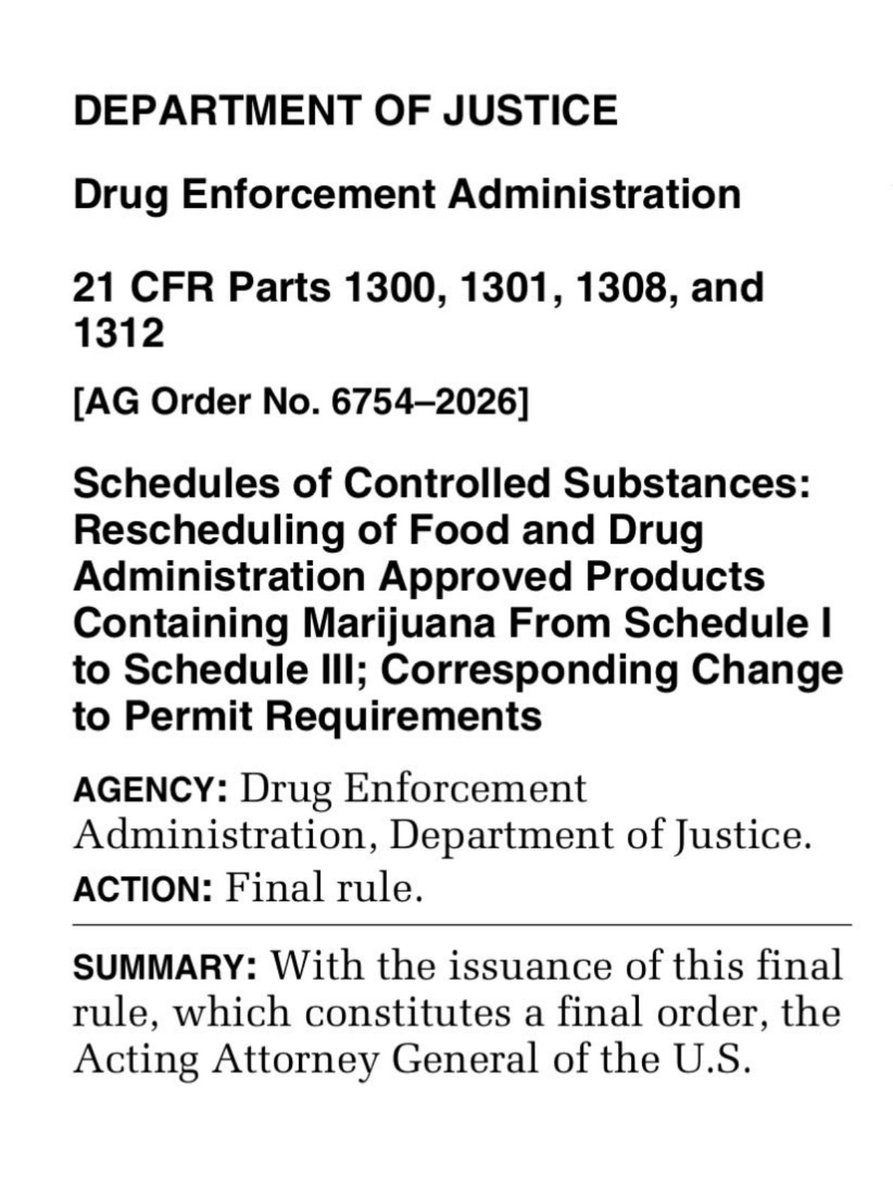
Finally, the Federal Register document was published today, and the DOJ/DEA order was announced the other day (April 23-24, 2026). What it means for the cannabis sector and $TLRY💰🍀: * This is one of the most important federal news for the industry in recent years. * It eliminates the 280E tax issue for many medical cannabis businesses, which can dramatically increase profitability. * It paves the way for: * expanded medical research * pharma partnerships * greater institutional access * more federal legitimacy. * For companies like Tilray, which have medical divisions and international infrastructure, the market sees this as a possible strategic advantage.
English
0
0
0
45
OVI
OVI@OVI_USA·
Finally, the Federal Register document was published today, and the DOJ/DEA order was announced the other day (April 23-24, 2026).
OVI tweet media
English
1
0
2
80
OVI
OVI@OVI_USA·
Finally, the Federal Register document was published today, and the DOJ/DEA order was announced the other day (April 23-24, 2026). What it means for the cannabis sector and $TLRY💰🍀: * This is one of the most important federal news for the industry in recent years. * It eliminates the 280E tax issue for many medical cannabis businesses, which can dramatically increase profitability. * It paves the way for: * expanded medical research * pharma partnerships * greater institutional access * more federal legitimacy. * For companies like Tilray, which have medical divisions and international infrastructure, the market sees this as a possible strategic advantage.
English
0
0
1
53
OVI retweetledi
Jeff Schultz
Jeff Schultz@JSchultz44·
Frame it. 💪🌱💚
Jeff Schultz tweet media
English
2
7
45
1.1K
OVI
OVI@OVI_USA·
Yes, one of the real criticisms of TLRY is that their portfolio is very large and sometimes the company seems slower than smaller, more “agile” players, especially on the premium branding and rapid innovation side. In cannabis, consumers change quickly, and brand loyalty is not yet at the level of traditional alcohol or tobacco. However, to say that “regulatory change will not matter” is an exaggeration. For the entire cannabis sector, regulation is probably the most important financial factor. $TLRY💰🍀 does not necessarily have to have “the best products in the industry” for the stock to perform. Sometimes the market rewards: * survival in a bear market, * access to cash, * international distribution, * consolidation capacity, * and exposure to the US before legislative changes. The criticism of execution and branding is valid. But the conclusion that they “have no chance” ignores the fact that sectors that are early in regulation change very quickly. In such industries, sentiment and the legal framework can completely transform a company's prospects in just a few years.
English
0
0
1
40
Donte
Donte@justluciano·
@OVI_USA They make terrible product and have no brand equity to drive sales velocity. In a highly competitive CPG market they are too bloated and slow to stand out on the shelf or consistently beat smaller more nimble competitors. The regulatory environment changing won’t matter.
English
1
0
1
19
OVI
OVI@OVI_USA·
$Tilray 💰🍀 now has over $250M–$290M in liquidity and explicitly says it wants “strategic opportunities.” This means $TLRY💰🍀 could buy: * distressed assets, * good brands at a discount, * cultivation facilities, * distribution networks. - Most importantly: The market is starting to believe that Tilray is preparing for a global consolidation phase before the US becomes fully accessible for medical and eventually adult-use cannabis. If Schedule III accelerates: * $TLRY💰🍀 could become much more aggressive with acquisitions, * and small and mid-sized US MSOs could become real buyout targets.
English
3
0
18
676
OVI
OVI@OVI_USA·
The difference is that the next 5-7 years could have a completely different context than the last 5-7 years. In the past, the entire cannabis sector was blocked by punitive 280E taxes, limited access to the banking system, the impossibility of listing for US operators, and high interest rates. Even good companies were affected. But now real structural catalysts are emerging: * possible Schedule III that would eliminate the 280E tax burden, * better access to capital and financial institutions, * industry consolidation, * entry of pharma and beverage partnerships, * and TLRY already has international infrastructure, distribution, and medical positioning. Yes, management made mistakes and dilution frustrated investors. No one denies that. But the market is not the same as it was in 2021-2023. If US regulations change, companies that survived the bearish cycle and have liquidity stand to benefit disproportionately. Many judge TLRY solely on the stock's decline, but ignore the fact that the entire cannabis sector has been through a historic bear market. The real question isn't "what have they done in the last 5 years?" but "what do the next 5 years look like in a completely different regulatory environment?"
English
1
0
0
13
Donte
Donte@justluciano·
@OVI_USA If they have been nothing but disappointing the last 5-7 years with this management team what makes you think they will be successful the next 5-7 years
English
1
0
0
17
OVI retweetledi
💚TLRY_MAX🌿
💚TLRY_MAX🌿@TLRY_Happy·
Each sunrise is a reminder. God’s plans are greater than yesterday.
💚TLRY_MAX🌿 tweet media
English
0
1
4
133