Obie Fernandez

14.8K posts

Obie Fernandez banner
Obie Fernandez

Obie Fernandez

@obie

CTO @zardotapp ✤ Partner at https://t.co/vR0SkHRGPa ­✤ Bestselling Author ✤ DJ/Producer (aka Kyberian, KNBI)

Worldwide Katılım Aralık 2006
1.5K Takip Edilen12.1K Takipçiler
Sabitlenmiş Tweet
Obie Fernandez
Obie Fernandez@obie·
My book is now available in all formats on Amazon!! Readers are singing its praises like “Best book about AI I’ve ever read.“ Check it out yourself now at amazon.com/dp/B0DN9KK4X7 #ai
English
4
7
27
9.3K
Obie Fernandez
Love the term "Super IC" What's left unsaid is eventually you don't need anything other than "Super ICs" because every other kind of work is delegated to autonomous AI agents. Existing companies that can adjust and shrink fast enough might survive the onslaught from new competitors.
Wade Foster@wadefoster

More ICs are choosing to stay ICs. Our CTO @BryanHelmig is a great example. He prototypes, ships features, writes code, teaches, and leads. He just doesn’t have direct reports. It’s been that way for a long time now (even further back than this pic 😂) I'm seeing more of this at Zapier - people who could move into management and are choosing not to. They'd rather manage AI agents and build. So we're leaning in. More builders, fewer layers. Giving motivated ICs unlimited access to AI tools. The rise of the Super IC is here. We’re setting @Zapier up to attract the very best. Sound fun? We’re hiring (~30 open roles and counting…) zpr.io/ASYpwVuiyLMT

English
0
0
4
1.1K
Obie Fernandez
Love the term "Super IC" What's being left unsaid is that eventually, you don't actually need anything other than "Super ICs" because every other kind of work is simply delegated to autonomous AI agents. Existing companies that can adjust and shrink fast enough might survive the onslaught from new competitors.
Wade Foster@wadefoster

More ICs are choosing to stay ICs. Our CTO @BryanHelmig is a great example. He prototypes, ships features, writes code, teaches, and leads. He just doesn’t have direct reports. It’s been that way for a long time now (even further back than this pic 😂) I'm seeing more of this at Zapier - people who could move into management and are choosing not to. They'd rather manage AI agents and build. So we're leaning in. More builders, fewer layers. Giving motivated ICs unlimited access to AI tools. The rise of the Super IC is here. We’re setting @Zapier up to attract the very best. Sound fun? We’re hiring (~30 open roles and counting…) zpr.io/ASYpwVuiyLMT
English
2
0
5
834
Obie Fernandez
Love the term "Super IC" What's being left unsaid is that eventually, you don't actually need anything other than "Super ICs" because every other kind of work is simply delegated to autonomous AI agents. Existing companies that can adjust and shrink fast enough might survive the onslaught from new competitors.
Wade Foster@wadefoster

More ICs are choosing to stay ICs. Our CTO @BryanHelmig is a great example. He prototypes, ships features, writes code, teaches, and leads. He just doesn’t have direct reports. It’s been that way for a long time now (even further back than this pic 😂) I'm seeing more of this at Zapier - people who could move into management and are choosing not to. They'd rather manage AI agents and build. So we're leaning in. More builders, fewer layers. Giving motivated ICs unlimited access to AI tools. The rise of the Super IC is here. We’re setting @Zapier up to attract the very best. Sound fun? We’re hiring (~30 open roles and counting…) zpr.io/ASYpwVuiyLMT

English
0
0
1
837
Obie Fernandez
The world is getting weirder by the day. Like that famous interview with Terrence McKenna back in the nineties. Things are just going to get weirder and weirder until you don’t really know what’s going on. The narrative will become incoherent. The Great Unraveling is underway and once all the chips are down, we’re going to be rebuilding from scratch. Just like how society reinvented itself during industrialization, we are going to be forced to reinvent ourselves, very soon. My fear is that it will be faster and harder than any previous disruption. We are charting entirely new territory.
David Shapiro (L/0)@DaveShapi

x.com/i/article/2033…

English
4
1
13
3.7K
Obie Fernandez retweetledi
Matteo Franceschetti
Matteo Franceschetti@m_franceschetti·
The top performers of the next decade don't look like the top performers of the last one. Two profiles win. The extreme expert, one engineer doing the work of an entire team alone, with 10 to 100 agents running underneath them. Irreplaceable because of depth. And the extreme generalist, a first-principles thinker who can cover almost any role in the company. The founder profile. The person who just gets things done. The distribution is shifting fast
English
69
121
1.1K
63.9K
Obie Fernandez retweetledi
ᴅᴀɴɪᴇʟ ᴍɪᴇssʟᴇʀ 🛡️
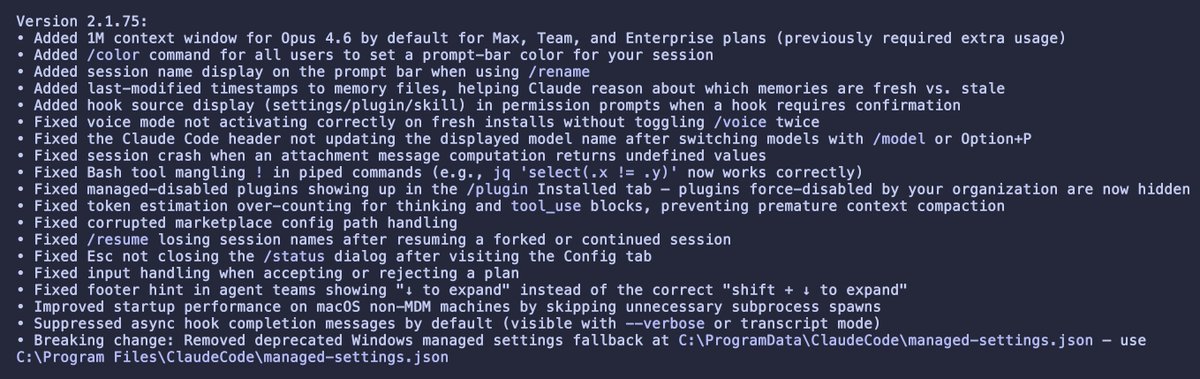
Holy crap this is like the update of updates. 1M context default now on Opus! For the same price!
ᴅᴀɴɪᴇʟ ᴍɪᴇssʟᴇʀ 🛡️ tweet media
English
25
11
248
18.1K
Obie Fernandez
Obie Fernandez@obie·
Expect more of this everywhere. Great time to be a talented and driven designer
Ole Lehmann@itsolelehmann

what's happening inside Anthropic right now is genuinely fascinating: DESIGNERS are now shipping production code with no engineer in the loop at all these are non-technical people with zero coding background. engineers on the team said designers are making "large state management changes you typically wouldn't see a designer making" think about what that means for a second. at every tech company in the world, designers and engineers are two separate roles. designers make mockups, engineers write code. that's been the deal for decades. at anthropic, that line is completely disappearing now. here's what their designers actually do now: it starts with a screenshot. 1) a designer takes their figma mockup and pastes the image directly into claude code. 2) claude looks at the image and generates a fully functional prototype from it. working code that engineers can immediately build on. this alone replaced the entire traditional cycle of: make static design → write spec → hand to engineer → wait → review → give feedback → wait again → repeat. but that's just prototyping. from there, designers implement front-end changes themselves. typefaces, colors, spacing, layout, etc directly in the codebase. no ticket filed, no engineer pulled in. and it goes further than visual polish. designers are now making state management changes (the code that controls how data moves through the app, even junior engineers find this tricky) and for their ongoing backlog of polish and bug fixes, they don't even open claude code. they just file a github issue (basically task description) describing what they want changed… and claude automatically proposes a code solution. then the designer reviews it and ships it. so there's a persistent stream of improvements flowing into production without pulling a single engineer off their work. they also use claude code to map out edge cases during the design phase. the stuff that used to only get discovered later when engineers actually built the thing. so now the designs are better AND they ship faster because the edge cases are already handled before engineering starts. one detail i love: they set up a custom memory file that tells claude: "you're working with a designer who has little coding experience. give detailed explanations. make smaller, incremental changes." claude adapted its entire approach based on that one file. here are some cool numbers, straight from the product design team: • claude code is now open alongside figma 80% of the time • 2-3x faster execution across the board. the designers' reaction when it all clicked: "holy crap, I'm a developer workflow" the boundaries between roles are dissolving. quietly. i think what's happening internally at anthropic is 2-3 years ahead of what will happen to the rest of the world

English
2
1
12
4.3K
Obie Fernandez
Obie Fernandez@obie·
We’re in a singularity already
Aakash Gupta@aakashgupta

Tobi Lutke just pointed an autonomous AI researcher at the code that renders every storefront on Shopify. The agent found a 53% speedup. Liquid is the templating engine behind every single Shopify store. When a customer loads a product page, Liquid parses the template, executes the logic, and renders the HTML. That code path runs billions of times per day across 5.6 million active stores serving 875 million customers. A 53% reduction in combined parse+render time means every product page, every collection page, every checkout screen loads measurably faster. A 61% reduction in object allocations means less garbage collection, fewer memory spikes, lower compute costs per request. At Shopify’s scale, even single-digit improvements translate to millions in saved infrastructure. This is a double-digit overhaul. Four days ago, Tobi ran the same tool on a query-expansion model overnight. 37 experiments. 19% improvement. A 0.8B model outperforming the 1.6B model it was meant to replace. Now he’s running it against production infrastructure code that processes $292 billion in annual merchandise volume. The tool is Karpathy’s autoresearch: 630 lines of Python. An AI agent that modifies code, runs a training sprint, checks if the metric improved, and repeats. No human in the loop. Tobi pointed it at Liquid’s Ruby codebase and let it rip. 29 experiments run. 10 kept. 21 files changed. The screenshot shows the agent running benchmarks, discarding failures, and committing winners to a git branch. Tobi’s caveat that the results are “somewhat overfit” is the most important line. Benchmark numbers on a specific test suite rarely survive contact with production traffic patterns. But the ideas survive. The agent doesn’t just try random mutations. It reasons through the codebase, finds structural inefficiencies, and proposes targeted rewrites. The diff shows it replacing simple_lookup byte scan matching with regex, inlining method dispatches in the renderer, and swapping each/while loops for optimized for loops. The CEO of a $120 billion company is personally running AI research agents against his own core infrastructure on a Wednesday afternoon and posting the raw terminal output. That tells you more about where software engineering is heading than any product announcement this year.

English
0
2
18
3.8K
Obie Fernandez retweetledi
andrew chen
andrew chen@andrewchen·
prediction re the end of spreadsheets AI code gen means that anything that is currently modeled as a spreadsheet is better modeled in code. You get all the advantages of software - libraries, open source, AI, all the complexity and expressiveness. think about what spreadsheets actually are: they're business logic that's trapped in a grid. Pricing models, financial forecasts, inventory trackers, marketing attribution - these are all fundamentally *programs* that we've been writing in the worst possible IDE. No version control, no testing, no modularity. Just a fragile web of cell references that breaks when someone inserts a row. The only reason spreadsheets won is that the barrier to writing real software was too high. A finance analyst could learn =VLOOKUP in an afternoon but couldn't learn Python in a month. AI code gen flips that equation completely. Now the same analyst describes what they want in plain English, and gets a real application - with a database, a UI, error handling, the works. The marginal effort to go from "spreadsheet" to "software" just collapsed to near zero. this is a massive unlock. There are ~1 billion spreadsheet users worldwide. Most of them are building janky software without realizing it. When even 10% of those use cases migrate to actual code, you get an explosion of new micro-applications that look nothing like traditional software. Internal tools that used to live in a shared Google Sheet now become real products. The "shadow IT" spreadsheet that runs half the company's operations finally gets proper infrastructure. The interesting second-order effect: the spreadsheet was the great equalizer that let non-technical people build things. AI code gen is the *next* great equalizer, but the ceiling is 100x higher. We're about to see what happens when a billion knowledge workers can build real software.
English
442
290
3.1K
1.3M
Boyuan (Nemo) Chen
Boyuan (Nemo) Chen@boyuan_chen·
Skills extracted from your own production code are worth 10x generic ones. The model knows Rails patterns but has no clue about your app's specific conventions and architecture decisions. The bookmark-to-like ratio on this post tells me a lot of devs are realizing personal skill curation is the next multiplier.
English
1
0
1
217
Obie Fernandez
Obie Fernandez@obie·
Just added two new Claude Code skills extracted from production Rails 8 code to my personal marketplace: rails-activity-timeline: Add an audit/activity feed to any model. Polymorphic events, configurable icons, live Turbo Stream updates, auto-logging concern for child models. Optional AI change summaries using Raix gem. rails-tiptap-autosave: Tiptap + Stimulus with 1s debounced autosave. Markdown stored in plain text columns — no ActionText. Handles BubbleMenu target relocation bugs, Turbo cache destruction, and save-on-navigate. The Stimulus controller alone is worth the clone. /plugin marketplace add obie/skills Learn more at github.com/obie/skills
English
5
7
148
9.7K
Obie Fernandez
Obie Fernandez@obie·
Yes exactly. The typical pattern is to create a minimal draft record on new (or lazily on first keystroke), then autosave PATCHes against that persisted record. Some folks use a status: :draft column to distinguish from "real" records. The skill covers the PATCH side but the draft creation strategy is up to you (eager on page load vs lazy on first edit).
English
0
0
1
111
RafaVerso
RafaVerso@dev_rafa·
@obie Thanks for your skills! A doubt: To use autosave in /new route, do you create a raw record and then trigger updates?
English
1
0
2
150
Joel Moss
Joel Moss@joelmoss·
@obie Yeah, but all that doesn't matter, because mine is better... as I wrote it 😜 (the joys of software dev 🤩)
English
1
0
0
35
Obie Fernandez
Obie Fernandez@obie·
@joelmoss I don't need to add anything to my rails apps to use it. Test tld instead of localhost. That I wrote it :)
English
1
0
0
41
Joel Moss
Joel Moss@joelmoss·
@obie Just out of interest, what is it that you like better about yours?
English
1
0
0
54