Sabitlenmiş Tweet

TheObservationChair 🇿🇦 🇵🇸
1.9K posts

@ObsChair
🇿🇦 observer | Collecting Ls from superpowers | My bio pic is literally just a chair watching you | My takes ≠ mainstream cope


“There was no time to get out of the way, this was milliseconds,” Steve Sweeney on the near-death experience in Lebanon. Israeli’s say they were targeting Hezbollah, I guess that big RT mic flag wasn’t big enough. “It was just by LUCK that we survived”. More of his dramatic account, right here on Sanchez Effect! For more FRESH content, check me out here: bitchute.com/video/FxsidvXS…
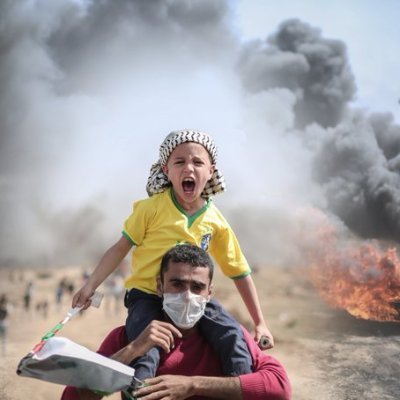
This is probably the most important article of the month: an op-ed by Oman's Foreign Minister, who mediated the talks between the U.S. and Iran, in which he writes that the U.S. "has lost control of its foreign policy" to Israel. He repeats that a deal was possible as an outcome of the talks (something confirmed by the UK's National Security Advisor, who also attended: x.com/i/status/20341…) and that the military strike by the U.S. and Israel was "a shock." Interestingly, given he is one of Iran's neighbors and given that Oman has been struck multiple times by Iran since the war began (en.wikipedia.org/wiki/2026_Iran…), he writes that "Iran’s retaliation against what it claims are American targets on the territory of its neighbours was an inevitable result" of the U.S.-Israeli attack. He describes it as "probably the only rational option available to the Iranian leadership." He says the war "endangers" the region's entire "economic model in which global sport, tourism, aviation and technology were to play an important role." He adds that "if this had not been anticipated by the architects of this war, that was surely a grave miscalculation." But, he adds, the "greatest miscalculation" of all for the U.S. "was allowing itself to be drawn into this war in the first place." In his view this was the doing of "Israel’s leadership" who "persuaded America that Iran had been so weakened by sanctions, internal divisions and the American-Israeli bombings of its nuclear sites last June, that an unconditional surrender would swiftly follow the initial assault and the assassination of the supreme leader." Obviously, this proved completely wrong, and the U.S. is now in a quagmire. He says that, given this, "America’s friends have a responsibility to tell the truth," which is that "there are two parties to this war who have nothing to gain from it," namely "Iran and America." He says that all of the U.S. interests in the region (end to nuclear proliferation, secure energy supply chains, investment opportunities) are "best achieved with Iran at peace." As he writes, "this is an uncomfortable truth to tell, because it involves indicating the extent to which America has lost control of its own foreign policy. But it must be told." He then proposes a couple of paths to get back to the negotiating table, although he recognizes how difficult it would be for Iran "to return to dialogue with an administration that twice switched abruptly from talks to bombing and assassination." That's perhaps the most profound damage Trump did during this entire episode: the complete discrediting of diplomacy. If Iran was taught anything, it is: don't negotiate with the U.S., it's a trap that will literally kill you. The great irony of the man who sold himself as a dealmaker is that he taught the world one thing: don't make deals with my country. Link to the article: economist.com/by-invitation/…

Hegseth: Iran is an energy rich country. instead, like so many other places, driven by a radical ideology, instead of investing in their people… they invested in missiles, and they invested in launchers and UAVS.



Trump in 2008: Anyone who invades the Middle East under false pretenses should be impeached.

🚨🇮🇷🇺🇸 THE STEALTH MYTH JUST TOOK A HIT, AND THAT SHOULD WORRY EVERYONE A U.S. F-35, the crown jewel of modern airpower, just limped home after taking fire over Iran. Not destroyed. Not confirmed shot down. But hit. And that alone changes the conversation. For years, the F-35 has been sold as invisible, untouchable. A jet designed to slip through enemy airspace like a ghost. So what happened? First, let’s kill the myth: stealth does not mean invisible. Every aircraft reflects radar. The trick is reducing that signal, bending it, scattering it, shrinking it into something harder to detect. Harder. Not impossible. And that distinction may be the whole story. Because the skies over Iran right now aren’t a one-off mission. They’re crowded, repetitive, predictable. F-35s have been flying there a lot. Same routes. Same altitudes. Same mission profiles. That matters. Air defense isn’t static. It learns. Modern systems don’t just “see” aircraft; they collect data over time. Patterns. Angles. Frequencies. Tiny radar returns that look like noise until they don’t. Do that enough times, and the noise starts to look like a signature. Then there’s the second possibility: this wasn’t just Iranian ingenuity. Iran doesn’t build its air defense ecosystem in isolation. It buys. It reverse-engineers. It integrates. Russia has spent years refining systems specifically designed to counter Western stealth. China has invested heavily in multi-band radar, systems that trade precision for detection, spotting stealth aircraft at longer ranges even if they can’t track them perfectly. Individually, these systems have limits. Together? They create something closer to a net. The third explanation is the simplest and the least comfortable: War is messy. Even the most advanced aircraft in history can be hit under the right conditions. A lucky shot. A brief exposure. A pilot forced into a less-than-ideal flight path. The same conflict has already seen drones shot down, friendly fire incidents, and dense, overlapping air defenses lighting up the sky. In that environment, “stealth” becomes less of a shield and more of an advantage, one that can be eroded. If Iran, with a patchwork of imported systems and domestic improvisation, can even touch an F-35, then the future of air warfare looks very different than advertised.




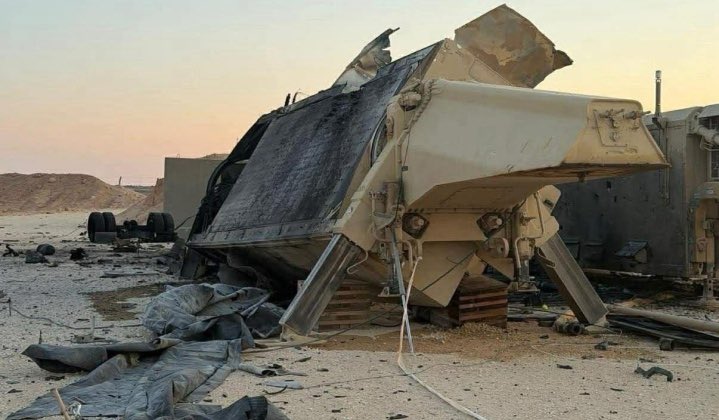


🇮🇱 🇮🇷Israel struck Iranian naval bases on the Caspian Sea for the first time. Missile ships, patrol boats, command centers destroyed. Iran's back door borders Russia. Whatever Moscow was shipping through that corridor just lost its delivery address.