Obvious Nchimunya Chilyabanyama

855 posts

Obvious Nchimunya Chilyabanyama

Obvious Nchimunya Chilyabanyama

@Obvious1chilya

Data Scientist, Researcher, Activist

Zambia Katılım Aralık 2015
181 Takip Edilen93 Takipçiler
Sishuwa Sishuwa
Sishuwa Sishuwa@ssishuwa·
@FMwenge Even insults are a form of democratic expression — though the ones unleashed in Bemba are more potent than those delivered in other Zambian languages. People who block others over differences in opinions are small-scale autocrats. We grow with more tolerance and understanding.
English
6
6
42
2.7K
Felix
Felix@FMwenge·
Yeah. You must have insulted me & my entire clan by the time I block you. The rest is your opinion and potential sources of new knowledge.
Felix tweet media
English
5
8
41
2K
Dora Siliya-PhD
Dora Siliya-PhD@Dora_Siliya·
@arsenalpanda11 Aa long as you are ready to host at least 30 funerals a year, pay for university schools fees, subsidise ceremonies, churches, schools, boreholes, & clinics because CDF is enough..its a great job. And oh, have constituents claim they must sleep in your house when in Lusaka.🤣😂
English
22
16
218
11.6K
Panda Monium
Panda Monium@arsenalpanda11·
So you mean to tell me none of you guys here want to be MP? Salary K80,000pm excluding allowances and benefits. No experience required. Ability to "yayaya" an added advanted. Women encouraged to apply.
English
19
58
386
27.1K
Sishuwa Sishuwa
Sishuwa Sishuwa@ssishuwa·
What do ministers in Hichilema’s Cabinet really stand for? By Sishuwa Sishuwa Isn't there even just ONE minister in the current Cabinet of Zambia who can come out in the public to say, “I do not agree with Bill 7, and I am stepping down”? As the Parliamentary Select Committee that has been appointed by the Speaker of the National Assembly to scrutinise the outlawed Constitution of Zambia Amendment Bill Number 7 of 2025 starts its sittings today ahead of debate and voting next week Tuesday, my thoughts are drawn to the calibre of ministers the country has had in the past. In the 1990s, Zambia had a vice-president and ministers – Akashambatwa Mbikusita-Lewanika, Baldwin Nkumbula, Ludwig Sondashi, Dipak Pael, Simon Zukas, Rodger Chongwe etc. – who all resigned on principle when Cabinet made decisions they did not agree with. In the early 2000s, Zambia had a vice-president and ministers – Godfrey Miyanda, Edith Nawakwi, Vincent Malambo, Ackson Sejani, Wiliam Harrington, Dawson Lupunga, Suresh Desai, Samuel Miyanda, Syamukayumbu Syamujaye etc. – who openly differed with the president in defense of the Constitution from executive manipulation. What has happened to our value system? Is the current crop of ministers so lacking in principle that none among them find anything wrong with Bill 7? Or does their failure to openly support the Bill indicate their anxiety that they are about to create a monster but simply lack the courage to come out? Are they so dependent on these jobs that they cannot imagine a life outside a ministerial post? Are they so terrified by Hichilema that they cannot publicly express any view that that diverges from his position? This brings me to another point. In nearly all previous cabinets, there were one or two ministers who were generally seen as capable replacements if anything happened to the president. Such individuals were highly competent, sufficiently educated and possessed ethical values – courage, compassion and love for fellow human beings, moral force of character, basic integrity, genuine humility, honesty, a predilection for consultation, consensus-building, communication, co-operation, active listening, and the selfless pursuit of the public good, and not the selfish striving for personal gain. It is hardly possible to look at Hichilema’s Cabinet today without being struck by the calamity of the absence of this kind of leadership. If anything happened to Hichilema today, who, among his current ministers, can be said to possess leadership qualities that make them a ready-made replacement? Of course, the vice-president would assume office if a vacancy arose in the presidency. But that would be because of operation of law, not capacity or competence. Never has a Cabinet been so devoid of principled men and women whom the public can count on in challenging moments. If there is any minister in the current Cabinet with the courage to stand up to Hichilema in defence of principle, public interest, or the Constitution of Zambia, now would be a good time to show it.
Sishuwa Sishuwa tweet media
English
43
32
117
12.4K
Sishuwa Sishuwa
Sishuwa Sishuwa@ssishuwa·
My reading of the family’s press statement indicates three reasons behind the family’s decision, in addition to the family’s feeling that the government is abrogating what was previously agreed by making unilateral decisions. The family appears unhappy: 1. That Hichilema will be at the airport to welcome the body and preside over a church service in an unstated location within the airport that was not part of the original agreement. 2. That members of the public including supporters of Lungu’s party are banned from going to the airport to receive the body, as attendance is strictly by invitation. In addition to the fact that this decision was not agreed with the family, it represents a departure from history. When President Mwanawasa and President Sata died outside the country, anyone interested was free to go to the airport. 3. ⁠That Hichilema will be the first person to view the body of Lungu on Thursday. It seems to me that the family, in the main, does not want Hichilema to have anything to do with the funeral. Remember that the family has repeatedly stated that they do not want president Hichilema anywhere the body or funeral of his predecessor, as per Lungu’s will. Why is it so hard for the president to respect the wishes of the grieving family members instead of putting political considerations? First, there is no law that makes it mandatory for the president of Zambia to attend anyone’s funeral. If the argument is that this is a state funeral, President Hichilema can delegate Vice-President Mutale Nalumango or anyone else to stand in for him for any government role in this funeral. I suppose the family would welcome the move. The State is not one individual but a system and any one person can stand for the State; i.e. Vice-President or Secretary to Cabinet. Second, it is against African culture to force oneself on a mourning family that has explicitly stated that they do not want you present. What exactly is in this funeral for President Hichilema that he has to be present? Hichilema did not enjoy a great relationship with Lungu. Where has this outbreak of love for his predecessor in death come from when he did not show it when he was alive? Insisting that he must attend plays into popular beliefs around superstition such as the one suggested in the writeup on the link below by Thandiwe Ngoma. facebook.com/share/p/1E8wsx… I hear some people saying we are tired of all this and we want the drama to end, but the loss is to the family. Our interests as members of the public are secondary. What have the rest of us lost? Nothing. The family has lost a loved one and their interests must take priority.
English
32
14
101
32.7K
Dingindaba Jonah Buyoya
Dingindaba Jonah Buyoya@BuyoyaJonah·
NOTE: 1991 to 2011 in literal terms were K1560 (K1.56 rebased) K3810 (K3.81 rebased) K3900 (K3.90 rebased) K3590 (K3.59 rebased) K5120 (K5.12 rebased)
English
1
3
17
4.2K
Dingindaba Jonah Buyoya
Dingindaba Jonah Buyoya@BuyoyaJonah·
Kwacha Historical Exchange rate against dollar under various administrations 1968 - Currency introduced ($1 - K0.96) 1991 - KK Exit - FTJ Entry ($1 - K1.56) 2001 - FTJ Exit - LPM Entry ($1 - K3.81) 2006 - LPM continues ($1 - K3.9) 2008 - LPM dies - RB Entry ($1 - K3.59) 2011 - RB Exit - MCS Entry ($1 - K5.12) 2014 - MCS dies ($1 - K6.34) 2015 - ECL Entry ($1 - K6.37) 2021 - ECL Exit - HH Entry ($1 - K16.04) 2025 - HH Continues ($1 - K28.83)
English
95
99
481
66.9K
Obvious Nchimunya Chilyabanyama
Obvious Nchimunya Chilyabanyama@Obvious1chilya·
To maintain proper branding, it’s essential for State House and universities to design a unique ceremonial gown for the President. It’s not ideal for the President to attend a graduation ceremony at one institution while wearing a gown from another. #zedtwitter #graduation
English
0
0
1
41
Sishuwa Sishuwa
Sishuwa Sishuwa@ssishuwa·
The fundamental issue here is not about the actions of an allegedly drunk police officer who freed 13 suspects from custody on New Year’s Eve. It is about the continued violations of the rights of suspects by the State. Under Zambian law, the police are required to charge suspects with a known offence and either release them on bond or present them before court within 48 hours. In practice, the police have kept suspects in detention, often without charge, for several weeks and sometimes months. This is not only unlawful but also a violation of human rights. The more than dozen individuals whom the officer helped to escape were not prisoners but suspects arrested for different offences that are bailable. Why were the suspects still in the police holding cell long after their arrest? Why were they not charged and either released on bond or taken to court where they could take plea and apply for bail? This incident is not isolated. It is part of a wider disrespect for the law by the police, one that has seen individuals being arrested and either kept in detention without being taken to court or taken to court where the state imposes punitive bail conditions. Take the example of Francis Kapwepwe, popularly known as Why Me. A 29-year old blogger, Kapwepwe was arrested in April 2024 on the Copperbelt and transferred to Livingstone, Southern Province, about 800 kilometres away, where he has neither relatives nor friends. Police stated that although Kapwepwe lives in Kitwe, the person who filed the complaint against him was based in Mazabuka, Southern Province. He was kept in detention without charge for four months and, following public uproar, was finally taken to court in August 2024. Kapwepwe, an ethnic Bemba, was ultimately charged with hate speech against the Tonga-speaking people of Southern Province. The charge arose from comments he made in a Facebook video that President Hakainde Hichilema, Zambia’s first Tonga-speaking president, had performed so poorly and divided the country to such an extent that voters are unlikely to vote for another Tonga in future. These remarks were interpreted by the complainant, a Tonga speaker, as hate speech, an offence legally defined as the act of expressing or showing hatred, ridicule or contempt for persons because of race, tribe, place of origin or colour. Conviction for hate speech carries a two-year prison sentence. After he pleaded not guilty to the charge, the presiding magistrate imposed a cash bail of K10,000 and two working sureties as conditions for his release from custody. The blogger has been unable to meet these bail conditions. In effect, Kapwepwe has been in prison since April last year, serving a sentence before trial commences and before he is convicted by any court of law. His case is a perfect illustration of the plight of the poor when it comes to accessing justice in Zambia. Although their freedom came from an unlikely saviour, the 13 suspects who were freed by a drunken police officer represent hundreds of ordinary Zambians who continue to languish in detention for petty crimes that attract police bond or are bailable. In Zambia, poor people in state custody and even in prisons are treated poorly and ignored by many. The drunk cop has merely opened a small window into these abuses which have been going on for a long time.
BBC News Africa@BBCAfrica

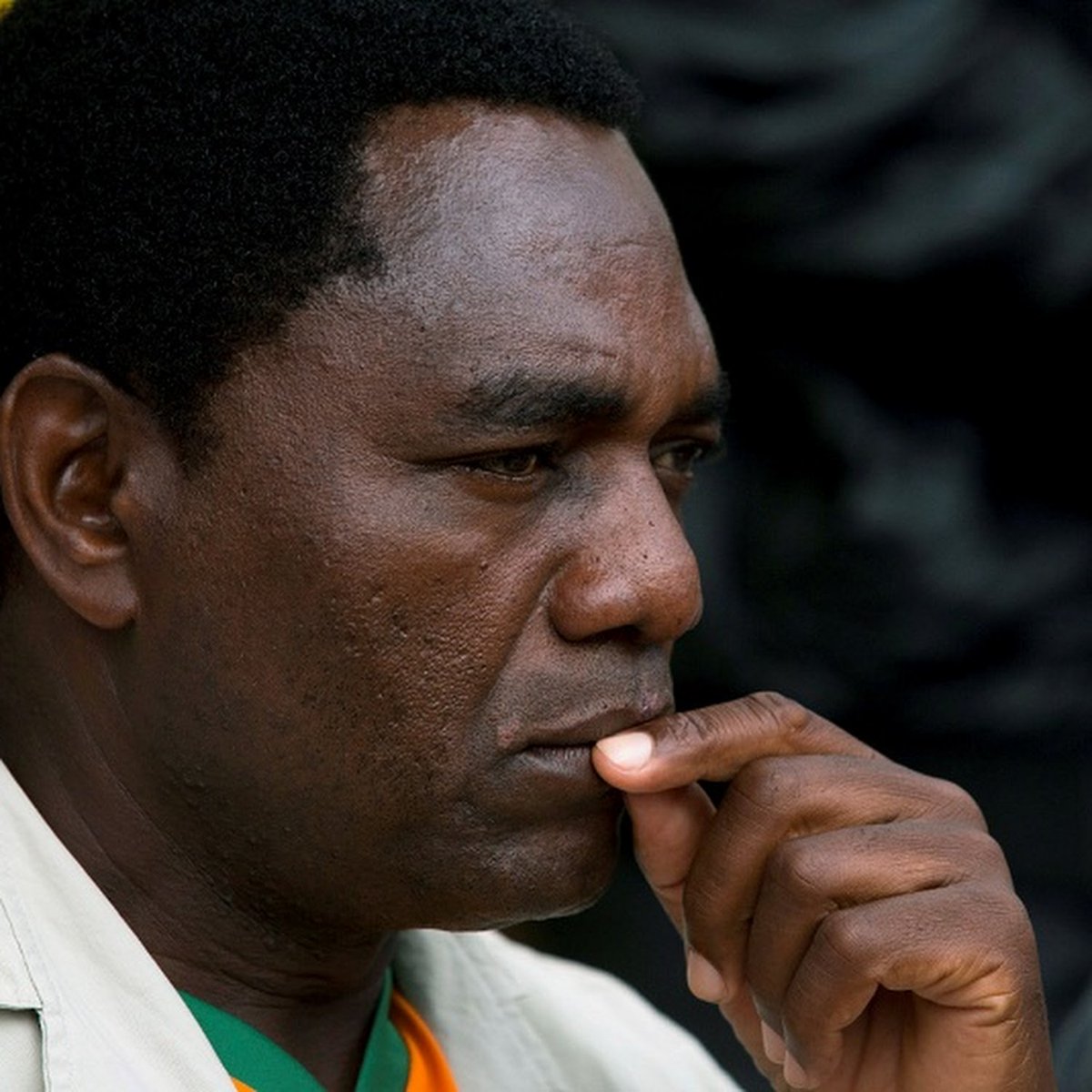
A drunken police officer in Zambia freed 13 suspects from custody to celebrate the new year, officials say. A police spokesperson said Titus Phiri, “forcibly seized cell keys" from a colleague, before releasing the inmates and fleeing himself. bbc.in/3PmxlV0
English
68
44
191
37.6K
Obvious Nchimunya Chilyabanyama
Obvious Nchimunya Chilyabanyama@Obvious1chilya·
@ZictaZM, it's crucial to ban the sale of SIM cards by freelancers. They often sell pre-registered SIMs. To combat scammers, we must ensure that every SIM card is registered to its rightful owner.
English
0
0
0
11
Obvious Nchimunya Chilyabanyama
Obvious Nchimunya Chilyabanyama@Obvious1chilya·
@ssishuwa You tea want us to believe your narrative… you opinion is not a fact ba Doc stop pretending to be the alpha and omega of knowledge
English
0
0
0
65
Sishuwa Sishuwa
Sishuwa Sishuwa@ssishuwa·
What happened to the Hichilema we had in opposition? By Sishuwa Sishuwa It all started in early October last year when rumours swelled that former president Edgar Lungu, who, having initially retired from politics in August 2021, was planning a political comeback, seeking to capitalise on the growing public discontent against his successor Hakainde Hichilema. In response, a ruling party activist swiftly petitioned the Constitutional Court, seeking a declaration that Lungu is not eligible to stand in any future election because of the constitutional two-term limit. Initially, there were 11 judges of the Constitutional Court who were set to hear and determine the Lungu eligibility case. Of these, six were generally seen as set to rule in Lungu’s favour since he had appointed all of them and they had, on previous occasions, ruled that he was eligible to stand. The remaining five judges – consisting of four new justices appointed by Hichilema and one Lungu-appointed judge but promoted by Hichilema who has consistently ruled that he does not qualify to stand for another election – were generally seen as set to rule in Hichilema’s favour. Upon realising that he lacked a clear majority on the Constitutional Court bench, Hichilema fired three judges, bringing the total number of the remaining judges to eight – four judges appointed by Hichilema and four appointed by Lungu. Then, the deputy president of the Constitutional Court Arnold Mweetwa Shilimi – one of the newly appointed judges and a very close personal friend of Hichilema – stopped one of the experienced judges, appointed by Lungu, from taking part in the eligibility case on the basis that the panel of judges hearing the matter should consist of an odd, not an even, number. This decision further reduced the total number of judges who finally sat to hear the Lungu eligibility case to seven, made up of one Judge appointed by Lungu but promoted by Hichilema and four judges appointed by Hichilema and the two who were appointed by Lungu. Since one of the three Lungu-appointed judges has been promoted by Hichilema and has always ruled that Lungu is not eligible to stand for election, the number of judges widely seen as likely to rule in Hichilema’s political interest is five with the remaining two likely to dissent or abandon their previous decisions and follow suit. This five is the guaranteed majority that Hichilema is counting on to exclude his main rival from the 2026 election when the case comes up for ruling on Tuesday, 10 December 2024. With a reconstituted Constitutional Court, the outcome of the eligibility case is such a foregone conclusion that it can only go one way. Hichilema thinks that removing Lungu, his main rival, reinforces his chances of re-election. To the contrary, the orchestrated exclusion of Lungu is a grave miscalculation that will come back to haunt Hichilema. In addition to the lasting damage a pro-Hichilema verdict will cause to both the remnants of credibility of the Constitutional Court and, more generally, the already weakened standing of the judiciary, the exclusion of Lungu opens room for the emergence of a better and perhaps more credible opposition challenger. I am aware that Hichilema also plans to disqualify Fred M’membe from the 2026 election using a dubious conviction from one of the many trumped-up charges the state or supporters of the ruling party have brought against the opposition Socialist Party leader. Not even the added exclusion of M’membe will save Hichilema, though the move, after the previous exclusion of Lungu, will further heighten tension and leave the country on the brink of social unrest. Hichilema’s record in office – particularly on the main issues such as anti-corruption, national unity, the economy, the state of democracy and human rights, and the cost-of-living crisis – is so dreadfully poor that it is his single major opponent. All the excluded candidates will have to do is to back the common candidate who will be adopted by the opposition. Unless he manipulates the constitution to extend his stay in office or remove the requirement that the winning presidential candidate should secure over 50% of the total votes cast, I simply do not see Hichilema winning a second term in 2026. Hichilema probably knows this, which might explain why he is increasingly using repression to contain dissent, inducing traditional leaders and weaker opposition parties to endorse him, and destroying the more serious political opposition, instead of delivering on his election campaign promises. Having spent fifteen years in opposition, it is understandable that Hichilema does not want to leave power after only five years. However, he only has himself to blame for the growing public discontent against his leadership. He has antagonised the multi-ethnic coalition that brought him to power, concentrated on fighting his predecessor rather than governing, prioritised the arrest of political opponents and critics rather than the deplorable economic conditions in which majority Zambians continue to live, paid more attention to the interests of foreign actors especially mining companies rather than domestic concerns, nurtured high-level corruption in government, destroyed any remaining semblance of autonomy in formal institutions by packing them with loyalists, and embraced and refined the authoritarian tendencies of his predecessors. All things considered, Hichilema is a failed political experiment. Sometimes I ask myself: what has happened to the Hichilema we had in opposition? The Hichilema in opposition could actively listen and learn. He promised people what they wanted, identified with the people and their needs, and played the part of the ordinary citizen who can represent all citizens. He appeared as a decent political leader who was outraged by anti-democratic or repressive legislation, abuse, injustice, lies, corruption, and ethnic-regional divisions, and a steady pair of hands who could help restore Zambia’s democratic tradition and resuscitate the faltering economy. In power or since his ascent to the position of President, Hichilema has so easily found comfort in the company of all the vices he denounced in opposition that one may think his conscience has been stolen. What would Hichilema’s former self think of him now? Lacking intellectual curiosity, the Hichilema in power is dripping with arrogance and talks even where he should listen. He is extremely detached from reality, has U-turned on many of the positions that made him attractive to most Zambians when he was in opposition, and has systematically moved to alienate the various constituencies (in the broader sense) that voted for him. Much of his behaviour seems to be geared – if any sense can be attributed to it – towards deliberately shedding the support that brought him into office, and certainly not mobilising support from anywhere. Indeed, he seems to enjoy de-mobilising his earlier support. Since he was elected, he shows very little sign of feeling any need for popular support. On the contrary, he goes out of his way to spit in the faces of his former supporters. Perhaps he is supremely confident of using the Electoral Commission of Zambia, the police, and the judiciary – formal institutions that he has loaded with his supporters – to steal the election. Perhaps he aims to declare an interminable state of emergency. Maybe he aims to change the constitution so that he can never be removed from office. In 2006, President Levy Mwanawasa said this about Hichilema: “His understanding of politics is that it doesn’t matter; you can cheat, provided you get your goals. The problem [with] Mr Hichilema is…that he wants to cheat, to mislead, to show that he is what he is not”. Was Hichilema a fraud who fooled many into believing that he was a bankable candidate only to show his true colours after assuming State power? Or perhaps he was, all along, just an incompetent political leader whose many weaknesses we overlooked in our quest to get rid of Lungu and a compulsive liar who made various promises which he had no intention of implementing and, in many cases, had the definite intention of doing exactly the opposite? Was his strategy to propose popular policies in order to get elected, and then to drop them after his election? Whatever the case, I miss the Hichilema we had before 2021. The one we have now is a completely different Hichilema I increasingly no longer recognise. What has really happened to the Hichilema we had in opposition?
Sishuwa Sishuwa tweet media
English
84
68
262
66.1K
Tabo Kaluwa
Tabo Kaluwa@TheRealTabo·
@jonathanlupand0 @diamondtvzambia Costa was a very biased.He came to the table with his mind already made up.He was looking to embarrass rather than to objectively question n as a result inform the viewers.i always loose confidence in the interviewer when I notice that he keeps interrupting the answers. Red flag
English
4
1
9
1.3K
Natasha M Lloyd
Natasha M Lloyd@Natashamwinji·
@isaacphiri360 @HHichilema This still does not change my perspective, you are telling a salon business person who makes less than K3000 a month to install a solar costing K24,000+ 😅😅 let's not mention the unemployed, there is a better way to communicate such a message as the head of state.
English
4
2
59
2.2K
Natasha M Lloyd
Natasha M Lloyd@Natashamwinji·
I usually avoid political talks, but I hope this statement in the diggers newspaper was just a misquote @HHichilema because it sounds like a slap in the face to ordinary Zambians who can't afford this back up power‼️‼️ for reference check the prices of the said solar.
Natasha M Lloyd tweet mediaNatasha M Lloyd tweet mediaNatasha M Lloyd tweet mediaNatasha M Lloyd tweet media
English
59
61
283
24.8K
Michelo Simuyandi
Michelo Simuyandi@bwantu·
View from the laboratory of Kabwe Central Hospital.
Michelo Simuyandi tweet media
English
3
2
38
1.3K