

Pedro Oliboni
154 posts

Pedro Oliboni
@OliboniPedro
econ / philosophy / PhD student @UChi_Economics website: https://t.co/wmFueQ9CZs
Katılım Mayıs 2016
1K Takip Edilen406 Takipçiler
Pedro Oliboni retweetledi


Pedro Oliboni retweetledi

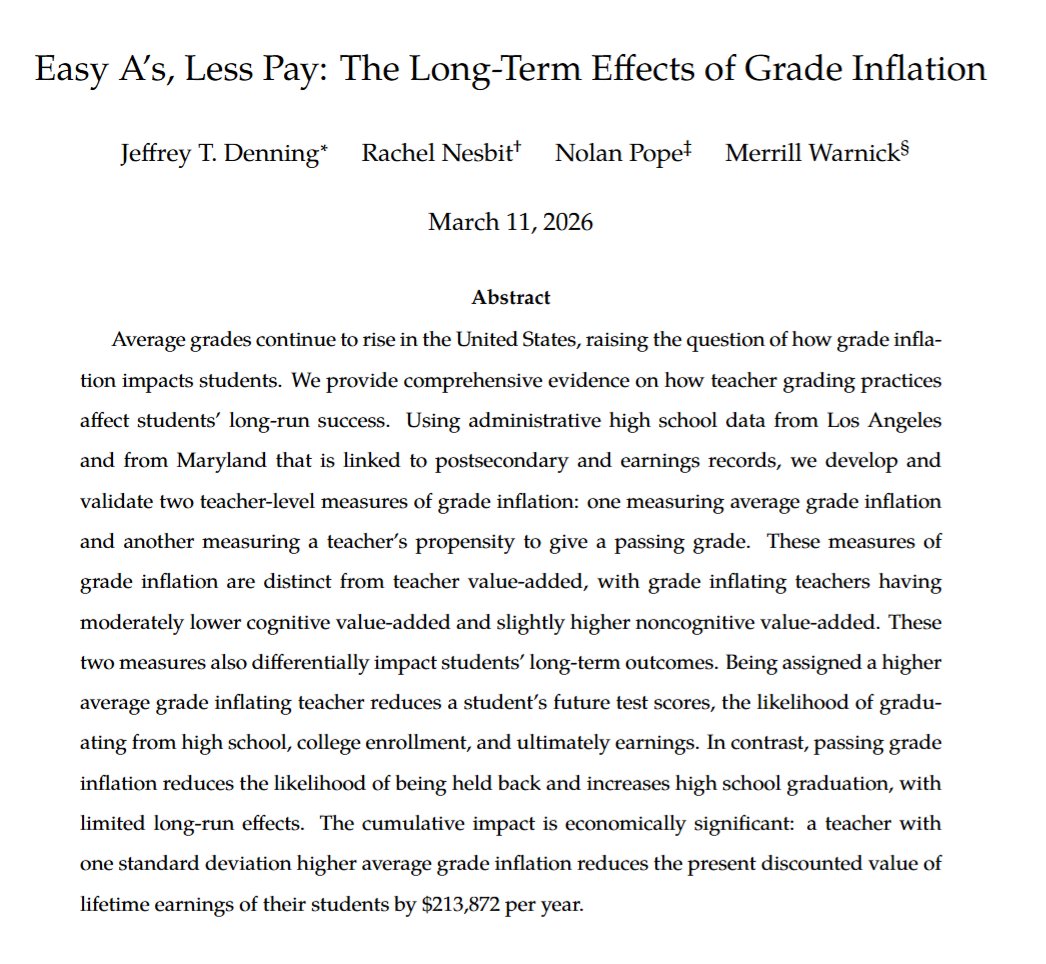
"A teacher with one standard deviation higher mean grade inflation reduces the present discounted value of lifetime earnings of their students by $213,872 per year of teaching." econweb.umd.edu/~pope/Grade_In…
English
Pedro Oliboni retweetledi

was just teaching about this yesterday
More Perfect Union@MorePerfectUS
A New York bill would ban AI from answering questions related to several licensed professions like medicine, law, dentistry, nursing, psychology, social work, engineering, and more. The companies would be liable if the chatbots give “substantive responses” in these areas.
English
Pedro Oliboni retweetledi

One of the more frustrating trends in public life over the past decade is how people who lead failing institutions blame social media for their failures.
A university president whose faculty have become political activists instead of educators and whose administrators multiply like rabbits will tell you that “misinformation on social networks” is eroding public trust in higher education. An editor whose publication lost its readership will claim that the real problem is X, rather than consider that the publication became boring, that the writing was uniformly uninspired, and that it stopped covering anything that mattered. A politician who loses an election will blame Meta algorithms rather than admit that voters simply did not like what was offered. A central banker whose institution missed the worst inflation in 40 years will worry publicly about TikTok videos spreading financial illiteracy.
The pattern is always the same. The institution fails at its core mission. The public notices. The people in charge, rather than examining what went wrong, identify an external force that is “polarizing.” The diagnosis is never “we did a poor job.” It is never “we lost our audience because we gave them nothing worth reading.” The diagnosis is always “bad actors are distorting the conversation.”
This is not new, of course. Before social media, talk radio was the scapegoat. Before talk radio, it was television. Before television, it was tabloid newspapers. Every generation of leaders has found a communication technology to blame for people’s loss of trust in them.
What is new is the intensity and the shamelessness. Over the last few years, “social media” has become a universal excuse that requires no evidence and tolerates no scrutiny. It is deployed reflexively.
The people who make this argument never seem to ask the obvious question: why are people on social networks so receptive to criticism of your institution in the first place? If your university were delivering excellent education at a reasonable price, no number of tweets would persuade parents otherwise. If your publication were covering important questions with clarity and substance, readers would not have migrated elsewhere. If the work you showcased were serious rather than trivial, people would still be paying attention.
Trust is not destroyed by social media. Trust is destroyed by poor performance, and social media makes it harder to hide. That is a different thing entirely, and the people running these institutions know it, which is what makes the excuse so cynical.
The honest version of the argument would be: “We used to be able to fail quietly because there was no mechanism for people to compare notes. Now there is, and we do not like it.”
That, at least, would have the virtue of being true.

English
Pedro Oliboni retweetledi

Brazil is underrated marginalrevolution.com/marginalrevolu…
English
Pedro Oliboni retweetledi

Pedro Oliboni retweetledi
Since relearning to write at @uchicago, I aimed to prune: only short, declarative, information packed, sentences, few adjectives, no adverbs, no subordinate clauses, but this is now LLM's preferred style, so humannness necessitates a defiant return to the ornate, labyrinthine, and gloriously textured baroque writing I first mastered amidst the golden echoes of my youth in Spain.

English
Price Theory changed my life. Apply to the Price Theory summer camp: bfi.uchicago.edu/events/event/2…
English
Pedro Oliboni retweetledi

Mahalo Bad Bunny for the Jones Act education break at Super Bowl … But seriously Puerto Rico like Hawai’i and the other non-48 parts of our country especially suffer from the jacked-up costs of living that result directly from the shipping monopoly stranglehold of this ancient federal law.
Scott Lincicome@scottlincicome
OMG he did it. He really did it! (Turn captions on)
English
Pedro Oliboni retweetledi
Olivier Blanchard (@ojblanchard1) had a provocative post yesterday about a higher preference of French people for leisure:
x.com/ojblanchard1/s…
I have learned nearly an infinite amount of economics from Olivier since I was an undergrad, and he came to Spain to present a report on our unemployment problem, so I feel a bit intimidated about pushing back on this idea.
I am perfectly happy with the idea that preferences are heterogeneous: some people like leisure more than others. And the goal of economic policy should never be to maximize output, but to maximize welfare. If most people in France enjoy sitting in the beautiful sun of Provence while productivity increases, who am I to question their wisdom?
But perhaps one of the aspects of economics that I have always felt uneasy about is how little effort we have put into exploring the extent to which preferences are endogenous.
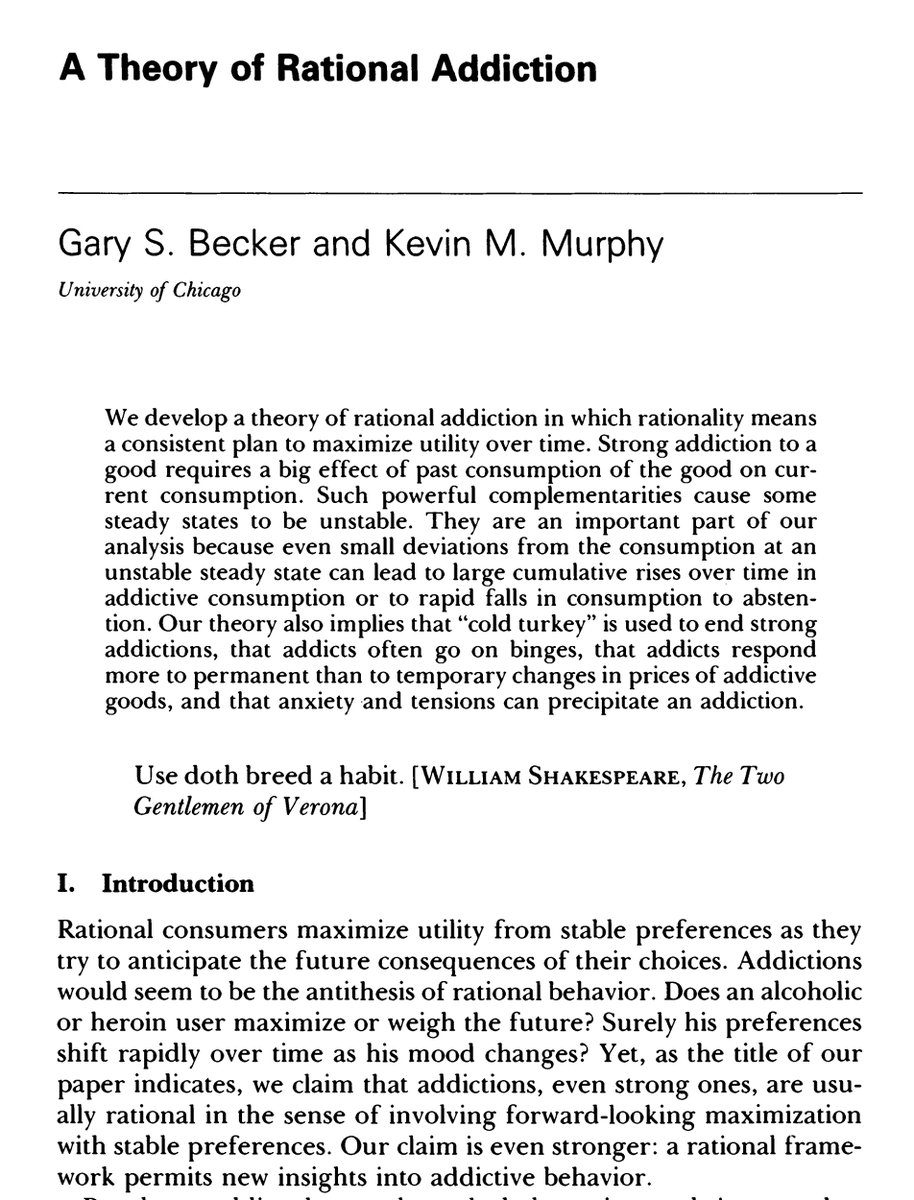
Let me borrow from an old idea of Gary Becker and Kevin M. Murphy (1988) in their classic “A Theory of Rational Addiction,” a beautiful piece of work all students of economics should read.
Becker and Murphy consider a model with two consumption goods: one that requires “consumption capital” to be enjoyed and one that does not. Think about fine wine: it takes some time and experience to truly enjoy a good bottle. In comparison, every kid enjoys candy on first taste, no experience required (nor much is gained from repeated tastings).
How much an agent invests in “consumption capital” determines whether increases in consumption of the first good in the past will lead to higher consumption of that good in the future. Many leisure activities belong to the former group, not the latter: going to the Opera, appreciating fine food, discovering the charming streets of a world-class city, ...
Based on that observation, let me extend Becker and Murphy’s framework to the work-leisure choice by introducing the notion of “leisure capital.”
Imagine a situation where, in France, taxes on labor income were high (or, equivalently, wages were lower than they should have been because of misallocation). This made leisure activities preferable in the past because their relative price was low (let’s assume the income effect was small), leading to an increase in the “leisure capital” of the French today and, therefore, in how French society takes advantage of increases in productivity.
Now, one could argue that this reasoning is a hyper-sophisticated form of rationality that does not resemble reality. But I have seen this phenomenon at a micro level: very rich people who made their own fortunes are often not very good at enjoying leisure, but their kids are extremely good at it, because they accumulated plenty of “leisure capital” when they were young.
More seriously, other observers of society would have found the reasoning natural, because there is a long tradition of analyzing labor supply decisions as embedded in social relations.
Let us start with Karl Marx. In historical materialism, consciousness follows the forces of production. When the forces of production generate a lower labor supply (for whatever reason), consciousness will follow through the multiple channels of the superstructure, starting with the creations of the culture industry that favor leisure. Having delightful bistros is an epiphenomenon of a deeper structure of relations of production.
In the opposite direction, E.P. Thompson, also from a Marxist perspective (though less orthodox), emphasized that the factory system required clock-based discipline and, therefore, that within a generation or two of the Industrial Revolution, punctuality became a cardinal virtue. Just reverse E.P. Thompson’s analysis.
And Émile Durkheim, with his view of how social facts shape the division of labor in society, might have agreed as well. For Durkheim, social facts are “every way of acting which is general throughout a given society, while at the same time existing in its own right, independent of its individual manifestations.” In this perspective, the French have absorbed a particular relationship to work through decades of participation in French economic life, which is not divorced from taxes and regulations.
Of course, one could reply that it might be the preferences for leisure that are behind higher taxes and regulations. For example, you can use regulations to move to a better coordination equilibrium: you do not want to take vacations if your spouse at another firm cannot take a vacation at the same time. This is what Max Weber would have called an elective affinity (Wahlverwandtschaft) of leisure and taxes. But that reply only reinforces my point that we probably want to think about preferences and economic policy as a simultaneous system, more than one driving the other.
The practical implication is that policy reforms may have effects far beyond what an analysis that takes preferences as given would suggest. If decades of high taxes built up “leisure capital” in France (which fits perfectly with Olivier’s observation that the French are better at leisure), lowering taxes tomorrow will not instantly undo that accumulation. Preferences have their own inertia. But by the same token, sustained policy changes can, over time, reshape what people want, not just what they can afford.
The real problem with all this reasoning, though, is that it makes welfare analysis a nightmare! I will leave that task to someone smarter than me.
Olivier Blanchard@ojblanchard1
The French are not lazy. They just enjoy leisure more than most (no irony here) And this is perfectly fine: . As productivity increases, it is perfectly reasonable to take it partly as more leisure (fewer hours per week, earlier retirement age), and only partly in income.
English
Pedro Oliboni retweetledi

Last August @ZMazlish and I put together a 2-week summer course on “the Economics of Transformative AI” at @DigEconLab.
For some great guest lectures, many thanks to the Stanford locals--
* @erikbryn
* @ChadJonesEcon
* @BharatKChandar
--and some of the attendees:
* MIT’s @arjun_ramani3 and @whitfill_parker,
* GovAI’s @t6aguirre,
* Epoch AI’s @ansonwhho,
* Oxford (now Bonn)’s Max Reith,
* Berkeley’s @SamiCPetersen and Eric Chen, and
* Columbia’s @tomwhoulden!
English

@OliboniPedro The formatting is inconvenient to read, theres no subscribe option, and I can’t repost. Do you want people to read this essay?
English
Pedro Oliboni retweetledi
the economic nostalgia agenda that does not respond to facts is so frustrating.
What's more amazing is I've emailed with the journalist and editor in charge of the article below, and .... they just can't see what they're missing.
x.com/ben_golub/stat…
Ben Golub@ben_golub
This NYT article on the "golden age" of air travel is an amazing example of an unthinking journalist failing to make contact with reality. The narrative: air travel used to be much better, but less affordable. 1/
English
Pedro Oliboni retweetledi

Our paper was selected as the Best Paper for 2025 by @SocRiskAnalysis! Published in Risk Analysis, it assesses global risks from early spread of pandemics and proposes mitigation strategies for deploying pandemic preparedness resources.
📖 Read here: shorturl.at/2qNEM

English
Pedro Oliboni retweetledi

Chicago students are built different
Tom Holden@t_holden
The great papers by @pzoch5 et al and @EconTraina don't seem to have reduced the rate at which people uncritically cite De Loecker et al., so I'm not optimistic that the great paper below will either. To allow the possibility of progress in our profession, I hope this changes.
English
@alexolegimas @sndurlauf @JesusFerna7026 @cblatts Highly recommend checking out anything by the incredible @DeirdreMcClosk
Also _The Economy of Esteem_ by the excellent Geoffrey Brennan and Philip Pettit
English

The economic toolkit is extremely powerful in helping us understand social phenomena, but only when the full set of human motivations are taken into account. This can be seen in the work of @sndurlauf, @JesusFerna7026, and @cblatts and many others.
English
Pedro Oliboni retweetledi
Part of the reason the current moment--global conflict, rise of populism, resentment, etc--has been so surprising to most in the policy space is that they were trained in the standard economic thinking of the time, which emphasized material comfort above all else.
The emphasis on material comfort gave rise to the worldview that if we were all just better connected, if prosperity could be shared through fair trade and economic relationships, then conflicts would melt away and we would approach "the end of history". Friedman's famous "McDonald's" theory is a good example of that--put a McDonald's in every country and we will have no wars and strife.
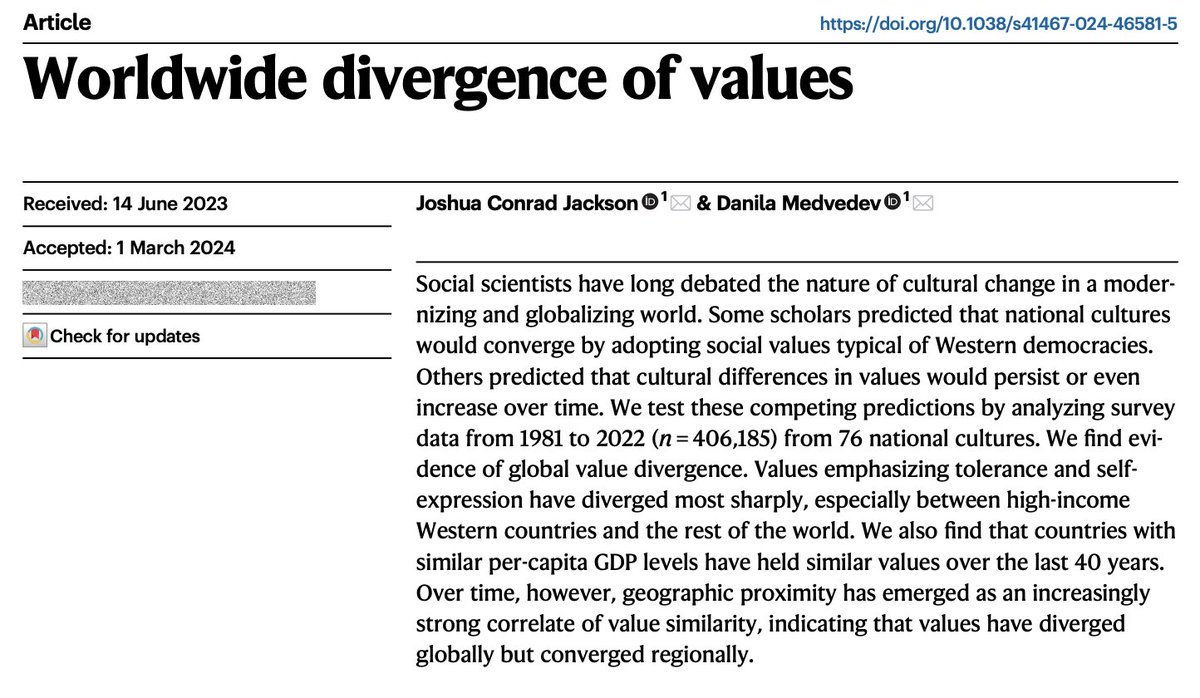
But this ignores basic human psychology: moral values, need for status, mimetic desires to dominate, need for meaning through sacrifice/religion are all integral to human motivation. These motivations operate all the time, but become even more extreme when material comforts *are* met. This is when people start looking for status and meaning on dimensions that seem self-destructive, fighting "metaphorical wars". You can see this in the divergence of values over time: as economies have become increasingly globalized and overall prosperity has increased, human values have *diverged* (see paper in reply).
These motivations are also why any "utopia" will always be doomed to fail.
Unlike many on here who critique economics, things like status, identity, mimetic forces are not outside the standard economics toolkit. There have been plenty of important papers written on status-seeking, culture, norms, and mimetic forces. But most of this work is either relatively recent or was on the periphery of economic thinking that permeated policy circles.
Séb Krier@sebkrier
Fukuyama was so prescient. In a society with strong rights and material comfort, but light on demanding shared purposes and some degree of sacrifice, thymotic energies go searching. Some quiet into bourgeois hedonism; other will seek “metaphorical wars” and eventually real ones.
English