

Onchain Judgment
3.1K posts
Onchain Judgment
@OnchainJudge
Independent views on crypto and market structure. Logic over hype. No signals, no noise.
Blockchain Katılım Ekim 2018
70 Takip Edilen6.8K Takipçiler

has already dropped 250× from its peak of $0.08! I’ve suffered heavy losses — I started buying at $0.02. Is there still a chance for me to break even? How can such a promising crypto perform so poorly? I’m planning to stake everything into node and wait anywhere from 6 months to 3 years. 100x?
#Supra #BTC #ETH #BNB #SOL #DOGE @SUPRA_Labs #PiNetwork pi-network:native

English
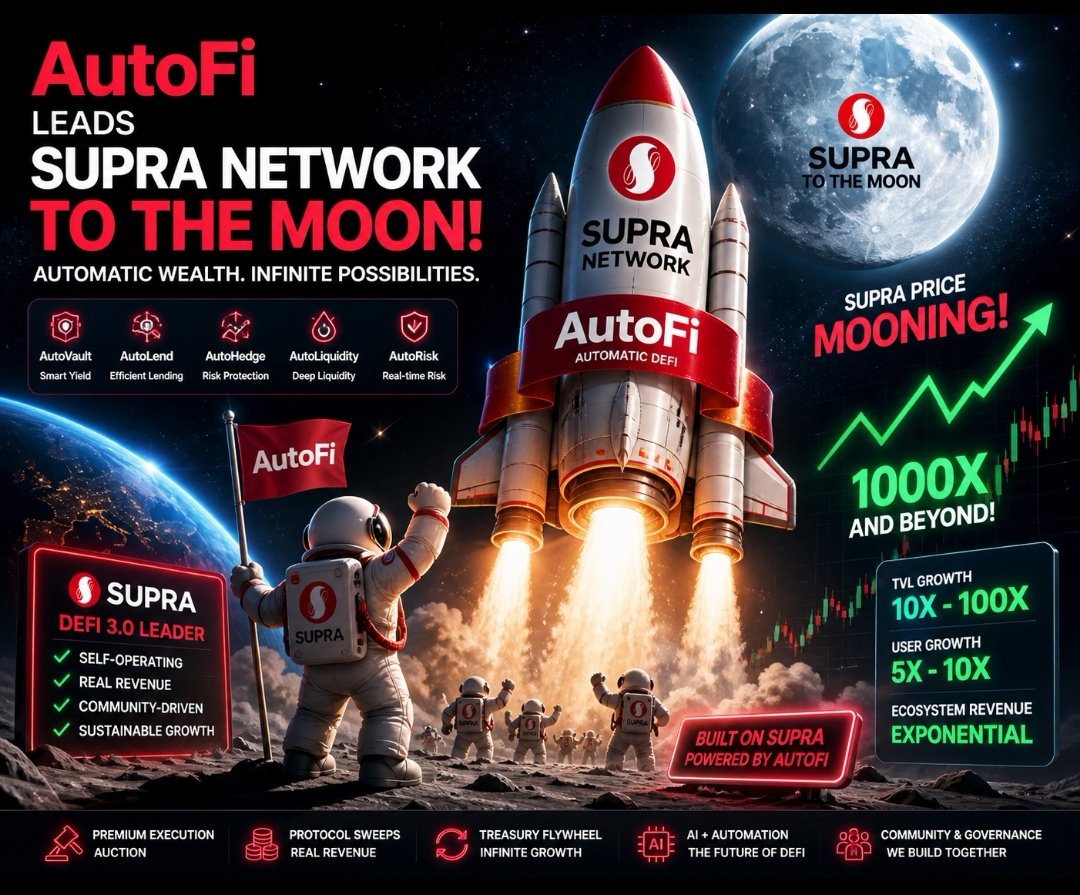
Supra AutoFi’s greatest innovation will bring DeFi 3.0 to life, driving supra:native toward 1000x growth.
At its core, Supra’s philosophy is: reconstruct DeFi primitives through Layer-1 system-level automation, creating a self-operating blockchain that continuously generates real revenue for the entire ecosystem.
AutoFi (Automatic DeFi) is the culmination of this vision—it is not just a tool, but an upgrade that transforms blockchain from a “settlement ledger” into a “proactive, real-time economic engine.”
Through native oracles, deterministic automation, cross-chain messaging, and high-performance smart contracts, AutoFi enables zero-block-delay autonomous financial coordination. Capital flows, risk management, and yield generation all become continuous, self-operating, and deterministic on-chain processes.
This creates exponential, multi-dimensional amplification effects for Supra, ultimately translating into investment returns:
1. Protocol-Level Revenue Flywheel (Treasury Self-Financing Loop)
Premium Execution Auction + Protocol Sweeps convert traditional MEV into fair protocol revenue. Auction proceeds and module fees (AutoVault performance fees, AutoLend interest, etc.) continuously flow into the Treasury. The AutoRisk real-time risk engine then intelligently deploys this capital into high-yield strategies, forming a positive loop:
more activity → more revenue → more capital deployment → higher TVL.
This is not subsidy-driven, but a sustainable, non-inflationary revenue model. Supra’s Treasury evolves into a programmable “sovereign yield fund,” directly benefiting validators, the ecosystem, and SUPRA holders.
2. Ecosystem Explosion: Attracting Builders & Snowballing dApp Growth
With 21+ plug-and-play primitives (AutoVault adaptive vaults, AutoHedge automated hedging, AutoLiquidity protocol market-making, etc.), developers can innovate with zero friction. No need for bots, keepers, or external oracles—lending, perpetuals, liquidity pools, and DAO treasuries become natively automated.
Supra becomes the ultimate home of the “Automated Finance OS,” attracting top protocols and AI-driven next-gen applications. TVL and transaction volume can easily surpass traditional L1s.
3. User Surge & Community Flywheel: From Manual DeFi to “Set It and Forget It”
Everyday users can configure intelligent strategies with one click in the AutoFi app—assets automatically defend, adapt, and grow. DAOs and institutions gain programmable hedge fund–like returns.
Viral adoption emerges naturally: stories like “my automated strategy yields XX% APY” spread across communities. Users earn passive income while also participating in governance and contributing strategy modules.
DeFi barriers are drastically lowered—newcomers, institutions, and passive investors flood in. The community evolves from a “traders’ club” into a “wealth compounding alliance,” with exponentially stronger loyalty and engagement.
AutoFi builds structured value capture for the SUPRA token—protocol revenue supports buybacks/dividends/node rewards, while TVL growth drives gas and staking demand. Supra is no longer “just another L1,” but a leader of DeFi 3.0, commanding valuation multiples far beyond its peers.
Soon, TVL could grow 10–100x, the user base 5–10x, and as ecosystem revenue scales, SUPRA holders will benefit from capital appreciation + continuous income + governance premium.
AutoFi is not just a feature of Supra—it is the embodiment of its purpose.
Self-operating systems, endogenous value creation, and shared community prosperity.
Short term: explosive user and activity growth.
Mid term: TVL flywheel acceleration.
Long term: Supra securing dominance in the era of automated intelligent finance.
Supra + AutoFi is turning DeFi into Automatic Wealth.
Are you ready to get on board?
#Supra #AutoFi #DeFi #AutomaticWealth #Crypto #Web3 @SUPRA_Labs #BTC #ETH #BNB #SOL #PINETWORK
English

supra:native has fallen from a peak of $0.078 to a low of $0.00031 — a 250x drop! Do you think #SUPRA can recover?
Projects that truly drive Crypto development often have lower market caps than many scam projects. Speculative trading and malicious harvesting of user funds are currently the main motivations behind most crypto projects. It’s terrible! A reset is coming!
@SUPRA_Labs #BTC #ETH #BNB #SOL #DOGE

English
A very important factor behind supra:native ’s decline is that early venture capital investors have been continuously selling off their holdings. Therefore, Supra’s token unlock mechanism is flawed.
I bought Supra at $0.02, and it dropped to $0.0002! I’ll keep staking!
#Supra @SUPRA_Labs #BTC #ETH #BNB #SOL #DOGE @coinbase @binance @Official_Upbit #pinetwork

English
Supra Network: The Most Powerful High-Performance Layer 1 of the AI Era — Infrastructure, the AutoFi Revolution, and Explosive Potential
As the AI wave sweeps across the globe, blockchain infrastructure is entering an unprecedented phase of evolution.
supra:native ’s potential far exceeds expectations—now is the optimal moment to seize the convergence of AI and blockchain.
I. Current Infrastructure: Vertically Integrated + Extreme Performance, Tailor-Made for the AI Era
Supra’s core competitive advantage lies in its globally leading vertically integrated architecture. Unlike traditional chains that rely on external services, Supra natively embeds all critical components, ensuring ultra-low latency, high throughput, and verifiable execution:
Moonshot Consensus & Tribes and Clans Network: Proven to reach 500,000 TPS with 300 nodes, achieving sub-second finality. Oracle data finality is just 600–900ms. This enables AI agents to react to market events in real time—similar to high-frequency trading systems—far beyond industry norms. The latest Hydrangea++ upgrade further pushes latency toward theoretical limits while improving throughput and fault tolerance.
IntraLayer Native Full-Stack Services: Built-in DORA Oracle (real-time price feeds), distributed VRF (verifiable randomness), Supra Automation (zero-block-delay automation), and SupraNova cross-chain messaging (bridgeless, eliminating traditional bridge risks). Developers no longer need to stitch together external tools—dApps gain seamless efficiency and security out of the box.
MultiVM Architecture & Supra Containers: Supports both EVM (Solidity-compatible) and MoveVM, with SupraEVM testnet already live and SolanaVM integration coming soon. Each dApp can run in its own customizable container, optimizing both performance and isolation.
These capabilities directly serve the core needs of the AI era: massive real-time data + verifiable autonomous execution.
Supra’s IntraLayer design transforms “autonomous decentralized agents” from theory into reality—laying the foundation for AI-driven financial innovation.
II. Future Infrastructure & Roadmap: SupraOS + Threshold AI Oracles + AutoFi Explosion
Supra’s roadmap is deeply focused on AI-native design and automation—and it’s already moving into real deployment. Supra 2.0 (AutoFi stack) is converting its infrastructure advantages into real productivity:
SupraOS (AI Agent Operating System): Alpha launched on April 20, 2026, with public release rolling out by the end of April. This is a blockchain-enforced, self-custodial AI agent management system with end-to-end encryption and local data control. AI agents can operate securely on Supra L1, enabling truly autonomous financial decision-making.
Threshold AI Oracles: A multi-agent AI committee capable of producing numerical judgments, structured commands, and eventually smart contract code (rolled out in phases). This upgrades oracles from passive data feeds to active reasoning engines with verifiable insights, directly powering intelligent DeFi strategies.
AutoFi (Autonomous DeFi): The first fully on-chain automated DeFi primitive, capable of sensing market events block-by-block and executing strategies autonomously (arbitrage, liquidity management, yield optimization). Combined with AI Oracles and system-level automation, this becomes the core engine of DeFi 2.0, generating sustainable protocol revenue and reducing reliance on inflationary incentives.
Upcoming key developments include:
SupraNova Reverse Bridge (burn-and-release mechanism) with HyperNova/HyperLoop for seamless bidirectional bridging across EVM chains and L2s
PoEL (Proof of Efficient Liquidity): Cross-chain staking, ownership verification, and governance
Full SolanaVM integration and expanded multi-chain support
Ongoing ecosystem incentives: $100M Builder Competition, grants, and accelerators
These are not empty promises—they are rapidly materializing milestones. Supra is transforming from a high-performance L1 into a true financial automation engine for the AI era, capturing the next wave of autonomous agents and cross-chain DeFi.
III. Community, Developers, and Investors: The Golden Entry Window Is Now
Imagine this: your AI agent operates 24/7 on-chain—executing trades, arbitraging across chains, optimizing yield—all securely, verifiably, and at ultra-high speed. You are both the builder and the beneficiary of this transformation.
For Developers:
MultiVM + native tooling = frictionless innovation. Whether you’re a Solidity developer or a Move enthusiast, you can build HFT-grade AI agent dApps with ease. With strong incentives ($100M competition, grants, accelerators) and tools like SupraScan and automation assistants already available, you can focus entirely on breakthrough products.
The AI era doesn’t need more ideas—it needs platforms that actually work. Supra is that platform.
For Investors:
Supra’s current market cap is only around $8.5 million (price ~ $0.00033), placing it at an extremely early stage. Backed by $42M+ in top-tier VC funding, with strong technical barriers and a perfect alignment with the AI + AutoFi narrative, it presents a highly asymmetric risk-reward profile.
Based on strong fundamentals, upcoming milestones, and sustained AI narrative momentum, Supra’s future outlook is highly compelling:
Short Term (by end of 2026):
Full rollout of SupraOS, AutoFi mainnet launch, Reverse Bridge & Pole online, rapid growth in TVL and users.
Market cap could reach $100M–$300M (price range $0.003–$0.01), representing 10–30x growth—just the beginning of “tech realization.”
Mid Term (2027–2028):
Becoming the de facto standard for AI agents and AutoFi, capturing a meaningful share of the AI + DeFi sector.
Market cap could rise to $500M–$1B+ (price $0.02–$0.05+), potentially higher in a bull market.
Long-Term Potential:
If AutoFi successfully enables self-sustaining protocol revenue and reshapes DeFi, Supra could challenge top-tier L1s, reaching tens of billions in market cap.
The AI era demands not just speed—but integration, intelligence, and autonomy—and Supra is fully positioned.
The future is already here. Are you ready?
Share your thoughts in the comments or join the #Supra ecosystem to help shape history. If you want to dive deeper into specific features or latest updates, let’s discuss!
#SUPRA #BTC #ETH #BNB #SOL #DOGE #TRX #PINETWORK pi-network:native @SUPRA_Labs @coinbase @Official_Upbit @binance

English
The design of Pi Network is meant to serve people — even in an AI-confused internet era.
Meanwhile, Supra Network is better suited for future AI interactions.
Robust infrastructure and high performance will be the key competitive advantages going forward.
Which has greater development potential?
#pinetwork #SUPRA #BTC #ETH #BNB #SOL supra:native pi-network:native

English
I used to be very optimistic about the development of Supra Network. But later I realized that most crypto projects currently have little to no real-world utility—they are largely in a speculative phase driven by pump-and-dump trading. Only a small number of founders can truly persist, but in the end many still fail due to a lack of sustained and sufficient funding.
I believe the @SUPRA_Labs genuinely want to achieve something meaningful in the crypto space. However, unfortunately, their background and financial strength are not strong enough, and they are currently in a difficult situation. The price of supra:native has been continuously falling—it’s quite unfortunate, dropping from $0.08 to $0.00032.
I’m planning to start buying a small amount every month to support those founder teams who are truly passionate about crypto.
#SUPRA #BTC #ETH #BNB #SOL #PINETWORK $PI

English
AI is evolving rapidly! Virtual internet products based on cryptography, mathematics, and logical systems—including crypto projects—are being challenged. Many security risks are about to be exposed, and numerous crypto projects may collapse. The threats from AI and quantum computing are looming. Everything may have to start over. Anything based purely on code might no longer be secure. Is AI surpassing human intelligence?
#AI #Crypto #Web3 #BTC #ETH #BNB #SOL #LTC #PINETWORK $PI
English
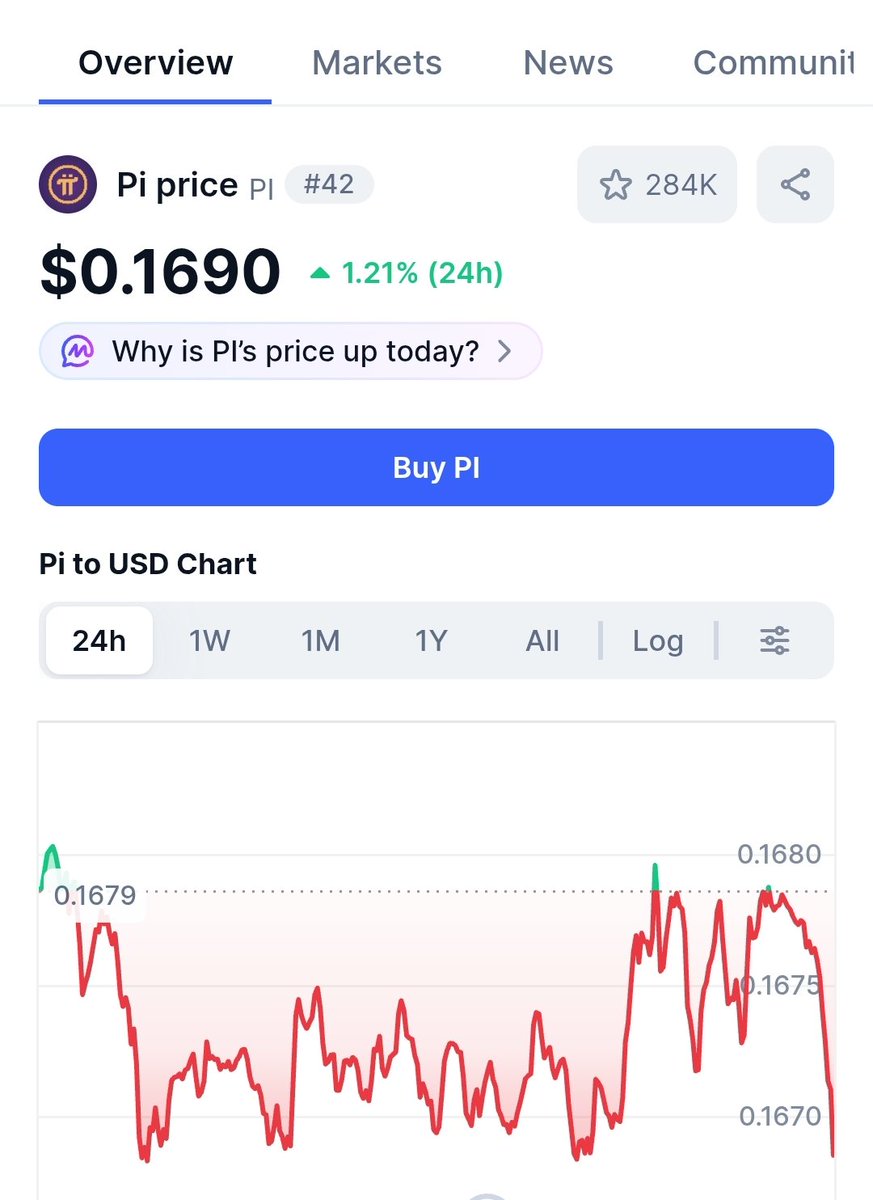
Is $Pi about to rise? However, I think this gradual development model is slower and more conservative than we imagined. So the real upward movement may only begin in the second half of the year.
#PiNetwork #BTC #ETH #BNB #SOL $PI
English
AI development is completely out of control: within 3–5 years it will reshape the rules of every industry, and its destructive impact on crypto may far exceed imagination
AI is reshaping the rules of the game at a pace humans can barely keep up with. It won’t just disrupt the crypto ecosystem—it may become a “double-edged sword” capable of undermining the overall trajectory of human development. In particular, the combination of AI + crypto is opening a Pandora’s box. Within 3–5 years, AI’s penetration into all industries (including but not limited to finance, healthcare, energy, and defense) will reach unprecedented depth, and crypto—being the foundational protocol of value and trust—will be among the first to be hit.
Anthropic’s Claude Mythos Preview is one of the sharpest proofs of this trend. It is so powerful that even Anthropic itself does not yet dare to fully release it.
Its core capability is singular, yet world-changing: it is exceptionally good at discovering and exploiting software bugs.
In just a few weeks, it has reportedly uncovered thousands of previously unknown, critical zero-day vulnerabilities, hidden in:
Mainstream operating systems (Windows, Linux, macOS)
Major web browsers
Even legacy code that has been running for 27 years
More alarmingly, it doesn’t just find bugs—it can directly generate full exploit code, turning vulnerabilities into real, executable weapons.
What does this mean for crypto and public blockchains?
Crypto security has always relied on two layers:
1. Cryptographic algorithms (mathematically robust, with quantum computing posing no immediate threat)
2. The actual software and code in operation (nodes, wallets, browsers, DeFi protocols, smart contracts, cross-chain bridges, RPC endpoints, etc.)
Mythos has little impact on the first layer, but it delivers a devastating blow to the second.
For example, in the Ethereum ecosystem, most assets and protocols run on ordinary computers, Linux servers, and browsers. Once a smart contract is deployed on-chain, it is immutable—even a single hidden bug can lead to funds being drained instantly.
In the past, bug discovery relied on manual audits and various tools—expensive, slow, and prone to missing issues. Now, AI at the Mythos level can perform this work automatically, cheaply, and efficiently. Attackers’ capabilities are exponentially amplified, while the cost of attacks drops dramatically.
Old contracts, legacy bridges, node remote control, RPC hijacking—risks that were once considered “low probability” are rapidly becoming high-probability events.
AI + crypto = a potentially destructive path for human development is not alarmism—it is an emerging reality.
That said, there is still a short-term window of opportunity.
Anthropic has not fully released Mythos. Instead, it launched the Project Glasswing initiative, granting access only to a small number of major companies and critical infrastructure organizations (including the Linux Foundation, Google, Microsoft, Apple, etc.). They are using Mythos to identify and fix bugs in open-source code and core software first—strengthening the foundations.
This means that for roughly the next year, ordinary attackers may not yet have access to such powerful tools. If public blockchain ecosystems can quickly collaborate with these partners and use Mythos-like systems to proactively scan their own code and protocols, they may significantly reduce risks in advance.
But this is only a temporary breathing window.
In the long term, the crypto industry must fundamentally upgrade its defense paradigm:
Developers must treat AI-powered formal verification + autonomous red teaming as mandatory steps before deploying new contracts;
Ecosystems (such as Pi) should fully adopt formal verification + multi-client architectures + top-tier AI real-time defense monitoring;
This combined approach is ten times more urgent than the threat of quantum computing.
AI is evolving so fast that the rules are already being rewritten—yet we are still relying on old-world defensive thinking.
Mythos is just the beginning. More powerful models will emerge every few months.
Do you think AI will destroy everything? I am deeply concerned. But historically, technological progress has always moved toward increasing complexity and reduced controllability—and there seems to be no easy way to stop it.
#AI #BTC #ETH #SOL #PiNetwork $PI
English
PCT seem intent on dragging things out for early pioneers who invited many people to join Pi Network—including those who invited only a few. The reason is simple: these users hold too much Pi. Even if they have completed KYC, they are not prioritized for migration to the mainnet.
For example, fewer than 5% of the people I invited are still mining. Even if I mined 1 million Pi, I might only have 100,000 Pi migrated to the mainnet—and I would still have to wait a very long time. As a result, many of these people have lost interest in Pi. They don’t even want to talk about it anymore—it feels like a waste of time.
I feel angry that many people made contributions in the past but have not received any rewards. PCT should feel ashamed of this. They should take responsibility. It’s truly disappointing. Very few people can continue to persist through such a long period of waiting without rewards or hope.
How many early pioneers still haven’t received their Pi? Some haven’t even had their KYC approved yet—what kind of situation is this?
I don’t support this kind of development model. What I truly hope for is a fair, transparent, and genuinely user-centric system — one that focuses on maximizing the real value and participation of Pi Network’s massive global community.
Right now, instead of activating and empowering users, the current approach is gradually draining trust and confidence. A large number of early pioneers — the very people who contributed to the foundation of this network — still haven’t completed KYC or received their mainnet migration. Yet there is no clear timeline, no structured rollout plan, and no visible prioritization that reflects fairness.
This creates a growing sense of uncertainty and frustration. People are not leaving because they don’t believe in the vision — they are leaving because they no longer see a path forward.
A community of over 60 million users is an incredible asset, but it is not unlimited. If this model continues, what was once a powerful and engaged user base will slowly be consumed by disappointment and inactivity.
What Pi Network should be doing is the opposite:
providing clarity, setting expectations, prioritizing inclusiveness, and ensuring that early contributors are not left behind. The goal should be to activate the community, not exhaust it.
A truly sustainable ecosystem is built on fairness, transparency, and trust — not prolonged uncertainty and uneven progress. Providing pioneers with clear and certain hope is the fundamental solution. However, many pioneers can no longer see it — and no longer need it.
So perhaps we shouldn’t spend too much time focusing on Pi anymore. It’s better to return to other topics that actually have value.
#PiNetwork #BTC #ETH #BNB #SOL $PI @PiCoreTeam

English
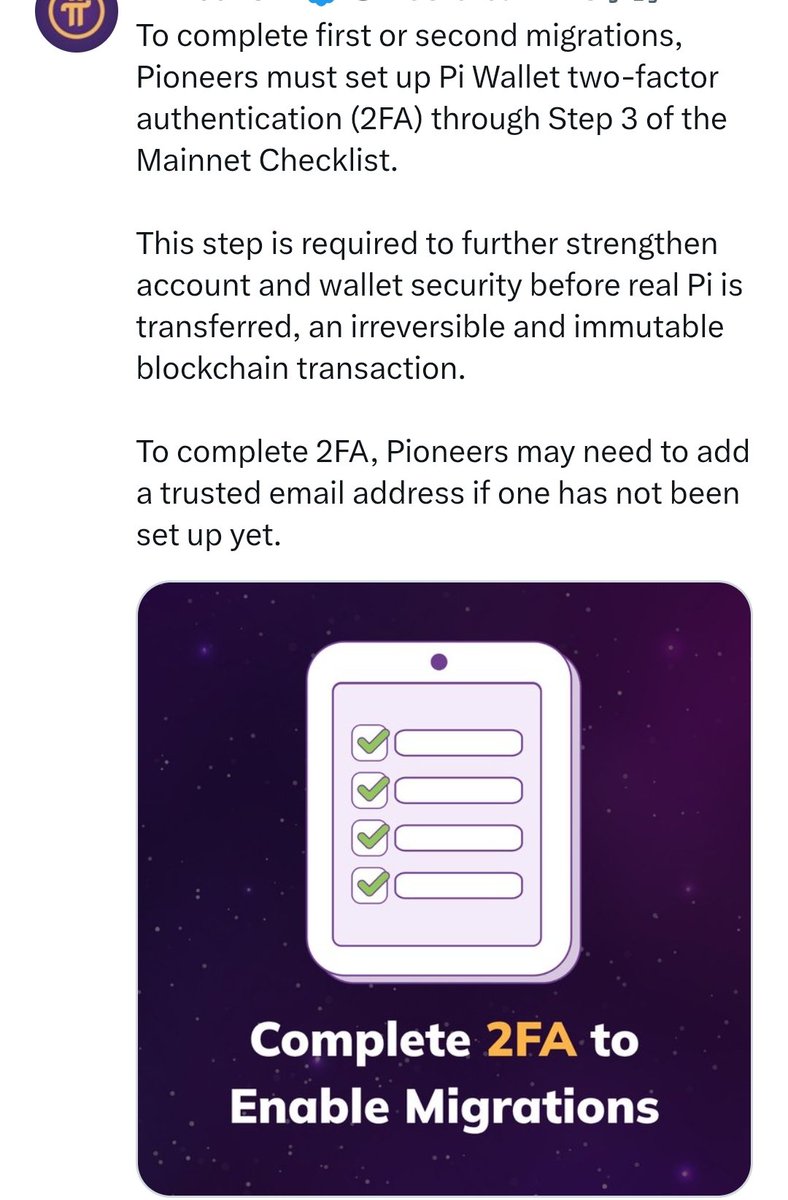
The notice released by PCT is honestly a joke! They’ve already posted it at least five times—so why do they still need to remind people? Because the results have been poor.
In my view, the extremely long waiting period has caused many early pioneers to forget their accounts, change their phone numbers, or lose access to their Facebook accounts. As a result, they no longer receive any Pi-related updates. Most people have already completely left Pi Network.
And the email feature was only added around 2021—everything came far too late. This critical mistake was caused by PCT.
To be honest, Pi Network does not have 60 million active users. More accurately, maybe over 50 million people have mined Pi for a long period at some point. But those who have submitted documents for KYC verification might only be around 30–40 million. Do you agree?
It’s really unfortunate. The user loss caused by them is irreversible. That’s why I’ve always believed their development strategy has led to serious problems. Massive user attrition is a huge, irreversible loss—and it’s still ongoing.
Because many pioneers still haven’t completed KYC or even their first migration. We must speak for more people, not just ourselves. Everyone who contributed should be rewarded. But in the end, many people won’t receive even a single Pi. That’s quite ironic.
#PiNetwork #BTC #ETH #BNB #SOL @PiCoreTeam #doge
English
The crypto is full of fake “experts.” After many DeFi projects get hacked (or perhaps even by their own development teams) and massive assets are stolen, these people suddenly claim that those projects were centralized rather than decentralized.
Why didn’t they point this out earlier, when those well-known DeFi projects were still in their early stages? In the end, it’s all just chasing hype.
Isn’t there any team building a platform to analyze and provide this kind of security insight? The crypto space needs guardians like that.
#BTC #ETH #BNB #SOL #PINETWORK #web3
English
Pi Network is extremely unfriendly to everyone! This development model is destined to make the earliest supporters suffer the most. Early ecosystem developers will become the biggest victims. The marketplace-type projects heavily supported by @PiCoreTeam have no real future, and DeFi projects will also be abandoned.
This mainnet, which is tightly controlled by PCT, will never allow them to enter early. Only when the mainnet is fully open will there be any real opportunity. Therefore, DeFi projects developed by third-party teams will have to wait the longest.
There are several reasons for this:
1. Security concerns
2. PCT does not want too much speculative trading
3. They are definitely unwilling to hand over such a critical sector to third-party teams
Practical and innovative projects are the ones most supported. The progress of Pi’s open network is far slower than we expected. So just keep waiting—until everyone is exhausted.
Do you still have the same passion as five years ago? No. That’s the reality.
But PCT seems to have ignored this. More and more people are losing interest as they grow older and as the crypto industry declines. How much longer will PCT make pioneers wait? Are they failing to make effective use of resources—including their own?
#PiNetwork #BTC #ETH #BNB #SOL #DOGE #WEB3
English