Open Infrastructure Chile

161 posts

Open Infrastructure Chile banner
Open Infrastructure Chile

Open Infrastructure Chile

@OpenInfraChile

Open Infrastructure is a regional Open Infrastructure User Group focused on community development across Chile. Join the community at: https://t.co/V0sXpybRxT

Santiago de Chile Katılım Ağustos 2013
514 Takip Edilen163 Takipçiler
Open Infrastructure Chile retweetledi
Wind River
Wind River@WindRiver·
.@TELUS is deploying 50% of their network to Open RAN in the next few years. Take a #SmartMinute to get a little bit smarter. Interested in hearing more about TELUS' Open RAN experience? Watch the full-length video here: #what_our_customer_say" target="_blank" rel="nofollow noopener">windriver.com/solutions/tele… @openinfradev #OpenRAN #OpenInfra
English
0
1
1
133
Open Infrastructure Chile retweetledi
Ceph
Ceph@Ceph·
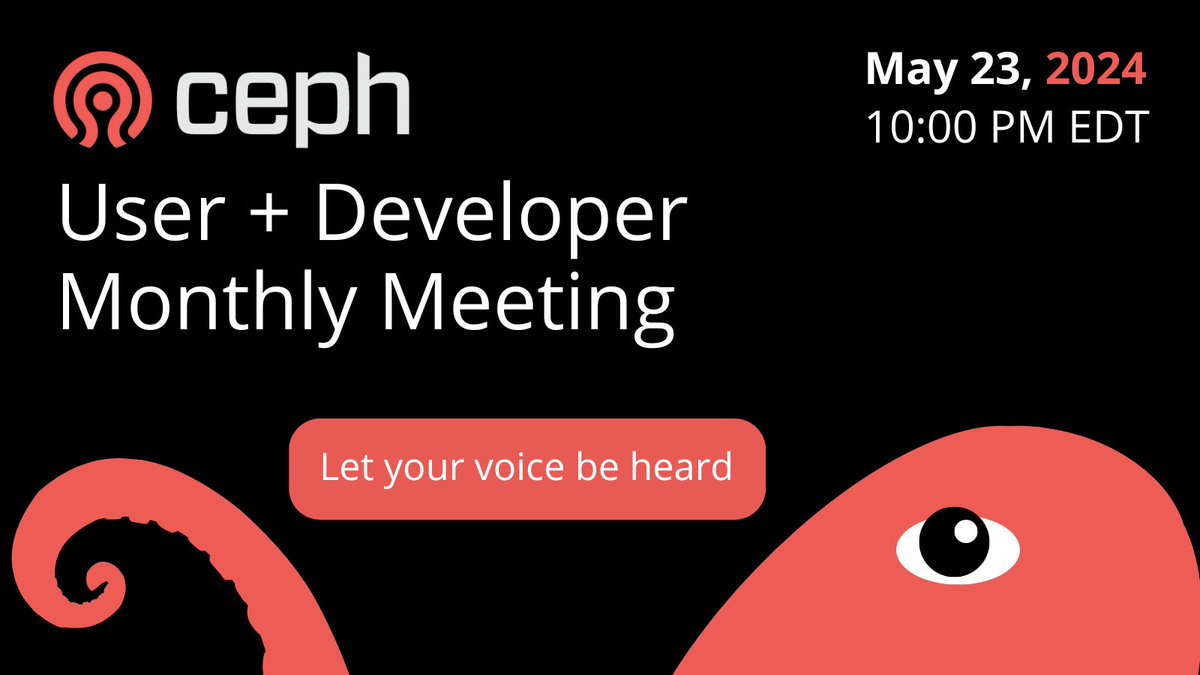
Our next Ceph User + Developer Monthly Meeting is coming May 23! The goal of these meetings is to elicit feedback from the users, companies, and organizations who use #Ceph in their production environments. Take the survey and share your voice: hubs.la/Q02wyKy20
Ceph tweet media
English
0
6
10
855
Open Infrastructure Chile retweetledi
OpenInfra Foundation
OpenInfra Foundation@openinfradev·
Join the OpenInfra community in translating the official Code of Conduct into Spanish to increase accessibility for the global community! Participate by reviewing the language and translating additional sections directly in GitHub. ow.ly/X9mj50QivGf
English
1
4
9
295
Open Infrastructure Chile retweetledi
Alex Xu
Alex Xu@alexxubyte·
What does ACID mean? The method to download the high-resolution PDF is available at the end. The diagram below explains what ACID means in the context of a database transaction. 🔹 Atomicity The writes in a transaction are executed all at once and cannot be broken into smaller parts. If there are faults when executing the transaction, the writes in the transaction are rolled back. So atomicity means “all or nothing”. 🔹 Consistency Unlike “consistency” in CAP theorem, which means every read receives the most recent write or an error, here consistency means preserving database invariants. Any data written by a transaction must be valid according to all defined rules and maintain the database in a good state. 🔹 Isolation When there are concurrent writes from two different transactions, the two transactions are isolated from each other. The most strict isolation is “serializability”, where each transaction acts like it is the only transaction running in the database. However, this is hard to implement in reality, so we often adopt loser isolation level. 🔹 Durability Data is persisted after a transaction is committed even in a system failure. In a distributed system, this means the data is replicated to some other nodes. – Subscribe to our newsletter to download the 𝐡𝐢𝐠𝐡-𝐫𝐞𝐬𝐨𝐥𝐮𝐭𝐢𝐨𝐧 𝐏𝐃𝐅. After signing up, find the download link on the success page: bytebytego.ck.page/9ae2dcca3a
GIF
English
15
312
1.3K
100.8K
Open Infrastructure Chile retweetledi
Alex Xu
Alex Xu@alexxubyte·
Explaining 8 Popular Network Protocols in 1 Diagram. The method to download the high-resolution PDF is available at the end. Network protocols are standard methods of transferring data between two computers in a network. 1. HTTP (HyperText Transfer Protocol) HTTP is a protocol for fetching resources such as HTML documents. It is the foundation of any data exchange on the Web and it is a client-server protocol. 2. HTTP/3 HTTP/3 is the next major revision of the HTTP. It runs on QUIC, a new transport protocol designed for mobile-heavy internet usage. It relies on UDP instead of TCP, which enables faster web page responsiveness. VR applications demand more bandwidth to render intricate details of a virtual scene and will likely benefit from migrating to HTTP/3 powered by QUIC. 3. HTTPS (HyperText Transfer Protocol Secure) HTTPS extends HTTP and uses encryption for secure communications. 4. WebSocket WebSocket is a protocol that provides full-duplex communications over TCP. Clients establish WebSockets to receive real-time updates from the back-end services. Unlike REST, which always “pulls” data, WebSocket enables data to be “pushed”. Applications, like online gaming, stock trading, and messaging apps leverage WebSocket for real-time communication. 5. TCP (Transmission Control Protocol) TCP is is designed to send packets across the internet and ensure the successful delivery of data and messages over networks. Many application-layer protocols build on top of TCP. 6. UDP (User Datagram Protocol) UDP sends packets directly to a target computer, without establishing a connection first. UDP is commonly used in time-sensitive communications where occasionally dropping packets is better than waiting. Voice and video traffic are often sent using this protocol. 7. SMTP (Simple Mail Transfer Protocol) SMTP is a standard protocol to transfer electronic mail from one user to another. 8. FTP (File Transfer Protocol) FTP is used to transfer computer files between client and server. It has separate connections for the control channel and data channel. – Subscribe to our newsletter to download the high-resolution PDF. After signing up, find the download link on the success page: bytebytego.ck.page/3581072b8e
English
79
4.4K
17.4K
2.9M
Open Infrastructure Chile retweetledi
Outreachy Internships
Outreachy Internships@outreachy·
Goodnews!! We received a flood of applications for the December 2023 internship cohort. Kindly check your mailbox or the Outreachy website dashboard to confirm your status. Congratulations to you all!
English
37
47
422
58.1K
Open Infrastructure Chile retweetledi
KCDGuatemala
KCDGuatemala@kcdguatemala·
Estas a un clic de todo un mundo, tal vez desconocido o ya transitado, donde podrás aprender y convivir acercá de Kubernetes. Te esperamos este 18 y 19 de agosto. Registro en kcdgt.com. Un evento de CNCF Linux Foundation. #KCDGuatemala2023 #kubernetes #linux
Español
0
4
4
222
Open Infrastructure Chile retweetledi
KCDGuatemala
KCDGuatemala@kcdguatemala·
Este 19/agosto en Tec Guatemala Douglas Alexander Lopez Rodriguez estará hablando sobre el tema "Custom Microservices deployments usando helm operators". No te lo pierdas. Registro en  kcdgt.com para ver su charla online. Cupo limitado @KubernetesDays #kubernetes
KCDGuatemala tweet media
Español
0
7
9
377