Sabitlenmiş Tweet

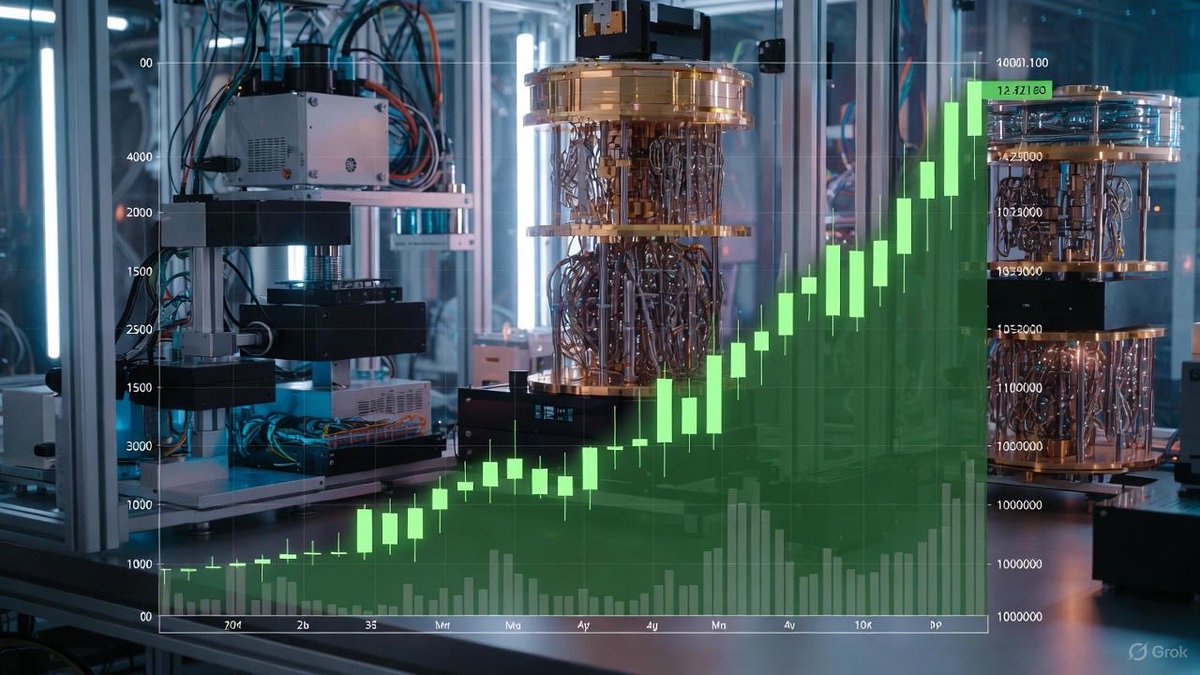
1994: IBM said “practical quantum computers in 20–30 years”
2025: 1,121 qubits
2029: >100,000 planned
Shor arrives exponentially — not linearly.
Anyone still betting on 20+ years is doing wishful physics.
English
Paul Quintin Cross
2.1K posts

@PQCArchive
Post-Quantum Cryptography. Migration risk. Timelines.
Nobody is talking about what the helium shortage means for quantum computing. Every superconducting quantum computer on earth, every system at IBM, Google Quantum AI, and Quantinuum, operates inside a dilution refrigerator cooled to approximately 10 to 20 millikelvin. That is colder than outer space. The cooling mechanism relies on the phase separation of a helium-3 and helium-4 mixture below 0.87 kelvin, where helium-3 atoms continuously cross the boundary between two quantum phases, absorbing heat in the process. There is no substitute for this mechanism at scale. It is the physics that makes superconducting qubits possible. Qatar produces one-third of the world’s helium as a byproduct of LNG processing at Ras Laffan. Iranian missiles hit Ras Laffan on March 18 and 19. QatarEnergy declared force majeure. Repairs will take three to five years. Helium spot prices have doubled. Approximately 200 specialized cryogenic containers worth roughly $1 million each are stranded in the Middle East, and their cargo begins boiling off after 35 to 48 days. The Quantum Computing Report and Nature flagged on March 27 that US quantum labs have begun implementing rationing protocols for helium-3 and helium-4 mixtures used in dilution refrigerators. Delayed cooldown cycles are being reported at IBM Quantum and Quantinuum facilities. The potential impact: 6 to 18 months of delays in qubit scaling timelines and post-quantum cryptography testing. Modern closed-cycle “dry” dilution refrigerators significantly reduce liquid helium consumption, and labs maintain months of inventory with recycling rates above 80 percent. Trapped-ion platforms like IonQ have minimal helium dependency. No quantum lab has shut down. The counterarguments are real and must be stated at full strength: quantum computing uses a tiny fraction of global helium supply, roughly 0.1 to 0.5 percent, and rationing prioritizes critical applications. But the second-order effects are what matter for trillion-dollar allocators. If qubit scaling delays by 6 to 18 months, then post-quantum cryptography standards migration slows by the same interval. That means the window during which current encryption remains vulnerable to future quantum attack extends. Every central bank, every sovereign wealth fund, every institution holding assets secured by RSA or elliptic-curve cryptography has a direct exposure to this timeline. And helium-3 is also the working fluid in the dilution fridges used for fusion energy research. The same shortage rationing quantum labs is rationing the facilities developing the energy source that could eventually replace the fossil fuels flowing through the strait that caused the shortage. The circularity is total. Follow the chain. Iranian missiles hit a Qatari gas plant. The gas plant produced helium as a byproduct. The helium cooled quantum computers to temperatures colder than deep space. The quantum computers were developing the encryption standards that protect the global financial system. The financial system runs on energy that transits the strait that Iran just blockaded. One missile. Six domains. Every node connected through a single element that weighs four atomic mass units, cannot be manufactured, and has no substitute. The market priced the oil. It has not priced the helium. And it has not begun to price the quantum. open.substack.com/pub/shanakaans…
🚀 Finland Just Hit the Quantum Future – Are You Ready to See It? Something extraordinary just happened at Aalto University in Finland. Scientists witnessed the launch of a brand-new quantum computer — IQM’s fourth one in the country. But this isn’t just any computer. It has 20 qubits, meaning it can solve problems in seconds that would take normal computers centuries. Imagine the secrets it could unlock, the discoveries it could make… and the possibilities it opens for the future of technology. Europe’s quantum revolution is here, and Finland is leading the charge. Could this machine change everything we thought we knew about computing? Source: The Quantum Insider. (2026). IQM launches fourth quantum computer at Aalto University in Finland.
NEWS 🚨: Google warns: quantum computers will break all the internet encryption by 2029. Emails, Bank systems, HTTPS, VPNs, Bitcoin are at risk.


🚨 UPDATE: Google sets 2029 deadline for post-quantum cryptography migration as quantum threats draw nearer.

Google bumps up Q Day estimate to 2029, far sooner than previously thought arstechnica.com/security/2026/…

If 2026 wasn't enough already: Google's worried Q-day is as early as 2029. blog.google/innovation-and…


Read the full story: cointelegraph-magazine.com/dirty-secret-q…
This is potentially the biggest news of the year Google just released TurboQuant. An algorithm that makes LLM’s smaller and faster, without losing quality Meaning that 16gb Mac Mini now can run INCREDIBLE AI models. Completely locally, free, and secure This also means: • Much larger context windows possible with way less slowdown and degradation • You’ll be able to run high quality AI on your phone • Speed and quality up. Prices down. The people who made fun of you for buying a Mac Mini now have major egg on their face. This pushes all of AI forward in a such a MASSIVE way It can’t be stated enough: props to Google for releasing this for all. They could have gatekept it for themselves like I imagine a lot of other big AI labs would have. They didn’t. They decided to advance humanity. 2026 is going to be the biggest year in human history.

#Ethereum PQ Migration strategy, let’s break it down and get real. “Quantum computing will eventually break the public-key cryptography that secures ownership, authentication, and consensus across all digital systems.” Officially, it is no longer if, but when. Important narrative change. Definitive. Absolute. “Enabling users to transition to quantum-safe authentication through account abstraction, without a disruptive ‘flag day.’” This references migration only, not disabling legacy ECDSA signed transactions. The important part has still not been solved. The official page pq.ethereum.org explicitly states that the fate of unmigrated funds “is ultimately a community governance question. Two natural scenarios exist: do nothing, or freeze vulnerable coins.” To me, this language points toward forks. If you hold ETH today, a “do nothing” outcome leaves vulnerable coins stealable, while a freeze (or lockup in a smart contract for years) means you could effectively lose access to those funds. Either path creates winners and losers. Assuming everything runs as designed, the implication, though never stated outright, is that some legitimate accounts will lose funds. Governance decisions, and in my view inevitable forks, will ultimately dictate who keeps what. Is this acceptable? Maybe, maybe not. It is a philosophical question, and not everyone will agree. Hence forks. I see no other realistic outcome. Ethereum’s own consensus puts the at-risk portion at roughly 0.1 percent to 5 percent of supply. But here is what is not said. This narrow risk estimate assumes that all upgrades will be completed before cryptographically relevant quantum computers (CRQCs) become available, development of which is occurring under extremely high levels of nation-state classification, with public timelines highly uncertain. “What is at risk” also does not factor in the very real conditions under which accounts might not migrate: dormant or long-inactive accounts, lost or irrecoverable private keys, unaware or uninformed users, technical or UX friction in migration, economic disincentives or negligible value from dust holdings, institutional or custodial or contractual barriers, immutable or non-upgradeable smart contracts, multi-party coordination failures, timing and governance delays, distrust of new PQ schemes, and legal or estate complications. Justin Drake (Ethereum Foundation researcher) has explicitly framed this view in the recent Bankless podcast, estimating that “at max two, three, four, five percent maybe” of Ethereum supply consists of funds that are “both lost and in quantum crackable addresses,” with his concrete prediction being around 2 percent, roughly an order of magnitude less than Bitcoin’s comparable exposure. He argues this small percentage carries “qualitative consequences,” leading him to “strongly advocate for not doing anything and really honoring property rights because at the end of the day, whatever, 2 percent is not a big deal.” Independent verification has not been performed and even so, well, it's probably not a big deal.... at least to 95% of the Ethereum community, minus the unrepresented account holders listed above. They might not be to happy about it. So the real question is still unanswered, how much is REALLY at risk? No one knows. Sources - (Bankless podcast, March 2026) Citations / Sources: • Official Post-Quantum Ethereum page: pq.ethereum.org • Justin Drake on Bankless podcast (March 2026): bankless.com/podcast/ethere… and full transcript at podscripts.co/podcasts/bankl… pq.ethereum.org



No major changes so far... Markets are being battered, with the situation surrounding Iran still undefined. With each new piece of news, the chart moves downwards, both in #BTC and other markets. The S&P 500 is already extremely negative, with a drop of 1.60%. Silver fell 5% today, and gold followed suit, already down 2.30%. Bitcoin has continued to fluctuate between negative and positive and, at the moment, is down 0.30%, still insignificant. But, in the case of BTC, it's not how much it fell that will matter, but where it will close the daily candle. In the next 6 hours, we will have a better definition of the situation surrounding #BTC, and a close still above $70k will leave the bulls with some strength for the weekend. The central idea here is that we cannot fall below $69k, or the bears will gain ground quickly. I still think we'll see big buyers acting in this region again, and we'll still salvage the daily candle. Yes, I know it's much easier to project a drop from here, but almost always when the crowd points in one direction, it's usually the wrong one. The fear is evident: look at USDT.D and you'll see that retail quickly hid there when the news started coming out. However, there also seems to be difficulty in staying above 7.71%. We should see a close below that region today. If that happens, we could see some relief over the weekend, both with #BTC going to $72k and with altcoins rising 10% or more. There's a lot of uncertainty out there. Stay alert if you're trading!