Patrick Hillmann

1.1K posts

Patrick Hillmann banner
Patrick Hillmann

Patrick Hillmann

@PRHillmann

Orderer of Chaos & Policy Junkie. Current CSO at Logical Intelligence, former CSO at Binance. GE, Edelman.

Chicago & Washington DC Katılım Ağustos 2010
694 Takip Edilen6.9K Takipçiler
Patrick Hillmann retweetledi

The Neuron
The Neuron@theneurondaily·
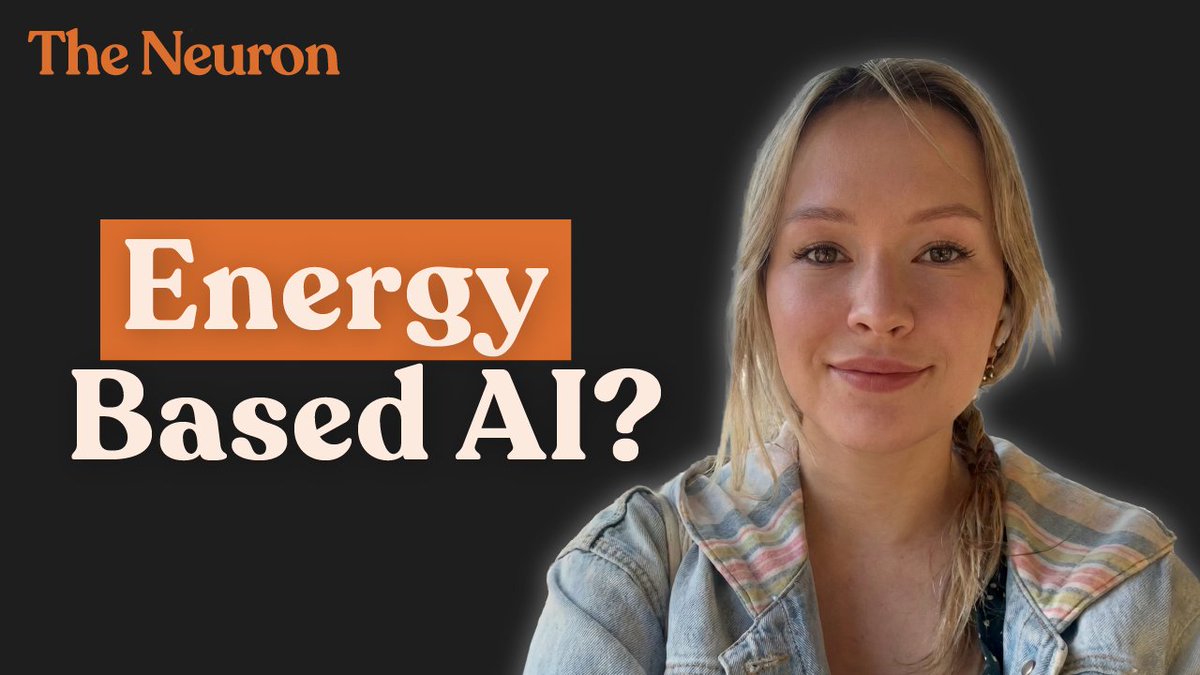
If AI only predicts words, is it really thinking? 🤔 In this episode of The Neuron, we sit down with @evelovesolive, Founder and CEO of @logic_int, to explore energy-based models — a fundamentally different way to build AI systems that reason, plan, and evaluate multiple possibilities at once. 📺 YouTube: link.theneurondaily.com/r/EIi7C9 🎧 Spotify: link.theneurondaily.com/r/FjG5tF 🎙️ Apple Podcasts: link.theneurondaily.com/r/xHFMRl #TheNeuron #TechPodcast #EnergyBasedModels #LogicalIntelligence #LLMAlternatives
The Neuron tweet media
English
0
4
15
740
Patrick Hillmann retweetledi
WIRED
WIRED@WIRED·
As the world’s largest companies pour hundreds of billions of dollars into large language models, San Francisco-based Logical Intelligence is trying something different in pursuit of AI that can mimic the human brain. wired.com/story/logical-…
English
6
8
57
33K
Patrick Hillmann retweetledi
Rohan Paul
Rohan Paul@rohanpaul_ai·
Logical Intelligence introduces first energy-based reasoning AI Model, and brings Yann LeCun to leadership as founding chair of their Technical Research Board The 6-month-old Silicon Valley start-up, unveiled an “energy based” model called Kona and says it is more accurate and uses less power than large language models like OpenAI’s GPT-5 and Google’s Gemini. It is also starting a funding round that targets a $1bn-$2bn valuation and has named LeCun chair of its technical research board. Most large language models answer by predicting the next token, which can sound fluent while still drifting into confident mistakes. Kona is an "energy-based reasoning model" (EBRM) that verifies and optimizes solutions by scoring against constraints, finding the lowest "energy" (most consistent) outcome. It's non-autoregressive, producing complete traces without sequential generation, reducing hallucinations. Focuses on trustworthy, math-grounded reasoning for high-stakes applications where LLMs fail, emphasizing safety, efficiency, and constraint enforcement in logic-heavy tasks like puzzles or proofs. How Kona operates Its a non-autoregressive "energy-based reasoning model" (EBRM) model, meaning it doesn't generate outputs sequentially (like LLMs do token-by-token) but instead produces complete reasoning traces simultaneously. Here's how it works step-by-step: - Input Conditioning: It takes a problem, constraints, and optional targets (e.g., a desired outcome like a proof goal or spec) as inputs. These condition the model directly, unlike LLMs which rely on probabilistic sampling. - Energy Function Scoring: Kona learns an energy function that assigns a scalar "energy" score to entire reasoning traces (partial or complete). Low energy indicates high consistency with constraints and objectives; high energy flags inconsistencies, violations, or errors. This global scoring evaluates end-to-end quality, allowing the model to assess long-horizon coherence without degrading over extended traces. - Optimization as Reasoning: Reasoning is reframed as an optimization problem. The model searches for the lowest-energy solution by minimizing the energy function, often through iterative refinement. It can revise any part of a trace mid-process, using dense feedback to localize failures (e.g., "this step violates constraint X") and guide corrections. - Continuous Latent Space: Unlike discrete token-based LLMs, Kona works in a continuous space with dense vector representations. This enables precise, gradient-based edits and efficient local refinements without regenerating entire sequences. - Output: The final low-energy trace represents a valid, constraint-satisfying solution. For example, in Sudoku, it maps allowable moves and finds a puzzle completion that minimizes energy (i.e., maximizes rule adherence). This mechanism draws from physics-inspired principles, where energy minimization finds stable states, similar to how natural systems settle into low-energy configurations. Overall, Logical Intelligence views EBMs as a path beyond LLM limitations, enabling AI that "knows" rather than guesses, with applications in verifiable, efficient reasoning. This aligns with LeCun's long-standing advocacy for objective-driven AI via energy minimization, as opposed to autoregressive prediction.
Rohan Paul tweet mediaRohan Paul tweet media
English
81
234
1.6K
306.9K
Patrick Hillmann retweetledi
TBPN
TBPN@tbpn·
BREAKING: Logical Intelligence has signed Meta’s former Chief AI Scientist @ylecun as the Founding Chair of the Technical Research Board
TBPN tweet media
English
9
10
202
50.7K
Logical Intelligence
Logical Intelligence@logic_int·
Our Aleph agent, powered by @OpenAI 's GPT‑5.2, scored 668/672, 99.4% w/hyper-efficiency on @gtsoukal et al.'s PutnamBench (the hardest formal math benchmark) a critical step in natural language automated code generation — English as programming — with hallucination-free results
Logical Intelligence tweet media
English
25
49
340
67.2K
Patrick Hillmann
Patrick Hillmann@PRHillmann·
There has been some noise on this platform about @OpenAI's GPT 5.2 model that was off-base. GPT 5.2 can reason mathematically at a level most people haven’t clocked yet. When you force it through a deterministic proof loop, the results are startling, as evidenced by @logic_int shattering the record and scoring 99.4% on PutnamBench. Congrats to both the @OpenAI and @logic_int teams
Logical Intelligence@logic_int

Our Aleph agent, powered by @OpenAI 's GPT‑5.2, scored 668/672, 99.4% w/hyper-efficiency on @gtsoukal et al.'s PutnamBench (the hardest formal math benchmark) a critical step in natural language automated code generation — English as programming — with hallucination-free results

English
0
2
5
916
Patrick Hillmann retweetledi
Logical Intelligence
Logical Intelligence@logic_int·
🚀 Aleph prover just went BEAST MODE 4 math problems unsolved for 20+ years. Formal proofs in Lean 4. Less than 48 hours. Under $5k total. ✅ Binomial tail bounds conjecture (Telgarsky, 2009) ✅ Quantum gate lattice approximation (Greene & Damelin, 2015)* ✅ Erdős 124 ✅ Erdős 481 ✅ #1 on PutnamBench leaderboard The era of AI mathematics is here. Special thanks to @BorisHanin and @ylecun for helping bring this to life 🙏 And massive kudos to the @LeanFRO team — none of this is possible without the incredible foundation you've built. Aleph will be soon available to the public, stay tuned! *conditional on results from Sardari (2015), formalization pending
English
27
73
380
116.2K
Nate Morris
Nate Morris@NateMorris·
It's garbage day in Kentucky and thanks to Mitch McConnell, things have gotten dirty. It's time to dump career politicians and take out of the trash. DONATE: secure.winred.com/morris-for-sen…
English
519
2.8K
8.2K
1.2M
Patrick Hillmann retweetledi
CoinDesk
CoinDesk@CoinDesk·
EXCLUSIVE: @binance exec Tigran Gambaryan said that, if asked, he would be proud to serve his country fighting crypto crime under the incoming Trump administration. By @IanAllison123. trib.al/v2Nk6NZ
English
21
10
40
25.8K
Eleanor Terrett
Eleanor Terrett@EleanorTerrett·
You know the wind is changing when former @SECGov enforcement attorney and frequent criticizer of the #crypto space @JohnReedStark is making statements like this. 👇🏼
John Reed Stark@JohnReedStark

Nah -- I'm too old for trolling (and I don't really know what "trolling" is anyway Eleanor). But I do know that the people have spoken and should be respected. The SEC's crypto-enforcement wave (which has been extraordinarily successful in the Courts) should stop -- and the SEC should instead refer crypto-matters out to other law enforcement and regulatory agencies. There doesn't seem to be a half-way. In other words, it will be tough for an SEC Chair on the one hand, per the ' 33 Act, argue that digital assets are securities so fraud in connection with certain digital assets is a securities law violation, but then on the other hand, per the ' 34 Act, argue that digital assets are not securities, so entities transacting in them need not register. Mark my words, with respect to SEC crypto-enforcement and rule-making, an SEC "pause to study the technological innovation of digital assets" is coming -- perhaps under the auspices of a "task force" or "special study." And that's fair, given the election results. SEC Chair Gary Gensler should respect the landslide victory of Big Crypto and the SEC staff should not partake in any sort of deep state subversion. The people have spoken, it's crypto-caveat emptor going forward . . . and let the chips fall where they may.

English
38
199
1.1K
125.3K
Patrick Hillmann
Patrick Hillmann@PRHillmann·
I know what country he’s a citizen of, where he lives, his “nationality,” and a hobby he has that would dramatically narrow down his identity for someone inclined to investigate. But why does it matter? If he wants his anonymity, he should have it.
English
0
0
2
430
Patrick Hillmann
Patrick Hillmann@PRHillmann·
There are three people in the USG that I am aware of who know the actual identity of Satoshi. I am very close with one of those individuals. While that person will never tell me who it is, I do know for a fact that it is not Peter Todd...nor any other North American for that matter politico.eu/article/peter-…
English
3
3
8
2.3K