Patrice Viot Coster
3.6K posts

Patrice Viot Coster
@PViotCoster
Sparring partner d'#entrepreneurs, offrant une chambre d'écho confidentielle, une curiosité exploratoire & un questionnement structurant
Paris, France Katılım Temmuz 2015
245 Takip Edilen492 Takipçiler
Sabitlenmiş Tweet

"Si l’entreprise veut de l’#innovation et de l’inattendu, elle doit laisser la possibilité aux salariés de le provoquer." @profhamel
Français
Patrice Viot Coster retweetledi

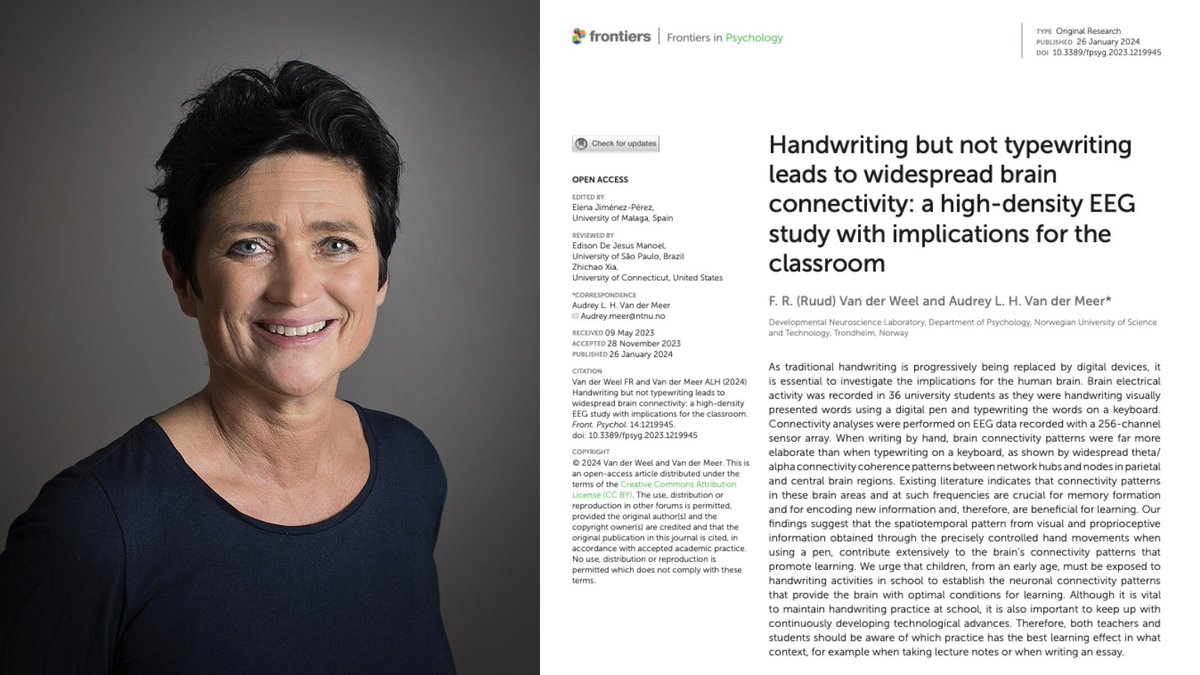
A Norwegian neuroscientist spent 20 years proving that the act of writing by hand changes the human brain in ways typing physically cannot, and almost nobody outside her field has read the paper.
Her name is Audrey van der Meer.
She runs a brain research lab in Trondheim, and the paper that closed the argument was published in 2024 in a journal called Frontiers in Psychology. The finding is brutal enough that it should have changed every classroom on Earth.
The experiment was simple. She recruited 36 university students and put each one in a cap with 256 sensors pressed against their scalp to record brain activity. Words flashed on a screen one at a time.
Sometimes the students wrote the word by hand on a touchscreen using a digital pen, and sometimes they typed the same word on a keyboard. Every neural response was recorded for the full five seconds the word stayed on screen.
Then her team looked at the part of the data most researchers had ignored for years, which is how different parts of the brain were communicating with each other during the task.
When the students wrote by hand, the brain lit up everywhere at once.
The regions responsible for memory, sensory integration, and the encoding of new information were all firing together in a coordinated pattern that spread across the entire cortex. The whole network was awake and connected.
When the same students typed the same word, that pattern collapsed almost completely.
Most of the brain went quiet, and the connections between regions that had been alive seconds earlier were nowhere to be found on the EEG.
Same word, same brain, same person, and two completely different neurological events.
The reason turned out to be something nobody had really paid attention to before her work. Writing by hand is not one motion but a sequence of thousands of tiny micro-movements coordinated with your eyes in real time, where each letter is a different shape that requires the brain to solve a slightly different spatial problem.
Your fingers, wrist, vision, and the parts of your brain that track position in space are all working together to produce one letter, then the next, then the next.
Typing throws all of that away. Every key on a keyboard requires the exact same finger motion regardless of which letter you are pressing, which means the brain has almost nothing to integrate and almost no problem to solve.
Van der Meer said it plainly in her interviews.
Pressing the same key with the same finger over and over does not stimulate the brain in any meaningful way, and she pointed out something that should scare every parent who handed their kid an iPad.
Children who learn to read and write on tablets often cannot tell letters like b and d apart, because they have never physically felt with their bodies what it takes to actually produce those letters on a page.
A decade before her, two researchers at Princeton ran the same fight using a completely different method and ended up at the same answer. Pam Mueller and Daniel Oppenheimer tested 327 students across three experiments, where half took notes on laptops with the internet disabled and half took notes by hand, before testing everyone on what they actually understood from the lectures they had watched.
The handwriting group won by a wide margin on every question that required real understanding rather than surface recall.
The reason was hiding in the transcripts of what the two groups had actually written down.
The laptop students typed almost word for word, capturing more total content but processing almost none of it as they went, while the handwriting students physically could not write fast enough to transcribe a lecture in real time, which forced them to listen carefully, decide what actually mattered, and put it in their own words on the page.
That single act of choosing what to keep was the learning itself, and the keyboard had quietly skipped the choosing and skipped the learning along with it.
Two studies. Two countries. Same answer.
Handwriting makes the brain work. Typing lets it coast.
Every note you have ever typed instead of written went into your brain through a thinner pipe. Every meeting, every book highlight, every idea you captured on your phone instead of on paper was processed at half depth.
You did not forget those things because your memory is bad. You forgot them because typing never woke the part of the brain that would have made them stick.
The fix is the thing your grandmother already knew.
Pick up a pen. Write the thing down. The slower road is the faster one.

English

Le paradoxe, "ce nerf du réel" (Christiane Singer), est une ressource précieuse, qu'on soit entrepreneur ou dirigeant.
Billet fruit d'échanges récents avec plusieurs qui buttaient sur un #paradoxe en fait précieux à identifier :
linkedin.com/posts/patricev…
Français

"Les LLM constituent une infrastructure cognitive. Or une infrastructure se gouverne. Tout comme le savoir, la culture et tout ce qui façonne l’esprit individuel et collectif des citoyens d’un pays s’organisent, se transmettent et se protègent"
@MarieDOLLE
#biencommun #commun

Français

En passant, on dirait presque du Goldratt #ToC, dans une version écosystème complexe.
"Local alignment ≠ global stability"
Français


« Chaque système est parfaitement conçu pour obtenir les résultats qu’il obtient. » W. Edwards Deming
Faute d'intention claire, "Le problème n’est pas la technologie mais la conception" @bduperrin
Et non, introduire l'IA n'est pas une intention.
duperrin.com/2025/11/06/des…
Français

en gardant à l'esprit que #apprendre et #entreprendre sont des activités relationnelles par nature.
Elles imposent de rester ancré dans le réel, en cherchant à confronter et combiner les regards plus qu'à implémenter les recommandations de la machine.
linkedin.com/feed/update/ur…
Français

Introduire de la technologie pour propulser son entreprise est nécessaire et pertinent, à condition de favoriser des usages qui nous maintiennent dans le #réel, sans nous enfermer dans les représentations qui nous sont poussées.
Pour cela, il faut #apprendre et #désapprendre...
Français
Patrice Viot Coster retweetledi

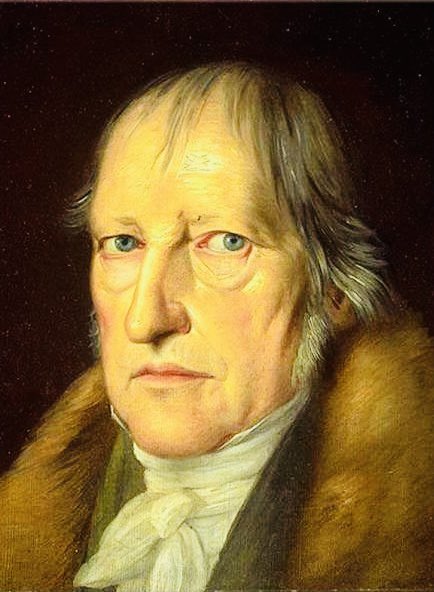
Je ne suis pas un grand lecteur de Hegel (le bonhomme m’effraie un peu…), mais en ces temps où l’IA galopante menace de doper la paresse intellectuelle, cette phrase de lui m’a scotché :
« Si l'apprentissage se bornait à une simple réception, le résultat n'en serait guère meilleur que si nous écrivions des phrases sur l'eau ; car ce n'est pas la réception, mais l'auto-activité par laquelle on se saisit de quelque chose, et la faculté d'utiliser, à nouveau, une connaissance, qui, seules, en font notre propriété. »

Français

Les effets d'annonces ne cachent que difficilement la réalité : l'IA est un argument percutant, mais rhétorique avant tout, qui habille des décisions stratégiques.
Plus ici : linkedin.com/feed/update/ur…
Français

Quand 3 notes cristallines ouvrent en nous des espaces inattendus...
Allez lire l'histoire de l'introduction des pianos dans les gares SNCF
linkedin.com/posts/patricev…
Français

@Digitaltonto Avec cette conclusion :
"We need to redefine the terms of our struggle in ways that tilt the playing field to our advantage. In the final analysis, that’s what makes the difference between people who want to make a point and those who actually make a difference."
English

... the act go forward or to violate the shared value." @Digitaltonto
digitaltonto.com/2025/when-you-…
English

"Instead of creating a conflict, we need to create a #dilemma for our antagonists. It starts with identifying a shared value and then designing a constructive act rooted in that shared value. That’s what creates the dilemma: Your opponents either need to let ...
English

"This is not the end of programming. It is the beginning of its latest reinvention." @timoreilly
#AI is “actually going to liberate developers to move into the business much more and be much more levered in the impact they deliver.” @ssankar
oreilly.com/radar/the-end-…
English

Parmi les défis derrière l’IA générative : celui de la place accordée aux personnes qui manipulent ces technologies. Qelques ressources proposées par LaborIA : laboria.ai/laboria-explor…
linkedin.com/feed/update/ur…
Français

#IA et #travail : passées les 1ères excitations puis de grandes désillusions, la problématique secouent nos entreprises, des + grandes au + petites, cotées ou pilotées par des #entrepreneurs. Voici un outil d'auto-diagnostic proposé par LaborIA pour y voir plus clair.

Français