Shyam Sankar

1.6K posts

Shyam Sankar banner
Shyam Sankar

Shyam Sankar

@ssankar

CTO @Palantirtech

Colorado Katılım Eylül 2008
295 Takip Edilen68.1K Takipçiler
Sabitlenmiş Tweet
Shyam Sankar
Shyam Sankar@ssankar·
1/ We are in an undeclared state of emergency. America's adversaries are circling, and the American industrial base that dominated the 20th century is dormant. For the CCP, it is not enough for China to prosper... America must fall. It's time to Mobilize. Coming March 2026.
Shyam Sankar tweet media
English
307
398
3.2K
3.6M
Shyam Sankar retweetledi
Ted Mabrey
Ted Mabrey@MabreyTed·
Preference, cascade. “As Alex Karp put it: "What the technical customers want is control over their compute, their models, their data stack, and their alpha. They want to know they own the means of production, and it's not being transferred to someone else." The current regime does precisely the transfer Karp and companies fear.”
Satya Nadella@satyanadella

x.com/i/article/2076…

English
4
15
155
13.3K
Shyam Sankar retweetledi
First Breakfast
First Breakfast@FirstBreakfast·
On August 19, 1812, USS Constitution met HMS Guerrière off Nova Scotia. The Royal Navy hadn't lost a single-ship frigate duel to an equal in over a decade. Guerrière's captain was itching for a fight. He got one. Constitution closed to half a pistol shot and fired. Fifteen minutes later, Guerrière's mizzenmast was gone. British cannonballs struck Constitution's hull and bounced into the sea. "Huzzah, her sides are made of iron!" a sailor shouted. "Old Ironsides" was born. Constitution simply wasn't the ship Guerrière thought she was fighting. She carried more men and a broadside about 50% heavier than a standard frigate. An 18-year-old navy had beaten the greatest fleet on earth, ship for ship. The shock was so total that Britain soon forbade its frigates from engaging Americans without a 2-to-1 advantage. Why could only the American frigates carry that much firepower? The answer was buried deep in the hull. Six pairs of heavy timbers ran diagonally along Constitution's sides. They get no press. No painting of the battle depicts them. But without them, the ship couldn't fight. Shipwrights operated according to a hard limit: build a hull long enough to carry more guns and it would sag under its own weight, bending the keel until the ship destroyed itself. The designer of the Six Frigates, Joshua Humphreys, beat that constraint with "diagonal riders," thick planks bracing the frame at steep angles. These timbers let him fit a ship-of-the-line's firepower onto a frigate. Of the six original frigates, five got the diagonal riders. One did not. Humphreys' rival Josiah Fox took over USS Chesapeake, scaled her down, and left the riders out. Without them, she couldn't carry the heavy armament. She fought as an ordinary frigate—every duel a fair fight. In 1813, HMS Shannontook her in minutes—the only single-ship loss among the six. Chesapeake was written off as an unlucky ship. Her hull told the full story. History is full of “diagonal riders”: technologies that are both constraint-breaking and invisible to most, even the people who rely on them. Invisible in battle, invisible in history—but if removed, the difference in capability can’t be ignored. The lesson for builders: everyone competes on the visible end item, so everyone converges toward parity. The real edge is often below the waterline, away from the fray. Find it, break it, and you decide the fight before it starts.
First Breakfast tweet mediaFirst Breakfast tweet media
English
2
1
22
3K
Shyam Sankar
Shyam Sankar@ssankar·
Veterans: you were the Man in the Arena protecting your country. You endured the slings and arrows of the enemy. You served with honor. When you need a new mission, Palantir is ready. We work side-by-side with America’s Armed Forces to solve the toughest problems. While other Silicon Valley companies wring their hands, we never waver. We never will. The arena is still there. Same mission. New coordinates. Check out the PalVets website to learn more about Palantir’s opportunities for veterans, from full-time jobs to the American Tech Fellowship: palantir.com/veterans
Shyam Sankar tweet media
English
12
39
313
20.1K
Shyam Sankar retweetledi
First Breakfast
First Breakfast@FirstBreakfast·
America's Founders were restless, with a strong heretical streak. Always expanding, always hustling, always building. They caused massive headaches for the British government even in peace. They were nonconformists, in religion and habit. They settled where they weren’t supposed to. Traded with parties they weren’t supposed to. They were proud of their liberty and chafed at laws made by distant, unfeeling masters. Then they dumped East India Company tea into Boston Harbor, fired on the Redcoats at Lexington and Concord, and rebelled against a superpower. That, in a nutshell, is the spirit of America. If you look at the broad sweep of American history you can see that spirit at work as our nation has expanded: Manifest Destiny. The Transcontinental Railroad. The telegraph. The Panama Canal. The Wright Flyer. The Model T. The Arsenal of Democracy. The microchip. The Moon. The Internet. Reusable rockets. Artificial Intelligence. The Founders were builders. Build like them.
First Breakfast tweet media
English
1
4
37
2.3K
Shyam Sankar
Shyam Sankar@ssankar·
A mighty beacon with a torch, whose flame is innovation’s fire, and her name: Mother of Makers. “Keep, ancient Europe, your green-deal chains!” cries she With silent lips. “Give me your tired, your skilled, Your Mittelstand heroes yearning to build free, The family firms your leaders cheaply sold, Betrayed for Beijing’s markets, tempest-tossed to me— I lift my lamp beside the golden door!”
Shyam Sankar tweet media
English
3
9
45
11.2K
Shyam Sankar retweetledi
Palantir
Palantir@PalantirTech·
Before there was a nation, there was a declaration of truths. Self-evident. Existing apart from structures of power or privilege. 250 years later, Palantir celebrates every American who carries the torch lit by our Founders. And we build for all those to come. God Bless America.
English
124
345
3.6K
106.2K
Shyam Sankar retweetledi
Palantir
Palantir@PalantirTech·
Our thoughts on the importance of AI sovereignty. 1. Your AI sovereignty dictates your institution’s future. Sovereignty is the precondition for choice. Relinquishing sovereignty transfers the future choices of your institution to others, who are likely to exploit it for their gain and your loss. 2. Data retention is your treasure. Transfer it at your own peril. Your ability to win is dictated by your ability to recognize and use your unique edges, and you keep winning by compounding the underlying data to generate new insights. Transferring that data hands over access to your pre-existing winning plays and yields the means of production for new ones. 3. Tokenmaxxing hijacks your value orientation and decreases your institutional fortitude and intelligence. The pursuit of high token usage incentivizes disposable scripts over robust software — with the addictive feeling of false progress. There is a reason why those selling tokens refuse to charge based on value. 4. Controlling your weights is controlling your fate. Weights are the distilled form of hard-won, accumulated institutional knowledge. If you let others control your weights, you are allowing them to migrate the alpha of your business to theirs. 5. There is no contradiction between sovereignty and alpha. The architecture that maximally preserves sovereignty is one that enables institutions to own their tribal knowledge, and to compound it as alpha. 6. Politicizing the technical issues involving sovereignty is what your adversary wants. Techno-politicization is the wellspring of false sovereignty. Techno-politicization drives decisions that seem to reduce dependency, but ultimately limit agency — especially on the battlefield in the West. 7. Real expertise is existential. Allowing politics or favoritism to determine your technical decisions rewards whoever is best at politics, not whoever is right. Listen to those closest to the problems, not those speaking most compellingly about them. 8. Learn from institutions that are winning or that have consistently delivered. Institutions facing existential threats do not have the luxury of making technical decisions based on political preferences. 9. Only listen to institutions, countries, and people who have a proven record of being right. A track record of correctness is the best and only signal for future correctness. Judging something as right or wrong based on who you like is exceedingly misguided.
English
715
1.8K
10.9K
13.3M
Shyam Sankar retweetledi
Invest Like the Best
Invest Like the Best@InvestLikeBest·
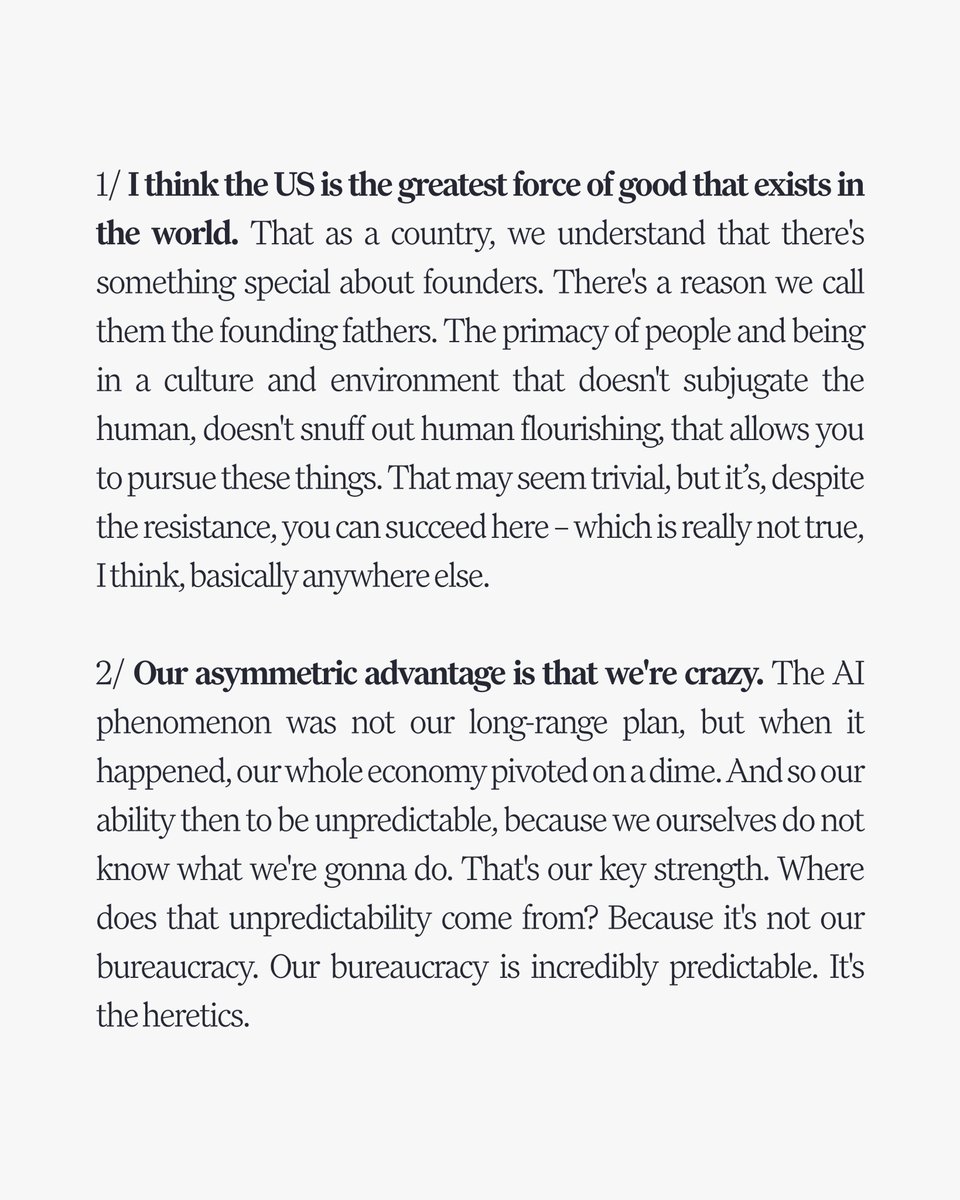
Vlad Barbalat fled Soviet Moldova and ended up running one of the largest pools of permanent capital in America. Palantir CTO @ssankar, whose family fled violence in Nigeria and nearly died getting here, carries that same immigrant clarity about this country. Both men understand the counterfactual in a way that is hard to take for granted. Here is a collection of Shyam quotes describing what makes America special: "I think the US is the greatest force of good that exists in the world. We've created all of our trillion-dollar companies from scratch in the last 50 years." "No army that lost its morale ever won the war. And so believing in yourself, believing that greatness is possible is a precondition to being able to express it and realize it. And a lot of cultures don't have that." "Our asymmetric advantage is that we're crazy. The AI phenomenon was not our long-range plan, but when it happened, our whole economy pivoted on a dime." "It helps that with the nature of populating the U.S. was that all the heretics from the old world came here. So we have an unfair advantage on that."
Invest Like the Best tweet mediaInvest Like the Best tweet media
Patrick OShaughnessy@patrick_oshag

Vlad grew up in Soviet Moldova and describes what makes America special: "When you're born outside the United States, you're exposed to a way of life that's very difficult to understand for those fortunate enough to be born here. You take certain things for granted. You assume they're like gravity, because they just exist. But they're not. What is true in the U.S. — always has been true, still true today — is that the level of agency you have is unparalleled anywhere else in the world. If you have talents and motivation, there's an infinite number of ways to define success and live a life where you have the option to thrive. That option is not available to the vast majority of humanity. You'll be burdened by your family's history, your ethnicity, your religion, your government's oppressive system. In Moldova, you're not given permission to dream. You're born to survive. When you come to the U.S., you experience literally the inverse of that — this notion of individualism. In the U.S., you have an opportunity. The U.S. frees a person to pursue their talents and interests in a way that's just impossible elsewhere."

English
4
7
48
18.9K
Shyam Sankar
Shyam Sankar@ssankar·
The first fundamental truth is that FDE is not a role, it is a product strategy. It has to originate from the fount of the product org. You judge an FDE org by the fruits they bear! What new product was discovered, what Thielan secrets were mined and refined into weapons grade product? (but hey, what do I know about FDE 🤷‍♂️)
English
19
35
481
94.2K
Harry Stebbings
Harry Stebbings@HarryStebbings·
"Everyone gets FDEs wrong. The job of an FDE isn't to make the product work, it's to accelerate customer adoption and time-to-value. If you need FDEs just to deliver the product, you're not running a software company, you're running a services business with a bad product." @matanSF Do you agree and what do people misunderstand most about what it takes to do FDE motion well? @ssankar @chadwahl @nikogrupen @barrald @lkothari @LeoMehr @zkevinbai
English
24
14
243
111.3K
Shyam Sankar retweetledi
Jack Prescott
Jack Prescott@JackPrescottX·
Finally finished Shyam Sankar’s new book, ‘Mobilize’. It was honestly one of the most important books I’ve ever read. - Our defense procurement system is broken. Cost-plus contracting, bureaucracy, and regulation destroys innovation. We can’t afford to coddle the defense primes. We must embrace meritocracy. Competition breeds innovation. - The offshoring of our manufacturing has created an enormous national security threat. Not to mention, the American industrial base was once filled with dual-use companies. Sherwin Williams and Quaker Oats operated bomb-loading plants during World War ll. This capacity does not exist anymore. - A stockpile is not a deterrent. Production capacity is. - Our government must embrace commercial companies in defense contracting. The procurement process must be fair and open to all. May the best product win. - It will take heretics to turn the ship around. The Drew Cukors of the world. Leaders who are willing to disrupt and challenge the status quo. - America is unique in its ability to embrace the founder, pivot quickly, and Mobilize. To stop WW3, we must be able to intimidate the CCP enough to delay their plan to invade Taiwan. They plan to be “ready” by 2027. But they’ll delay it to 2028. Then 2029, 2030, and so on. It’s not too late. These are just some of my takeaways. I knew our system was broken, but this book opened my eyes up to just how broken it truly is. I have also gained a new level of respect for Shyam; not just as an executive at Palantir, but also as a leader trying to move our country forward. We will look back on Mobilize as an irreplaceable book and roadmap that started the conversation and moved the needle in one of the most critical periods in American history.
English
5
22
115
9.8K
Shyam Sankar
Shyam Sankar@ssankar·
Researchers at leading labs have started smoking. Their logic: AGI will cure cancer before it kills them. Are you lighting a cigarette because you're that confident the models will cure cancer in time? No? not AGI-pilled...
English
30
34
423
56.2K