

Pathikrit Bhattacharya
63 posts
New pre-print!
Happy to share our work with @BLecampion on the mechanics of fluid-driven slow slip and earthquake nucleation in 3D.
Free to access here:
arxiv.org/abs/2309.04567
English
@EliasHeimisson @uni_iceland @Stanford @Caltech @ETH Hi Elias. Sorry to have not seen this till so late. Many many congratulations on the job! When do you start? And, more importantly, when can I come to visit you in Iceland?
English

Excited to announce my return to the @uni_iceland as a tenure track Research Specialist in Seismology starting Jan 1 2024! My journey has taken me from Iceland to @Stanford, @Caltech, and @ETH, now it brings me back home. Looking forward to exploring new frontiers in #seismology

English
Pathikrit Bhattacharya retweetledi

What causes UHT metamorphism? - a question that has puzzled geoscientists for a long time!
Here is an attempt to constrain and categorize the mechanisms of UHT-M: twitter.com/NatRevEarthEnv…
Was great working with Shujuan_Jiao, Mike Brown @RossMitchellGeo @chrisfpclark & others!
Nature Reviews Earth & Environment 🌈@NatRevEarthEnv
Ultrahigh-temperature metamorphism represents the most extreme thermal conditions the continental crust is capable of sustaining This new Review assesses the characteristics and mechanisms of UHT metamorphism nature.com/articles/s4301… Free: rdcu.be/c8774 @pd_chowdhury
English
Pathikrit Bhattacharya retweetledi

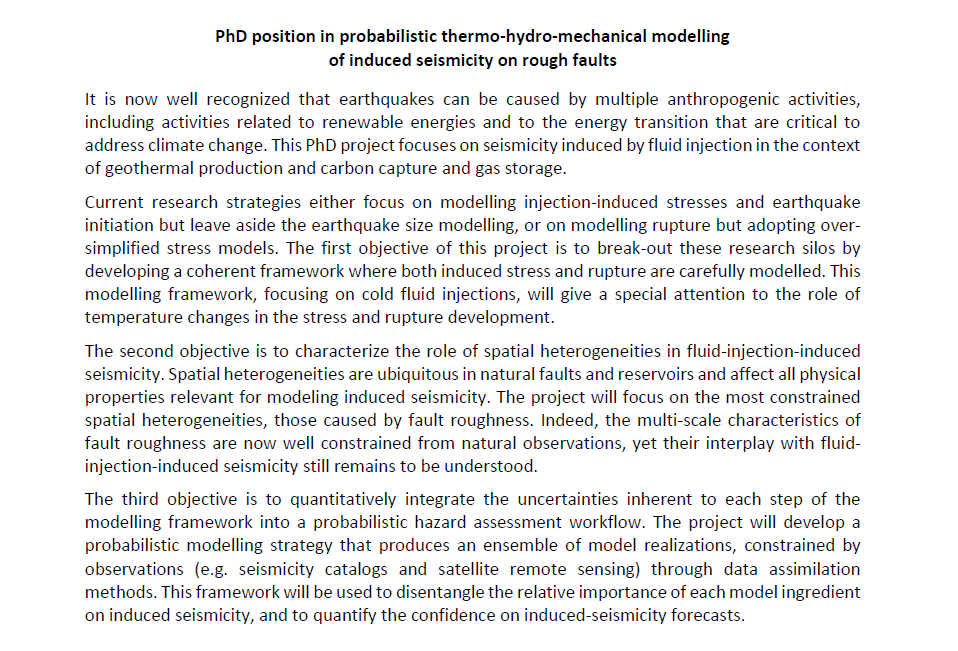
New PhD position on computational mechanics of induced seismicity for geothermal energy and carbon capture and gas storage, at @EQ_Geoazur @umrGeoazur (@Univ_CotedAzur French Riviera) and @TNO_Research (The Netherlands).
Apply by April 30 2023: dropbox.com/s/03gmd39qh2in…

English
Pathikrit Bhattacharya retweetledi

First high-precision observation of postseismic deformation following ~600-km deep earthquake
+ and! the observation points to a low-viscosity layer at the bottom of upper mantle
+ a lot more to do in this "deep earthquake geodesy"!
nature.com/articles/s4158…
English
@BaoningWu I love the play on the Gardner and Knopoff (1974)!
English

Does the Catalog of California Earthquakes, With Aftershocks Included, Contain Information About Future Large Earthquakes? agupubs.onlinelibrary.wiley.com/doi/10.1029/20…
English
Pathikrit Bhattacharya retweetledi

What is the fundamental relationship between silent earthquakes (slow slip event) and regular ones? A new theory accounting for finite rupture depth gives an insightful answer and can reconcile the current debates. Our @NatureComms paper with @DocTerremoto nature.com/articles/s4146…

English
@DocTerremoto @GarethDLaT Is pulsed flow along fault zones consistent with the deposition and accumulation of fault-associated mineral deposits like many valuable (e.g., gold) and rare earth metals often found along fault zones? Mineralization along faults can be uniform for large distances.
English
@GarethDLaT @PathikritBhatt2 Sure but my specific question for the experts is:
is it common to see fault zone fluids pulsing (squirting as in the video) rather than steadily flowing?
English
OTD 3 years ago the French town of Le Teil was severely shaken by a very shallow M4.9 earthquake. Here is the causative fault zone, a few 10 m undergound, squirting fluids, as seen in one of the boreholes we drilled through it.
GIF
English
@GarethDLaT @DocTerremoto For water to build up in a fracture, does the permeability in (within?) the region of the fracture not have to be larger than the surrounding flow paths? This was the motivation for thinking of permeability enhancement as a possible explanation for this squirting.
English
@DocTerremoto That is so cool. Maybe you will pick up some sadistic vibrations!
English
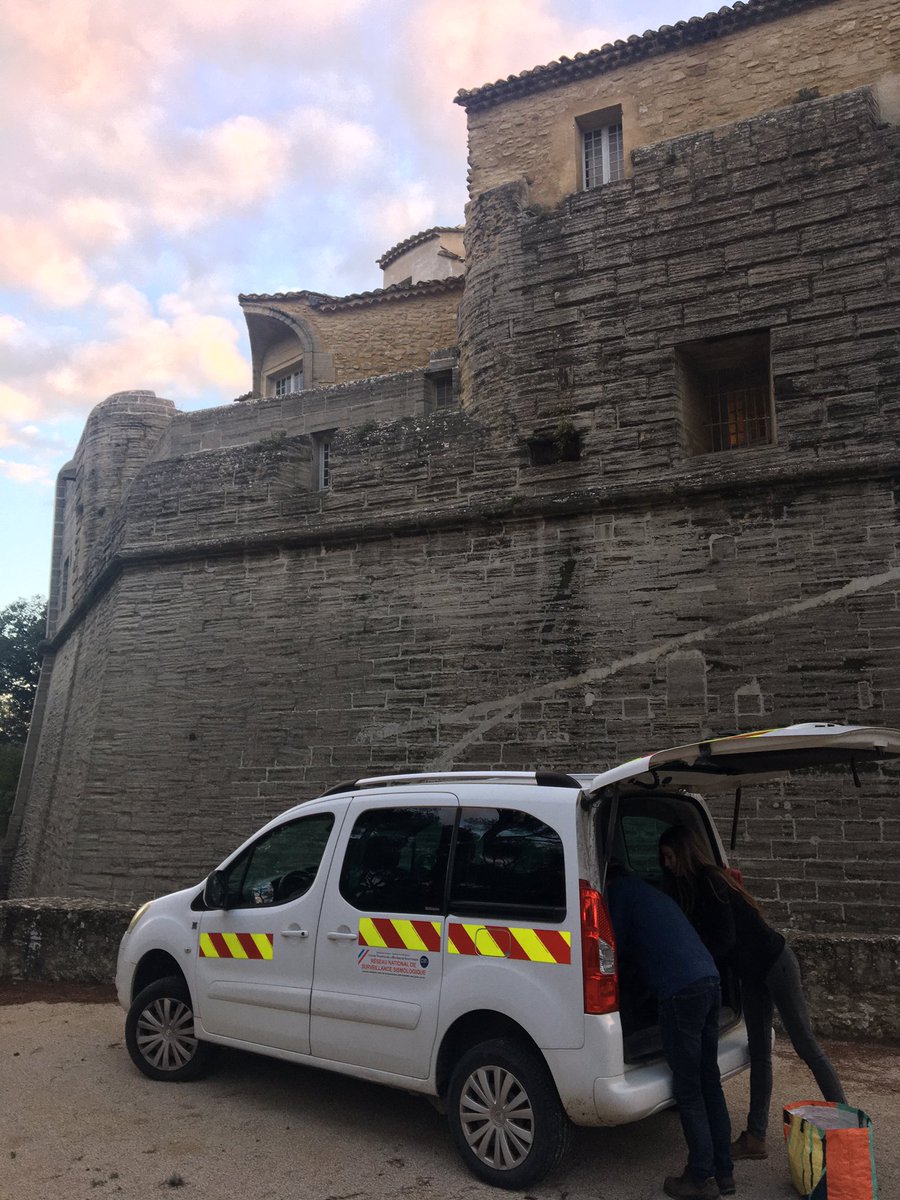
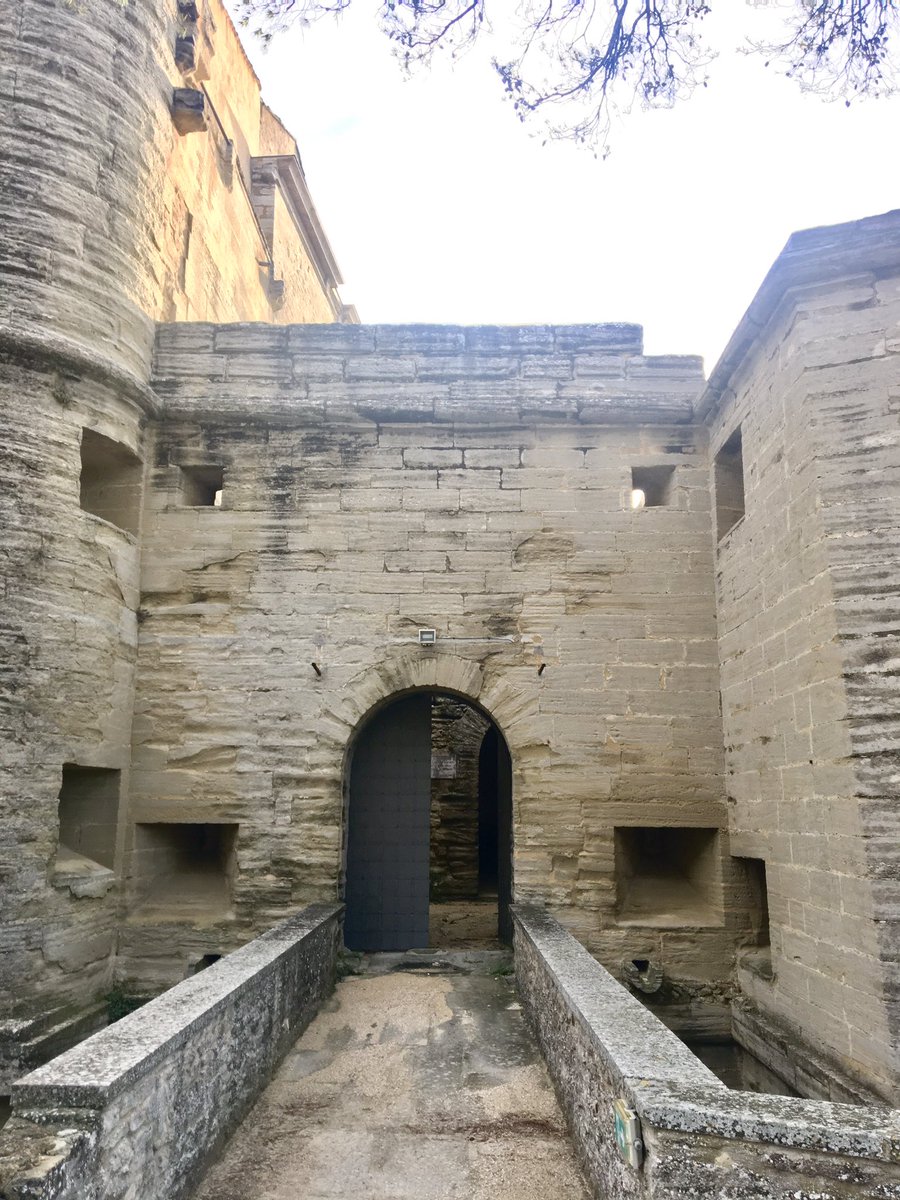
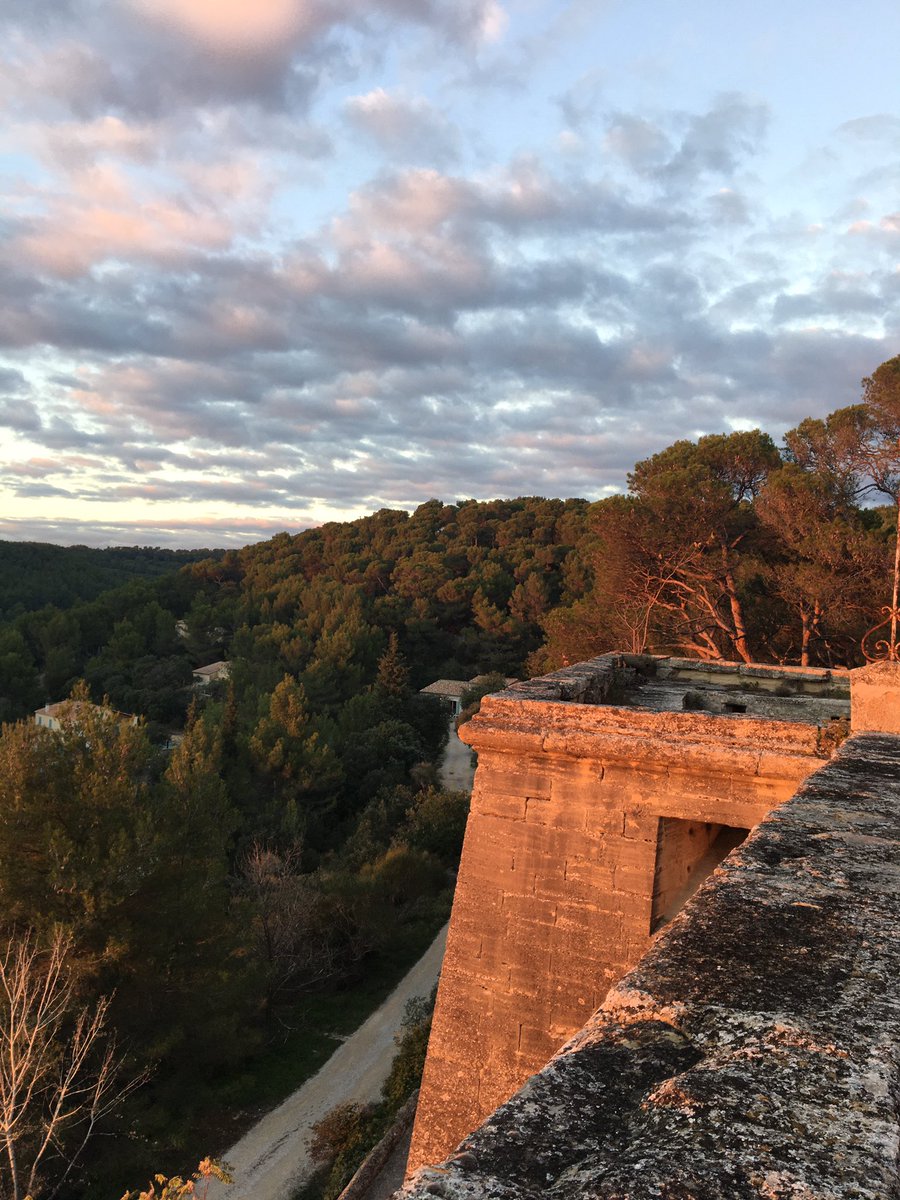
Some seismic stations are located in very original spots. French station SAUF is in Chateau de Saumane, where Marquis de Sade grew up and was introduced to debauchery. If those walls could speak, maybe you’d hear it in SAUF’s seismograms!
English
@ViescaRobert @antoine_jacquey Finally. Congrats Antoine and Robert on this insightful piece of work!
English
Pathikrit Bhattacharya retweetledi

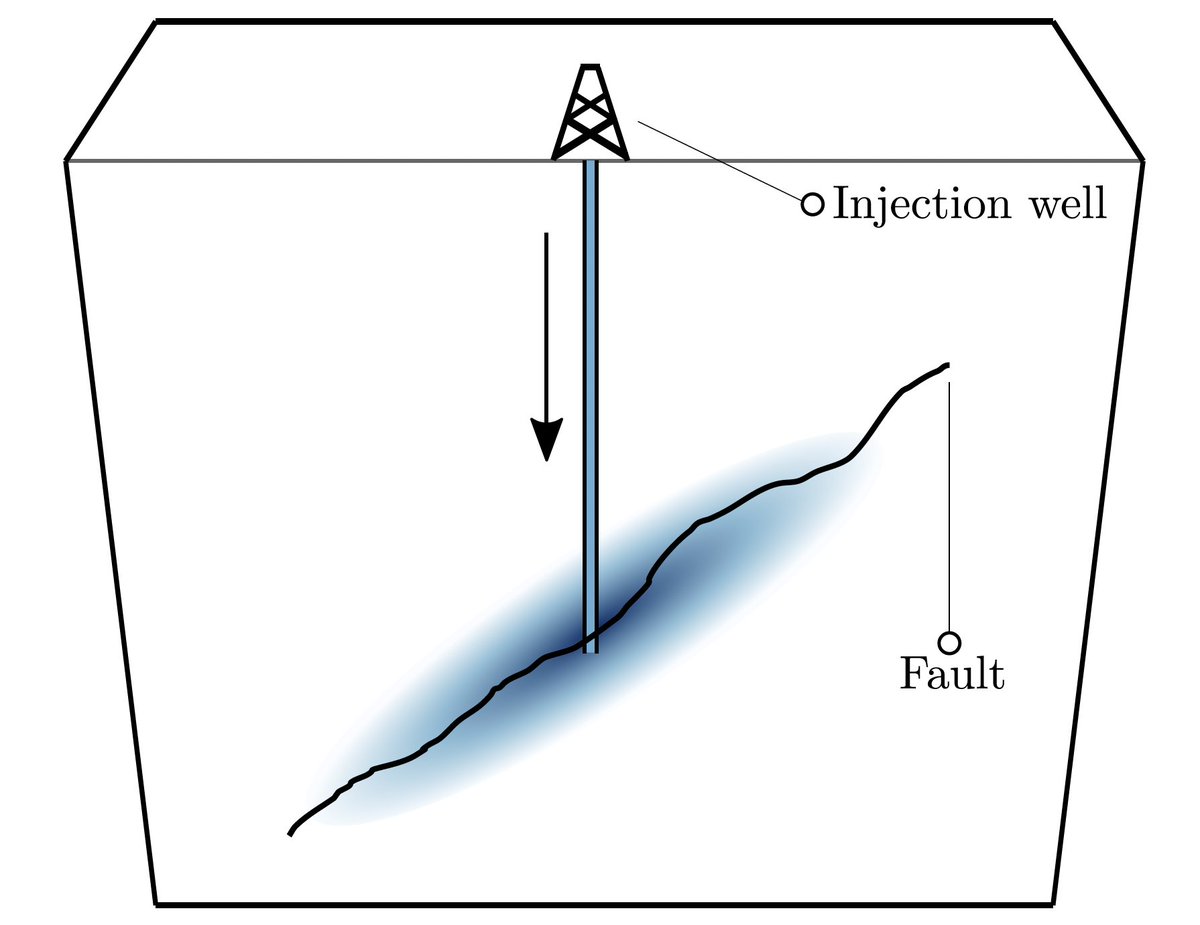
"Nucleation and arrest of fluid-induced aseismic slip," A. B. Jacquey & R. C. Viesca
essoar.org/doi/abs/10.100…
English
@rock_nFault @SapienzaRoma Looks like one of Chris's hands is better than two lab hands for most people!
English
@GregMclaskey Great paper Greg! And congratulations to Sara.
English

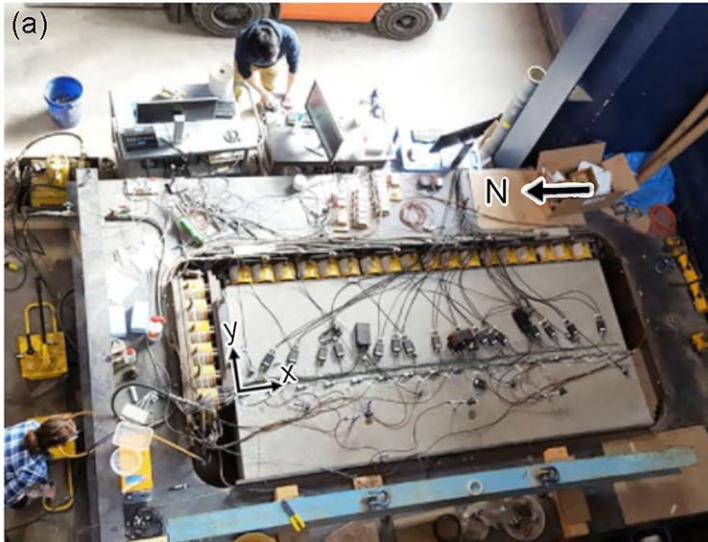
We show how initial stress levels affect the propagation of fluid-induced aseismic slip, the transition to dynamic rupture, and the overall rupture extent. And the sample is large enough that both the first and second authors are in Fig1a!
English
I’m happy to share that Sara’s paper on fluid injection into a 3-m rock is now online in JGR
doi.org/10.1029/2022JB…
I’m super proud!
English
Pathikrit Bhattacharya retweetledi

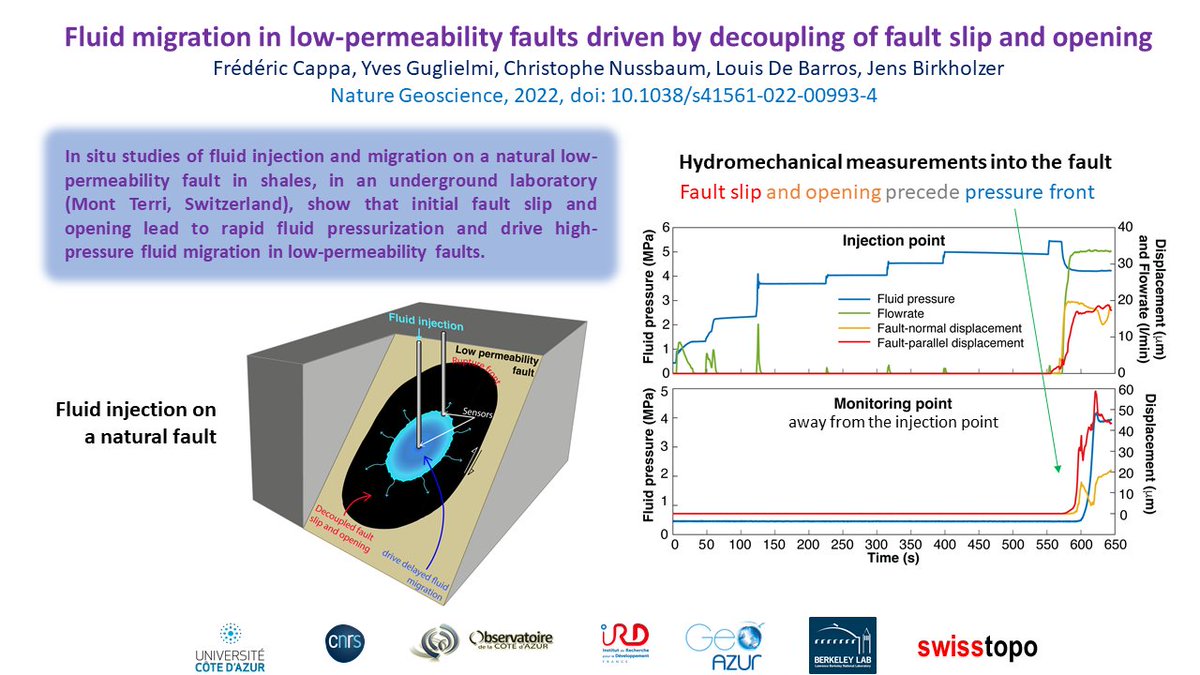
New water-injection experiments into faults crossing tunnels show how fluids migrate on low-permeability faults: fault slip and opening precede and drive the fluid pressure front.
New paper in @NatureGeosci led by @EQ_Geoazur's Fred Cappa: nature.com/articles/s4156…
English
@EliasHeimisson @MCSlab_uiuc @ViescaRobert You are correct. But this is no better than what the Slip law does. Unfortunately we removed the Slip law counterpart of S19 during revisions. I will send it to you over email.
English
@PathikritBhatt2 @MCSlab_uiuc @ViescaRobert If I understand plot S19 it seems like aging law has initially the correct evolution of the friction coefficient at reslide... but maybe I'm thinking about this wrong
English
@EliasHeimisson @MCSlab_uiuc @ViescaRobert In the Ampuero Rubin world, instability length scale estimates (for at least the Aging law) do come from comparing this latter fracture energy with the energy release rate. You could be correct that the relevant fracture energy for cycles is the slide-hold-slide estimate.
English
@EliasHeimisson @MCSlab_uiuc @ViescaRobert Interestingly, if you estimated fracture energy in the classical sense, where the fault is being driven to failure from near steady state (most comparable to velocity steps), lab data are pretty consistent with the Slip law.
English