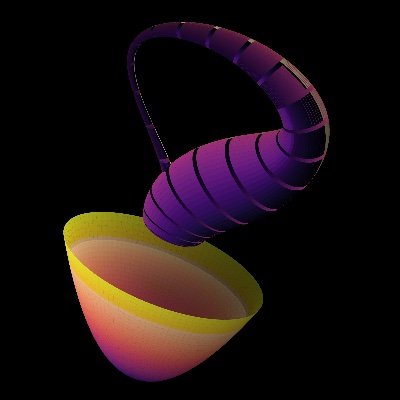
A physical system, its phase-space state, and the energy function that governs the flow, all linked together.
The point of the animation is that these are not three different objects. They are three views of the same dynamics. The pendulum on the left is the physical motion. The curve on the floor is the evolution of its state. The translucent surface shows the energy landscape that organizes that motion.
“I may speak the English Language better than the Chinese language, but I’ll never be an Englishman, not in a thousand generations.”
-Lee Kuan Yew (Founded Singapore)
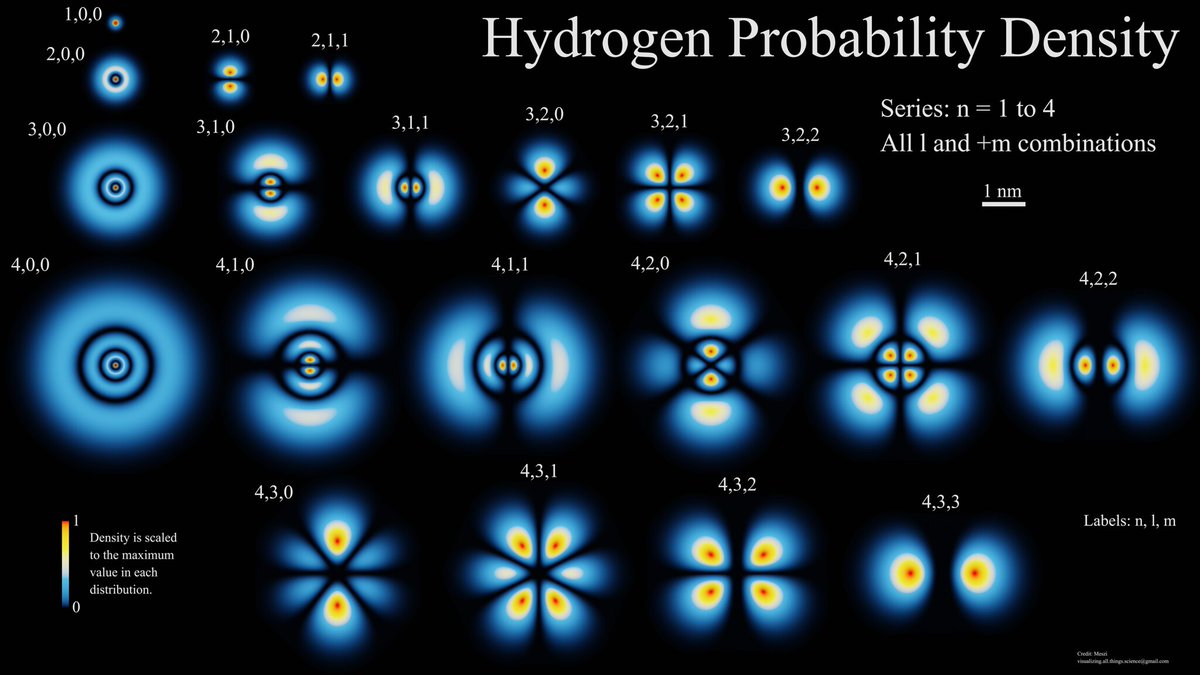
The smallest units of matter are not physical objects in the ordinary sense; they are forms, ideas which can be expressed unambiguously only in mathematical language.
-- W. Heisenberg
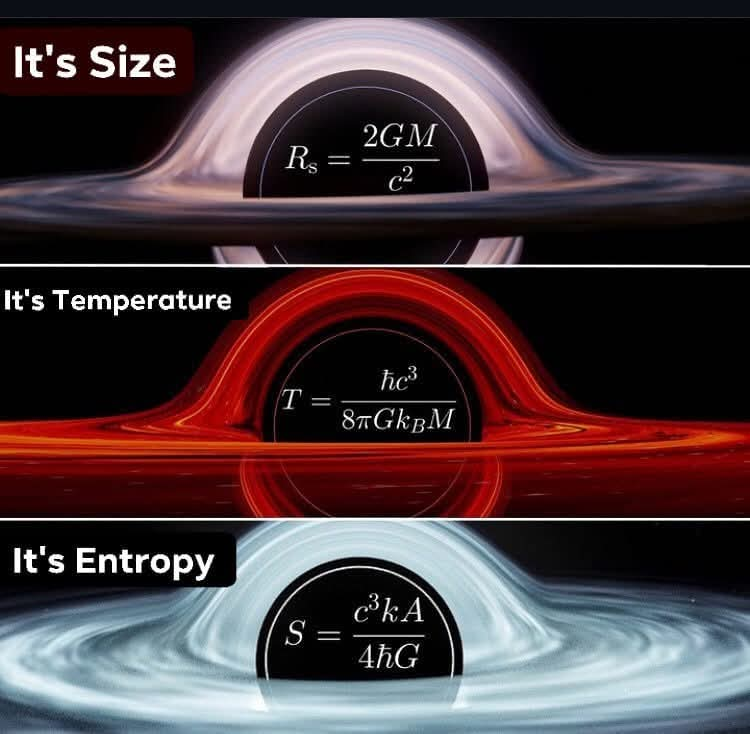
Key physical properties of a black hole's event horizon using fundamental equations.
The first formula is the Schwarzschild radius. It defines the size of the event horizon. This tells us the exact distance from the center where nothing, including light, can escape the black hole's gravity.
The second formula is the Hawking temperature. It gives the temperature of the black hole. This shows that black holes emit faint radiation due to quantum effects and slowly lose mass over extremely long times.
The third formula is the Bekenstein-Hawking entropy. It calculates the entropy of the black hole based on the surface area of the event horizon. This links black holes to thermodynamics and reveals that their information content is stored on the horizon surface rather than inside the volume.
Which one surprises you the most?
Alguns nomes não passam. Viram memória, referência e parte eterna da nossa história. 🇧🇷✨
Entre conquistas, emoção e inspiração, esses gigantes ajudaram a escrever capítulos que o esporte brasileiro jamais vai esquecer.
Ídolos assim se despedem, mas nunca da lembrança de um país inteiro. ❤️
Warmup to Statistical Mechanics
What Exactly is a Hamiltonian A
System?
In ordinary Mechanics, you might begin with position and velocity. Hamiltonian Mechanics rewrites the same motion in a different language. Instead of position and velocity, it uses position and momentum. We write the position variables as q and the momentum variables as p. Then the full state of the system at one instant is
(q, p)
That pair is one point in phase space.
Why do we do this?
Because in these variables, the equations of motion take a remarkably clean form. Everything is generated by one single function, the Hamiltonian
H(q, p)
and in the simplest cases this Hamiltonian is just the total energy written in terms of position and momentum.
So if you know H, you know the dynamics.
You might wonder, but how can one function generate motion?
The rule is
dqᵢ/dt = ∂H/∂pᵢ
dpᵢ/dt = −∂H/∂qᵢ
These are Hamilton’s equations.
Now read them slowly 😄
The rate of change of position comes from differentiating H with respect to momentum. The rate of change of momentum comes from differentiating H with respect to position, with a minus sign.
This constitutes the whole engine.
A simple example makes this less abstract:
Take one particle of mass m moving in a potential V(q). Then the Hamiltonian is
H(q, p) = p²/(2m) + V(q)
The first term is kinetic energy. The second term is potential energy.
Now apply Hamilton’s equations.
First,
dq/dt = ∂H/∂p = p/m
So momentum tells you how position changes.
Second,
dp/dt = −∂H/∂q = −dV/dq
Thus, momentum changes because of force.
If you now combine these two equations, you recover ordinary Newtonian mechanics. Since p = m dq/dt, we get
m d²q/dt² = −dV/dq
So, Hamiltonian mechanics is not a different theory. It is the same mechanics, written in a form that exposes its geometric structure much more clearly.
The animation
The full 3D surface is the Hamiltonian itself, the energy landscape H(q, p). The floor underneath is phase space, marked by energy contours and the local flow field. The bright moving point is one actual state (q(t), p(t)) evolving under Hamilton’s equations. Its trail shows that the motion is not arbitrary. It is guided everywhere by the geometry of the same single function H. The render is doing more than illustrating a particle moving, it is showing how one function organizes the whole phase-space motion.
The math breakdown:
Start with one degree of freedom. The state is described by position q and momentum p. So the system lives in a two-dimensional phase space with coordinates
(q, p)
Now choose a Hamiltonian
H(q, p)
Think of H as the energy function. In many standard systems,
H(q, p) = kinetic energy + potential energy
For a particle of mass m in a potential V(q), this becomes
H(q, p) = p²/(2m) + V(q)
Hamilton’s equations say
dq/dt = ∂H/∂p
dp/dt = −∂H/∂q
Now substitute this specific H.
First compute the p derivative:
∂H/∂p = ∂/∂p (p²/(2m) + V(q)) = p/m
So
dq/dt = p/m
Now compute the q derivative:
∂H/∂q = ∂/∂q (p²/(2m) + V(q)) = dV/dq
So
dp/dt = −dV/dq
These two first-order equations completely determine the motion.
Now, connect this back to Newton’s law.
From
dq/dt = p/m
we get
p = m dq/dt
Differentiate both sides with respect to time:
dp/dt = m d²q/dt²
But Hamilton’s second equation gives
dp/dt = −dV/dq
So , together they imply
m d²q/dt² = −dV/dq
This is exactly Newton’s second law for motion in the potential V(q).
Thus, Hamilton’s equations do not replace mechanic, they reorganize it.
#HamiltonianMechanics#PhaseSpace#ClassicalMechanics#MathematicalPhysics#DifferentialEquations#Mathematics#Physics