Peetr

92 posts

Peetr

Peetr

@Peetr_11

Everyday; Next Level. Rinse; RePeate, RePete, RePeet-RePete,RePeetRe ∞

Katılım Ocak 2024
44 Takip Edilen6 Takipçiler
Peetr retweetledi
Nysa Finance
Nysa Finance@NysaFinance·
We are proud to introduce Nysa Finance, your smart gateway to RWAs. Nysa is a lending and borrowing protocol enhanced by a strong focus on RWAs, a Smart DCA System and a robust Risk-Framework. Keep reading to learn more👇
GIF
English
3
11
21
756
Peetr retweetledi
HSuite
HSuite@HSuiteNetwork·
The #TrustWallet hack wasn’t a crypto failure — it was an identity & intent failure. What happened to Trust Wallet is a textbook software supply-chain attack. Malicious code was injected into a trusted browser update. Once users authenticated and entered their seed phrase, the attacker didn’t need phishing, approvals, or further consent. Control was absolute. 🚨 Here’s the uncomfortable truth: Authentication alone is not security.📛 Most systems still assume that if you authenticated once, every action afterward is legitimate. That assumption breaks down in an agentic, automated world — whether it’s CI/CD pipelines or wallets. ➡️ Where wallets must evolve Traditional wallets focus on identity (“Who is this?”). But modern threats require intent, policy, and context (“Should this action be allowed now?”). That’s why we’re building Hsuite Native Connect (HNC) differently. ❓ Why Hsuite Native Connect is stronger by design Hsuite goes beyond login and signatures to become a control plane: * Policy-gated actions – authentication ≠ authorization * Context & risk awareness – device, action type, value thresholds * Step-up approvals – sensitive actions require explicit confirmation * No raw seed exposure in browsers – keys aren’t casually typed into extensions * Agent-aware permissions – agents get capabilities, not blanket power * In short: even if identity is compromised, intent is still enforced. 👨‍🏫 The bigger lesson This incident isn’t about one wallet. It’s about an industry still treating wallets as key containers, when they need to be policy engines. As AI agents, automated pipelines, and autonomous transactions become normal, the question shifts from “Who logged in?” to: “Who is allowed to do what, under which conditions?” That’s the future we’re building toward with Hsuite Native Connect — where trust isn’t assumed after login, but earned at every action. Security in the agentic era won’t be louder warnings or longer passwords. It will be architecture. Secure your access to the digital command center. Join the Waitlist: #ILoveHsuite #Hedera #XRPL #Web3Security @Stone_XRPL @Genfinity
English
12
37
93
4.9K
Peetr retweetledi
HSuite
HSuite@HSuiteNetwork·
Introducing HSuite Wallet—the Universal Remote Control for your digital economy. By utilizing the HSuite Native Connect (HNC) protocol, we have redefined Simplicity for the modern user: 🔹 Connect ONCE: Authenticate a single time to access and approve accounts across #Hedera and #XRPL instantly without logging out. 🔹 Unified Dashboard: View all your balances, including #HBAR, #XRP, tokens, and NFTs, in one consolidated, beautiful interface. 🔹 10x Faster Connections: Our direct P2P communication eliminates the 200-500ms latency penalty caused by traditional relay servers. 🔹 Native-First Support: Experience the full power of native chain features with no EVM detours or contract-based compromises. Stop juggling multiple sessions and regain your Digital Self-Determination. 👇 Join the Alpha Whitelist today! 👇
English
11
53
125
2.8K
Peetr retweetledi
Nysa Finance
Nysa Finance@NysaFinance·
Dear users, the DAO proposal has finally been published. 🗳Voting period: Jan 2, 2026 → Jan 22, 2026 All details have been shared in our Discord channel.
GIF
English
3
8
22
490
Peetr retweetledi
HSuite
HSuite@HSuiteNetwork·
Are you tired of the friction and fragmentation in Web3? Your digital experience should be simple and sovereign. Yet, most solutions still treat native ledgers like #Hedera and #XRPL as if they were Ethereum, forcing crucial native features through slow, complicated workarounds 🚧. This creates friction, limits adoption, and causes users to lose sovereignty in systems meant to be decentralized. 😎 We are changing that. We are building the foundation for Digital Self-Determination. We believe the digital command center is the New Browser—where Identity, payments, and AI converge. Join the revolution and experience true simplicity. 👇 Join the Waitlist now! 👇 #Web3UX #Hedera #XRPL #ChainAgnostic
English
17
41
112
8.7K
Peetr retweetledi
JoeHighTimes 🚯
JoeHighTimes 🚯@JoeHighTimesNFT·
merry Christmas everyone!! 🎄
JoeHighTimes 🚯 tweet media
English
9
6
72
1.9K
Peetr retweetledi
CANDY | ℏ/acc
CANDY | ℏ/acc@candy_hbar·
The 2 week countdown begins! 🎄🎅 How will CĦRISTMAS STOCKINGs 2025 work? 🧦✨ Read carefully and drop any questions in the comments. RT if you are not on the Whitelist yet!
CANDY | ℏ/acc tweet media
English
47
141
168
6.6K
Peetr retweetledi
HSuite
HSuite@HSuiteNetwork·
Advanced programmability is coming to the #XRPL! Come speak with our developers and learn why this is a game changer for everyone. Starting soon, don't be late!🚀 x.com/i/spaces/1djGX…
English
2
21
48
2.7K
Peetr
Peetr@Peetr_11·
@candy_hbar Stocking-me-up for festivities 🎄
English
0
0
1
37
Peetr retweetledi
Peetr retweetledi
House of Ingwe
House of Ingwe@EcoLodgeProject·
It feels good that after two years we are able to say: Welcome Eco Genesis 🐆 Good morning $HBAR
GIF
English
7
8
21
467
Peetr
Peetr@Peetr_11·
@HyzenAI When People witness Integrity, they respond with Trust. - You guys need to decide how you're gonna show up!
English
0
0
0
11
Hyzen.ai
Hyzen.ai@HyzenAI·
The people have waited long enough. Our website and whitepaper are going LIVE very shortly 😉
English
3
8
34
964
Peetr retweetledi
HSuite
HSuite@HSuiteNetwork·
Why Off‑Chain Logic Is Essential for the Future of Distributed Ledger Technology Distributed Ledger Technology landscape and adoption: Digital‑asset adoption has surged: live DLT participation is up eight‑fold since 2020, almost half of banks now issue digital assets and companies invest millions annually. Yet nearly half of projects remain on private blockchains constrained by the trilemma, underscoring the need for off‑chain logic. The blockchain trilemma and the global‑state bottleneck: Blockchains must balance decentralisation, security and scalability, yet maintaining a single replicated state across all nodes severely limits throughput because every node must process every transaction. Sharding partitions the network to reduce duplication, but shards still replicate their internal state and cross‑shard coordination adds overhead. The trilemma therefore remains unresolved until execution moves off‑chain. Why smart contracts struggle to scale: Smart contracts run deterministically on every node. In Ethereum, the Ethereum Virtual Machine processes roughly 30 transactions per second because most operations read or write shared state, making parallel execution difficult. Cross‑shard contracts must lock state and coordinate across shards, so concurrency remains limited even in sharded networks. Other limitations of smart contracts: Smart contracts encode objective conditions but cannot handle subjective terms like “best efforts.” Because code and data are duplicated on every node, storage and computation are scarce, gas fees are high and enterprise‑level data does not fit on‑chain; complex applications therefore require off‑chain computation with verifiable proofs. Sidechains, rollups and why they are not enough: Sidechains and rollups offload activity from the main chain but often rely on small validator sets, complex peg mechanisms or sequencers, introducing security and interoperability risks. Cross‑chain bridges have been exploited repeatedly, so simply moving smart‑contract execution off the main chain does not solve core problems. Off‑chain execution and emerging solutions: Off‑chain compute with on‑chain verification is emerging as a practical solution. Cross‑shard frameworks route requests to off‑chain hubs where trusted nodes run contracts and produce proofs, improving throughput and latency. Oracle networks like Chainlink Automation 2.0 and proof‑of‑SQL systems offload calculations and data queries, and researchers note that storing hundreds of transactions per second on‑chain would consume terabytes per year while off‑chain networks using trusted execution can process thousands of transactions per second with minimal latency. Why the future of DLT lies beyond smart contracts: Smart contracts cannot meet global demand because replication and gas limits create bottlenecks and cross‑chain fixes add attack surfaces. Hybrid architectures that keep settlement on‑chain while moving logic off‑chain—through execution hubs, oracle networks and cryptographic proofs—enable high‑throughput, data‑rich applications without compromising trust. Key takeaways:👇 👉 Adoption is accelerating: live DLT participation has grown eight‑fold since 2020 and budgets are rising. 👉 On‑chain throughput is capped: deterministic execution and shared state limit systems like the EVM to around 30 transactions per second. 👉 Sidechains and rollups offer limited relief: smaller validator sets, sequencers and cross‑chain bridges introduce new risks. 👉 Off‑chain execution and hybrid models are essential: off‑chain hubs, oracle networks and proof‑of‑SQL enable complex logic with verifiable results and deliver the throughput and flexibility needed for mainstream adoption. In summary, smart contracts introduced programmable trust but cannot scale alone. As the digital‑asset economy grows and applications demand higher throughput and richer functionality, off‑chain logic and verifiable computation will underpin future distributed ledgers. SmartNodes: chain‑agnostic off‑chain compute on Hedera and beyond: As off‑chain execution becomes a necessity, some projects are already building architectures that effectively replace traditional smart contracts. SmartNodes, developed by HSuite on the Hedera network (upcoming on other chains), provide an instructive example of how off‑chain logic can unlock scalability while maintaining security and flexibility. Unlike smart contracts, SmartNodes are customisable programs deployed inside virtual machines above the base layer, so they operate as a “layer 1.5” between the ledger and external applications. This architecture lets SmartNodes leverage cloud resources for heavy computation and store unlimited data, overcoming the memory and gas limits that constrain smart contracts. Because SmartNodes are not tied to a specific virtual machine, they can be written in common web‑development languages like JavaScript and Python, making the transition from web2 to web3 easier for developers. SmartNodes also offload complex validation logic off‑chain. When a user submits a transaction, the SmartNode reads the transaction memo, retrieves the relevant validator rules and executes the logic in an off‑chain environment; only if all conditions are satisfied does it commit the final result on‑chain. This approach provides several benefits: 🎯Unlimited complexity and low cost: because computation occurs off‑chain, there are no gas limits and the cost of executing equivalent operations is can be up to 80 times lower than running them in Hedera’s smart‑contract service. 🎯Chain‑agnostic interoperability: the SmartNodes library exposes a unified API that abstracts away chain‑specific operations. The same createAccount or storage operation can be invoked for Hedera or XRPL, and the SmartNode automatically translates these high‑level calls into native transactions. Transactions can occur on or off chain and even across chains, allowing SmartNodes to access any blockchain, DLT or internet‑connected data source. 🎯Oracle‑free external data: SmartNodes mitigate the “oracle problem” by integrating external APIs and databases natively. Instead of relying on a single external feed, the SmartNode itself fetches and verifies data, reducing the risk of oracle attacks. 🎯Redundancy and fault tolerance: because SmartNodes run in clusters with distributed key generation and multisignature schemes, no single node failure can compromise the system. If one SmartNode goes down, another can assume its role without interrupting service. 🎯Configurable security levels: developers can choose from different security modes. At the highest level, all operations are controlled by SmartNode operators via multisignature validators, while lower levels allow partial or full app‑level control, enabling a balance between security and flexibility. By combining these features, SmartNodes exemplify how off‑chain logic can scale distributed ledgers. They remove the replication bottleneck by executing computation off‑chain, allow cross‑chain transactions through a unified interface and provide enterprise‑grade security and fault tolerance. Because they are chain‑agnostic, SmartNodes can run on Hedera today but can be extended to other ledgers, making them a strong contender for future DLT applications. In essence, SmartNodes demonstrate that the evolution beyond smart contracts is not hypothetical but already underway—and that off‑chain programmable logic is critical to scaling DLTs.
HSuite tweet media
English
4
43
118
4.8K
Peetr retweetledi
HSuite
HSuite@HSuiteNetwork·
🔥HSuite’s Deflationary Tokenomics and Cross-Chain Expansion Plans in 2025🚀 Deflationary Tokenomics by Design: HSuite’s native token (HSUITE) is deflationary by design, meaning its supply is intentionally reduced over time through token burns. In the HSuite ecosystem, tokens are burned during major activities to create scarcity and support token value. Notably, every expansion and significant utility usage triggers a burn, permanently removing HSUITE tokens from circulation. This deflationary model is built into the platform’s economics: rather than inflating the supply, HSuite consistently applies token burns across all ecosystem activity to benefit holders through increased scarcity. Such burns aren’t just occasional events – even routine usage like NFT-based subscriptions and cross-network payments will automatically burn tokens on both the source and destination chains, adding continuous deflationary pressure as the network grows. Cross-Chain Expansion Strategy and Token Burns: A cornerstone of HSuite’s 2025 strategy is cross-chain expansion – extending its platform from Hedera to other blockchains – which is tightly coupled with its deflationary tokenomics. Each new chain integration is funded by a standardized $2 million investment that comes entirely from burning existing HSUITE tokens. In practice, HSuite will burn $2M worth of HSUITE on the current chain and then create an equivalent amount of HSUITE tokens on the new chain. This approach ensures no new tokens are minted out of thin air for expansions (avoiding dilution of existing holders). Instead, expansions are self-funded through token burns, so supply on existing networks is reduced while launching the token on a new network. HSuite’s first cross-chain expansion is confirmed to be the integration with the XRP Ledger (XRPL). Development began in late 2025, with a 12-month timeline targeting a September 2026 launch. Upon this XRPL expansion, HSuite will execute a $2M token burn event, a deflationary action that directly benefits all current HSUITE holders by shrinking the circulating supply. The expansion model also allocates resources to the new chain’s ecosystem – for example, the XRPL launch will include a $1M development fund for that community – but importantly, 50% of the expansion’s value flows back to existing networks. In fact, HSuite splits each expansion’s proceeds so that half are distributed to the existing chain treasuries. This means legacy communities get revenue sharing from new launches, further aligning incentives across chains. Following XRPL, HSuite has a roadmap for multiple chain expansions through 2027. High-priority targets include Solana (planned Q4 2026 – Q4 2027) and Cardano (Q1 2027 – Q1 2028), among others. Each integration will follow a proven, standardized process and repeat the deflationary funding mechanism. In short, every new chain added to HSuite’s ecosystem triggers a $2M token burn on existing chains, expanding HSuite’s reach while tightening its token supply. This cross-chain strategy not only widens HSuite’s user base and utility – bringing in new users, developers, and liquidity with each chain – but also creates a compounding value effect, as each addition makes the overall multi-chain network more valuable for all participants. Benefits for Holders and New Investors: For existing HSUITE holders, the deflationary, multi-chain model is designed to sustainably increase token value and utility. Every expansion strengthens the ecosystem without diluting holders’ stakes – there is “No Dilution,” as expansions are funded by burns rather than new token creation. This deflationary impact (burning $2M in tokens per expansion) directly boosts scarcity, which can put upward pressure on the token’s price over time. Additionally, the revenue-sharing aspect means that half of the funds from each new chain launch are funneled back into existing chain treasuries. In practical terms, HSuite’s long-term supporters share in the success of every expansion, receiving ecosystem reinvestment that can enhance the value and development of the original network. Crucially, HSuite’s model has proven its viability on Hedera over the past three years, with real revenue-generating applications and enterprise adoption already in place. This track record gives current holders confidence that the project’s growth is grounded in real utility, not hype. For new investors, HSuite’s approach offers an enticing blend of innovation and investor-friendly economics. The cross-chain expansions signal continuous growth into new markets – HSuite is not confined to a single blockchain’s user base, but is actively onboarding multiple major networks. This broad reach can translate to greater demand for the HSUITE token across different communities. At the same time, the deflationary tokenomics ensure that as the project grows, the token supply remains in check or even decreases, aligning with investors’ interest in scarcity. Unlike many projects that raise funds by printing more tokens (inflating supply), HSuite’s expansion model strengthens the token’s value proposition with each step – every new chain is a value-add event rather than a dilution event. Early and potential investors can thus anticipate that HSuite’s planned expansions (e.g. into XRPL, Solana, Cardano) will not only broaden the platform’s utility, but also reinforce the economics that drive token value. In sum, HSuite’s “burn to grow” strategy marries aggressive ecosystem expansion with a disciplined deflationary supply, offering a compelling narrative for both long-time holders and newcomers looking for sustainable, multi-chain crypto growth.
HSuite tweet media
English
9
49
150
4.8K
Peetr retweetledi
HSuite
HSuite@HSuiteNetwork·
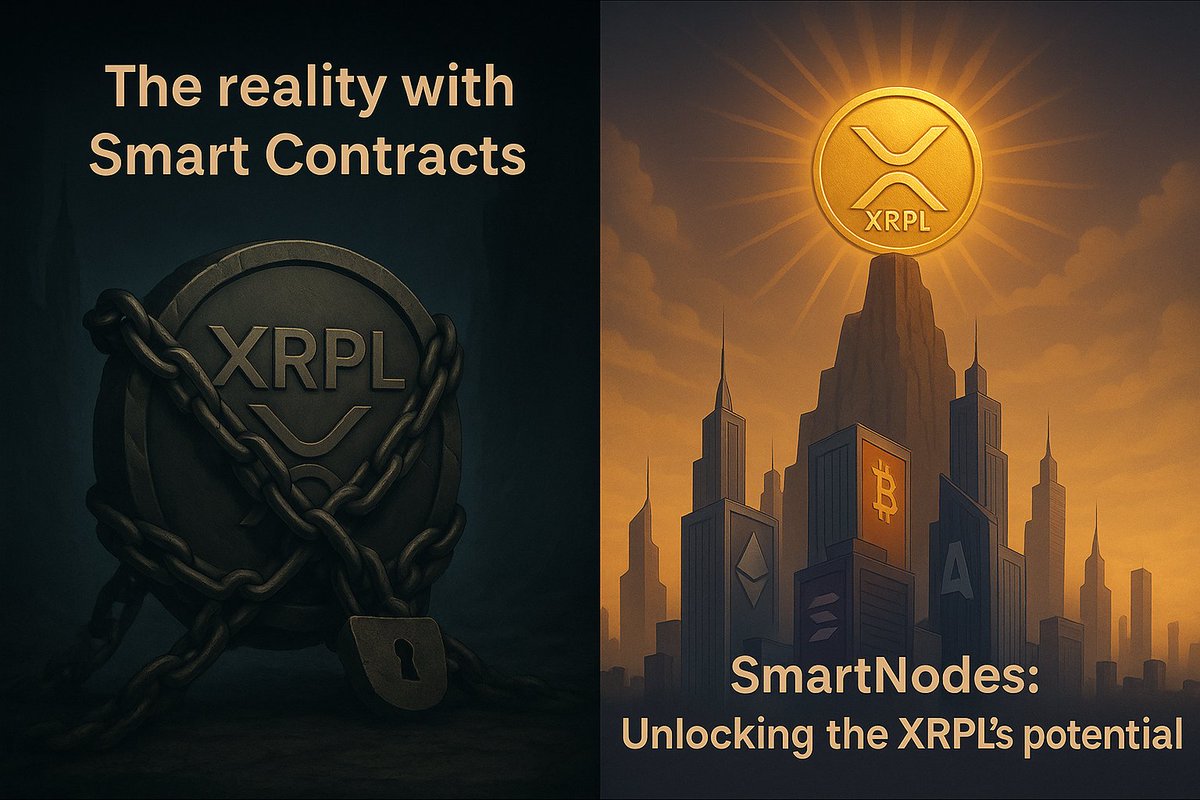
SmartNodes on XRPL: Unlocking Scalable Programmability XRPL’s Smart Contract Gap: The XRP Ledger (XRPL) is known for speed, low fees, and built-in features like a DEX, tokenization, escrow, and NFTs . But it has never supported arbitrary smart contracts. This was a deliberate choice by its creators, who prioritized stability and security over the complexity of Turing-complete code . Ripple CTO David Schwartz has described XRPL as a “fixed-function ledger,” leaving complex logic for other systems. This foresight spared XRPL from common vulnerabilities, but it also limited programmability. Developers wanting DeFi protocols or dApps have had to look elsewhere. To bridge the gap, XRPL has explored Hooks (lightweight scripts, still in development) and an EVM-compatible sidechain, launched in 2025. The latter saw over 1,400 smart contracts deployed in its first week, showing strong demand. But sidechains bring bridge risk and added complexity. XRPL still needs a scalable, secure approach to programmability. Why Smart Contracts Struggle: Traditional smart contracts enable DeFi, NFTs, and dApps—but at a cost. On Ethereum and similar chains, every node executes every contract. This creates high fees, congestion, and security risks. Vulnerabilities are permanent once deployed, and billions have been lost to exploits . Recent attacks even used Ethereum contracts to distribute malware via NPM packages . Smart contracts also depend on external oracles for real-world data , which can be compromised. The result: a powerful tool that too often proves inefficient, expensive, and fragile. XRPL’s founders foresaw these issues—which is why XRPL avoided them at its core. Enter SmartNodes: SmartNodes, pioneered by HSuite on Hedera, provide programmability without burdening the base ledger. They run off-chain but anchor results to the blockchain, offering what HSuite calls a “Layer 1.5” model . Key advantages: 👉Scalability: Off-chain execution means near-unlimited complexity, no gas or memory caps. 👉Security: Bugs can be patched; redundant nodes ensure reliability. 👉Oracle-Free: SmartNodes can pull data from any API or chain directly. 👉Developer-Friendly: Built in common languages like TypeScript. 👉Cost Efficiency: Up to ~80× cheaper than on-chain contracts. In short: XRPL stays lean, while SmartNodes handle complex logic off-chain. Why This Matters for XRPL: SmartNodes could unlock what XRPL has long lacked: flexible programmability at scale. Potential impacts include: 👉DeFi & DApps: Lending, trading, and derivatives platforms can run logic via SmartNodes while settling transactions on XRPL. 👉Cross-Chain Bridges: SmartNodes can coordinate assets across XRPL, its EVM sidechain, or other blockchains. 👉Enterprise Adoption: Businesses can integrate XRPL with real-world systems, keeping logic private but settlement public. 👉Mass Adoption Ready: Offloading computation keeps XRPL fast even with millions of users. HSuite is actively expanding from Hedera to XRPL . Their vision: “write once, deploy anywhere,” enabling SmartNodes across multiple chains. For XRPL, this could mean catching up to—and even surpassing—Ethereum-style programmability, but with greater efficiency and security. Conclusion: XRPL’s creators avoided embedding smart contracts to protect the network. That decision left XRPL stable, but limited in scope. SmartNodes provide the missing piece—programmability without the pitfalls. By combining XRPL’s trusted settlement with off-chain computation, SmartNodes could transform it from a payments-focused ledger into a platform for DeFi, dApps, and cross-chain services. For the XRP community, this isn’t just an upgrade; it’s a game-changer for XRPL’s future growth.
HSuite tweet media
English
10
51
129
5.6K
Peetr retweetledi
HSuite
HSuite@HSuiteNetwork·
Conclusion Smart contracts made DLT programmable but are limited: slow, costly, insecure, and non-scalable. Ethereum dominates today due to early adoption, but this cannot last forever. Smart Nodes, already with live use cases on Hedera and expansion to the XRPL imminent, offer the next step: scalable, cheaper, more secure, and developer-friendly. If DLT truly becomes the backbone of the digital world, Smart Nodes – not traditional smart contracts – are the likely foundation. [5/5 👍]
English
0
4
18
720
Peetr retweetledi
HSuite
HSuite@HSuiteNetwork·
Why Smart Contracts Fall Short Smart contracts were revolutionary, but they carry structural weaknesses that limit their long-term potential: 🎯Scalability: Ethereum’s base layer handled ~15 TPS, and even Hedera’s EVM tops at ~300 TPS . Popular apps like CryptoKitties clogged Ethereum , showing how fragile throughput can be. 🎯Cost: Every operation costs gas. Under heavy load, fees spike to tens or hundreds of dollars. Failed transactions still burn gas . 🎯Security: Code is immutable and hard to audit. Exploits (e.g., The DAO hack in 2016 ) and DeFi breaches continue to cause major losses . 🎯Inflexibility: Once deployed, contracts are extremely hard to upgrade or patch . 🎯Oracle Dependency: Contracts can’t access outside data natively. Reliance on third-party oracles adds vulnerabilities . Despite these flaws, smart contracts dominate due to Ethereum’s first-mover advantage, strong developer community, and established standards (ERC-20, ERC-721) . [1/5 👇]
HSuite tweet media
English
2
50
120
3.9K
Peetr retweetledi
Crypto School
Crypto School@Crypto4RestofUs·
$BONZO what JUST happened to the price?
English
5
15
48
1.5K
Peetr retweetledi
HSuite
HSuite@HSuiteNetwork·
🚀 MAJOR ANNOUNCEMENT: We're officially evolving from HbarSuite to HSuite as our unified brand name! After 3 years of proven success on Hedera and with V2 technology ready for multi-chain deployment, we're embracing our multi-chain future! 🌐 #HSuite #MultiChain [1/12 👇]
English
21
90
312
14.3K