Students remember more when they write it down on paper. Not type it. Not screenshot it. Write it!
The act of writing slows students down, adds tactile feedback, and helps lock it into memory.
Veteran teachers don’t struggle with feedback because they’re unwilling to grow.
The issue is the system treats a first-year teacher and a 20-year teacher the same. That doesn’t make sense.
A new teacher is building a foundation. They need structure, modeling, and direct feedback. A veteran teacher is in a different place. They’ve taught thousands of lessons, worked with hundreds of students, and refined their craft. They need someone who can challenge them and understand their level.
But the system applies the same rubric, checklist, and process to everyone.
And it’s not working.
Large-scale evaluation reforms haven’t shown meaningful gains in student achievement. In another study, only about one in four teachers said feedback actually improved their teaching.
That should tell us something.
The strongest research points elsewhere. Instructional coaching shows significant improvement in both teaching and student outcomes. Why? It’s ongoing, specific, and grounded in real classrooms. It meets teachers where they are.
That’s the difference.
You can standardize evaluation, but you can’t standardize growth.
We’ve tried to fix weak feedback by making it more standardized. The problem isn’t the form. It’s the fit.
This isn’t about administrators doing something wrong. Most are doing what they’ve been asked to do. The system just doesn’t match the complexity of the work.
A veteran teacher doesn’t need more boxes checked. They need someone who understands what they’re trying to do and can think with them at a high level.
Evaluation should be less about judging and more about helping.
More aspirational. More conversational.
Not “Here’s what to fix,” but:
What are you working on?
What’s been effective?
Where do you want to grow?
Because growth is voluntary. You can require evaluation, but you can’t force improvement.
That comes down to credibility and relevance.
Teachers act on feedback when they believe the person giving it understands their work, content, and students.
That’s why coaching works. It’s ongoing, specific, and built around real practice. It creates ownership, not compliance.
Veteran teachers don’t ignore feedback because they think they know everything. They ignore feedback that doesn’t match their level.
After enough years, you learn to filter what helps from what just checks a box.
Because growth isn’t one-size-fits-all.
And pretending it is doesn’t make it better. It just makes it look more organized.
References:
National Bureau of Economic Research
American Educational Research Association / American Educational Research Journal
Review of Educational Research
Happiness requires struggle. Without struggle, the world would lack meaning and our joys would feel empty.
ㅤ
Be grateful for your struggles, because within them is the constant opportunity for purpose.
Teachers often notice the cracks before the data does.
Right now, many are seeing:
– A sharp drop in focus during reading and writing (thanks to cell phones)
– A growing dependence on AI to think and write
We’re not heading for a learning crisis.
We’re already in one.
The Anxious Generation was published two years ago today, in a very different world. Back then, the most common objection I got was resignation: "The train has left the station." "You can't put toothpaste back in the tube." "It's how the kids connect today."
Today, the world looks very different. It turns out that if our kids were all on a train and we learned it was heading toward a collapsed bridge, we'd find a way to stop it and bring them safely back to the station. That’s what’s happening now.
After the historic verdicts in Los Angeles and New Mexico, today is a great day to reflect on the capacity of people in democratic societies to take action, even when opposing some of the most powerful corporations in history. We're getting access to the courts. We're getting phone-free schools. We're seeing whole neighborhoods letting kids out to play, unsupervised, which is what we older folk all remember as the best part of childhood.
So I want to recognize:
--The mothers (and, right behind them, fathers) who rose up by the millions and powered the movement.
--The farsighted governors and legislators in red states and blue states who have been innovating on policy solutions.
--The leaders of a dozen of nations, who are raising the age to 16 for opening social media accounts (with a special shoutout to Australia, for going first).
--The teachers and school administrators who had their classrooms disrupted for 15 years, and who are now eager to think through new solutions as screens have taken over and obstructed learning.
--The grassroots organizations who have been dedicating their efforts to advocate for all of the above in their local communities.
--The millions of members of Gen Z who have been rising up, demanding agency over how they spend their lives in the digital era, and finding better ways to connect in real life.
And one final group: the survivor parents--the ones you saw in those pictures of people embracing on the front steps of the LA courthouse. I have met many over the years. I am in awe of their courage and tenacity, their willingness to tell their stories of loss, over and over again, to different audiences, in the hope that no other parent would have to endure what they have endured. At long last, juries and legislatures are hearing you, and are acting.
Together, we are calling the train back to the station. Together, we are rolling back the phone based childhood and reclaiming life in the real world.
The work continues. If you’re not already involved, join us: anxiousgeneration.com/join
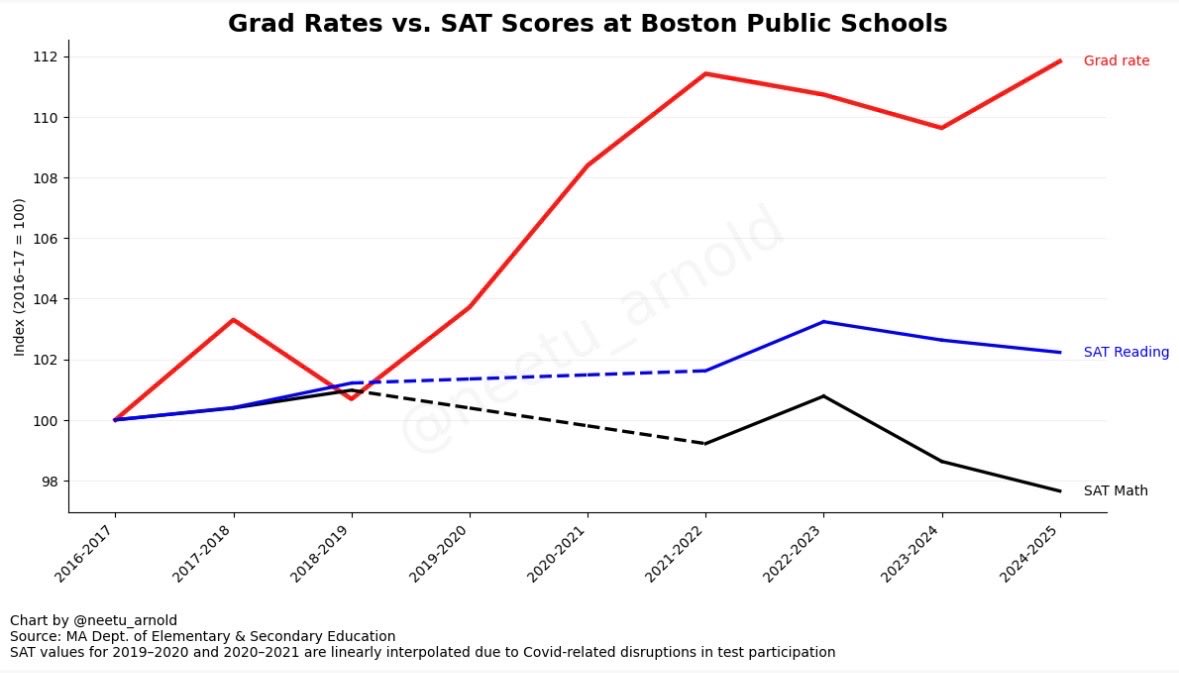
🧵In just 20 years, Boston Public Schools jumped from 59% ➡️ 81.3% graduation rate. But are students actually more academically prepared?
SAT scores showed clear declines
Full breakdown for overall, low-income, and English Learner (ELL) students👇
Real positivity isn’t soft. It’s strong. It’s resilience and mental toughness. It’s overcoming negativity and adversity. It’s seeing all the crap in the world and choosing a positive attitude and a path forward.
If a player doesn’t play hard all the time, no skill they bring to the table can offset that. Playing hard is a prerequisite to playing. Period. Nobody succeeds by making half an effort. Make sure your players understand that laziness is unacceptable. Competing to WIN is a skill!
One family, the right-wing Trump-aligned Ellisons, will soon control:
TikTok
CBS
CNN
HBO
Discovery Channel
BET
Cartoon Network
Comedy Central
DC Studios
Fandango
Miramax
MTV
Nickelodeon
Paramount
PlutoTV
Showtime
TBS
The CW
TNT
Warner Bros.
And more
This is oligarchy.
The American education system is fixated on finding the latest method or system to get students reading and writing.
Unfortunately, no hack exists. Reading is sometimes dull. Writing is often hard.
You can’t entertain yourself to an education.