
Peter K. Jackson
17 posts

I was taken by surprise this morning when congratulatory emails started arriving in my inbox. I'm incredibly honored, grateful, and humbled to be included among such an esteemed group of scientists, many of whom I’ve admired for decades.
While this recognition is individual, science is fundamentally a collaborative and team effort. I wish to express my heartfelt gratitude to my extraordinary trainees whose talent, creativity, resourcefulness and persistence have built everything that our lab is known for and taken our research in directions I had never imagined; to my mentors who ignited my curiosity and led by example; to my collaborators who have introduced me to new fields and inspired me with the beauty of their science; to my colleagues who have so generously supported and advocated for me time and again; and to the community of cell biologists, molecular biologists, and neuroscientists who have trusted and incorporated our technologies into their research, given us invaluable feedback, and inspired us to continue building.
Being able to do science, to expand human understanding of the natural world, is an enormous privilege and joy. I can't wait to see what the future holds for molecular technologies that enable scientists to probe proteins, RNA, and living systems in new ways!
English
Pleased to share our latest in Cell showing SARS-CoV-2 uses airway cilia to cross the mucin barrier and microvilli for viral exit. Omicron variants bind cilia better! Great collaboration with Raul Andino (UCSF) & Nayak, Milla, Nolan labs (Stanford). doi.org/10.1016/j.cell…
English
@stanfordcbio Stanford has an amazingly broad range of faculty and collaborators working with state of the art technologies. If you would like to go after a major problem in modern biology or medicine, Stanford has the tools to support you.
English

Grad school application season is upon us! Interested in applying to graduate school or know people who are? Check out and share the CBIO PhD Preview Program!! Please retweet to increase our reach 🦀
English
AddThis | Home
Pleased to share our latest in Cell "A defective viral genome strategy elicits broad protective immunity against respiratory viruses", a new way to block SARS-CoV-2 and other viruses. Great collaboration with Raul Andino & Judith Frydman.
authors.elsevier.com/c/1eA9eL7PXf0M…
English
Excited by Amy McKeever’s article in National Geographic “COVID-19 linked to new diabetes cases—but long-term problems may be more severe”, covering our teams’ recent findings in Cell Metabolism “SARS-CoV-2 infects human pancreatic β cells and elicits β cell impairment”!
English
The paper is titled “Discovery of ciliary G protein-coupled receptors regulating pancreatic islet insulin and glucagon secretion” and I would like to thank the authors Chien-Ting Wu, Keren Hilgendorf, Romina Bevacqua,Yan Hang, Janos Demeter and Seung K. Kim!
English
Peter K. Jackson retweetledi
Delighted to share our latest story: GPCRs including the omega-3 fatty acid receptor FFAR4 localize to cilia of endocrine pancreas beta and alpha cells to regulate insulin and glucagon secretion. Collaboration with Seung Kim’s lab
genesdev.cshlp.org/content/35/17-…
English
Can COVID-19 lead to diabetes? Here’s a comment on our recent story in National Geographic
nationalgeographic.com/science/articl… via @NatGeo
English
Our new study “SARS-CoV-2 infects human pancreatic β-cells and elicits β-cell impairment” is now online at Cell Metabolism (cell.com/cell-metabolis…). We show that COVID-19 attacks beta cells and insulin secretion.
English
My article is featured on the @ResearchGate #COVID19 community page. Read it here: researchgate.net/publication/34… Wonderful team effort and a new, very rich pathway to explore. pjackson@stanford.edu
English
Our new article showing that COVID-19 infect multiciliated cells in airway epithelia is published in Nature Communications and featured on the @ResearchGate #COVID19 community page. Read it here: researchgate.net/publication/34…
English
Today was my last day as chair of the Stanford Biology department. After six years, my last official act was to send out faculty offer letters to two awesome young scientists who we want to bring here. Saving the best for last!
English
@Mill_lab @StanfordMed Thanks for getting the point! Paper is now accepted!
English
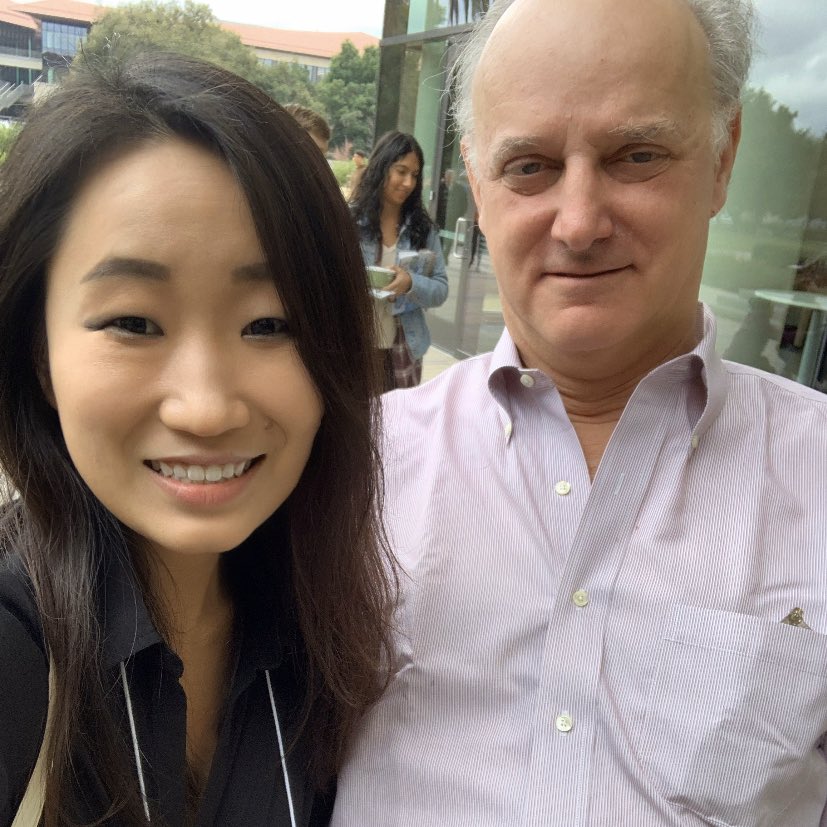
#Tbt annual meeting with Peter is always a lot of fun! Who could believe 30 years apart, we have both worked on the same bench on the third floor @WhiteheadInst in ‘David’s lab’!!!
English

Congratulations to KerenHilgendorf working with @PeterKJackson and @ReiterLab on this wonderful @CellCellPress publication! Creative use and stunning images of our cADDIs biosensor in the cilia of preadipocytes. Visit our site to see the entire collection of targeted biosensors.
Cell@CellCellPress
Article in this issue of Cell: Omega-3 Fatty Acids Activate Ciliary FFAR4 to Control Adipogenesis - zpr.io/tsnT9
Montana, USA 🇺🇸 English