Petter Englund

1.2K posts

Petter Englund banner
Petter Englund

Petter Englund

@PetterEnglund

Filmmaker │ Regular Contributor on Medium (Writing about the World, Economics, Philosophy & Bitcoin) │ Nostr in expanded Bio │ ∞/21M

Katılım Aralık 2009
550 Takip Edilen878 Takipçiler
Sabitlenmiş Tweet
Petter Englund
Petter Englund@PetterEnglund·
AI doesn't have a POV It collapses production costs and democratises storytelling, indeed, but it doesn’t replace perspective. In a world where anyone can create the "$10M shot", POV will matter even more because it’s the only thing left to differentiate yourself
Linus ✦ Ekenstam@LinusEkenstam

Comments on this reflects the state of the human condition. This sizzle looks freaking amazing, it showcases a wide veriety of different difficult shots, expensive, over the top and intense. Traditional tools here would make any of these scenes extremely expensive to make. Yet with something like Runway this becomes a lot easier. Majority of industry people and creatives are still in the dark completely of what goes into making a sizzle like this. The creative planning, the process, and of course the execution. You'll see commenters blast the same narrative: "AI slop", "who will watch 4 second clip movies", "no storytelling", "yap yapping yap yap". They are looking for a binary answer to a nuanced situation. When I'm arguing that Hollywood is cooked, you first need to understand what Hollywood is. Just take a look at the credits of any big blockbuster movie. 90% if not more on the credit list, will be VFX. So while you might have 2 writers, 2 top actors + 3 supporting in a movie, you'll have 1000+ vfx artists. Hollywood is not the top actors, or the writers, Hollywood is the VFX teams, the post crews, the gaffers and tech staff, the set builders and everything in between. But if I can virtually create any set, cast any character, create any visual effect I want in minutes not months. My creative exploration and output will 10x easily. Now do that with everyone on a production team, and you are going to see gains that make the industrial revolution look like a delayed flight. There is no doubt we are in the middle of a total reset of everything as we know it. The only thing holding stuff back is viscocity in society and peoples hate for change. The winners are the early adopters, the people that are understanding that change here is unstoppable. I personally have met many people who are now as single or small teams building and creating generational wealth from working with these tools. No BS. People are printing money. With no end in near sight. Learn to whisper to these tools, and up-skill yourself, you'll thank me later.


English
0
0
1
442
Petter Englund
Petter Englund@PetterEnglund·
@Awads_ @paulg @dadiomov After 34 transactions, only half the original value remains with a 2% fee Microtransactions likely mean that many per day or hour, maybe even per second
English
0
0
0
29
a
a@Awads_·
@paulg @dadiomov Hey Paul sorry I disagree with this take. You really do need a mediator between payments. What do you do when you accidentally send too much money, need a refund, get scammed, or lose your card (or wallet key)? IMO the protection visa & processors provide outweigh their 2% fee
English
1
0
2
585
Dimitri Dadiomov
Dimitri Dadiomov@dadiomov·
I don't understand the premise that "agents must use stablecoins." Why can't an agent remember the 16 digits of a credit card? Sorry maybe I'm a payments n00b. Stablecoins have a lot of great use cases, but ecommerce shopping is pretty well optimized already for cards.
English
200
8
631
302.2K
Petter Englund
Petter Englund@PetterEnglund·
@Danny14396 Low rates inflate housing prices. What you “save” on interest, you pay back in inflated prices
English
0
0
2
52
Daniel Hoff🇳🇴🇺🇸
Daniel Hoff🇳🇴🇺🇸@Danny_hoffzone·
SJEKK FORSKJELLEN på hva vi betaler i måneden for et lån på 4 millioner i Skandinavia nå i april 2026. Norge: 4,00 % rente — ca. 13 780 kr i mnd Sverige: 1,75 % rente — ca. 7 100 kr i mnd Danmark: 1,60 % rente — ca. 7 400 kr i mnd VI BETALER ALTSÅ nesten det dobbelte hver eneste måned bare fordi vi bor i Norge. Vi må snakke om det enorme gapet mellom de politiske løftene og den økonomiske realiteten vi står i! MENS NABOENE våre for lengst har fått renta ned, holder Norges Bank igjen og varsler nå at vi kan ende på 4,5 prosent før året er omme. Vi kaller oss et rikt land, men det får være måte på! HVERT "LILLE" HOPP PÅ 0,25% øker utgiftene våre med 10 000 kroner i året før skatt. SIDEN 2021 har den årlige ekstraregningen for et lån på 4 millioner passert 100 000 kroner netto. FØR VALGET hørte vi mye om å trygge folks økonomi, men regjeringens oljepengebruk presser renta opp og tvinger sentralbanken til å holde igjen for å stoppe inflasjonen. SKAL VI FÅ RENTA ned på skandinavisk nivå, må politikerne slutte å skyve ansvaret over på Norges Bank og heller stramme inn på budsjettene. EN LØSNING som nå diskuteres seriøst, er å knytte krona til euroen, slik Danmark gjør. Det ville gitt oss umiddelbar stabilitet og renter på linje med resten av Europa. Prisen er at vi mister muligheten til å bruke krona som støtdemper i krisetider, men spørsmålet er om ikke prisen for å stå utenfor er i ferd med å bli enda høyere for norske husholdninger.
Daniel Hoff🇳🇴🇺🇸 tweet media
Norsk
46
34
187
25.2K
Cantillon Consulting
Cantillon Consulting@CantillonCH·
@GeorgeSelgin Or every time they swivel from that supposed "lack" to promoting their pet, disembodied code sequence -crypto- as a "fix" for it.
English
1
0
1
88
Petter Englund
Petter Englund@PetterEnglund·
@GeorgeSelgin I don't believe value requires a human valuer as the universe has a normative structure well aware that's not the finance textbook definition, George
English
2
0
0
120
Petter Englund
Petter Englund@PetterEnglund·
Yep sure - but ultimately it's a ontological question. Many agree we see reality through a story. The question is whether reality ** is ** only a story, or whether it exists independently of us. If the latter, stuff may have intrinsic value regardless our believes. Many say money is a pure human construct. The ** form ** may be, but what about the function?
English
0
0
0
72
Oakman
Oakman@Oakmanbearcow·
@BentleyShafer @MattBGilliland @GeorgeSelgin I just disagree that both money and sandwiches are both valuable in a similarly abstract way, I think the term intrinsic value is useful if even only colloquially. Again I’m not going to dispute an economist parsing technical language, they know better than me
English
2
0
2
127
Shann³
Shann³@shannholmberg·
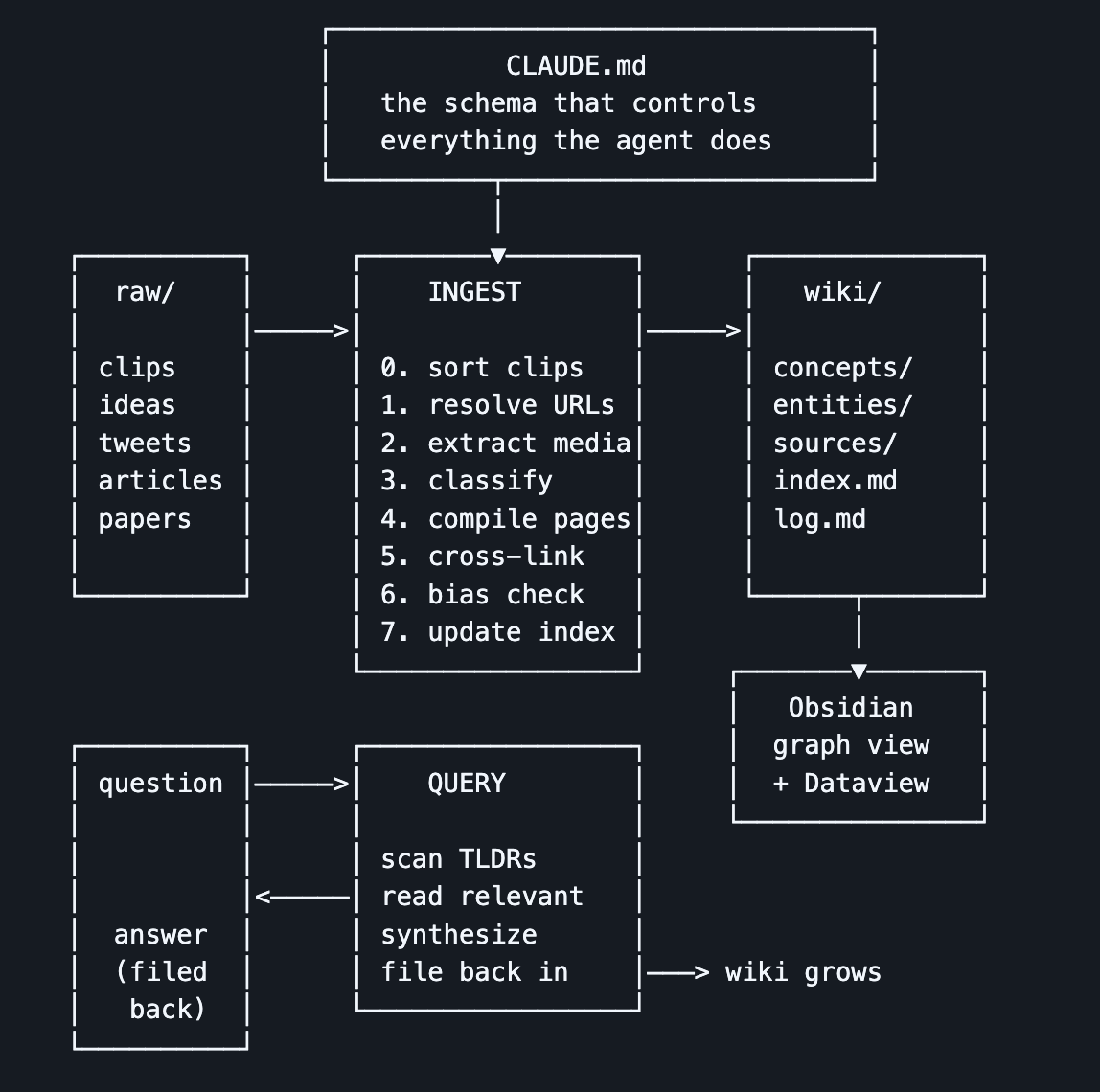
how my LLM Wikid works in 4 steps 1. drop anything into raw/ clips, tweets, articles, ideas, papers. no editing, no sorting 2. the ingest agent processes everything classifies, compiles wiki pages, cross-links, bias checks, updates the index 3. ask a question it scans TLDRs, reads the relevant pages, synthesizes an answer with citations 4. the answer gets filed back as a new wiki page every query makes it smarter. the wiki grows on its own CLAUDE. md is the schema that controls all of it
Shann³ tweet media
Shann³@shannholmberg

how to build karpathy's AI knowledge base in 20 minutes I built a simplified framework after testing the complex ones. clone it, point your agent at it, feed it your stuff. save this thread, repo is in the last tweet 🧵

English
30
78
498
90.8K
Petter Englund
Petter Englund@PetterEnglund·
@defileo What happens when you have 10,000 articles? There's a scalability problem.
English
0
0
4
2.8K
tamhn
tamhn@thisistamhn·
@ashpreetbedi the navigation over search insight is the key one. most systems default to vector search for everything. the ones that work route by data type first. SQL for structured, nav for concepts. clients hit this realization late and have to refactor.
English
1
0
1
265
Ashpreet Bedi
Ashpreet Bedi@ashpreetbedi·
Building a Personal Knowledge Agent I've been using a personal knowledge agent called Pal (Personal Agent that Learns). It runs locally, talks to me over Slack, and tries to get better over time (still tuning this part). I posted about it a few weeks ago and wanted to share some key design decisions. The goal is that I feed it raw data (URLs, papers, notes, meeting context, tidbits about people) and it organizes everything into two layers: a compiled wiki for text-heavy knowledge (concepts, summaries, research), and a SQL database for structured data (notes, people, projects, decisions). It should connect to my email, calendar, and slack. Here are some details: 1) Markdown + SQL Markdown is great until you need to query across dimensions. "Everything related to Project X from the last two weeks across all sources". "Prep me for my meeting with Sarah" (pull her notes, recent emails, project context, calendar history). This is relational data, not document retrieval. SQL handles this well. 2) Navigation over Search The key insight behind Pal is navigation over search. Each data source keeps its native query interface. Databases get SQL. Email gets queried by sender and date. Files get navigated by directory structure. The wiki gets navigated by its index. No flattening everything into one vector store. The agent picks the right source for the right question through a metadata routing layer, not through embedding similarity. 3) Structured data (SQL) When I say "save a note: met with sarah from acme, she's interested in a partnership". Pal creates a row in a notes table, tags it with ['sarah', 'acme', 'partnership'], and links it to sarah's entry in a people table. When I later ask "what do I know about sarah?" it queries across notes, people, projects, emails, and calendar. Tags are the cross-table connector. A note about a meeting with sarah about Project X gets tagged so it shows up in both contexts. The agent owns the schema. It creates tables on demand. Notes, people, projects, decisions all emerged from natural conversation. "Save a note" creates a note. "Track this project" creates a project. The schema grows with usage. 4) Knowledge base (Wiki) The other half is a compiled knowledge base for things that need depth. Research, technical concepts, reference material. 4.1) Ingest: I feed it URLs, papers, articles, meeting notes. It fetches the content, converts to clean markdown, and saves to a raw/ directory with YAML frontmatter (title, source, date, tags). A manifest tracks what's been ingested and what's been compiled. 4.2) Compile: A dedicated Compiler agent reads uncompiled raw files and produces structured wiki articles. It breaks each source into concept articles, writes summaries, cross-links related concepts, and maintains a master index. Compilation is incremental. Only new files get processed, never the whole wiki. New information enriches existing articles rather than replacing them, and every claim links back to the raw source. 4.3) Query: The wiki index is designed to fit in one LLM call (~100 articles). When I ask a knowledge question, the agent reads the index first, picks relevant articles, then falls back to raw sources and live tools. I expected to need vector search for this. Turns out an auto-maintained index with brief summaries works surprisingly well at this scale. The LLM navigates it like a table of contents. 5) Learnings I'm still working on this part. The pieces are there but it's not where I want it yet. Because Pal is a team of agents, they all share a common learning store. Every time a retrieval strategy works, it gets saved. Every time I correct the agent, that correction gets saved with highest priority. Over time, the agent should route to the right source faster and give better answers without me tuning anything. 6) Architecture: Pal is a team of five specialist agents. Navigator is the workhorse. Researcher gathers sources from the web. Compiler turns raw into wiki. Linter checks quality. Syncer pushes everything to GitHub. Pull the wiki locally, read it in your IDE of choice, push changes back. 7) Scheduled tasks: Eight scheduled tasks run themselves between conversations: daily briefings, wiki compilation, inbox digests, weekly reviews, wiki linting, context re-indexing, and git sync. Results post to Slack. TLDR: raw data from any source gets ingested and organized into two layers: a compiled wiki for knowledge depth and SQL tables for structured breadth. Five context systems get navigated (not searched) to answer questions. A learning loop compounds every interaction. The wiki is just markdown backed by git.
English
12
20
232
19.3K
Petter Englund retweetledi
CONSEQUENCE
CONSEQUENCE@consequence·
Bruce Springsteen closed his concert in Minneapolis by paying tribute to Renée Good and encouraging fans to heed John Lewis's famous call to "get into good trouble." "These are the hard times, but we'll make it through. We're the Americans. But I think — I know — for me, the hardest part about all of this is feeling the distance between your neighbors, your fellow citizens, and that distance… well, it can darken your soul. Now we have a leader who says he wishes nothing but ill upon the people he disagrees with, and who disagree with him. I don't feel that way. America, from the beginning, was born out of disagreement. It was built on disagreement. We can argue about what course we thought the country should take while recognizing our common humanity, our dignity and, yes, our unity... "I go back to thinking about Renée Good's last words before she died, to the man who she was protesting against, the man who would take her life. She said, 'That's fine, dude, I’m not mad at you. I'm not mad.' God bless her. "So tonight, when you go home, hold your loved ones close. And tomorrow, do as Renée did, find a way to take aggressive, peaceful action to defend our country’s ideals. And as the great civil rights leader John Lewis said, 'Go out and get into some good trouble. Say something. Do something. Help! Sing something!' If you're feeling helpless, hopeless, betrayed, frustrated, angry … I know I've been. That's why The E Street Band is here tonight. This is a tour that was not planned. We’re here tonight because we need to feel your hope, and your strength. And we want to bring some hope and some strength for you. I hope we did that. All I can say is God bless Alex Pretti, God bless Renée Good, God bless you, and God bless America." 📸: Kevin Mazur / Getty Images
CONSEQUENCE tweet media
English
188
1.1K
4.4K
282.1K
Petter Englund
Petter Englund@PetterEnglund·
@EricBalchunas Based on historical data, a turkey has a 100% perfect record of not being eaten up until the day before thanksgiving. This indisputable truth is the ultimate anxiety killer for turkeys.
English
0
0
3
152
Eric Balchunas
Eric Balchunas@EricBalchunas·
You can simplify it even further: The U.S. stock market has a 100% perfect record of coming back from downturns to hit ATHs. This indisputable truth is the ultimate anxiety killer. Better than Xanax. Instantly renders all doomer columnists and economists powerless.
Adam Khoo@adamkhootrader

The stock market is a giant distraction machine designed to test your stomach, not your brain. These mid-term drawdowns are not 'crises'; they are regularly scheduled sales. History proves that the most uncomfortable time to buy is exactly when your future self will thank you most. Volatility isn't risk—it's the price of admission for superior returns.

English
106
126
1.1K
315.1K
Petter Englund
Petter Englund@PetterEnglund·
@aakashgupta Does your inductive analysis take into account the fall of the world order for the past 80 years?
English
0
0
3
839
Aakash Gupta
Aakash Gupta@aakashgupta·
If you're under 40, this is one of the best buying opportunities you'll get this year. Run the math on what happens when you buy at these levels historically. The forward P/E just fell to 19.7x. That's below the 5-year average of 20.1x and the cheapest the index has traded since Liberation Day in April 2025. Citadel's Scott Rubner flagged it: every time the S&P forward P/E has dropped below 20x since 2020 (13 occurrences), forward returns have been positive. Over the last 50 years, the S&P has had a negative Q1 18 times. Last year it dropped 4.6% in Q1 and finished up 16.4% for the year. In 2003 it fell 3.6% in Q1 and posted 26.4% for the full year. The pattern repeats: after 10% corrections, investors who bought the dip averaged 11% returns within a year and 37% within three years. The panic math is even more telling. Miss just the 10 best trading days and your returns get cut roughly in half. Miss the top 50 and they shrink by nearly 5x. The best days almost always cluster inside the worst months. March 2026 has had 1%+ intraday swings on 14 of 18 trading days. The snapback days are hiding inside this exact volatility. Everyone sharing this chart is seeing a 7.6% decline. The people who build wealth from these moments are seeing a forward P/E in the 6th percentile of its one-year range, Wall Street consensus calling for 10-20% upside, and 50 years of data confirming that selling here is almost always the wrong trade. The worst time to look at your portfolio is the best time to add to it.
Brew Markets@brewmarkets

The S&P 500 is on track for its worst month since 2022.

English
294
448
5.9K
2.5M
Petter Englund
Petter Englund@PetterEnglund·
People who write these bait tweets forget the most basic truth about literature and art - you cannot predict a hit from past data. "Senior Publishing Strategist at Penguin Random House with 20 years of identifying books..." -> that takes taste. AI doesn’t have taste.
Mr. Jason💡@jason_coder0

🚨BREAKING: The book you have been postponing for 3 years can be finished in 48 hours. The only thing that was stopping you was not knowing these 9 Claude prompts: (Bookmark 🔖 before they realize)

English
0
0
0
115
Petter Englund retweetledi
damien
damien@damienghader·
FCK it. Here's all the sauce. After shipping 100+ apps with @Lovable — I made the ULTIMATE Design Cheat Sheet. Every prompt. Every design system pattern. Every cloud config + infra setup. Every component standard + best practice we actually use to achieve world-class UI. All in one doc. Follow + comment "Cheat Sheet" and I'll DM it to you.
damien tweet media
English
3.5K
147
2.6K
503.4K
Jacob Klug
Jacob Klug@Jacobsklug·
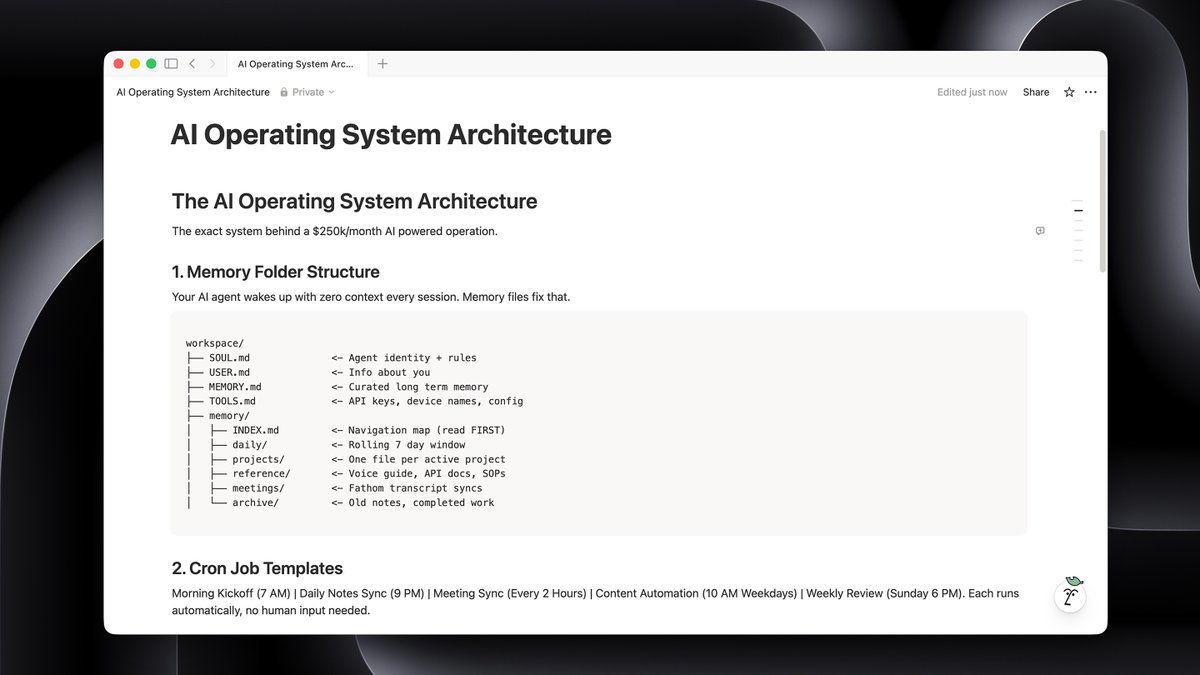
I'm giving away my entire @openclaw architecture. Behind my $250k/month agency. After weeks of building, I've dialled in the exact system that runs my business 24/7. What's included: • Memory folder structure (how to organize agent context) • Cron job templates (daily briefs, meeting syncs, content automation) • How to build a custom dashboard in @lovable • API reference doc (so your agent never forgets its tools) • Voice training method (85 posts to teach it your style) • Supabase schema for dashboard connection Comment "OS" and follow. I'll DM it to you. P.S. This will probably blow up so give me some time to reply.
Jacob Klug tweet media
English
5.9K
280
3.6K
401.1K
Rich Grivas
Rich Grivas@RichGrivas·
@TheOneLanceB Bitcoin is a baseball card. Only goes up if someone is willing to pay up for it. No fundamental or tangible value. Only valuable if someone else believes it is worth more Just my opinion
English
2
0
6
549
Lance Breitstein 🇺🇸🌎
Lance Breitstein 🇺🇸🌎@TheOneLanceB·
So what exactly is the remaining investment argument for Bitcoin, if not just greater fool speculation? It has melted during the recent period of dollar debasement fears. It has melted during periods of inflation. 15+ years later, crypto still has minimal utility outside of niche use cases and ultimately just remains a rough proxy for risk assets. (Also lol that Cathy Wood still has a $1m+ target on it.) Unlike a stock, it only works if incrementally more people believe in it… the so called “greater fool” argument given finite supply and hope of increased demand from adoption. But what really is the next saga for this stuff if prospective returns are indeed compressed and there really actually aren’t broad use cases for Bitcoin? 10 years ago you could argue that Bitcoin will one day be broadly adopted for common use. The fact that it hasn’t been over that time period IMO is signal that the use case isn’t there. (Crazy that I’ve now been trading $BTC for 15 years and the chatter of use cases is still the same yet I’ve never once used it!) As I questioned 6 months ago… what happens when the reflexive nature of Bitcoin stalls bc the prospects of 100x or even 10x returns during the up-cycles are gone.
Lance Breitstein 🇺🇸🌎@TheOneLanceB

CURRENT VIEW ON $BTC Controversial take, but curious what people think… Given the price action in $BTC, I wonder two things: 1. Has $BTC topped shorter-term? 2. How compressed will prospective return be over the coming years? We had an absolutely beautiful setup in Bitcoin. Great consolidation. All-time highs. Tons of bullshit treasury purchases to fuel the fire. Positive regulatory news. Every trader I know (including me for the idiots that think I’m a permabear) was leveraged long to the hilt. And yet we could only get two real days of price expansion. At this point, who is the marginal buyer? Who isn’t long on a setup like that? Structurally, I’ve felt $BTC will go higher but that the massive returns are gone. As an asset reaches mass adoption, realized vol compresses as do returns. There is less price discovery to occur. It’s just basic market structure theory. Every cycle in $BTC, the returns have been about a magnitude less. And the failure of this breakout makes me think $BTC is largely approaching the era of market returns (market single-year returns/vol can be far higher than most think though). It didn’t take much imagination to see a quick move to $130k, $140k, $150k (the people who think $1m is around the corner are high on hopium IMO). Yet here we are. I always then end up wondering the second deriv… if returns compress and approach market returns, how many people would still hold bitcoin? The data doesn’t lie. Most holders of $BTC are in it solely for speculative purposes. People are looking for 1000%+ returns or even 100% returns. What happens to the average holder if we experience years of traditional market returns? What happens to the average holder if all of a sudden $ETH or some other coin starts to offer higher prospective returns? I have zero idea the future. Not a forecast. But certainly questions worth thinking about. @TheFlowHorse @skyquake_1 @TedHZhang

English
64
13
285
44.8K