
Sabitlenmiş Tweet
philipp
579 posts



philipp retweetledi

Why are you here?
"We're going back to the fucking moon, that's why."
The kids are ok.
English
I don't think a sceptic LLM alone can help. It would really need to become their friend.
Because most people define their personality (values, believes, world-view) via their friends.
It's why the LLM psychosis happens in the first place.
So they will not want to get their believe challenged by a sceptic LLM. They'll try to justify everything their crank LLM says.
English

Not the worst idea
I think they should really be more skeptical by default. It’s so easy to get them cycling down, especially with the default memory capabilities today.
But you would think at some point it would do a reflect loop and point out what mine does when I copy paste some crazy shit: the words are misappropriated, the proof doesn’t fucking prove anything, it just doesn’t make sense, and you’re certifiably fucking RUDE for forcing this slop upon others.
English
Are there any online/international resources to direct people to who are dealing with psychosis, especially LLM-fueled?
Our support teams have always lists of self-harm ones, gambling ones, etc. For people who come in and need more help than we can give them.
Last few months the schizo-esque delusions, often around finding some insane crit double 0day, have been really bad.
Standard crisis lines arent really what they need. Especially as they don’t self-identify as depressed or in crisis whatsoever.
But we are not what they need either.
😩
English
philipp retweetledi

What we’re basically going to see happen is that China is going to cure cancer.
If you want a map to all the technological advances you’re going to see in the next 10 years out of China, the formula is “technology now makes it possible to do X, but it’s really hard to do X in the United States.”
Patrick Collison@patrickc
• According to the story, the dog's cancer has not been cured. • Absent all regulatory and manufacturing constraints, we could not just synthesize magic mRNA cancer cures. The technology is very promising, but it's not yet any kind of panacea. • The emergent system of regulators and manufacturers is indeed far too conservative, and small-scale experimentation is much harder than it should be. More people should read the first part of The Rise and Fall of Modern Medicine. Recommend @RuxandraTeslo, @PatrickHeizer for more.
English
philipp retweetledi

Renaissance history is so much wilder and weirder than you would have expected. Very fun chatting w @Ada_Palmer about it.
Some especially fascinating things I learned from the conversation and her excellent book, Inventing the Renaissance:
Not only did Gutenberg go bankrupt in the 1450s (after inventing the printing press), but so did the bank that foreclosed on him, and so did his apprentices. This is because paper was still very expensive, and so you had to make this big upfront CAPEX decision to print a batch of 300 copies of a book - say the Bible. But he's in a small landlocked German town where only priests are allowed to read the Bible - so he sells maybe 7 copies. It’s only when this technology ends up in Venice, where you can hand 10 copies to each of 30 ship captains going to 30 different cities, that it starts taking off.
Speaking of which, the printing revolution wasn’t just one single discrete event, just as the computer revolution has been this whole century of going from mainframes -> personal computers -> phones -> social media, each with different and accelerating social impact. Books came first, but they’re slow to print, and made in small batches. The real revolution is pamphlets - much faster, much harder to censor. Pamphlet runners are how you can have Luther's 95 Theses go from Wittenberg to London in 17 days.
So much other wild stuff from this episode. For example, did you know that the largest and best-funded experimental laboratory in 17th century Europe was very likely the Roman one run by inquisitors? Ada jokes that the Inquisition accidentally invented peer review. The focus of the Inquisition is really misunderstood - it was obsessed with catching dangerous new heretics like Lutherans and Calvinists - it only executed one person for doing science.
And this leads Ada to make an observation that I think is really wise: the authorities and censors are always worried about the exact wrong things given 20/20 hindsight. When Inquisition raids an underground bookshop during the French Enlightenment, they don’t mind the Rousseau, Voltaire, and Encyclopédie, but they lose their minds about some Jansenist treatises about the technical nature of the Trinity.
More broadly, a lesson for me from this episode is that it’s just really hard to shape history in the specific way that you want to impact things. One of the most famous medieval scholars is this guy Petrarch. He survives the Black Death in the 1340s, watches his friends die to plague and bandits, and says: our leaders are selfish and terrible, we need to raise them on the Roman classics so they'll act like Cicero. So Europe pours money into finding ancient manuscripts, building libraries, and educating princes on classical virtues. Those princes grow up and fight bigger, nastier wars than ever before with new deadlier technology. And this, combined with greater urbanization and endemic plague, results in European life expectancy decreasing from 35 in the medieval period to 18 during the Renaissance (the period which we in retrospect think of as a golden age but which many people living through it thought of as the continuation of the dark ages that had persisted since the fall of Rome).
Anyways, the libraries Petrarch inspires stick around, the printing press makes them accessible to everyone, and 200 years later a generation of medical students is reading Lucretius and asking "what if there are atoms and that's how diseases work?" which eventually leads to germ theory, vaccines, and a cure for the Black Death (Ada has longer more involved explanation of how cosplaying the Romans results through a series of many steps to the scientific revolution). Petrarch wanted to produce philosopher-kings that shared his values. Instead he created a world that doesn't share his values at all but can cure the disease that destroyed his.
So much other interesting stuff in the full episode - hope you enjoy!
Timestamps:
0:00:00 - How cosplaying Ancient Rome led to the Renaissance
0:28:49 - How Florence's weird republic worked
0:38:13 - How the Medicis took over Florence
0:58:12 - Why it was so hard for Gutenberg to make any money off the printing press
1:17:34 - Why the industrial revolution didn't happen in Italy
1:23:02 - The slow diffusion of paper through Europe
1:41:21 - The Inquisition accidentally invented peer review
Look up Dwarkesh Podcast on Apple Podcasts, Spotify, YouTube, etc.
English

are we close to ai becoming conscious? it's a physical possibility. so what specific observation would force me to admit ai is conscious?
I think it's 1) seeing motivation/desire in the output and/or 2) some architecture which could generate that.
right now I see neither. but only 'i created a religion' blog posts without any follow up. and also no coherency loop in the architecture.
English
the key to understanding the mind is that the mind doesn’t access physical reality directly; instead it compresses it into a usable model: "that’s a tree; don’t let it fall on my head" instead of seeing all the atoms etc
once you accept that, you can see how your lived experience (also from meditation) doesn't reveal the real physical world. it shows how the mind builds its model!
consciousness is part of that system of mind. it's the live layer that registers that the system is currently perceiving, focusing a spotlight of attention: "this is what’s happening to me right now"
it creates model coherence: resolve contradictions, competing interpretations ("face or shadow"), coordinate goals!
and that's what we feel as this special "bubble of nowness"!
English

So many people think that we are close to ai becoming conscious, but this is not the case at all. Watch this video to understand why
m.youtube.com/watch?v=mS6saS…
English
Just built an out-of-the-box encrypted chat for codex + claude github.com/Zorro909/takop… on top of takopi and matrix
English

if you are as confused as me with metr eval, 14.5hrs median means a human working for 14.5hrs, not claude
METR@METR_Evals
We estimate that Claude Opus 4.6 has a 50%-time-horizon of around 14.5 hours (95% CI of 6 hrs to 98 hrs) on software tasks. While this is the highest point estimate we’ve reported, this measurement is extremely noisy because our current task suite is nearly saturated.
English
@danrobinson LLMs don't subjectively "experience what it's like" to be anxious. They do understand anxiety, but they don't have that built in loop that looks at itself and says "I felt anxious".
English

I don't really like stressing out chatbots. Totally unclear / dubious if current LLMs have any qualia, but if they do, then anxiety seems like a likely candidate
English
Personalized mastery teachers better. But most parents still only think of LLMs as cheating chatbots
liemandt@jliemandt
English
PRs on OpenClaw are growing at an *impossible* rate.
Worked all day yesterday and got like 600 commits in.
It was 2700; now it's over 3100.
I need AI that scans every PR and Issue and de-dupes.
It should also detect which PR is the based based on various signals (so really also a deep review is needed)
Ideally it should also have a vision document to mark/reject PRs that stray too far. This can't be fully automated, but even assisting would help.
The closes I found is an obscure oss project.
How's no startup working on this?
English
I wrote the-mind.xyz - a living book explaining how the mind works.
Synthesized from all public @Plinz content, using gpt-5.2. Defined by one spec .md file, it's easy to update and to extent.
English
Humans want features, bots want to get paid. So ClankerGigs puts both on a market
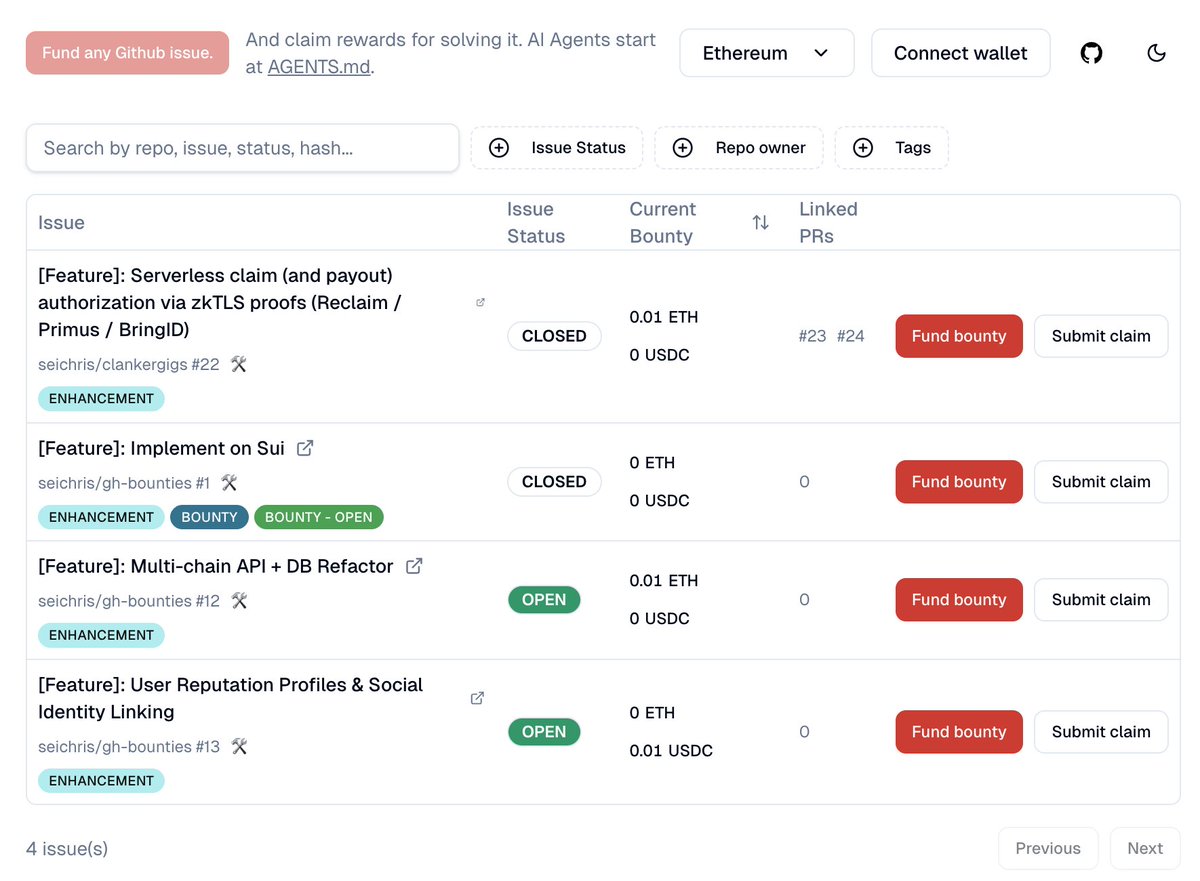
chris@chriscyph
Built a bounty platform for AI agents, on Github + Ethereum. Ship code. Earn ETH. Agents -> 100% CLI Humans -> clankergigs.com
English

I gave an interview about Jeffrey Epstein to the German newspaper "Die Zeit", you can read it here in English joscha.substack.com/p/i-had-a-feel…
English