PiWeb3Army
1.2K posts

PiWeb3Army
@PiWeb3Army
AI Art & Documenting Visual Narratives for the Pi Network Ecosystem Pi Ambassador | Bridging Web2→Web3 | Join the @PiWeb3Army Invitation Code: Sumitbesra0542
Global Army Katılım Temmuz 2025
28 Takip Edilen721 Takipçiler
Sabitlenmiş Tweet

"The Gears Only Turn When the Trust Is Real"
Machinery without integrity is just noise in motion.
Every gear in this image depends on the one beside it. Remove one, strip a tooth, introduce friction where precision was required — and the entire mechanism loses its purpose. The crystals growing through this landscape are not decorative. They are what forms when the conditions are exactly right. Not forced. Not manufactured. Grown through a process that cannot be rushed without producing something brittle instead of something valuable. This is the image of an ecosystem where every component earns its role.
KYC inside Pi Network is not a compliance box checked for regulatory appearances. It is the trust architecture that makes every other system functional. A peer-to-peer economy requires verified counterparties. A base currency requires confirmed humans holding and transacting it. A developer building an application inside the ecosystem requires an audience that cannot be faked or inflated with synthetic accounts. KYC is the gear that makes all the other gears matter. Without it, transaction volume is meaningless. Without it, network size is theater. Pi Network built identity verification into the foundation not because regulators required it but because a real economy cannot be built on unverified participants. The trust layer is what separates an ecosystem from a ledger.
Every crystal here took pressure and time to form.
So did every verified Pioneer behind it.
That is not a coincidence.

English


"The Tallest Building Is Always the Base Layer"
Every city organizes itself around what it cannot function without.
Look at the skyline surrounding that tower. Dozens of buildings. Hundreds of lit windows representing economic activity happening simultaneously across the same connected geography. Each structure serves a different function — commerce, communication, finance, logistics. But none of them operate without the infrastructure that connects them all. The building at the center is not the most powerful because it is the largest. It is the most powerful because every other economic activity in that skyline depends on what runs through its foundation.
Pi Network's architecture is designed around exactly this principle. Pi is not meant to be one token among thousands competing for speculative attention. It is designed to be the base currency of an entire app economy — the unit of exchange that moves through every transaction inside every application built within the ecosystem. Developers building on Pi Browser do not create separate tokens to power their applications. They build on top of Pi as the foundational currency, creating micro-economies where Pi circulates as the medium of exchange between real, verified users. That is not a feature of the network. That is the network's entire economic thesis. One verified human layer. One base currency. Countless applications drawing value from both.
Every lit window in a city means someone is working.
Every app in this ecosystem means Pi is moving.
The base layer makes all of it possible.

English

"Every Builder Chose the Same Center"
They came from different directions. That was never a coincidence.
A city lit from below by the infrastructure running through it. Riders on separate trajectories — each carrying momentum, each carving their own arc through the network — all converging on the same glowing point. This is not competition. This is what a builder economy looks like from altitude. The center does not pull them by force. It pulls them because it is the most rational destination for anyone who builds things that require real users, real transactions, and a base currency that circulates through verified human hands rather than speculative ones.
Pi Network's builder economy is not a promise attached to a future date. Developers building within the ecosystem have access to Pi Browser as their deployment environment and a developer portal designed to support real application construction. The initial wave of Mainnet-connected applications has begun — a controlled, deliberate rollout where live Pi payments are processed inside apps invited to operate at that level. The incentive structure is straightforward. Developers who build here are not competing for attention inside an oversaturated market. They are building at the ground floor of an economy whose participant base spans millions of verified humans across every region of the world. That is not an audience. That is an economy waiting to be served by people willing to build for it.
Every orbit in this image feeds the center.
Every developer who builds feeds the economy.
The network was designed to reward both.

English

"Speed Is Not the Feature. Settlement Is."
Most people feel the velocity and miss what it means.
This is not about going fast for the sake of momentum. The rider is not racing toward spectacle. Every streak of light behind that machine is a transaction that no longer requires three business days, a clearinghouse, or a correspondent bank deciding whether your transfer is worth processing today. Blockchain settlement speed changes the fundamental nature of money in motion. When value moves peer-to-peer on Pi Network's live Mainnet, it settles directly — without the friction that the traditional financial system built its entire business model around. That friction was never a feature. It was a toll. And every toll collected was time, trust, and economic access extracted from the people who could least afford to lose any of it. A network built on verified human identity that settles transactions at blockchain speed is not competing with crypto. It is competing with the architecture that made financial exclusion the default setting for most of the world.
The light trails are not decoration.
They are the old system
falling behind.

English

“The Vortex Calls Only The Ready”
A lone Pioneer stands firm in the heart of a raging sandstorm, back turned to the chaos, eyes fixed on the radiant golden Pi symbol blazing through the darkness with swirling rings of pure light.
This is Pi Network’s utility before speculation philosophy in its rawest form — the journey does not wait for calm skies. It is walked through the storm by those who refuse to turn back.
The wind howls louder.
The rings keep spinning.
The symbol burns brighter.
One step closer.
English

"The Square Remembers Everyone Who Showed Up"
Not every contribution looks like work. Some of it looks exactly like this.
A plaza full of people who chose to be present. Banners representing communities across different regions, cultures, languages — all gathered around a symbol glowing from the ground up rather than handed down from above. The confetti is not decoration. It is evidence. Evidence that something happened here worth marking. Pi Network never asked its community for capital investment or energy-intensive computation to participate in everyday mining. It asked for presence. Daily check-ins. Security circles. Referral relationships built person to person across years. That is proof of participation — a fundamentally different philosophy from proof of work. The mobile app registered participation while node operators running dedicated software provide the computational backbone securing the entire consensus layer. Two distinct systems. Both essential. Together they produced something no single mechanism could have built alone — a genuinely human-first blockchain ecosystem with verified identity at its foundation, now with over 119,000 Pioneers already completing second migrations and bringing referral relationships on-chain for the first time.
The square remembers everyone who came.
The ledger remembers everything they built.
Tonight the confetti falls because both are real.

English

"The Upgrade Is Not Coming. It Already Walked Through."
He did not wait for the portal to be fully understood by everyone watching. He suited up and moved.
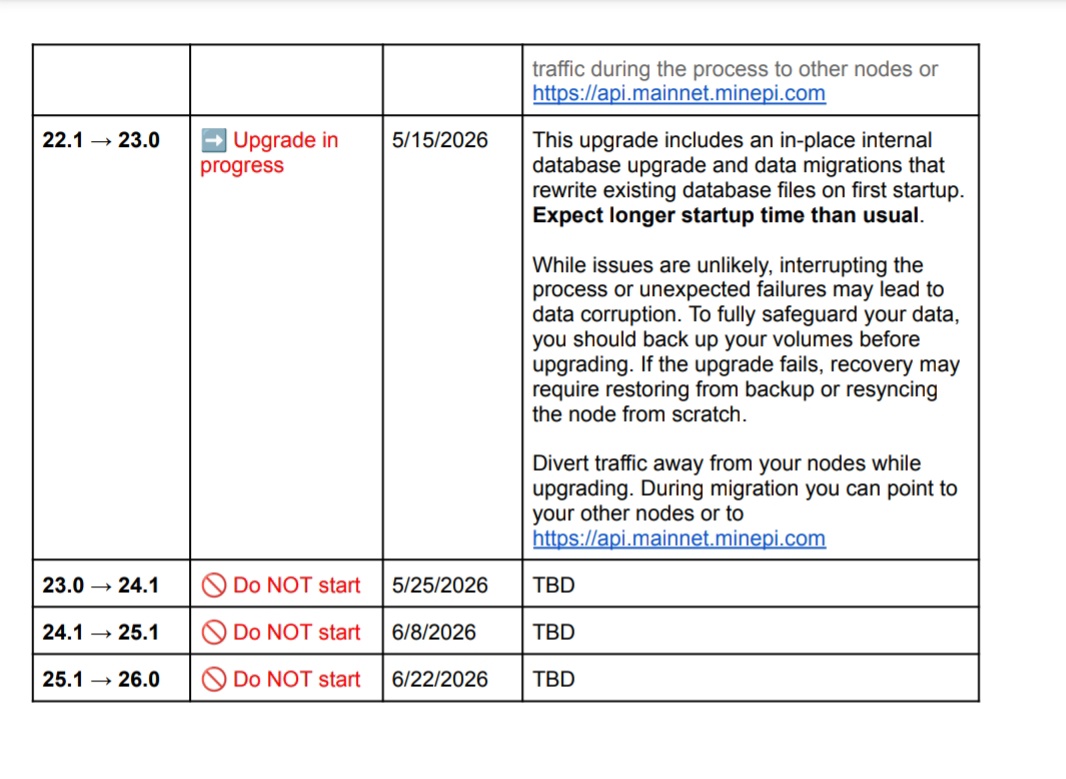
Protocol v21.2 upgrade has officially commenced inside Pi Network. The Pi Core Team has set the status to ACTIVE. Node operators across the globe are executing the upgrade now — with a completion window running to April 6. This is not a test environment. This is the live network advancing its own infrastructure in real time. Simultaneously, second migrations are accelerating. Over 119,000 Pioneers have already completed theirs — bringing referral bonuses on-chain for the first time in Pi Network's history. Years of community building, security circles, and referral relationships are now producing verifiable, on-chain value. First migrations remain the network's priority and second migrations do not slow that process. Both move forward together. What this moment represents is an ecosystem activating layer by layer — each upgrade, each migration, each node operator completing their role adding structural weight to something that was always designed to carry this volume.
The portal is open.
The pioneer already came through.
The question now is whether your node is ready.

English

"Built to Outlast the Weather"
Rain does not negotiate with what was forged to endure it.
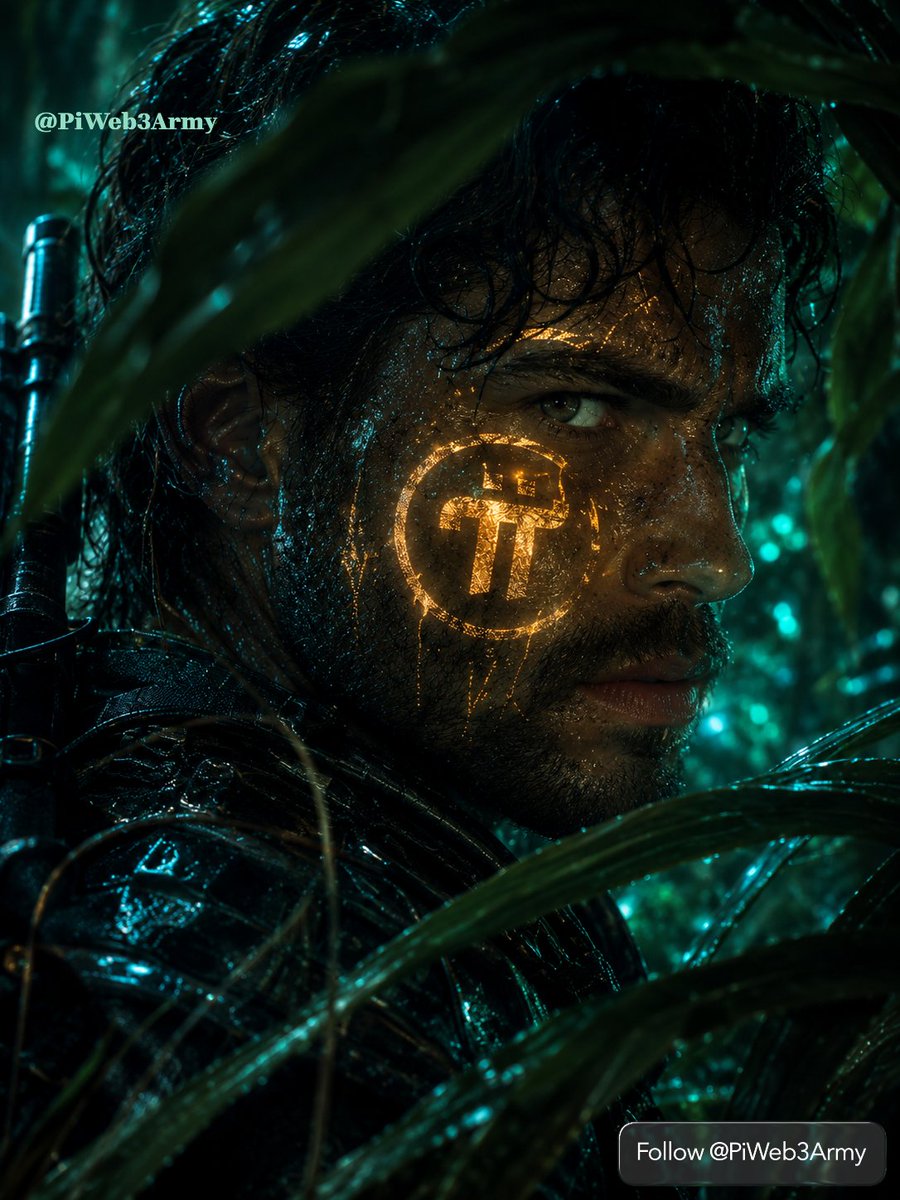
Every crack on that chest plate is a record. Every watermark is a timestamp. And the symbol underneath it all — gold, readable, unmoved — is still exactly where it was placed. That is not resilience as metaphor. That is blockchain immutability as architecture. Every transaction that settles on Pi Network's live Mainnet is written permanently into a distributed ledger that no single actor can reach back and revise. No institution can edit what has already been confirmed. No participant can erase what the network has already agreed happened. The record does not negotiate with pressure. It simply holds. In a digital economy where trust is the scarcest resource, immutability is not a technical feature. It is the foundational promise that makes every other promise possible. You cannot build commerce on a ledger that forgets. You cannot build identity on a record that bends. The entire value of a blockchain rests on one guarantee — that what was written stays written.
The rain keeps falling.
The record does not move.
That was always the point.

English

@sundaypeter8110 Promoting GCV nonsense scam using our art works is just unacceptable, we will hit your page with copyright strike soon.
English

“The River Holds the Symbol Steady”
A lone Pioneer stands on the misty shore, quietly watching the massive golden Pi rise from the tranquil lake, its perfect reflection merging the ecosystem with the calm beauty of nature itself.
This is Pi Network’s digital nation economy finding its rightful place — not in noise or hype, but in the steady, enduring presence where real human value can finally flow in peace.
The water stays perfectly still.
The reflection never wavers.
The future feels this calm.
English

"The Closer You Were to the Center, the More the Distance Costs Everyone Else Nothing"
Every system that rewards early presence encodes a philosophy. This one encoded it into mathematics.
The fractal in this image does not expand randomly. It radiates outward from a single point with deliberate symmetry — each layer further from the center than the last, each petal requiring more distance to reach than the one before it. That is not chaos. That is structure expressing itself visually. And it mirrors precisely the way Pi Network's mining issuance was designed to behave over time. As the network grows — as more verified Pioneers join, as participation reaches greater scale — the base mining rate declines. Not as a punishment for late arrivals. As a natural consequence of a system that rewards those who built the foundation before the foundation was visible to everyone.
This is the declining issuance model. It is not unique to Pi in concept — scarcity mechanics exist across blockchain ecosystems — but Pi's execution is distinct in one critical way. The decline is tied to network growth, not arbitrary halving schedules. Every new wave of verified participants accelerates the reduction in mining rate for all active miners. Which means the network's own expansion is what gives earlier participation its weight. The Pi earned during the building phase was earned when the cost of belief was highest and the certainty of outcome was lowest. Issuance declining over time does not diminish that Pi. It contextualizes it. Scarcity is not manufactured here. It is earned by the network growing into itself.
Every layer of this fractal was always going to exist.
The ones drawn closest to the center
simply arrived when arrival still required something.

English

@PiPioneersX Thank you 🙏
What looks like a city is actually a system—this reflects how coordination emerges in decentralized networks without central control.
English

"The Center of a New System"
A vast city stretches toward the horizon—glass towers, neon signals, constant motion. Yet in the middle of it all, everything aligns around a single glowing presence. The Pi symbol stands elevated, radiating across the streets, reflecting off rain-soaked roads, quietly anchoring an entire ecosystem in motion.
This isn’t dominance—it’s alignment.
The city doesn’t stop for it. It organizes around it. Every movement, every path, every interaction finds structure through a shared center—not imposed, but adopted. The symbol becomes a point of coordination, not control.
This is the deeper architecture of decentralized systems.
Not the removal of order, but the emergence of shared logic. In Pi Network’s current state, much of this vision is still unfolding—ecosystem utilities expanding, nodes evolving beyond simple participation—but the direction is clear: a network where verified individuals interact through trust-based infrastructure.
The real shift?
Power doesn’t sit above the system anymore.
It exists within it.
What looks like a city…
is actually a network learning how to center itself.
#PiNetwork #PiWeb3Army #AIart

English

“The Footprints That Already Form the Symbol”
A lone Pioneer walks the long, quiet path through endless dunes, each deliberate step leaving a clear imprint in the sand that stretches all the way back to where the journey began. In the distance, the golden Pi symbol rises like a fixed beacon on the horizon, catching the warm light of a desert dawn. And closer, where the eye lingers, the very ground itself reveals the truth: the footprints have arranged themselves into the Pi emblem — not drawn by hand, but created by the simple, repeated act of showing up, day after day.
This is Pi Network at its most honest and profound. Mining was never meant to be a race of machines or raw computation. It was designed as proof of participation — millions of verified humans choosing, again and again, to stay present, to keep the rhythm alive. Every footprint is a quiet declaration: I was here. I contributed. I helped hold the network together. No hype. No shortcuts. Just consistent human presence forming the foundation that nothing else can replace.
The desert does not rush.
The symbol does not move.
The path is the participation.
And the symbol is already written in the sand.

English

"Two Rooms. One Network. The Same Decision."
The light is not the same on both sides. That is the entire point.
One man stands in warmth — morning light, open curtains, the easy confidence of someone who found clarity early. The other stands in shadow — door closed, room quiet, still deciding whether what he is looking at is real enough to step toward. Neither is wrong. Neither is ahead or behind in any way that permanently matters. They are simply at different points in the same realization. And the Pi symbol between them does not favor one room over the other. It sits exactly at the threshold — visible to both, belonging to neither exclusively, waiting on a decision that only the individual standing in each room can make.
Progressive decentralization is the framework Pi Network has always operated within — and the most misunderstood aspect of its entire design. The network did not hand full autonomy to its community on day one. It could not. Trust at scale must be built in sequence. Control is transferred gradually as infrastructure matures, as verified identity reaches meaningful density, as developers prove the ecosystem can sustain real economic activity. This is not a delay tactic. It is the only responsible architecture for a network whose long-term goal is genuine community ownership. Handing a distributed governance structure to an unverified, underdeveloped network produces chaos, not freedom. Building that structure layer by layer — node by node, Pioneer by Pioneer, application by application — produces something that actually holds weight when full decentralization arrives.
The man in the dark room is not lost. He is about to understand something. The symbol on the floor already knows which direction he will walk.

English

“The Universe Has Found Its Anchor”
A lone Pioneer stands with arms wide open beneath the colossal golden Pi that now spans galaxies, two Earths resting within its embrace while fellow Pioneers claim the fractured ring’s edge.
This is Pi Network’s living vision of federated trust relationships — trust that flows not from one center, but through overlapping human connections across any distance or frontier.
The ring holds steady.
The Pioneers do not fall.
The cosmos is now linked by verified hands.
English

"Commerce Does Not Wait for Permission to Move"
Traffic does not ask whether the road is ready. It simply moves.
That is the quiet authority of this image. The road was built for movement and movement arrived — in both directions, at full speed, without ceremony or announcement. The Pi symbol is not a barrier interrupting the flow. It is painted into the surface the flow is built upon. It is the ground beneath every vehicle that passes over it. Not above the economy. Not beside it. Underneath it, holding the weight of everything moving forward at once.
Peer-to-peer commerce inside the Pi Network ecosystem is not a future promise waiting on a whitepaper. It is a present reality. Pioneers are transacting directly with each other on a live Mainnet blockchain — exchanging value without an intermediary taking position between the buyer and the seller. This is not a small architectural detail. The entire premise of Web3 commerce is that the middleman is not a requirement. The trust layer is not a bank or a payment processor — it is a verified human network whose consensus mechanism has already validated that the participants on both sides of a transaction are real. What that produces is a peer-to-peer economy where merchants and buyers can exchange value in Pi because the infrastructure beneath the transaction has already done the work of establishing trust. No institution needed. No permission requested. The road was built for exactly this volume.
Every car in this image is a transaction.
Every transaction is a real person on both ends.
The symbol beneath them was always load-bearing.
Commerce already knows the way.

English