Pishty

749 posts

Pishty banner
Pishty

Pishty

@Pishtywan

Katılım Kasım 2012
69 Takip Edilen194 Takipçiler
Sabitlenmiş Tweet
Pishty
Pishty@Pishtywan·
I built a Gradio app to dive into the latent space of the new V-JEPA 2.1 models. Found something interesting: specific latent dimensions are hyper-sensitive to temporal shifts, regardless of the video content. Could be an insight into its world model logic... or just a nothing burger.
Pishty@Pishtywan

x.com/i/article/2043…

English
0
0
0
118
Pishty retweetledi
Shane Gu
Shane Gu@shaneguML·
10 years ago today, we lost Sir David MacKay FRS. Physicist. Mathematician. Polymath. Gone at 48. I was working on my PhD at Cambridge, and attended some of his last lectures and symposium. He was a reason that attracted me to Cambridge over MIT in 2014. His textbook, Information Theory, Inference, and Learning Algorithms, was the first ML book I ever read — recommended to me by none other than Geoff Hinton. He used that same information theory to build Dasher — a text entry system where users steer through a continuous stream of letters flowing toward them, with a probabilistic language model making likely next letters larger and easier to reach, so that any tiny movement — a finger, a gaze — becomes efficient writing. It was the first ML application that truly blew my mind, and sent me deep into a rabbit hole: arithmetic coding, PAQ8 compression, nonparametric models. A journey I partly owe to his PhD student Christian Steinruecken, who also happened to share my love of Japan. As Chief Scientific Advisor to the UK's Department of Energy & Climate Change, he brought a physicist's clarity to policy. In Sustainable Energy – Without the Hot Air, he ran the numbers on our entire energy diet — and made me confront an uncomfortable truth. One of the biggest single factors? Beef — roughly 1,000 days of cow-time per steak. Hard to argue with the data. Hard to act on it when you were born and raised in Japan. I'm still working on that one, David. At his final symposium in Cambridge — just a few weeks before his passing — the room told the full story. Geoff Hinton and his Caltech PhD advisor John Hopfield — both Nobel Prize winners in Physics 2024 — gave tributes. Environment policy advisers spoke. Dasher users sent video messages of thanks from around the world — people who found their voice because of him. It was extraordinary to witness, in one room, just how many minds and lives a single person had touched. The story of how Hinton first noticed him: at a conference workshop poster session, among everyone who stopped by, it was the young MacKay who asked the sharpest, most penetrating question. Hinton remembered it. That's how it begins. I've always liked physicists who cross into ML — they bring a groundedness, a refusal to hide behind formalism without meaning. David MacKay and Max Welling are the role models I point to. Not just for the mathematics they built, but for how they carried it: with humility, curiosity, and a stubborn insistence on reaching beyond academia. He seemed to know his time was limited, and gave everything anyway. His legacy stays.
Shane Gu tweet media
GIF
Shane Gu tweet mediaShane Gu tweet media
English
16
83
661
64.8K
Pishty retweetledi
Thanh Pham
Thanh Pham@runsonai·
I open-sourced DDTree-MLX: tree-based speculative decoding for Apple Silicon. Now you can run Qwen 3.5 27b on your Apple machines 1.5x faster than normal. Expect even faster on smaller models. It runs Qwen 3.5 27B locally with MLX, extends DFlash with draft trees, and gets ~10-15% faster than DFlash alone on code + structured prompts while keeping output lossless. Built on the works of @bstnxbt @liranringel @yaniv_romano github.com/humanrouter/dd…
English
24
48
450
25.7K
Pishty retweetledi
Goodfire
Goodfire@GoodfireAI·
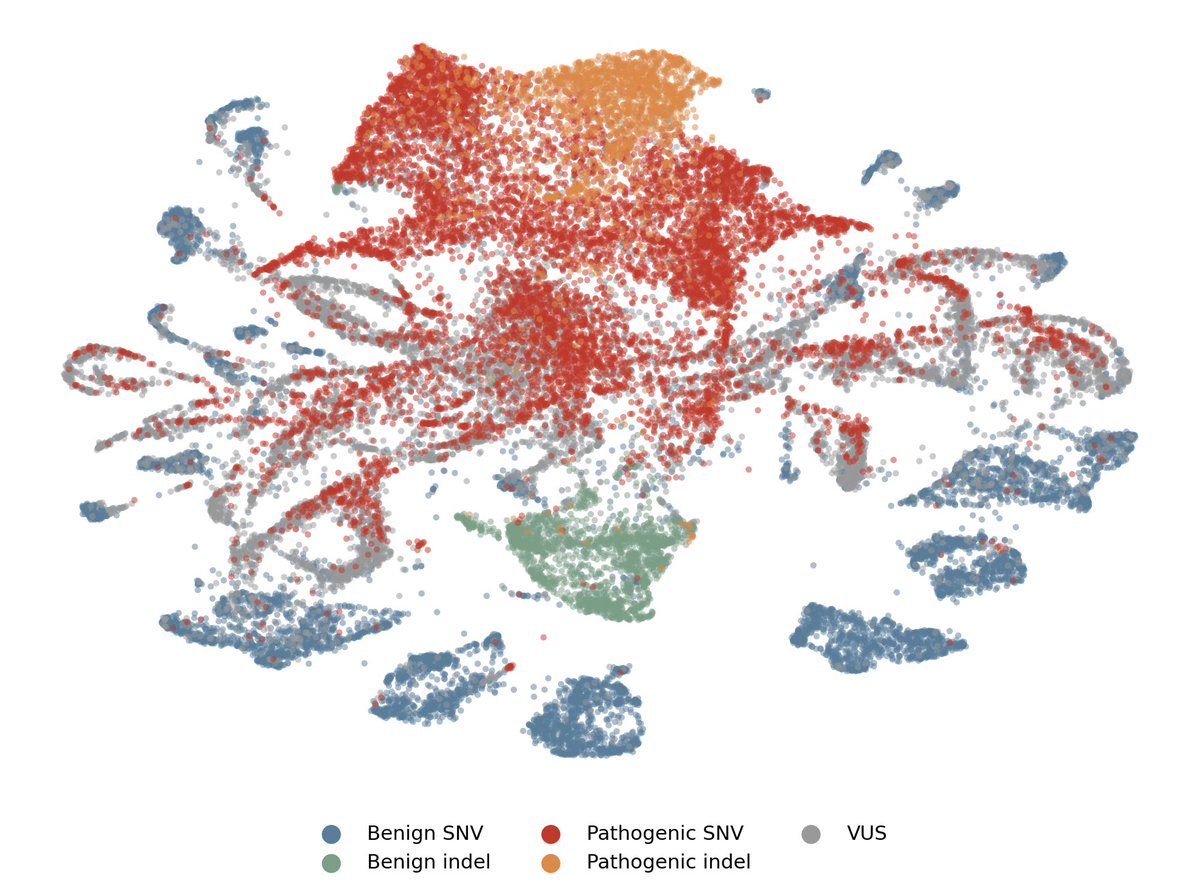
We achieved state-of-the-art performance in predicting which of 4.2 million genetic variants cause diseases by interpreting a genomics model, in a new preprint with @MayoClinic. We're now releasing an open source database for all variants in the NIH's clinvar database. 🧵(1/8)
Goodfire tweet media
English
9
151
794
159.1K
Pishty
Pishty@Pishtywan·
@rUv Would be interesting to compare it with an M5 max with 128gig unified ram.
English
2
0
1
1.6K
rUv
rUv@rUv·
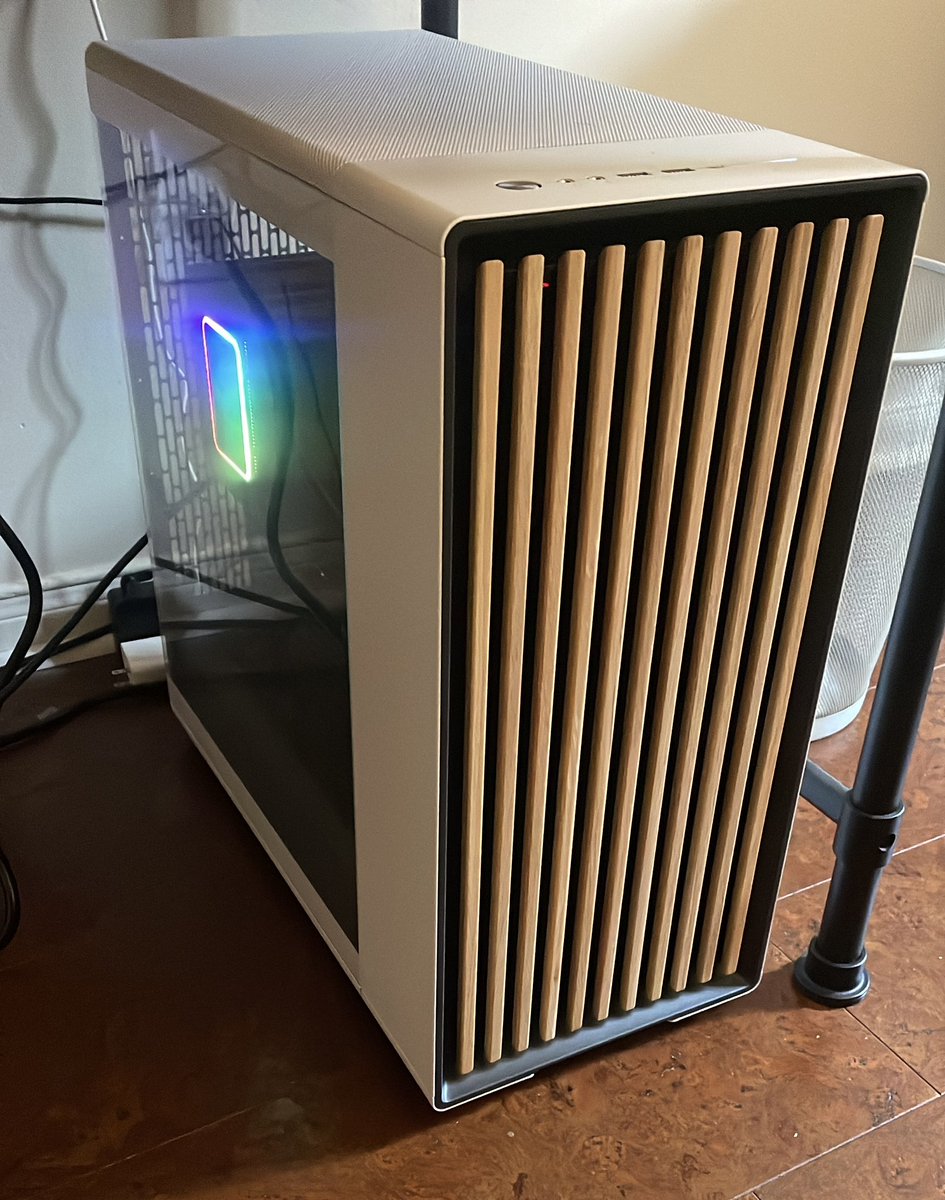
I told the guy at the shop what I was building and he just stared for a second and goes, “what are you building, Skynet?” Introducing ruVultra. My kids didn’t miss a beat: “yeah, basically.” And once you look at the numbers, it stops sounding like a joke. I built this entire system by hand, in an evening. It’s a sovereign AI node. A brain in a box. Ryzen 9 9950X with 16 cores / 32 threads, tuned with a custom Ubuntu kernel and over clocked thermal profile pushing toward ~6GHz burst behavior. With AVX-512, each core processes wide chunks of data at once, so vector comparisons, filtering, and boundary detection happen in parallel, not sequentially. The CPU becomes a real-time reasoning engine, not just a coordinator. Then the GPU takes over when needed. An RTX 5080 with ~10,000+ CUDA cores running in the ~2.5–3.0GHz range, handling dense math, embeddings, and batch workloads. It’s a split system: CPU for structure, GPU for intensity. Compared to a high-end Mac mini or even a Studio, you’re looking at 5–10x faster performance on real AI workloads. Not just because of raw power, but because of architecture. No shared memory bottleneck, no abstraction layers, full CUDA access, full control over scheduling and memory. This machine doesn’t wait on anything. You’ve got 128GB of RAM now, which keeps most working sets local, but there’s room to grow that to 1TB of RAM (estimated at $30k), turning it into a true in-memory system. Same with storage, plenty of headroom for multiple additional TB of NVMe, extending your dataset without killing performance. At roughly a $10k budget, you’re sitting in a sweet spot. Not cluster-scale, but powerful enough to behave like one node of a serious system. You can run meaningful local workloads, test ideas end to end, and iterate without waiting on the cloud.
rUv tweet media
English
96
9
180
105.4K
Pishty retweetledi
Qianqian Wang
Qianqian Wang@QianqianWang5·
Most multi-view reconstruction models need full supervision. We show they can self-improve without any ground truth labels. Introducing SelfEvo: Self-Improving 4D Perception via Self-Distillation. Up to +36.5% in video depth, +20.1% in camera estimation, zero annotation.
English
4
34
252
20.8K
Pishty retweetledi
Khai Loong Aw
Khai Loong Aw@khai_loong_aw·
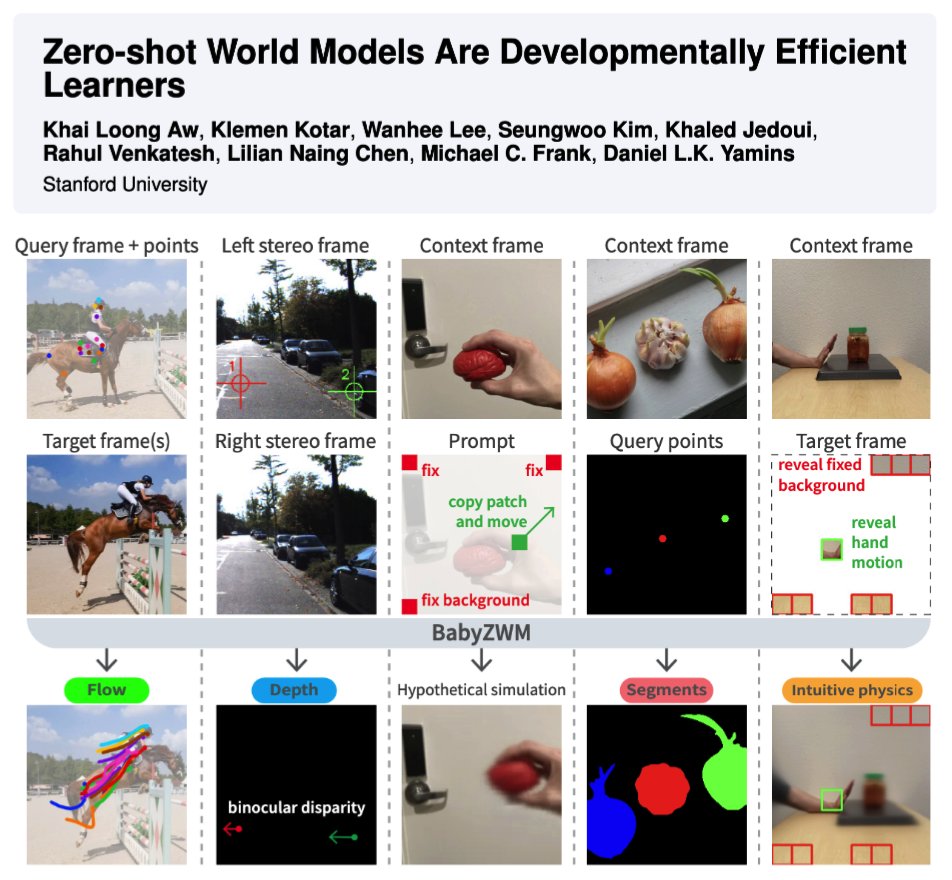
Today's best AI needs orders of magnitude more data than a human child to achieve visual competence. We introduce the Zero-shot World Model (ZWM), an approach that substantially narrows this gap. Even when trained on the first-person experience of a single child, BabyZWM matches state-of-the-art models on diverse visual-cognitive tasks – with no task-specific training, i.e., zero-shot. 🧵
Khai Loong Aw tweet media
English
3
67
344
34K
Pishty retweetledi
clandestine.eth 🦇🔊
clandestine.eth 🦇🔊@0xClandestine·
All of sudden alot of people seem to be working on DFLash for MLX. Everyone is focused on running the draft model on GPU alongside the target model. Apple's research from December proposes a different approach: heterogeneous accelerators/mirror speculative decoding.
clandestine.eth 🦇🔊 tweet media
English
5
4
58
4.1K
Camus
Camus@newstart_2024·
“Einstein is the problem.” Eric Weinstein didn’t mince words on Triggernometry. If general relativity holds, we’re trapped on one fragile planet. Even terraforming the Moon and Mars only gives us three reachable spheres — nowhere near enough diversification for long-term survival. A single catastrophe could wipe us all out because we all share the same atmosphere. The only real escape, he argues, is cracking physics beyond Einstein so we can get very far, very fast. Otherwise we’re stuck playing cosmic Russian roulette. It’s a sobering wake-up call about how dangerously misaligned our priorities have become.
English
637
278
3.3K
891.6K
Anemll
Anemll@anemll·
~ 6.5 - 6.7 t/s for GLM 5.1 on M5 Max 128GB Added “Dense” model export, now model load is only 5s ! Experts are streaming from SSD, so we do not pre-load it. Added direct SSD->Slot memory path, removed prefetch... Many dead end experiments. See Export a “dense-only GGUF” and “Fast path ” in tools/flashmob-sidecar/README.md WIP branch for Flash-MoE-SSD github.com/Anemll/anemll-…
English
12
13
180
28.9K
Pishty
Pishty@Pishtywan·
@sotoalt_ How many frames are u feeding the model for a prediction ?
English
0
0
0
8
Pishty retweetledi
SotoAlt
SotoAlt@sotoalt_·
been learning JEPA and world model stuff. here is LeBall - a pong game where a 13M param JEPA-style world model (inspired by LeWM) predicts where the ball will go next. The cyan ghost shows the 1-step prediction. In AI mode, the opponent paddle uses the prediction to track the ball. Still early,using a CNN encoder instead of the paper's ViT-Tiny, and no CEM planning yet.
English
3
1
7
659
Pishty
Pishty@Pishtywan·
How is this not a reality tv show
English
0
0
0
17
Ivan Fioravanti ᯅ
Ivan Fioravanti ᯅ@ivanfioravanti·
Needle in a haystack is far too easy for any modern LLM, I added it to my bench suite, but it's 100% for nearly all of them. I'm gonna remove it 🤷🏻‍♂️
English
6
0
14
2K
Ivan Fioravanti ᯅ
Ivan Fioravanti ᯅ@ivanfioravanti·
MLX: there are far too many servers now: vMLX, oMLX, Osaurus, LMStudio, mlx-lm, mlx-vlm. I will start some benchmarks now to figure out which one I'll use 🧐
English
56
12
458
30.1K
Pishty
Pishty@Pishtywan·
@CigsMake Cigs were good for u back then
English
0
0
2
1.3K
Cigarette Nostalgia
Cigarette Nostalgia@CigsMake·
Chelsea’s club doctor in 1978 coming on the field with a cigarette in his mouth to stretcher off a player
English
80
787
7.5K
633.3K