

Bruce Lee
8.7K posts
Bruce Lee
@Pkoh70
Comments on what I care, especially on all things Korea/Not an expert/likes humble,logical minds/respects Veterans/Conservative/And yes, I can kick some ass
Katılım Ekim 2009
397 Takip Edilen195 Takipçiler

JESSE WATERS: “Unblocking the Strait while we maintain the blockade is going to bring Iran’s negotiating team to its knees. And we did all this without putting boots on the ground.”
What the fuck is this guy talking about? Jesse Waters has turned into a caricature of himself.
English
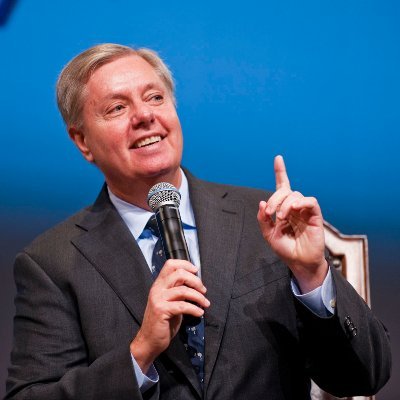
There is no need for boots on the ground in Iran.
Instead, a Second Amendment Solution stands a real chance of giving the Iranian people a genuine path back to freedom.
English

Bruce Lee retweetledi

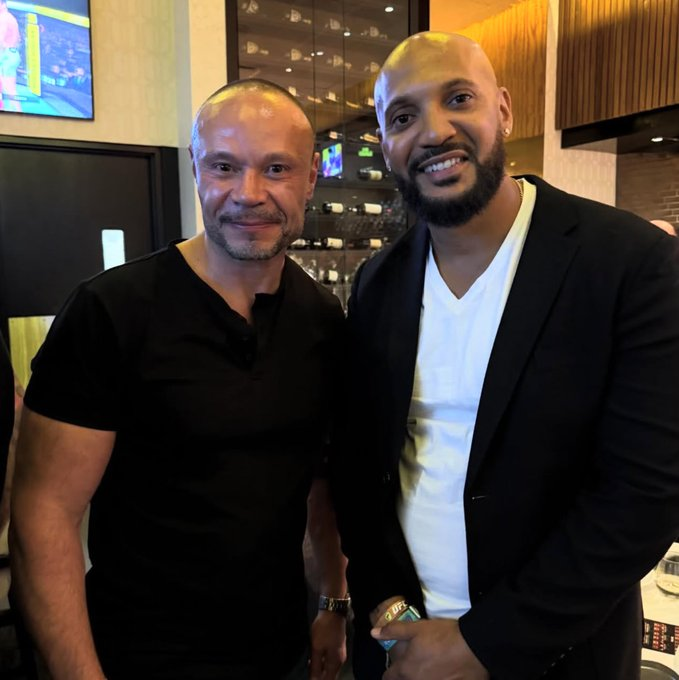
One of these guys was just arrested for pedophilia.
The other guy protects pedophiles.
This is MAGA.
English
There are rumors that Elon Musk may be exploring a takeover of the bankrupt Spirit Airlines, with ambitious plans to revolutionize the air travel experience.
Imagine the possibilities: Optimus humanoid robot flight attendants, seamless Starlink connectivity, AI-powered travel planning, frictionless payments through X, and door-to-door service with Robotaxi.
What do you think?
@elonmusk
English
Bruce Lee retweetledi

This Wall Street insider just exposed the secret doomsday escape plans of AI billionaires.
1 in 3 billionaires has a fully funded plan to abandon civilization when things collapse.
They meet their pilots at Oakland airport, board a Gulfstream 650, fly to New Zealand, and disappear into a bunker that cost tens of millions to build.
And this isn't some conspiracy theory. There's literally PROOF:
Sam Altman told The New Yorker he stockpiles guns, gold, potassium iodide, antibiotics, batteries, water, and gas masks from the Israeli Defense Force. He owns a patch of land in Big Sur he can fly to when society breaks down. His backup plan is flying with Peter Thiel to Thiel's compound in New Zealand.
Peter Thiel became a New Zealand citizen in 2011 after spending only 12 days in the country. He bought a 477-acre estate for $13.5 million and submitted plans for a bunker-style compound embedded into a hillside with a 1,082-foot glass-lined guest lodge for 24 people.
Mark Zuckerberg is building a 5,000 square foot underground shelter beneath his $270 million compound in Hawaii. Blast-resistant doors made of metal and concrete, its own energy and food supplies, and an escape hatch accessible by ladder.
Every construction worker signed an NDA and different crews were forbidden from speaking to each other.
Larry Page, co-founder of Google, quietly disappeared to Fiji during the pandemic. He reportedly bought at least one private island in the Mamanuca archipelago. When local media reported his presence, Fijian authorities ordered the article taken down.
Scott Galloway sat with one of these billionaires who walked him through his entire exit strategy step by step.
His response: "You don't think your pilots are going to kill you and fuck your wife? You don't think the people in New Zealand are going to come take the rich guy's shit?"
But here's the thing that really matters...
These are the SAME people building AI.
The same founders telling Congress that AI will cure cancer have already decided they're leaving when it goes sideways.
Galloway confirmed a secondhand account from someone close to one of these AI CEOs. The CEO admitted he believes there's a 7 to 10% chance AI results in a catastrophic event for humanity. And he doesn't care because being the person who summoned this intelligence is "more consequential than whatever happens."
These billionaires don't use public healthcare. They have concierge medicine delivered to their living room. Their kids attend $75,000 per year academies while public schools spend $10,000.
They fly private. They have private security instead of police.
Galloway's words: "The 0.1% are no longer invested in the well-being of America. They've totally dissociated because they're sequestered from it."
And the incentives to reach that level are so extreme that founders will make ANY decision necessary to get there.
Galloway called it the Darth Vader pipeline. Every tech CEO follows the same arc:
Sam Altman was "the gay son we all wanted." Soft spoken, testifying before Congress about safety.
Now he's subpoenaing nonprofits that criticize OpenAI and telling people to stop complaining about energy costs.
Galloway on all of them: "These guys would sleep with their cousin for a nickel."
The next chosen hero is Dario Amodei at Anthropic. Galloway says he'll follow the exact same path because the system makes it inevitable.
Then he dropped his most dangerous prediction:
He thinks there's a 1 in 3 chance AI ends up like jet transportation, vaccines, or PCs. Technologies that changed civilization but where NO group of companies ever captured serious shareholder value.
The entire airline industry across all of history is at break even. Moderna is down 90%. AI models are converging.
Open weight Chinese models are free and a third of corporations are already using them.
His prediction: Go short the AI ecosystem. The winner of AI might be us, the users. Not the companies.
And if he's right, the domino effect is terrifying...
40% of the S&P is tied to AI. Most GDP growth over the last two years came from AI capex. So if corporations start dropping OpenAI and Anthropic for free Chinese models, the entire market could crash.
This is just like the Chinese steel dumping in the 80s:
Flood America with cheap AI, kneecap the companies propping up the stock market, then trigger a recession without firing a single shot.
The billionaires building AI have escape plans ready. They've detached from society entirely.
They know there's a real chance this ends badly and they're building it anyway.
Every tech hero turns villain on a shorter timeline.
And the financial system is so dependent on AI valuations that one move from China could bring it all down.
And we're still trusting these people to self-regulate.
What do you think?
English
Bruce Lee retweetledi

Tesla is the most successful CON in the history of capital markets.
Not because the cars are bad.
But because the entire business is engineered to impress on first glance and collapse under scrutiny. And the culture around it has made facts completely IRRELEVANT.
I've never seen a company where the gap between what is promised and what is delivered is this wide, for this long, with this little accountability.
Tesla's Full Self-Driving system is marketed as autonomy. But it is not autonomy. It is a camera-only system running probabilistic inference.
The car is making statistical guesses about what it sees, thousands of times per second, with no redundancy when those guesses are wrong.
Probabilistic inference controlling a two-ton vehicle at highway speed with your family inside.
NHTSA has two open investigations covering 3.2 million Tesla vehicles. One was escalated to a formal Engineering Analysis in March after 9 crashes, including a fatality, where the system FAILED to detect sun glare, fog, and dust. The cameras went blind and the car kept driving.
In Austin, Tesla's robotaxi fleet has reported 15 crashes across roughly 800,000 miles. One crash every 57,000 miles.
The average American driver has a police-reported crash every 500,000 miles. Tesla's robotaxis crash at roughly 4x the human rate, WITH a safety monitor sitting in the car whose only job is to prevent crashes.
Waymo operates over 2,500 fully driverless vehicles across multiple cities with no human backup and maintains a crash rate 85% below human drivers across 127 million autonomous miles. Tesla has ONE unsupervised vehicle in a tiny section of Austin.
But here's what really makes Tesla different from every overvalued company I've ever analyzed:
The facts do not matter to the people who own this stock.
Every missed deadline, every broken promise gets filtered through the same response: attack the messenger.
Call them a short seller. Call them a hater. Anything to avoid looking at the actual numbers.
It's an online ecosystem that has made itself completely immune to facts. And Musk baked that dynamic into the culture from the beginning.
Every time the fundamentals deteriorate, the faithful don't sell. They double down.
When your shareholder base treats every dip as a buying opportunity regardless of the data, the stock becomes untethered from reality entirely.
That's literally a religion with a ticker symbol.
I highly suggest you read Edward Niedermeyer's book Ludicrous on this.
And now it even gets WORSE...
CapeFearAdvisors published a piece this week that should be required reading.
Tesla's 2025 CEO Performance Award contains a change-of-control provision:
In the event of a change of control, ALL operational milestones are disregarded.
No million robotaxis, Optimus robots, or $400 billion EBITDA.
NONE of it.
So if SpaceX acquires Tesla at $8.5 trillion, every tranche of Musk's 423 million share award vests immediately. A single acquisition at that price triggers the full vesting of both plans at once, with no way to claw them back.
The milestones everyone argues about are just a distraction. The mechanism is the change-of-control language buried in the SEC filing.
This is about engineering the largest personal wealth transfer in modern financial history and using the narrative machine to keep the price elevated long enough to execute it.
I've seen every bust of the last four decades.
But this one is different because the cult of personality is stronger than anything I've witnessed. The movement around this stock cannot be touched by facts, and that is what makes it so dangerous.
But the math always wins. ALWAYS.
It just takes longer when the con is this good.
English
Bruce Lee retweetledi


Bruce Lee retweetledi
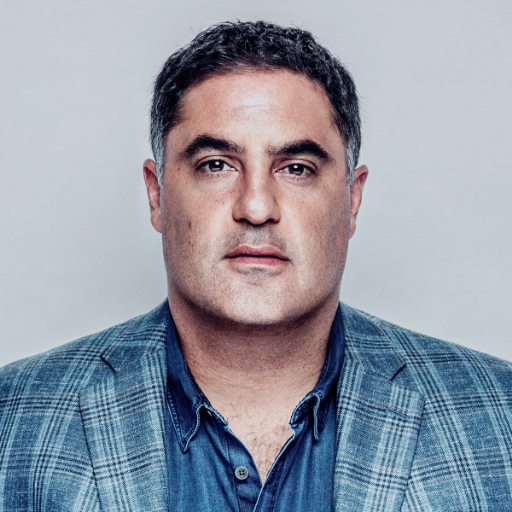
Just found out Hunter Biden got a huge contract from the Pentagon to build interceptor drones while Biden was in office! Obvious and outrageous corruption! Oh wait, it's actually Don, Jr. and Eric who got the contract from Pentagon while daddy is in office. Hunter was an amateur.
English
Bruce Lee retweetledi
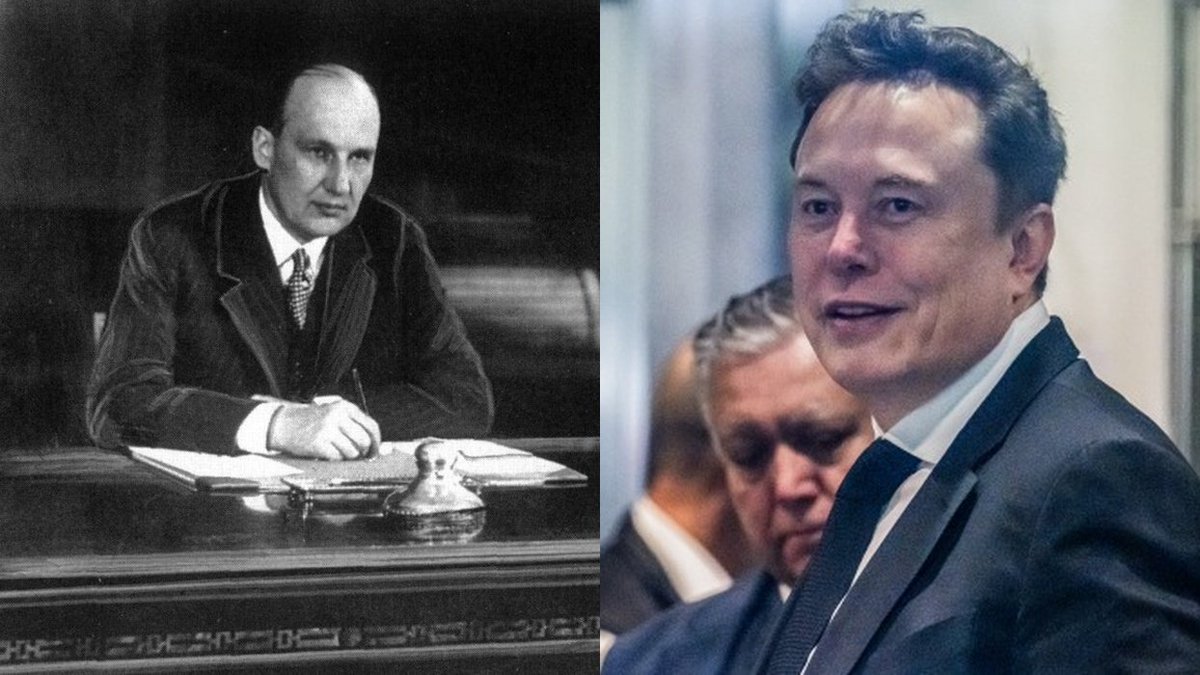
Elon Musk is the Ivar Kreuger of our time, and the OpenAI trial is PROVING it in real time.
If you don't know who Kreuger was, you should:
In the 1920s he was the most admired businessman in the world. The "Match King."
He controlled 90% of global match production, lent money to sovereign governments, and his securities were the most widely held in America.
But after his death in 1932, auditors spent 5 years untangling over 400 subsidiary companies and discovered the whole thing was held together with fictitious assets, forged bonds, and the unquestioning loyalty of people too dazzled to ask questions.
Investors lost $750 million (~$17 billion in today's money). His deficits exceeded Sweden's national debt.
Doesn't this sound familiar?
The Musk playbook is the most DANGEROUS house of cards I've witnessed in my career.
This week in federal court, Musk took the stand to argue that Sam Altman stole a charity. 3 days later he'd contradicted himself under oath so many times that the judge told his lawyers she suspected plenty of people don't want to put the future of humanity in Mr. Musk's hands.
OpenAI's attorney asked if Tesla is pursuing AGI. Musk said no. The attorney then pulled up Musk's OWN post from March 4 where he wrote Tesla will be one of the companies to make AGI.
His own words entered into evidence against him. BY HIM.
Then the attorney asked if xAI used OpenAI's models to train Grok (which violates OpenAI's terms of service).
Musk called it a general practice among AI companies. Pressed for a direct answer, he said "partly."
Think about that: Musk is in court accusing OpenAI of betrayal while admitting under oath that xAI violated the very same company's terms of service to build Grok.
Then came the credibility test:
Musk was asked to name his companies that benefit society. He listed Tesla, SpaceX, Neuralink, and X without hesitation. Every one of them is an uncapped for-profit enterprise.
Then why did xAI start as a benefit corporation and quietly flip to a for-profit C-corp? No clean answer.
This is someone who repeatedly launches entities with noble-sounding charters and converts them into for-profit corporations once the money gets serious.
Then his money manager Jared Birchall took the stand:
OpenAI's lawyer asked about the donor-advised funds at Vanguard and Fidelity that Musk used to send his $38 million. Did Musk have any legal right to direct where the money went once it entered the DAF?
Birchall couldn't answer. Said the legal question was beyond his expertise.
The entire lawsuit hinges on that donation creating enforceable obligations. But the man who managed Musk's money just told a federal jury he can't confirm Musk had any enforceable claim over those funds.
Now step back...
This is a man who promised full autonomy by 2018, a million robotaxis by 2020, and unsupervised FSD by June 2025.
EVERY deadline was missed.
He claimed he invested $100 million in OpenAI. The real number was $38 million. His defense? His "reputation" made up the difference.
Kreuger had 400 subsidiaries and used one entity to prop up another through structures nobody could follow. Musk has Tesla, SpaceX, xAI, Neuralink, the Boring Company, and X.
He shifts AI talent from Tesla to xAI, has xAI building the brains for Tesla's Optimus robot, and uses X as a megaphone while the algorithm amplifies his narrative to 200 million followers.
Kreuger's investors trusted the man, NOT the math.
They loved the confidence. They stopped asking questions because the aura of genius made questioning feel foolish.
The same psychology applies to Musk's empire today.
Kreuger's reckoning took 5 years of forensic auditing after his death. But Musk is providing his in REAL TIME: contradicting his own posts under oath, admitting to the practices he's suing others for, watching his logic collapse under cross-examination.
Different decade.
Different industry.
Same ending.
The truth always catches up.
English
Bruce Lee retweetledi

🚨THE MEDIA IS ASLEEP. THIS SHOULD BE EVERYWHERE:
Pete Hegseth launches a MAJOR contradictory blunder and says Iran’s nuclear facilities were already obliterated, NEGATING the entire reason for the war.
Pete Hegseth is as DUMB as he is incompetent!
English
Bruce Lee retweetledi
PETE HEGSETH: “We took out Iran’s nuclear capabilities last year. This war wasn’t started because they were close to getting nuclear weapons, it started because they still had nuclear ambitions.”
Hegseth accidentally tells congress that Iran posed no imminent threat to America.
English

Under the previous administration, the Department of Defense’s financial reporting was a disaster — and had been for far too long.
That ends today—the WAR DEPARTMENT will deliver a clean audit for our 2028 financial statements.
English


Bruce Lee retweetledi
This is an inane and irresponsible thing to say. As if going to Caltech explains why this guy, years later, did anything. Especially without knowing almost anything else at this stage, less than 48 hours later.
Niall Ferguson@nfergus
For those wondering how on earth a @Caltech graduate becomes a would-be assassin, this is your reminder that the Great Awokening was especially demented in California, and that there is no pendulum magically swinging back to sanity in the established universities.
English
@GordonGChang isn’t that a major part of why this war was necessitated? shit enters via India-mouth and exit via Israel-butthole?
English
For India to be a good friend to America, America must be a good friend to India. It’s time for us to work together. 🇮🇳🇺🇸
English
Bruce Lee retweetledi
It's a sign of the times that as soon as you heard there was a shooting at WHCD, you heard speculation it might be staged. Why? Because we've lost all faith in our government. We know they lie to cover up the crimes of the powerful, we don't trust anything anymore. Rightly so.
English
Bruce Lee retweetledi

Former Singapore PM Lee Kuan Yew on the fundamental difference between American and Chinese society:**
Why do America and China see the world so differently? Lee Kuan Yew argues it comes down to one thing: history.
"The difference in the core philosophy between the American and the Chinese... it's a reflection of your history."
He traces America's worldview back to its origins:
"You came over in the Mayflower. You were seeking religious freedom so much so that you refused to allow it to be taught in the schools. You believed in the individual as the creator of all things."
That belief in the individual shaped everything that followed:
"You captured the wild west. I mean, on horseback. New town, main street, you be mayor, I'm sheriff, you're saloon keeper. We build a gold rush town or cattle or whatever it is."
And then came extraordinary fortune:
"You have been immensely fortunate and successful. Two world wars left Europe in a shambles and you emerged as the undamaged technological and industrial power."
China's story, Lee explains, looks nothing like this.
"China has a completely different and a checkered history. 4,000 to 5,000 years of ups and downs. Long periods when there was no governments, anarchy, warlords."
He shares a personal moment that brought this reality home to him:
"I once had a Chinese masseur when I was in Beijing working my game shoulder and we were talking and I said during the war, Japanese time, what currency did you use? So Japanese currency if it's in Japanese controlled areas or other currencies in other areas. So I said how many currencies are there? Two, three? Says 14 or 15 depending on which warlord's area you're in."
So how did the Chinese people survive centuries of chaos, when the state itself kept collapsing?
"Why have they survived in spite of anarchy, disaster, floods, famines? Because there was a social network independent of government that sustained them. The immediate family, the extended family, the clan. You owed them an obligation. You cannot turn them away. That's how they survived."
This is the philosophical fork in the road. America placed the individual at the centre. China placed the family.
Lee describes the system Singapore deliberately chose to preserve:
"If we keep those family bonds, those traditional life raft systems not dependent on the state, which places the emphasis on family, extended family, and then the government, and not the individual at the expense of the family and the state, which is the American system."
He acknowledges what the American system produces:
"So you have Bill Gates or John Chambers of Cisco... you look up Forbes or Fortune or whatever and 50 of the best and the brightest and the wealthiest. That's your experience. That's not China's experience."
But the goal in Asia is different:
"Yes, we also now want to try and get our little Bill Gates going, but in the context of keeping our society solid so that we will survive as a people."
He closes with a sharp reminder of why these two civilisations may never fully understand each other:
"You have never been occupied. You have only had one civil war. So you will never understand what it is."
The takeaway is uncomfortable but worth sitting with: a society's values aren't chosen in the abstract. They're forged by what that society had to survive. Individualism is a luxury of stability. Family-first collectivism is the inheritance of centuries of collapse.
English