Southern Plains Perspective

12.2K posts

Southern Plains Perspective

Southern Plains Perspective

@PlainsSouthern

the content of this communication is totally my own.

Oklahoma, USA Katılım Haziran 2018
1.4K Takip Edilen635 Takipçiler
Southern Plains Perspective
Southern Plains Perspective@PlainsSouthern·
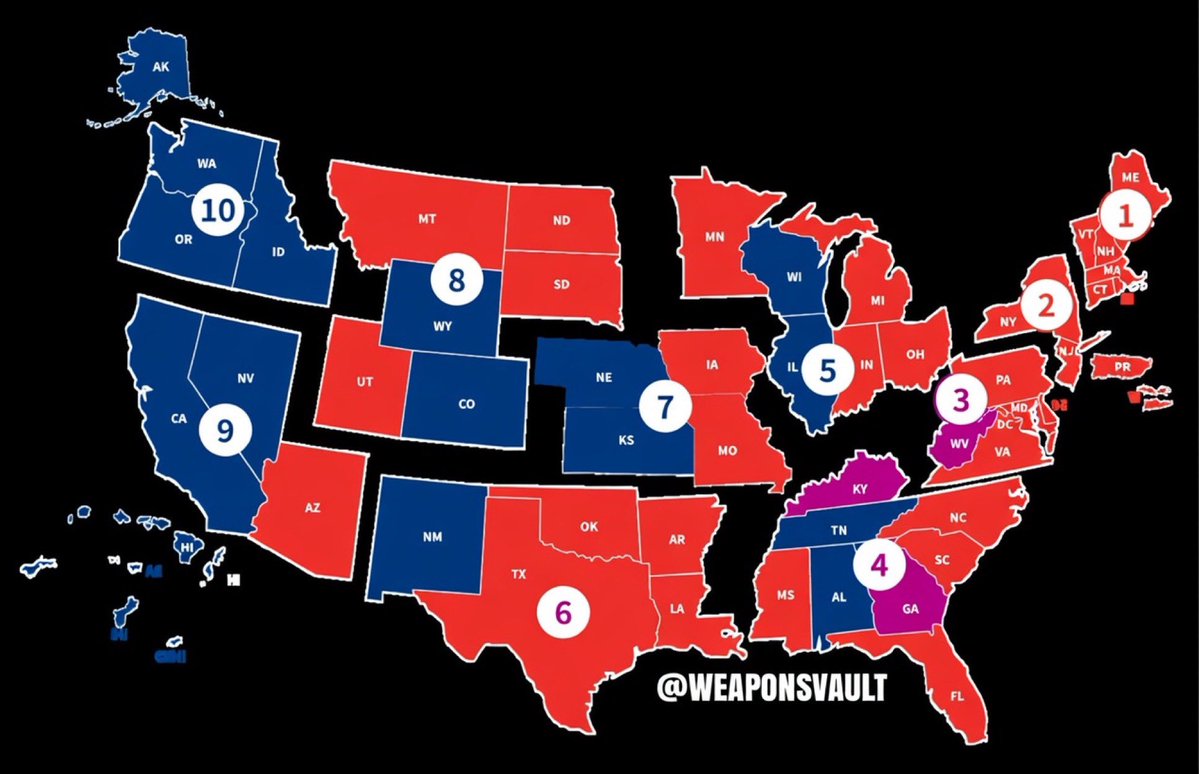
@Tenn_MAGA2 Seriously…get off the emotions and look at things like population, potential industrial production base, blue water ports, economic activity and geographic features that lend themselves to defensive strong points. Ideological purity means nothing against fortified positions
English
0
0
0
13
Nick
Nick@Tenn_MAGA2·
If a civil war broke out today what region would win?
Nick tweet media
English
1.3K
55
272
2.6M
Southern Plains Perspective
Southern Plains Perspective@PlainsSouthern·
@epaleezeldin @JaguarRoper Me looking at input costs, wondering what happened to export markets & waiting for DC to open the Mexican border for cattle regardless of screwworm because of retail beef prices..
GIF
English
0
0
3
87
Lee Zeldin
Lee Zeldin@epaleezeldin·
Every farmer now has the Right to Repair their own equipment thanks to President Trump. It’s crazy that our talented farmers were being prevented from doing this previously. This announcement is about common sense. Farmers will be able to spend more time in the field and less money in the repair shop because of this important new EPA guidance.
English
411
2.8K
12.8K
278.5K
Caring Guy💙🇺🇸🌈✌🏻
Caring Guy💙🇺🇸🌈✌🏻@caringguy1957·
That’s one of the dumbest attempts at spin I’ve seen in a while. You’re celebrating “right to repair” like it solves farmers’ problems, while completely ignoring the actual crisis they’ve been dealing with. Giving farmers the ability to fix their own equipment doesn’t mean much if they can’t sell what they grow. Tariffs slammed U.S. agriculture, especially during the trade war with China. Soybean exports collapsed, markets dried up, and farmers got stuck with crops they couldn’t move. What was the solution? Billions in taxpayer-funded bailouts just to keep farms afloat, and even farmers will tell you those bailouts only covered about 25% of their losses. So let’s be clear about the reality you’re glossing over. Farmers didn’t suddenly get richer or more secure, they got squeezed so hard by trade policy that the government had to step in and write checks to cover only a fraction of the damage. And here’s the part you don’t seem to understand, equipment working does them no good if there’s no profitable market for their crops. You can have the best tractor in the world, but if your soybeans are sitting in a silo because tariffs killed demand, you’re still losing money. There hasn’t been a worse president for farmers in modern times. Record bailouts, lost export markets, and long-term damage to global trade relationships, all while pretending that a repair policy is some kind of victory lap. That’s not “common sense,” it’s distraction.
English
20
10
82
1.8K
Southern Plains Perspective
Southern Plains Perspective@PlainsSouthern·
@ChrisClaytonDTN @gravelmath I’m old enough to remember when ag groups said things like “we don’t want welfare, we want a fair price & international markets. Let us compete on a level playing field & we will do the rest.” Or in a shorter version, “we want trade, not aid.” Man….I really am getting old…
English
1
0
4
300
Chris Clayton
Chris Clayton@ChrisClaytonDTN·
I hate fact-checking the White House. Trump opens his farmer event noting he just gave $12 billion to farmers. He said Biden would never do that. Biden signed the law for $10 billion in aid that became ECAP.
English
13
11
88
12.3K
Stop Autocrats 🇺🇸
Stop Autocrats 🇺🇸@justicenow_alan·
The viral claim that “$60B was spent on rural broadband and nobody got hooked up” is false. The BEAD program totals $42.5B, and the money has not been spent yet. States only recently had their plans approved, and no funds have been awarded to ISPs for construction. That’s why no one is connected yet — the program is still in the pre‑deployment phase, exactly as designed.
English
56
8
28
102.1K
Southern Plains Perspective
Southern Plains Perspective@PlainsSouthern·
@BuffalOKstate I don’t care what we’re called if we can win start winning in anything other than wrestling (which is awesome—but our hoops, baseball and football? Woooffff)
English
0
0
1
129
BuffalOKstate
BuffalOKstate@BuffalOKstate·
Glad we’re all having the Okie State or not Okie State debate again. Came a little early this year
English
7
0
19
3K
Southern Plains Perspective
Southern Plains Perspective@PlainsSouthern·
@CBKimbrell they never heard “Long Gone to Saskatchewan” by Corb Lund—take the $ for the high priced Alberta ranch, go to Saskatchewan & get a place 5 times the size. Jeez-sell, buy a place 5 times the size & still have tons of cash left over. Not seeing much sense in their choice here…
English
0
0
4
679
Southern Plains Perspective
Southern Plains Perspective@PlainsSouthern·
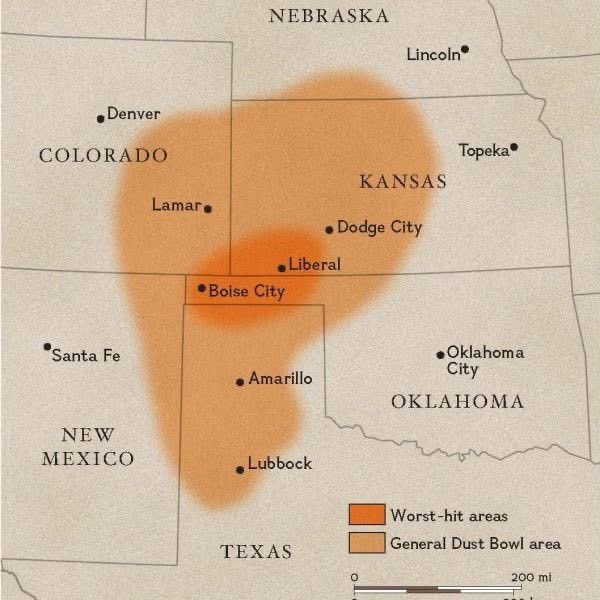
@ChrisMartzWX agree that the DROUGHT wasn’t caused by farming, but if the land hadn’t been worked you wouldn’t of had the monster dusters so you can argue that tillage caused the dust bowl-also, the droughts of the ‘50’s & 2011-15 were both more intense than the 30’s in west ok & no dust bowl
English
0
0
1
27
Chris Martz
Chris Martz@ChrisMartzWX·
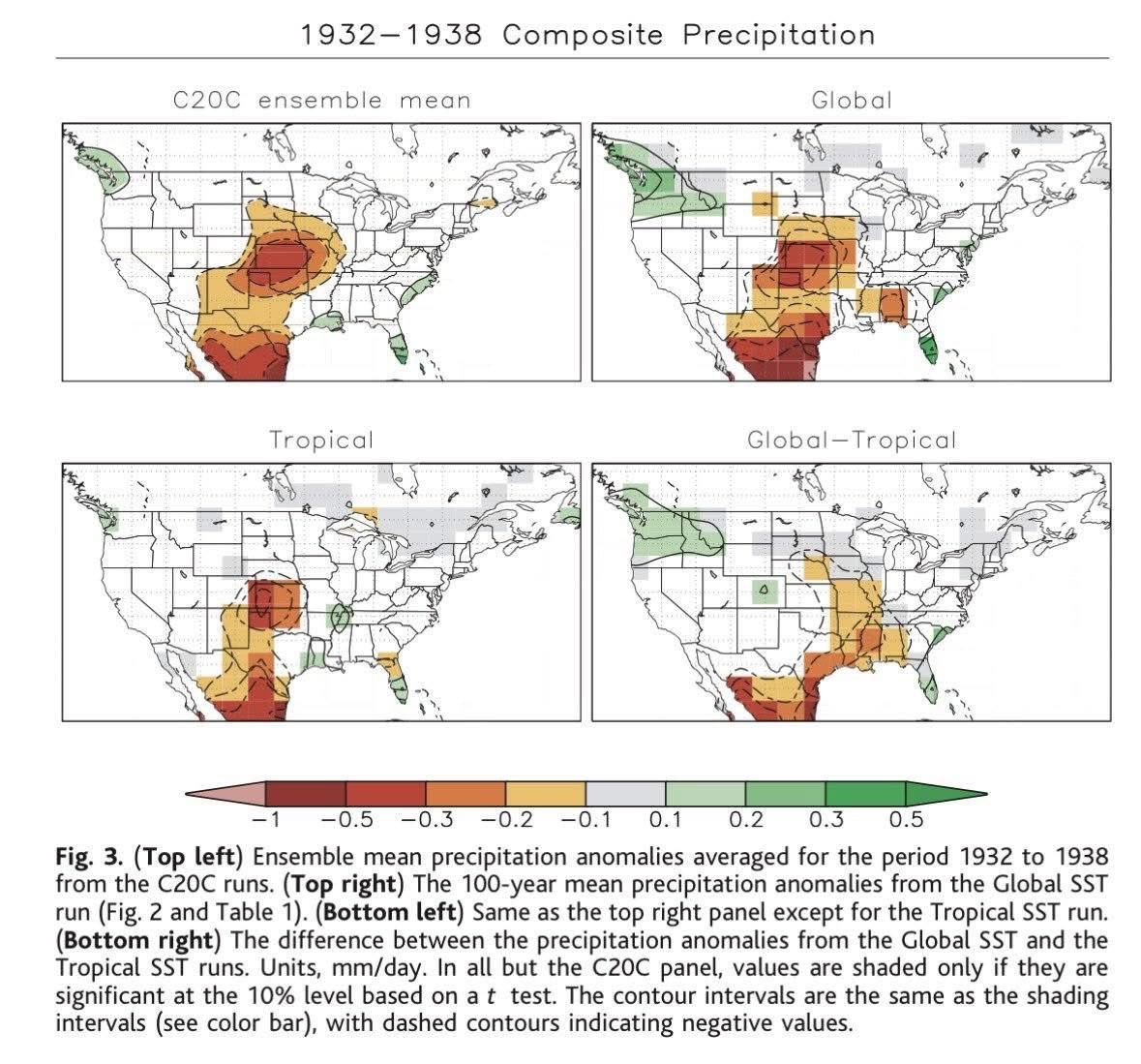
Okay. Let's have some fun. Whenever you bring up the heatwaves and drought of the 1930s, climate panic puppies are quick to dismiss them as “statistical outliers” that were caused by “unsustainable farming practices” in the Great Plains. This is cute, but it's not really true. The decade-long drought of the 1930s covered much of the United States and significant portions of Canada. The extreme heat in July-August 1930, June 1933, May-August 1934, June-August 1936, and September 1939 also covered much of the Continent. But the “Dust Bowl” itself was primarily confined to a relatively small area in northern Texas, the Oklahoma Panhandle, and western Kansas. In other words, farmers plowing up deep-rooted perennial prairie grasses and replacing them with shallow-rooted annual crops outside of places like Liberal, Kansas or Boise City, Oklahoma were not responsible for the heatwaves and continental-scale drought. Sure, those agricultural practices amplified drought conditions and, by extension, the intensity of heatwaves on a very localized basis, and they stirred up the dust storms that swept through the Great Plains, but those farming practices were not the actual cause the persistent drought or heatwaves during the 1930s. The drought was naturally forced by persistent La Niña conditions (similar to what has been occurring in recent years) in the equatorial Pacific Ocean and an unusually warm subtropical North Atlantic (Schubert et al., 2004; Seager et al., 2008). 🔗science.org/doi/10.1126/sc… / open-access: www7.nau.edu/mpcer/direnet/… 🔗journals.ametsoc.org/view/journals/… Below average sea surface temperatures (SSTs) in the tropical Pacific produced negative 500 hPa geopotential height anomalies over the tropics, which led to positive anomalies over the mid-latitudes. This created large-scale subsidence (sinking air) over the Plains, which suppressed rainfall for several years. Concurrently, a warm North Atlantic generated anticyclonic rotation in the mid-to-upper troposphere and low-level cyclonic flow that cut off moisture transport from the Gulf of Mexico (or America if you prefer; I'm not going to get into that argument with anyone) to the central United States, especially during the summer and fall. These two factors alone initiated the drought, as they had during the preceding centuries and also recently. In fact, severe droughts in the Great Plains typically happen about once or twice a century (Woodhouse & Overpeck, 1998), and occasionally have been so severe that they transformed the region into a de-facto desert with blowing sand. 🔗journals.ametsoc.org/view/journals/… Notably, multi-decadal droughts during both the 13th and 16th centuries exceeded the 1930s drought by intensity and duration, all naturally forced. A tree-ring analysis in Nebraska found that the 13th century Medieval drought lasted an incredible 38 years (Herweijer et al., 2006). 🔗journals.sagepub.com/doi/10.1191/09… / open-access: researchgate.net/profile/Richar… Land degradation only locally enhanced drought and heatwave conditions during the 1930s. It did not cause it, nor did it enhance those similar conditions exhibited elsewhere on the entire continent. In other words, you cannot simply dismiss the 1930s heatwaves and droughts because they are problematic for your narrative. It was almost entirely natural. It verifiably happened. And, it isn't going to be dumped down the memory hole so long as I am still standing, I can rest assure you of that.
Chris Martz tweet mediaChris Martz tweet media
English
28
229
972
42K
Steve
Steve@JNadaneo·
@johnkonrad @PeteButtigieg Rural internet that connected nobody but handed out some vouchers and eight or nine EV charging stations. Unbelievable.
English
7
3
53
5K
Chris Martz
Chris Martz@ChrisMartzWX·
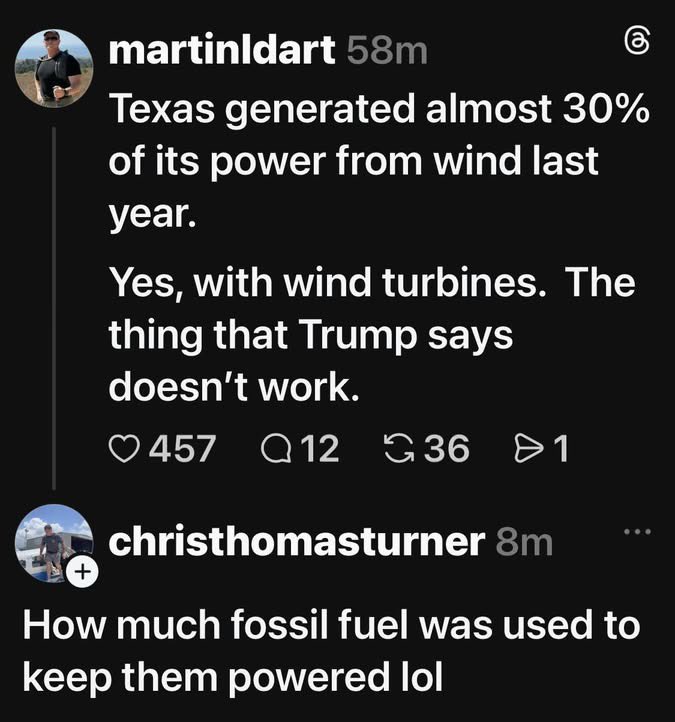
There is nothing “cultural” about this debate, simpleton. The difference between fossil fuels / nuclear and solar / wind is that the former two are reliable and work on their own when you need them most, while the latter two are variable in adverse weather conditions and thus require either fossil fuel or expensive battery backup to keep up with sudden spikes in demand. Nuclear fission provides a near constant source of electricity. It’s objectively the best energy source on the planet, but it has stigma because of boomers with China syndrome, as well as Big Green and Big Oil opposition.
Tony Annett@tonyannett

I am convinced that the obsession with fossil fuels and nuclear by men in particular is that they are coded “masculine” whereas solar and wind are coded “feminine.” Get culture war bullshit out of technology!

English
39
109
620
11.3K
Southern Plains Perspective
Southern Plains Perspective@PlainsSouthern·
Crazy— Oil and gas prices go up and my twitter/X feed is swamped by folks talking about how horrible wind and solar power are…. Gotta be a coincidence…….
English
1
0
0
46
adam baldwin
adam baldwin@iamyourfarmer·
I think in a time of war the tone of administration representatives shouldn’t match that of some online influencer sitting in their driveway getting real with y’all
English
4
0
11
1.1K
Southern Plains Perspective
Southern Plains Perspective@PlainsSouthern·
@MGanjafairy @jdpoc Actually gas systems froze during winter storm uri in ‘21-issue was almost none of the grid/generation in Texas was winterized for that kind of storm. Pesky change in the jet stream led to snow in northern Mexico. Don’t blame renewables for that-the ones up north worked fine.
English
0
0
4
336
merri ganjafairy
merri ganjafairy@MGanjafairy·
@jdpoc Ask them how they work in 50 below zero. ? They dont people freeze and die thats why Raphael take a powder to Mexico instead
English
20
0
1
6.4K
John O'Connell
John O'Connell@jdpoc·
American (lack of) education has a great deal to answer for…
John O'Connell tweet media
English
195
917
19.3K
297.4K
Southern Plains Perspective
Southern Plains Perspective@PlainsSouthern·
@kansasangus Droughts combined with age of producers-you can fight your 3rd extended drought in 15-20 years or sell out, rent out or sell your land & enjoy your last few years with your wife-look at average age of producers-in your late 60s 70s or early 80s what would you do?
English
0
0
2
23
Adam Jones
Adam Jones@kansasangus·
Now that the cow herd numbers are out and the naysayers and folks talking their positions have had a second to come to grips that the herd is still contracting... Let's start discussing what appears to be much of cow country experiencing dry and drought conditions.
Adam Jones tweet media
English
8
3
53
12.5K
Southern Plains Perspective
Southern Plains Perspective@PlainsSouthern·
@BoscoCode @StevenTDennis So why a national push to ban wind & solar? Shouldn’t the market decide? Without the fed assistance wind & solar are still the cheapest sources (solar has upfront costs but those are made up quick once the project is online). you can even do ag around them (mainly graze)
English
0
0
1
14
discuss_with_integrity
discuss_with_integrity@BoscoCode·
@PlainsSouthern @StevenTDennis Yeah, I agree. My point is that the difference is good conservative, reality based management. Different geographies, power usage profiles, capital availability, grid maintenance history. Nothing magic about wind power, pro or con. It’s genuinely terrible in some situations.
English
1
0
2
17
Southern Plains Perspective
Southern Plains Perspective@PlainsSouthern·
@BoscoCode @StevenTDennis Focusing on affordable & low cost fuel mix—just like today. It just happens to be that now wind is the cheapest source. Gas is 2nd until solar gets built out then it falls to 3rd & solar is 2nd. Except for some reason folks now want to force higher priced fuel by fighting wind
English
1
0
0
21