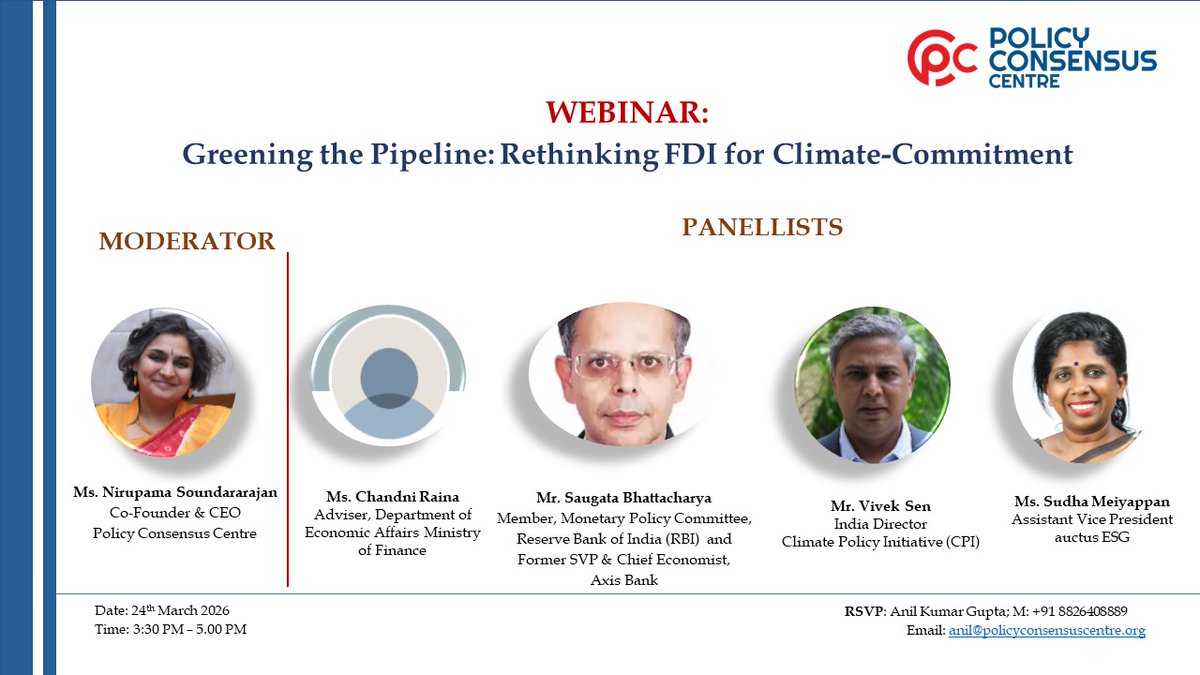
Indian MSMEs are driving the country’s e-commerce export boom, with over 1 lakh MSMEs exporting goods worth nearly $16 billion in 2023-24. However, payment reconciliation remains a critical bottleneck - one that increases compliance costs and limits global competitiveness. At the Policy Consensus Centre, we recently hosted a webinar on “Addressing Payment Reconciliation Challenges for Indian E-commerce Exporters” with key stakeholders, including @RBI representatives, MSME associations, and exporters, to identify pain points and actionable solutions. Key Challenges Identified: 🔹 High reconciliation costs due to bank fees, penalties, and CA certifications 🔹 Rigid 25% invoice-realisation variance limit, misaligned with e-commerce business models 🔹 Cumbersome documentation processes, including excessive self-attestation requirements 🔹 Challenges with third-party payments and unsold inventory regulations Policy Recommendations: ✅ Introduce a de-minimis level for export bills to ease regulatory burdens ✅ Leverage data analytics and blockchain for compliance simplification ✅ Increase the invoice-realisation variance limit from 25% to 50% ✅ Enable a single annual forex reconciliation statement for MSMEs ✅ Streamline third-party payment frameworks for seamless transactions Read the entire policy brief in the link below policyconsensuscentre.org/wp-content/upl… @FinMinIndia @DoC_GoI @ICRIER @VKwuthoo @SMEForumIndia #Export #MSME #ForeignTrade #Payment #IndianExporter #TradePolicy #IndianEcommerce #PaymentReconciliation #RBI