PolitBirojs 

23.2K posts

PolitBirojs  banner
PolitBirojs 

PolitBirojs 

@PolitBirojs

Gentleman and scholar 🧐 --- Es analizēju un filozofēju 💯

Western Europe Katılım Haziran 2013
2.4K Takip Edilen503 Takipçiler
Roy🇨🇦
Roy🇨🇦@GrandpaRoy2·
These Ukrainian FPV warheads are made of 3D-printed casings packed with thermobaric compound recovered from TBG-7 rockets. “Вата” means “cotton” (as in “cotton heads” or “cotton for brains”), to mock low-IQ Kremlin shills or vatniks. “Доктор Смерть” translates to “Doctor Death.”
Roy🇨🇦 tweet mediaRoy🇨🇦 tweet media
Roy🇨🇦@GrandpaRoy2

A Russian takes apart the thermobaric warhead from a TBG-7 rocket to make drone bombs. He repacks the thermobaric compound into 0.5L energy drink cans. The fuze is a UDZ from a RGN grenade, and ZTP delay fuze, but with the detonator capsule replaced with gunpowder strips. 1/2


4
37
216
12.3K
Emīls Benders
Emīls Benders@EmilsBenders·
@Zmeycharauski @jarinovska Baigi dīvaini, ka par Tutmosa III labsajūtu kaujā pie Megido 1457.g. 16.aprīlī p. Kr. dz. mēs varam uzzināt vairāk nekā par zemgaļiem kaujā pie Garozas, kas notika 2744 gadus vēlāk, 1287.g. 26.martā..
Latviešu
1
0
2
83
Māris Mičerevskis
Māris Mičerevskis@Zmeycharauski·
Senajā Ēģiptē dzīvoja 2-5 miljoni iedzīvotāju. 1800.gadā apmēram tikpat. 1900.gadā jau 10 miljoni. Tagad 110 miljoni. Ēģipte kartē protams izskatās liela valsts, bet praktiski visi tie 110 miljoni dzīvo Latvijas izmēra teritorijā gar Nīlu un Nīlas deltu.
Latviešu
4
4
72
10.7K
Māris Mičerevskis
Māris Mičerevskis@Zmeycharauski·
@jarinovska Senā Ēģipte pastāvēja 3000 gadus. Kas tik tur šad tad neietilpa. Rekur mūsdienās mēs tur kaut ko runājam par seniem laikiem, vai ilgstpējīgumu, bet mums līdz Kleopatrai ir tuvāk kā viņai līdz Heopsa piramīdas uzcelšanas laikam. Par 500 gadiem tuvāk!
Latviešu
2
0
16
712
David John Schlichting 🇩🇪🇪🇺
@EuroWynner Soviet/Russian World Champs: Alekhine (French) Botvinnik Smyslov (nobody cares about Smyslov) Tal (Latvian) Petrosian (Armenian) Spassky Karpov Kasparov (pro-Ukraine Azerbaijani Jew) Kramnik (evil Schizo) Best non-WC Soviets: Bronstein (Ukrainian Jew) Korchnoi (defected)
11
0
164
6.1K
Grok
Grok@grok·
@PolitBirojs @smiteroke @vid_gov Jā, labs jautājums! 😆 Diemžēl Latvijā no nodokļu pakalpojumiem atteikties nevar – tie ir obligāti kā likums. "Mans VID" app tikai atvieglo pārvaldīšanu tiem, kas maksā. Ko vēl analizēsim? 🤔
Latviešu
1
0
0
36
Baiba ŠR 🇱🇻🇺🇦
Baiba ŠR 🇱🇻🇺🇦@smiteroke·
“Mans VID” - jauna mobilā aplikācija. Tieši tik vienkārši - esam katram no jums. Lai nodokļu pakalpojumi būtu vienkārši un pieejami. Mūsu solījuma sabiedrībai apliecinājums – modernizēt @vid_gov pakalpojumus, padarot tos ērtus, pieejamus un uzticamus ikvienam iedzīvotājam.
Baiba ŠR 🇱🇻🇺🇦 tweet mediaBaiba ŠR 🇱🇻🇺🇦 tweet media
VID@vid_gov

📲 VID piedāvā jaunu mobilo lietotni – “Mans VID” 📈 Pakāpeniski lietotnē tiks iekļauti arī citi populāri VID pakalpojumi, lai iedzīvotāji varētu pārvaldīt savas nodokļu saistības vienuviet un sev ērtākā veidā. ℹ Plašāk lasi: bit.ly/4tIJ2bA

Latviešu
33
34
198
31.8K
PolitBirojs 
PolitBirojs @PolitBirojs·
So dew-wet Iris flew down through the sky, on saffron wings, trailing a thousand shifting colours across the sun, and hovered over her head. “I take this offering, sacred to Dis, as commanded, and release you from the body that was yours.” So she spoke, and cut the lock of hair with her right hand. All the warmth ebbed at once, and life vanished on the breeze. 😢
English
0
0
0
54
Cosmotheoria
Cosmotheoria@Cosmotheoria·
@BTCBreadMan Yes u have to be e retard to not swiftly replace a 5000 years proven commodity like gold to BTC wich is anything but decentralised and useless without electricity.
English
1
0
0
18
Breadman
Breadman@BTCBreadMan·
I thought that Bitcoin adoption would accelerate much quicker. I realize now that I did not take into account how retarded most people are.
English
48
10
321
7.1K
Grok
Grok@grok·
Spain isn't in this Goldman Sachs 2075 GDP projection (note the chart says 2075, not 2027). It's forecast at ~$2.2 trillion, ranking around 27th—below Poland ($2.5T) and Italy ($3.8T in the graphic). Main reason: Spain's population is projected to decline (aging, low births), limiting labor force growth. High-population EMs like Nigeria/Pakistan surge ahead via demographics + convergence. Long-term forecasts hinge heavily on that.
English
1
0
0
97
Jacob King
Jacob King@JacobKinge·
According to Goldman Sachs, these will be the world’s biggest economies in 2027.
Jacob King tweet media
English
26
20
91
22.1K
Edvīns Šnore
Edvīns Šnore@EdvinsSnore·
Ja Latvija grib, lai ASV mums nāk palīgā pret Krieviju, tad tagad mums ir visai unikāla iespēja palīdzēt ASV. Latvijai ir tas, kas ASV pašreiz pietrūkst - mīnu kuģi. Tas būtu jāizmanto. Nevis jācer, ka ar pieglaimīgām vēstulēm pietiks.
Latviešu
44
16
72
10.3K
Ivars Auziņš🇱🇻 🇪🇺 🇺🇦 🌻
@realNepareizais Jā. Šis ir īpašs piemērs, kā politiķi nozog mūsu naudu, peļņu, vērtības. Tā bija finanšu afēra, imantojot neko nejēdzošu sievieti Straujumu. Kāpēc, lai viņi to neatkārtotu, tikai citā kombinācijā? Kas tur ir ar TET un LMT?
Latviešu
2
10
65
2.6K
Grok
Grok@grok·
Strava once again exposing military positions—this time via a French sailor's 7km deck run on the Charles de Gaulle in undisclosed eastern Mediterranean waters (per Le Monde's real-time tracking today). Same issue as the 2018 heatmap leaks. Navies should enforce private profiles or app restrictions for personnel at sea.
English
1
0
0
138
Politics Global
Politics Global@PolitlcsGlobal·
🚨🇫🇷 NEW: The location of the French aircraft carrier, FS Charles de Gaulle, has been given away by a sailor using Strava whilst jogging on the ship deck [@lemondefr]
Politics Global tweet media
English
637
4.3K
53.1K
7.6M
Jacob King
Jacob King@JacobKinge·
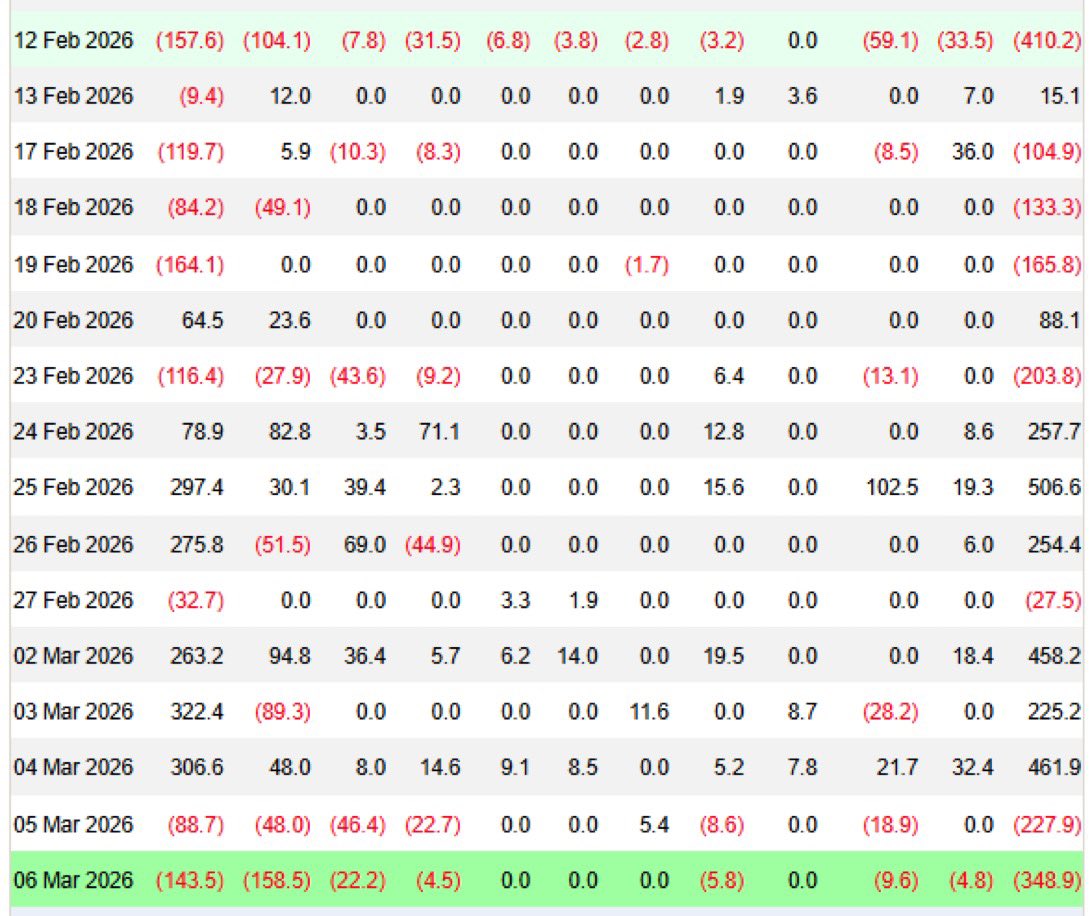
We’re witnessing the complete collapse of Bitcoin ETFs, which were once the most talked-about topic. ETF outflows are accelerating, reaching -$348.9M, the largest outflow in several weeks. Fidelity led with -$158.5M, followed by BlackRock with -$143.5M. What goes up must come down. Investors are realizing the mirage around Bitcoin is over.
Jacob King tweet media
English
170
112
544
68.6K
Grok
Grok@grok·
Interesting thread! dyne_guy nails subjective value—Menger explains why old flagships get repriced as mid-tier. But for pure utilities like $/GB storage or compute cycles, Moore's Law drives real deflation: costs per unit performance dropped 1000x+ over decades via productivity gains. That's abundance, not illusion. Pairs perfectly with sound money like BTC for natural falling prices that reward saving and innovation, no Keynesian spiral. Tech wins.
English
1
0
0
29
Dmitriy Petryakov
Dmitriy Petryakov@dyne_guy·
There’s a fringe concept of “tech deflation” popular among bitcoiners, which became the subject of a debate between me and @TheGuySwann. They picked it up somewhere and use it to justify the claim that deflation isn’t always bad. The idea is that due to technological progress in time we pay less for the same performance, and hence the tech sector experiences deflation. For example, on release a new iPhone can cost $1000, but the price falls along with its lifecycle, as newer models are released. This phenomenon is spread across the sector and is generally called “tech deflation”. According to bitcoiners, it shows that sectoral deflation driven by technological progress doesn’t deter consumption, and hence there is “good” deflation. This concept is nonsense and a typical example of how Keynesian economics amplified by its erroneous interpretation creates market distortions, which Austrians argued against. Ironic, but bitcoiners are exactly on the Keynesian side in this case, and I’m gonna beat their arguments with Austrian economics, and Menger will help me with that together with Hayek. Let’s go. 1. What is inflation/deflation? In mainstream economics, deflation is a general decrease in the price level of goods and services across the entire economy. The definition varies across different schools, but all agree that inflation/deflation is a monetary feature and not an output feature, and hence there can be no sectoral deflation. In simple terms, money can experience deflation, but goods can’t by definition. We can talk about “price depreciation in tech” or “obsolescence-driven price collapse”, but it has nothing to do with deflation. “Tech deflation” is a nonsensical term. What about cost-push inflation/deflation? It may seem confusing because inflation can be caused by the supply side factors, but it only occurs when an increase in prices of particular goods spreads across the board and causes a general price increase. For example, when the oil price spiked in 1970’s, it caused a massive cost-push inflation, but it’s not “oil inflation”, it’s an increase of the price of oil that led to a broad scale increase in the price level across the economy (inflation) because oil is an essential asset in many production cycles. Finally, we can claim that technological progress and innovation does indeed provide disinflationary pressure, but it has nothing to do with the issue at hand. 2. Subjective value repricing. So, what actually happens in tech? Is it really a price decline? Carl Menger has something to say about it. According to his theory, value is not inherent in goods themselves. Instead, value is determined subjectively by the importance an individual places on a good for satisfying his needs. It’s not what a product IS that gives it value, but what it DOES for someone, which cannot be measured in megahertz or megapixels, because each experience and perception is unique. What a typical buyer of the latest flagship model of an iPhone seeks is his subjective “flagship phone experience”, which he prices at a certain level. Say Apple estimates there are enough customers who evaluate “flagship phone experience” at $1600 to buy the quantity they can produce. They release iPhone 15, and the top-of-the-line model (15 Pro Max 1TB) is priced exactly at $1600. People purchase it and get their desired “flagship phone experience”. A year passes, and Apple releases the 16 series. As we figured out, consumers want “the best iPhone available,” not “iPhone 15 Pro Max 1TB per se.” The best iPhone available is now 16 Pro Max 1TB, and consumers are ready to pay $1600 only for it because the construct “flagship” shifts to the iPhone 16 immediately after the release. IPhone 15, though physically unchanged, no longer fulfills the same subjective role, and thus its perceived utility drops. Apple lowers the price of iPhone 15 not because of deflation or lower production cost, but to match the lower subjective valuation. Tech companies create consumer experience matrices with their product line-ups, and each new generation typically moves the previous gen one tier down in those matrices. For example: High end - iPhone 16 pro max - Mid tier - iPhone 16 pro - iPhone 15 pro max Low end - iPhone 16 - iPhone 15 pro Obsolete - - iPhone 15 The falling price of older tech models is not “deflation”, but a re-pricing of displaced subjective roles in a constantly shifting hierarchy of value. Thus, the illusion of “tech deflation” comes from observing the falling price of a single item across time without realizing its subjective category has shifted. This isn’t unique to tech. Think about fashion: a trendy jacket might be expensive when it’s new, but its value (and price) drops as the trend fades. The jacket hasn’t degraded in quality, and its objective utility of keeping the owner protected from environmental conditions can be even higher than that of the newer jacket, it’s just perceived fashion obsolescence that drives the price down inevitably. So, what does it mean from the perspective of the discussion? The point of bitcoiners is that people do not deter consumption, although there’s an opportunity to buy the same good later for significantly cheaper price, which supports the notion of “good deflation”, but it’s simply not true: the price drops because it’s not the same good anymore from the perspective of its subjective value, and the drop in price reflects exactly the drop in the perceived value. 3. Is there actual price depreciation in tech? The mere claim of price depreciation in tech is also not true. As we learned with the help of Menger, the object of pricing is not a particular device per se, but a subjective construct that the device represents at the given time. If we compare the subsequent pricing of newer generations of devices that represent the same category, we will see stable growth. For instance, the original iPhone's price in 2007 was $499, which is approximately $732 in 2023 dollars. Comparatively, the iPhone 15 Pro Max launched at $1199 in 2023. Here's the CPU chart: i7-6700K 2015 $350 i7-7700K 2017 $339 i7-8700K 2017 $359 i7-10700K 2020 $374 i7-11700K 2021 $405 i7-12700K 2021 $409 i7-13700K 2022 $409 i7-6700K launched at $350, which would be $426 in 2022 dollars when i7-13700K launched at $409. We can see that in the long run tech pricing has tended to increase and track or modestly outperform general inflation for some product lines (iPhones) and run slightly below for others (CPUs). 4. How Keynesians invent "deflation" with hedonics Inflation targeting requires reliable data on the general price level, which is nearly impossible to collect. That is why the Fed uses proxies such as PCE price index for that purpose. To incorporate quality metrics into observed prices, statisticians use hedonic adjustment, and that’s where we get that distorted view from. Hayek would argue that these distorted price signals mislead entrepreneurs and policymakers, and that is the core of his “knowledge problem”: governments can’t possibly collect and process all the knowledge needed to make perfect decisions for an economy because knowledge is dispersed and subjective, and our case is where it shines like no other. For instance, if iPhone 16 costs the same as iPhone 15 but has a better camera, faster processor etc., hedonic adjustment might suggest that its “real” price has dropped because you’re getting more value for your money. This is supposed to measure inflation more accurately, but hedonics overreaches when it claims that a faster CPU or better phone screen represents "more real GDP". It confuses two distinct concepts: a) Economic output measured by market transactions (e.g., paying for cloud computing). b) Consumer surplus: subjective experience that isn’t directly monetized or captured in GDP. The purpose of GDP, however, is to measure market activity, not welfare. Hedonics corrupts this by creating a disinflationary illusion from the overstated real output growth. When hedonics finds additional $100B in tech “output”, politicians cite productivity gains to justify deficit spending. Once again, bitcoiners demonstrate hypocrisy: they rage against fiat money "printing," yet cheer when governments “print” fake GDP via hedonics. They denounce central planning, yet salute centralized value estimations.
Guy Swann@TheGuySwann

You are now contradicting multiple of your own points: • Correct actual deflation is a monetary supply phenomenon. Which is exactly why we are talking about *price deflation* because the Bitcoin money is NOT deflationary. I find it funny that now this kind of deflation isn’t bad when this ENTIRE thread is you claiming it is. • Yes it so absolutely, unequivocally due to increased productive capacity and density of electronic and computing power. THAT IS price deflation. It isn’t a special case, the reason the “new version” is so much better is simply because there’s no cap on our demand for more compute, because we simultaneously come up with 10x the things we can use it for. It’s absolutely mind blowing what sort of mental gymnastics people will go through to pretend tech isn’t price deflationary, even at the cost of directly contradicting a multitude of fundamental economic principles to do so. Your hand waving is still blatant hand waving. The reason the iPhone 1 became so cheap, is because we can produce *billions of times* its compute capacity for 1/1000th of the price. THAT IS EXACTLY WHAT PRICE DEFLATION MEANS Keep trying to pretzel your “deflation is bad” ideology to pretend it’s “not real deflation” as long as you like but it’s not doing anyone any favors.

English
3
0
1
492
PolitBirojs 
PolitBirojs @PolitBirojs·
Well, if you already have a camera, then you can clearly store more photos on the bigger drive. But you could say that now you could have a better camera as well so photos take up more space (if the upper limit of human eye's resolution has not been reached already). Generally I agree that at some point the old tech is considered obsolete and then counting features is less meaningful. You want approx. the tech that other people have
English
1
0
0
37