
Sabitlenmiş Tweet

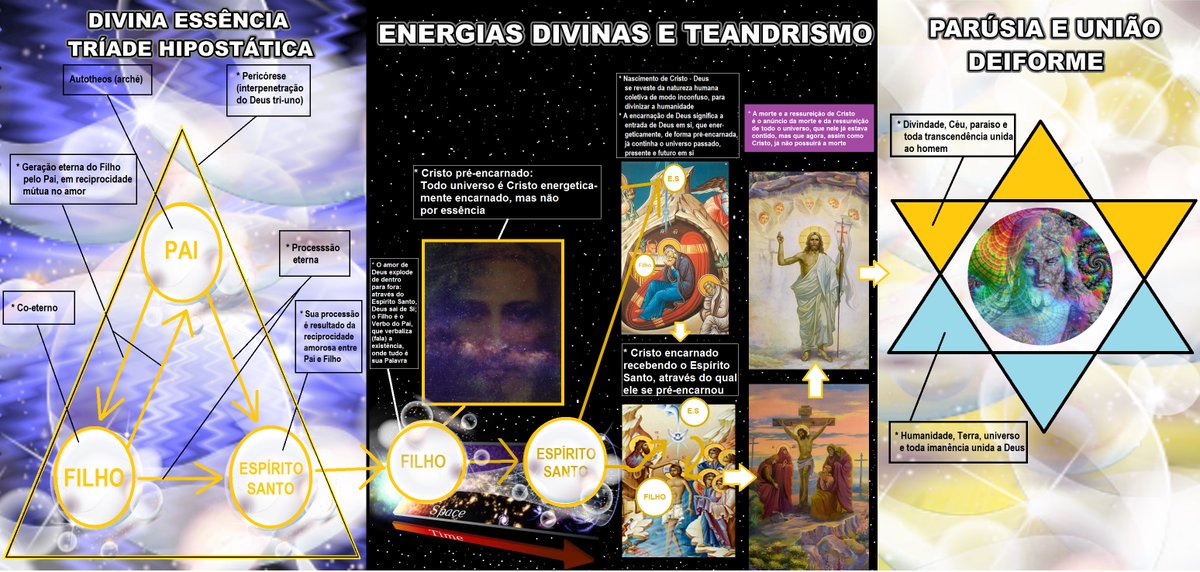
Nesse fio, juntarei conteúdo da teologia cristã ortodoxa que traduzo, salvo pela internet ou crio. 🧵
(repostando)
#ortodoxia
#féapostólica
#ortodoxo
#theosis
#palamas
#deificação
#cristianismo



Português
Postulio ☦️🇧🇷
4.5K posts

@Postulliok
Não tenho conta aqui há uns 5-6 anos. Só criei porque esse site não deixa mais ver conteúdo sem estar dentro. Orthodox, Male.




@BrutalColonizer @abermal22 @asuka_chiquita Mas raça é CONSTRUÇÃO SOCIAL crlh. Não existia raça branco, e nem raça negra até ontem. Os europeus viviam se matando entre eles mesmos e se odiando por causa de ETNIAS diferentes mesmo tendo tonalidade de pele igual ou parecida. Sinto muito se vc é burro retardado
Tanto a idéia de imputação quanto de infusão são ortodoxas, mas o principal fundamento de todos é: Το γαρ απρόσληπτον και αθεράπευτον Ou "o que não foi assumido não pode ser redimido", ou ainda mais literalmente "o que não é assumido não é curado". Essa frase de São Gregório Nazianzo sintetiza como o arianismo e o apolinarismo foram estraçalhados, e já refuta heresias futuras. Se a encarnação do Verbo fosse apenas uma instanciação da natureza de sua Mãe, ao invés de se tratar dele assumido a natureza humana coletiva de forma total e em todos os tempos, então a encarnação de nada serviria, e a salvação seria impossível, pois não haveria recapitulação retornando até Adão, nem o cosmo poderia ser transfigurado (não haveria novo Céu e Nova Terra), já que ele caiu também por estar submetido a Adão. A salvação é para o conjunto do homem, não para pedaços e partes. Cristo sofre a humanidade inteira na Cruz em todos os tempos. O sofrimento da alma deixando o corpo é o sofrimento de todos os que morreram e exatamente pela consubstancialidade tornada possível pela união hipostática. Imagine o peso disso! Cristo sofreu o inferno, embora não tenha sido condenado ao inferno. Aí está o paradoxo, satanás foi enganado e a morte foi morta de forma triunfal. É por isso que tipos de soteriologia que focam excessivamente no aspecto legal (jurídico) sem balancear com o ontológico perdem totalmente o ponto. O aspecto legal existe, mas a salvação não é meramente um tribunal: é cura em um sentido real! A própria raiz da palavra salvação no grego significa cura (σῴζω ou sozo). Cristo não nos salva por fora através de imputações jurídicas dos pecados da humanidade nele, ele nos salva por dentro; O REINO DE DEUS ESTÁ DENTRO DE NÓS E O ESPÍRITO SANTO NÃO É UM "HABITUS" - está em nosso templo-coração! E, através de sua divindade, Cristo diviniza sua carne na transfiguração, assim como nos diviniza. Cristo é o modelo da divinização do homem pela sua divinização auto-divinizada. Cristo se revestiu do homem, tornando-se o que ele é; aquele que busca ser salvo deve se revestir de Cristo, tornando-se o que ele é. Essa frase de São Gregório Nazianzo também destrói a lógica da eleição incondicional de que Deus pré-condena alguns e pré-salva outros antes de criar o mundo, pois Cristo contém a economia de toda humanidade e entra na humanidade, tanto entre ela como pessoa humana divina, quanto literalmente dentro dela, como se houvesse uma backdoor para dentro da natureza humana geral. Além disso, essa frase mostra que, apesar de Cristo tomar a natureza humana, essa tomada ocorre em sua Mãe. Ou seja, a Theotokos é de fato uma deusa-ponte do Deus-ponte. Ela é o portal da salvação, refutando o desdém protestante.


“Salvation is understood not as justification attributed juridically to those who believe in God, or distributed by the Church from the deposit of created grace earned by Christ, but as a new life that shines forth directly from the sanctified and risen body in the members of Christ’s mystical body, which is the Church – that is, as an effect of the personal communion between the faithful and Christ. Thus salvation is not an external, juridical, and static position but a new quality in a continuous development of the human person.” Saint Dumitru Staniloae, The Experience of God, Volume 5: The Sanctifying Mysteries, p. 126
☦️ 𝗣𝗔𝗣𝗔𝗟 𝗧𝗥𝗜𝗨𝗠𝗣𝗛𝗔𝗟𝗜𝗦𝗠 𝗜𝗦 𝗨𝗧𝗧𝗘𝗥𝗟𝗬 𝗥𝗜𝗗𝗜𝗖𝗨𝗟𝗢𝗨𝗦!☦️ It was not the Roman/Latin Church that first brought the Gospel to the Slavic peoples, the Arabs, or even, surprisingly, the Anglo-Saxons (the kind of centralized, Latin-dominated structure we associate with the medieval Roman Church came later: youtube.com/playlist?list=…). Nor were the Romans/Latins the pioneers among the Chinese; that honor goes to Syrian missionaries from the Church of the East, who arrived as early as 635 AD and received imperial permission to spread the faith. The Roman/Latin Church was likewise not the first to carry the Gospel to India. Even among the Germanic tribes, we cannot overlook the role of heretics, specifically the Arians, in spreading (albeit a distorted) version of the Christian message. The Arians reached and converted the Visigoths, Ostrogoths, and Vandals in places where the official Roman Church had not yet penetrated. Only later did the Roman Church bring those Arian-converted peoples into line with apostolic doctrine. The Roman Church only grew larger than the Eastern and Oriental churches (Chalcedonian and non-Chalcedonian) after the fall of the Byzantine Empire and thanks to the 'discovery' of the New World. I won't deny that God's hand was at work in decisive moments. God is able to draw good even from heretics or apostates, just as He has used pagans for His purposes. He raised up Cyrus the Great, who, through his conquests and decree, made possible renewed contact between the Hebrews and Zoroastrian influences. This helped prepare the way for later conversions among Persians, Arabs, and Egyptians (though, sadly, many of those regions later fell to Islam). Cyrus's era also lies behind the origin of the Magi who came to worship Christ, through the influence of the prophet Daniel in the Persian court. Likewise, God used Alexander the Great, another figure providentially guided, to reshape earthly geography into evangelical geography. His empire spread Hellenistic culture and the Koine Greek language across vast regions, creating the very linguistic and cultural conditions that would allow the Gospel to spread so rapidly in the centuries that followed. What enabled the Roman Church to dominate the conversion of the Americas was largely a matter of geography. God simply uses the circumstances that arise to advance His plans for the future, but this is far from proof that Roman Catholicism is the true Church. There was a time when the heart of Christianity wasn’t centered in the West at all, and Western Christianity itself was under serious threat. After the fall of the Western Roman Empire, the West experienced a profound intellectual and cultural blackout, nearly losing contact with the broader Christian world. Meanwhile, in the East, all the major dogmatic questions were being defined and settled. The Bishop of Rome wasn’t even present at the Councils of Nicaea (325), Constantinople I (381), Ephesus (431), or Chalcedon (451). Outside its immediate sphere, Roman influence was mostly limited to North Africa, and even there, it often met resistance when it tried to overstep. That’s why St. Augustine is so crucial for the West: he held things together amid the collapse, serving as the primary theological and moral authority. In the East, he’s respected as a saint, but he’s far less central. The West only began to recover with the Carolingian Renaissance. Even monastic tradition came from the East (Egypt, the true homeland of monks), as a direct continuation of apostolic asceticism, which traces back to the Essenes and the Prophets. Christian anthropology and "psychology" aren’t inherently Western or Latin in origin (the West gradually distorted them, unfortunately). For instance, St. Gregory the Great drew the concept of the seven capital sins from the monk St. John Cassian, who passed on the teachings of the blessed desert father Evagrius Ponticus about the logismoi. Despite Evagrius following Origen and holding some heretical views, he was respected by figures like St. Athanasius (a non-Roman Catholic from Alexandria), St. John Chrysostom (non-Roman, from Constantinople), St. Gregory of Nyssa (non-Roman, under Constantinople), and others. The vast majority of the great saints from early Christianity weren’t Roman Catholics at all! Even the idea of the West as a bastion of culture and intellectual life is a later development. Byzantium was the true center of the Christian world; that’s where universities, public hospitals, and major fields of study actually emerged, not in the West as is often claimed. Why isn’t this widely acknowledged? Because there’s long been a kind of academic bias or neglect toward Byzantium. Only recently have scholars begun seriously revisiting the historical impact of the Byzantine Empire and Orthodox Christianity on the West (and even on the Islamic world). Much more remains to be said about how the East was absorbed into the West, not just through heresies or Renaissance influences like Gemistus Pletho, but even in faithful orthodoxy. A great deal of Eastern Christian material circulated in Western monasteries. If truth were decided by sheer numbers, the Arians could once have claimed to be the "true" Christianity. By the same logic, the Byzantine East had a far larger Christian population than the Latin West for centuries. And if we’re playing the numbers game today, it only weakens the Roman Catholic position further. Statistically, the vast majority of Catholics hold views closer to evangelical Protestantism, even denying the Real Presence in the Eucharist! We shouldn’t judge by the present moment. The next two or three centuries, leading toward the end times, will belong to Orthodoxy (though we won’t be around to see it). After that brief period of glory, the great deception will come when the Katechon is removed, and true Christians will become a tiny minority once more. TL;DR Claiming that all of Christendom rests on the Bishop of Rome isn’t just historically illiterate, it’s arrogant, proud, and frankly shameless, the kind of overreach you’d expect from a con artist... And if we're counting contributions: Protestants have plenty to show too. They basically launched patristic studies as a serious discipline, they've been relentless missionaries reaching the ends of the earth, and they've made massive contributions to science, culture, and education. x.com/DianeKamer/sta…


THE CURSE OF THE FILIOQUE, THE PROPHET PALAMAS, AND THE DISENCHANTMENT OF THE WORLD St. Gregory Palamas was prophetic when he said that the Latin conception of God would eventually lead to atheism. Deism comes directly from an ontotheological view of God, rooted in the scholastic idea of a generic God that we can dissect like a lab specimen. It's not a God known through experience, but through the worship of reason. Make no mistake: without the Latin conception of God, there would have been no Descartes, Hume, or Kant, nor the many deists of the Enlightenment. This is the causal chain of events: 1. The Filioque (a departure from what the Holy Spirit had defined in the councils) 2. Roman Catholics begin to make statements about God's essence based on the cult of reason; dialectic corrodes theology, destroying the mystery and breaking with the idea that God is known through lived experience 3. Roman Catholics start treating God not as the Holy Trinity, but as a generic "God" (the Catholic version of Natural Theology) 4. God is pushed out of the world once His presence and actions in it are reduced to mere analogies and created effects, and the beatific vision is seen as something reserved only for after death (this plants the seed of deism) 5. Groups, movements, and schools of theological speculation emerge, detached from the patristic tradition (this sectarian spirit would later inspire the various Protestant sects) 6. Europe plunges into religious wars. 7. Philosophical visions alternative to both Catholicism and Protestantism begin to appear, but still carrying the flawed presuppositions of both (God is removed from religion) 8. Deism, the Enlightenment, and modernity 9. Atheism From the Cathar heresy and the prelest of medieval stigmatics, to influential mystics such as Meister Eckhart, Renaissance Neoplatonism and Hermeticism, the subversive Alumbrados, Lutheran Pietism, the Devotio Moderna, Methodism, and even the modern Charismatic Movement, all of these were, in one way or another, reactions over the centuries to the sterile conception of God that emerged after the Great Schism. All of these movements reflected a desire to recover something that had been lost, even if they often pursued it in misguided ways. Quietism was one such reaction, yet Roman Catholicism ended up condemning not only its errors, but also aspects that contained genuine spiritual insight and that might have developed into a distinctly Latin form of hesychasm through figures such as John of the Cross, perhaps even providing a bridge between East and West. Even the mysticism of Jakob Bohme can be seen as part of this broader attempt to recover what had been lost. There's a reason Orthodoxy never had to go through any of this. The Orthodox world never needed Franciscan movements, the Devotio Moderna, or Pietist reformers, and it never experienced the Enlightenment as a spiritual crisis. That's why the idea of God as a mere object in academic manuals and catechisms, distant from us and from the world, must be strongly resisted in Orthodoxy! The Holy Trinity must not be turned into an idol of our own minds. * * * Another Gregory once said: "Concepts create idols; only wonder comprehends anything. People kill one another over idols. Wonder makes us fall to our knees" ― Saint Gregory of Nyssa
Genuinely surprised Dyer didn't attribute transgenderism to the filioque


