Prafull (Modi ji ka Parivar)

121.1K posts

Prafull (Modi ji ka Parivar) banner
Prafull (Modi ji ka Parivar)

Prafull (Modi ji ka Parivar)

@Prafulp

Multi verse Katılım Mart 2010
7.5K Takip Edilen1.2K Takipçiler
Prafull (Modi ji ka Parivar) retweetledi
𑘢𑘿𑘨𑘜𑘪 𑘟𑘹𑘫𑘢𑘰𑘽𑘚𑘹 
रामदास स्वामी हे शिवरायांचे गुरु होते की नव्हते यावर अजून एकमत नाही हे मान्य. पण म्हणून एखाद्याने रामदास स्वामी महाराजांचे गुरु आहेत असं म्हटलं तर तो महाराजांचा अपमान झाला म्हणणे हे मूर्खपणाचे नाही काय? एक एक किल्ला घेण्यात ज्यांनी आयुष्य पणाला लावलं त्यांनी समर्थांची एका किल्ल्यावर राहायची सोय करणे किंवा परवानगी देणे यावरून सुद्धा साधारण आदर होता हे तरी स्पष्ट होते. पण रामदास बामण त्यामुळे “अपमान झाला, अपमान झाला” म्हणून बोंबलणे आता कुणीही ऐकून घेऊ नये. बामणाने छत्रपती म्हटलं नाहीतरी अनाजी पंत वगैरे बरळणारे आज पानसरे च्या पुस्तकातील एकेरी उल्लेखाच समर्थन करत आहे. 😄 महाराष्ट्र हा पुरोगामी वगैरे अजिबात नाही. इथली वैचारिक चळवळ ही ब्राह्मण विरुद्ध ब्राह्मणेतर यातून निर्माण झाली आणि त्याला इंग्रजांची फूस होती. महाराष्ट्रात जर शिवाजी महाराज झाले नसते तर तामिळनाडू प्रमाणे ब्राह्मणांना इथूनही पळून जावे लागले असते इतकी विषारी वैचारिक चळवळ या लोकांनी चालवली होती. आज ती संपण्याच्या मार्गावर आहे, आणि शिवरायांच्या विचारानेच ती संपेल. 🚩🌺जय जय रघुवीर समर्थ 🌺🚩 🚩🌺हर हर महादेव🌺 🚩
𑘢𑘿𑘨𑘜𑘪 𑘟𑘹𑘫𑘢𑘰𑘽𑘚𑘹  tweet media
MR
6
17
72
3K
Prafull (Modi ji ka Parivar) retweetledi
Aabhas Maldahiyar 🇮🇳
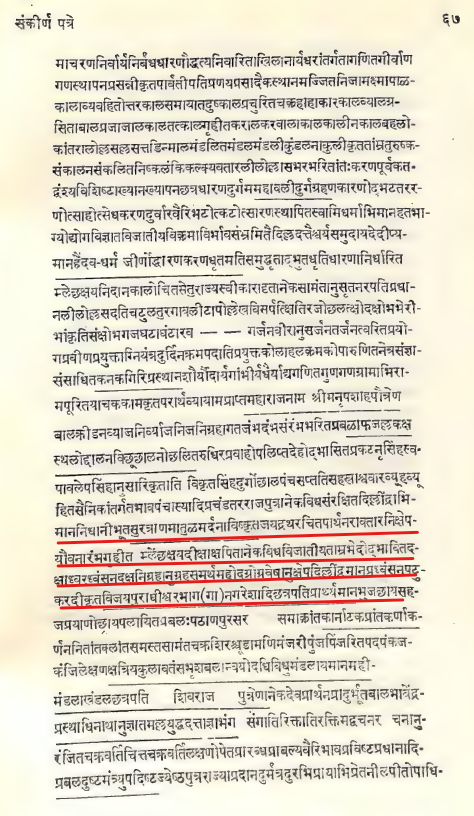
One of the most wrong thing to do would be secularize #ChatrapatiShivajiMaharaj. There are many but I'm citing a few records from primary source. His son Sambhaji Maharaj says-- "…who, at the very dawn of youth, had already bound himself by a solemn vow—to humble and overthrow the Mlechhas (Muslims)". Source: dānapatra, 1680 cited in Shivacharitra Saahitya, Part 14 (Pune: Bharat Itihas Sanshodhak Mandal), doc. no. 39, p 67.// image-1 Contemporary Record Shivabaharat (SB) records Ali Adil Shah speaking to Afzal Khan as below (image-2): "The religion of the Muslims is being destroyed by the hero who holds great pride and self-respect." (SB, 17:12) "The territories consisting of forts, forests and mountains which I had given to Aurangzeb with the intention of making a treaty, those territories were forcibly taken over by that mighty, subjugated and mad Shivaji, insulting me and those Muslims." (SB, 17: 17, 18) "He (Shivaji) has been insulting the Yavanas (Muslims) since his adolescence." (SB, 17:21).
Aabhas Maldahiyar 🇮🇳 tweet mediaAabhas Maldahiyar 🇮🇳 tweet media
English
2
87
213
4.8K
Prafull (Modi ji ka Parivar) retweetledi
Bhaskar Mishra
Bhaskar Mishra@Bhaskar_m11·
तारीफ है मौलाना की...आज जलेबी नहीं बनाई..सीधी बात बोली.. सेक्युलर और जय भीम वाले हिंदुओं..सुन लो 🤨🙄
हिन्दी
48
736
973
17.7K
Prafull (Modi ji ka Parivar) retweetledi
𝐊𝐫𝐢𝐬𝐡𝐧𝐚𝐩𝐫𝐞𝐞𝐭𝐢
Most people are using ice & heat WRONG ❌ - Ice for swelling - Heat for stiffness That’s it. That’s the rule. Use ice on fresh injuries (sprain, bruise) Use heat for muscle pain, cramps, back pain Wrong choice = slower healing Save this. You’ll need it someday.
𝐊𝐫𝐢𝐬𝐡𝐧𝐚𝐩𝐫𝐞𝐞𝐭𝐢 tweet media
English
22
139
188
2.9K
Prafull (Modi ji ka Parivar) retweetledi
Facts
Facts@BefittingFacts·
So called Aam Aadmi Arvind Kejriwal who had promised to not take any government bunglow has now shifted to his second Sheesh Mahal. Luxury has become habbit of Kejriwal and he cant live without it. Here are few pictures of his new house. An aam aadmi cant dream to live in house like this. #KejriwalSheeshMahal2
Facts tweet mediaFacts tweet mediaFacts tweet mediaFacts tweet media
English
23
189
576
15.6K
Prafull (Modi ji ka Parivar) retweetledi
OsintTV 📺
OsintTV 📺@OsintTV·
𝗙𝗮𝗿𝗲𝘄𝗲𝗹𝗹 𝘁𝗼 𝗮 𝗠𝗮𝗻 𝗼𝗳 𝗖𝗼𝘂𝗿𝗮𝗴𝗲 23-04-2026 - Poonch, J&K With heavy hearts, the Indian Army bids goodbye to Tahir Fazal, who stood firm alongside our troops during Operation Sarp Vinash 2003. Poonch will remember him. So will the nation. He chose courage when it was hardest. He stood his ground when it mattered most. Thank you for your service. Rest in peace.
OsintTV 📺 tweet media
English
47
244
1.4K
26.6K
Prafull (Modi ji ka Parivar) retweetledi
News Algebra
News Algebra@NewsAlgebraIND·
SSUBT spokesperson Anand Dubey - "Can all businessmen, Bollywood stars, and cricketers speak Marathi here? Then why are taxi and auto drivers being forced to learn Marathi?"
English
100
783
4.2K
96.6K
Prafull (Modi ji ka Parivar) retweetledi
Kreately.in
Kreately.in@KreatelyMedia·
7 Kgs of beef were recovered from Ramudih Upkramit Urdu Vidyalaya in Rohtas, Bihar where 175 Hindu & 25 Muslim children study. Children's families say that beef was brought to serve it during the mid-day meal. 2 teachers were arrested & remaining 5 teachers fled the school.
English
79
1.6K
2.6K
27.8K
Prafull (Modi ji ka Parivar) retweetledi
Oxomiya Jiyori 🇮🇳
Sir ji Quraishi @DrSYQuraishi, you once headed the very institution you are now busy maligning. The word is not “deleted.” The word is CLEANSED. Removing dead voters, duplicate voters, and ghost voters is the ECI’s primary constitutional duty, the same duty you swore to uphold during your own tenure. The Supreme Court examined plea after plea on SIR and ruled firmly in favour of the ECI. The judiciary has spoken. The law is settled. Yet here you are, sowing seeds of suspicion on your own former institution to please a particular political camp. Political ambition has clearly clouded your conscience. A former CEC casting aspersions on the ECI is not dissent. It is a betrayal of the chair you once occupied.
Oxomiya Jiyori 🇮🇳 tweet media
English
49
156
284
2.8K
Prafull (Modi ji ka Parivar) retweetledi
History इतिहास 🇺🇲🛕 🚀
The Saint in Pieces How the Church Systematically Dismembered Francis Xavier's Incorrupt Body The silver casket lay in the dark of the basilica like a reliquary in a gothic fever dream. Inside, beneath 32 ornate panels depicting episodes from a dead man's life, lay what remained of Francis Xavier: his torso, his head, his legs. Not his right arm. Not his right hand. Not his intestines, or his shoulder blade, or the toe that a Portuguese woman had bitten off in 1554, her mouth departing with a martyr's prize and blood pooling on the stone floor of the church in Goa. By 1614, sixty-two years after Xavier's death on an island off the coast of China, the Jesuit order had come to understand something that the history of Christendom had long practiced in secret: a saint's body was not a body at all. It was inventory. It was currency. It was an empire's most negotiable asset, and it needed to be distributed. The dismemberment began, appropriately enough, with the instrument of blessing. Xavier's right forearm, the one that had traced crosses over thousands of foreheads, that had baptized converts in the Malabar Coast and Japan and Macau, was severed in 1614 by order of Claudio Acquaviva, the Superior General of the Society of Jesus. It was done carefully, surgically, the body exhumed again in secret. The lower arm and hand were sent to Rome, to Il Gesù, the mother church of the Jesuit order. They remain there still, displayed in a silver reliquary draped in baroque marble and painted saints. The upper arm was divided. Half went to Cochin, half to Macau. By 1620, six years after the forearm's removal, the Church's appetite had grown. The intestines came next. All the internal organs of the chest and abdomen, extracted and distributed across the Catholic world like pieces of a saint-shaped jigsaw puzzle. A shoulder blade to Macau. Segments of bone to churches built in his name throughout India and Japan. Each fragment carried with it not just the supposed power of holiness but also the implicit logic of imperial Christianity: that a dead man's pieces belonged to Rome, and Rome would see them scattered across the globe, from the Vatican to the missions in the Far East. For seventy-two years, the institutional plundering continued in this fashion. Xavier's body, which had arrived in Goa in 1554 in a state of such perfect preservation that observers reported it "more like the garden of the bridegroom when the south wind blows than that of human flesh," became the property of an industrial machine, a Catholic supply chain for producing relics. Then came the autumn of 1686, when a Jesuit provincial opened the casket to conduct a routine inspection and recoiled at what he found. The face was deformed. The skin had been ravaged by moths, as if even insects understood something the Church had long ago forgotten: that this had been a man, and men decay. The horror of the moment produced an almost absurd gesture toward mercy. Locks were affixed to the removable silver panels. They wanted to stop the unraveling, to preserve what remained. But the symbolic closing of the casket could not undo what had already been done. The Basilica's rector, confronted with the knowledge that Francis Xavier's remains had become a kind of open grave, that they might continue to deteriorate, that there might always be new reasons to slice away another piece for another church in another distant mission, wrote to Rome with a plea of such desperate intimacy that it survives as the only moment when the institution seems to flinch. He asked permission to throw the keys into the sea. He never did. The keys were not thrown. The casket remained locked, but locked caskets held no power. Xavier's body, or what was left of it, has since become a kind of specter haunting the architecture of Catholic devotion. His right arm tours North America. His toe sits in a museum in Lisbon, displayed only since 2009, hidden for centuries by a family that understood, perhaps better than the Church itself, that some things should remain private. His teeth are in one place, his fingernails in another. He is scattered across Rome, Japan, Macau, Goa, and a dozen other cities whose churches claim fragments of his flesh as proof of their own spiritual legitimacy. Today, millions of pilgrims file past his torso every ten years at the Basilica of Bom Jesus, where the decayed remainder rests in a glass container encased in a silver casket. They come to witness not quite resurrection but its opposite: the continued survival of what should have rotted away centuries ago. They come to see the saint who has been broken into pieces by the very institution that canonized him, and somehow, against all rational expectation, still seems to hold together.
History इतिहास 🇺🇲🛕 🚀 tweet media
English
1
11
18
738
Mihir Jha
Mihir Jha@MihirkJha·
Ye Challenge hai ye Offer?? 😼
Mihir Jha tweet media
Dansk
333
47
304
10.5K
Prafull (Modi ji ka Parivar) retweetledi
Sameer Rao
Sameer Rao@CivitasSameer·
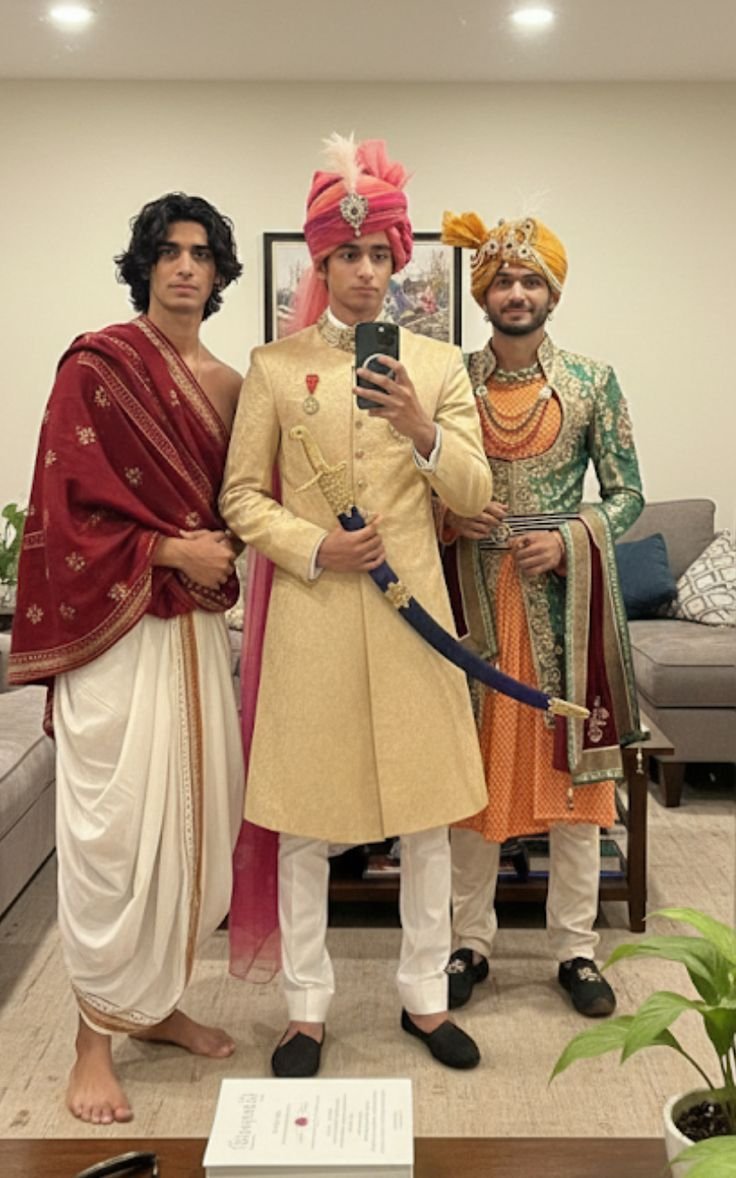
Hindu civilization represents one of the most extensive and internally diverse reservoirs of textile production and aesthetic philosophy in human history, not merely as a matter of cultural expression but as a deeply embedded economic and civilizational system that once structured the material life of the subcontinent. For centuries, the Indian economy functioned substantially as a textile economy, with entire regions specializing in distinct weaving techniques, dyeing processes, and garment traditions that were intimately tied to climate, geography, ritual function, and social organization. Clothing in this context was not a superficial layer of identity but a living grammar of civilization itself, encoding metaphysical ideas, social roles, and ecological adaptation within its very fabric. It is therefore profoundly paradoxical that in the contemporary moment, a civilization that once clothed the world now exhibits a persistent psychological inclination to imitate Western sartorial norms as markers of modernity, sophistication, and authority. This is not a trivial matter of taste. It is a symptom of a deeper epistemic subordination in which the colonized mind continues to seek validation through the aesthetic frameworks of its former colonizer. Even those who are conscious of this tendency often find themselves participating in it, which only reinforces the extent to which this condition has been normalized.The postcolonial Indian state, far from acting as an agent of civilizational recovery, has largely perpetuated colonial aesthetic codes within its institutional structures. The continued use of uniforms such as the brown khaki worn by police forces is not an incidental choice but a direct inheritance from colonial administrative logic, where visual authority was constructed through distance, intimidation, and uniformity rather than cultural resonance. The persistence of such symbols reflects an uncritical continuity of colonial governance aesthetics that has not been subjected to serious philosophical interrogation. Similarly, the broader ecosystem of political and cultural organizations, including influential bodies such as the Rashtriya Swayamsevak Sangh, has historically relied on uniform styles that emerged in specific historical contexts but may now require a more deliberate and self aware evolution. This is not a denunciation but an invitation to refinement. If the objective is the cultivation of a confident and self conscious civilizational identity, then the visual language through which that identity is expressed must be continuously reexamined and elevated. A civilization that aspires to renewal cannot remain aesthetically static.The problem extends beyond uniforms into the very nomenclature and symbolic architecture of the state. Titles, institutional names, and bureaucratic conventions continue to echo colonial frameworks, thereby reinforcing an underlying dissonance between the civilizational identity of the people and the formal structures that govern them. A serious project of decolonization must therefore operate not only at the level of policy but at the level of symbols, aesthetics, and everyday experience. The redesign of official attire, the reimagining of institutional language, and the normalization of indigenous forms within public life are not cosmetic exercises. They are foundational acts in the reconstruction of cultural confidence. Indian clothing traditions are not only aesthetically rich but functionally superior in many respects, as they evolved in direct response to the climatic conditions, bodily ergonomics, and social practices of the subcontinent. The continued privileging of rigid, climate-inappropriate Western forms, such as the so-called Oxford style, reflects not rational choice but inherited bias. At the same time, any call for the revival of indigenous aesthetics must confront the historical realities of the traditional textile economy. These systems were undeniably shaped by feudal and caste-based structures that restricted mobility, concentrated knowledge within hereditary communities, and limited the capacity for large-scale production. Romanticising this past without addressing its structural limitations would be intellectually dishonest. The task, therefore, is not restoration but transformation. Indian textile traditions must be industrialised, democratised, and integrated into modern economic frameworks in a manner that preserves their aesthetic integrity while dissolving the social hierarchies that once governed their production. Industrialisation in this context is not a threat to tradition but a necessary condition for its survival and expansion. By breaking the link between caste and occupation, and by opening access to design, production, and distribution, India can convert its cultural capital into a scalable and globally competitive industry.The global fashion system already recognises the value of Indian aesthetics, often in ways that are exploitative and asymmetrical. Luxury brands such as Prada routinely appropriate motifs, techniques, and visual languages derived from Indian handloom traditions and maximalist design philosophies, repackaging them within Western branding frameworks and extracting disproportionate economic value. This phenomenon is not simply a matter of cultural theft. It is enabled by a domestic failure to adequately value, protect, and promote indigenous design systems. When a civilisation does not assert ownership over its own aesthetic vocabulary, it inevitably becomes a resource pool for others. In this light, any political ideology that claims allegiance to civilizational identity, including those operating within the broad framework of Hindutva, must be evaluated not only on its rhetorical commitments but on its capacity to materially cultivate and project cultural excellence. A truly serious civilizational state would treat fashion, design, and aesthetics as strategic domains of national development rather than as peripheral concerns. The industrialisation of culture, understood as the systematic organisation, scaling, and global dissemination of indigenous forms, becomes an essential component of national power. Hindu society cannot compete globally by mimicking external models while neglecting its own unparalleled heritage. It must instead undertake a disciplined process of modernisation that is rooted in its own civilizational logic, where tradition is not discarded but reengineered, and where cultural confidence is not asserted through slogans but embodied in the very fabric of everyday life.
Sameer Rao tweet mediaSameer Rao tweet mediaSameer Rao tweet media
English
12
74
561
10K
Prafull (Modi ji ka Parivar) retweetledi
𝗠𝗮𝗿𝗮𝘁𝗵𝗮 𝗘𝗺𝗽𝗶𝗿𝗲 𝗟𝗲𝗴𝗮𝗰𝘆
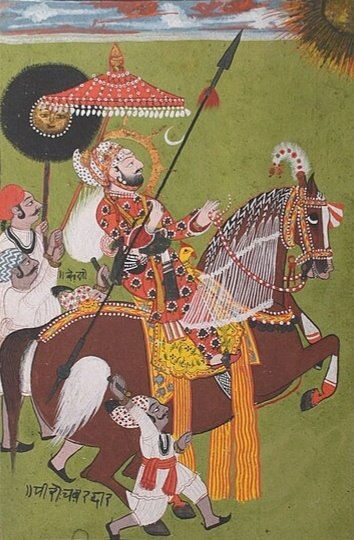
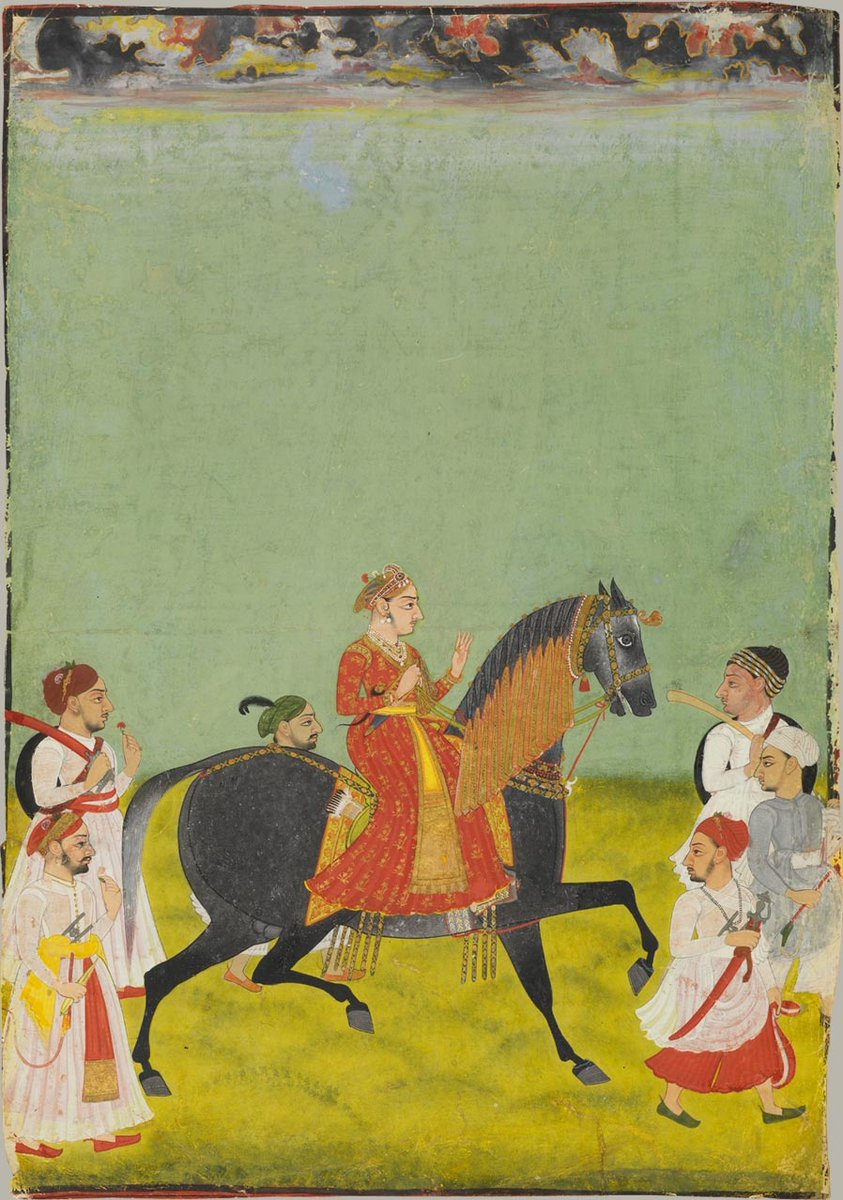
Maratha Rule In Rajasthan Is Generally Labelled As Anarchy & Pillage But This Letter Shows The Maratha Justice ⚖️, Peshwa Orders Govindrao Krishna And Tukoji Holkar To Stop Raiding Mewar As Rana Ari Singh II Had Already Paid His Tributes To The Maratha Government.
𝗠𝗮𝗿𝗮𝘁𝗵𝗮 𝗘𝗺𝗽𝗶𝗿𝗲 𝗟𝗲𝗴𝗮𝗰𝘆 tweet media𝗠𝗮𝗿𝗮𝘁𝗵𝗮 𝗘𝗺𝗽𝗶𝗿𝗲 𝗟𝗲𝗴𝗮𝗰𝘆 tweet media
English
1
2
11
178
Prafull (Modi ji ka Parivar) retweetledi
𝗠𝗮𝗿𝗮𝘁𝗵𝗮 𝗘𝗺𝗽𝗶𝗿𝗲 𝗟𝗲𝗴𝗮𝗰𝘆
.... A Force Will Be Despatched Towards Mewar To Chastise The Rana, A Letter Was Addressed To Malharrao Holkar To Keep The Force Ready, This Letter Shows The Policy Of A Disciplined Overlord To His Irregular Tribute Paying Subordinate.
𝗠𝗮𝗿𝗮𝘁𝗵𝗮 𝗘𝗺𝗽𝗶𝗿𝗲 𝗟𝗲𝗴𝗮𝗰𝘆 tweet media
English
1
2
10
172
Prafull (Modi ji ka Parivar) retweetledi
𝗠𝗮𝗿𝗮𝘁𝗵𝗮 𝗘𝗺𝗽𝗶𝗿𝗲 𝗟𝗲𝗴𝗮𝗰𝘆
Rana Raj Singh II Of Mewar Refused To Pay Tribute To The Marathas In 1759-60 A Warning Letter Was Despatched To Him To Immediately Pay The Tributes To Govindrao Krishna (Maratha Governor Of Ajmer) & Jankoji Shinde At The Sight Of This Letter, If This Is Not Done ....
𝗠𝗮𝗿𝗮𝘁𝗵𝗮 𝗘𝗺𝗽𝗶𝗿𝗲 𝗟𝗲𝗴𝗮𝗰𝘆 tweet media
English
1
2
10
201
Prafull (Modi ji ka Parivar) retweetledi
𝗠𝗮𝗿𝗮𝘁𝗵𝗮 𝗘𝗺𝗽𝗶𝗿𝗲 𝗟𝗲𝗴𝗮𝗰𝘆
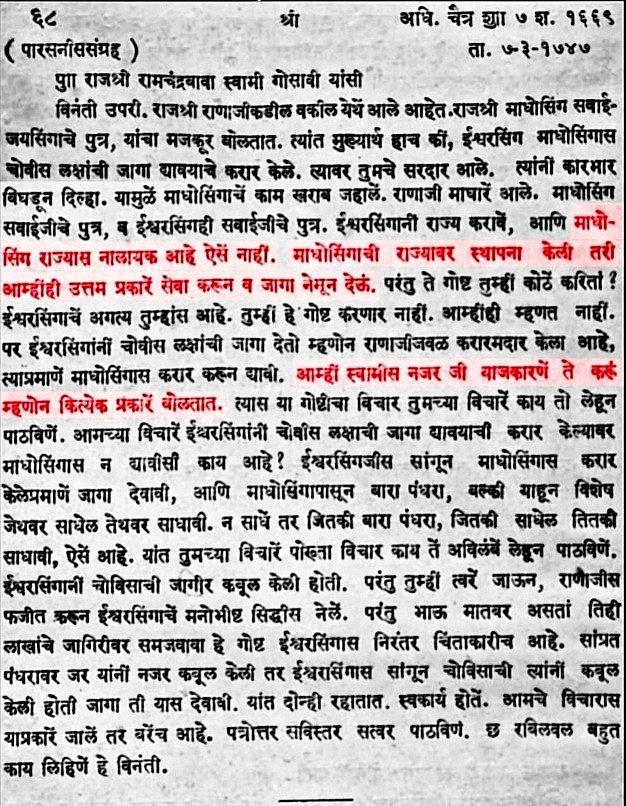
A Letter From Peshwa Nanasaheb To Ramchandrababa 7/3/1747 — Peshwa Summarised A Letter That He Recieved From The Rana Of Mewar Where He Promised To Serve The Marathas Better Is Madho Singh Is Supported By Them And Will Pay The Swami (Chhatrapati Shahu) A Nazar (Succession Fee...
𝗠𝗮𝗿𝗮𝘁𝗵𝗮 𝗘𝗺𝗽𝗶𝗿𝗲 𝗟𝗲𝗴𝗮𝗰𝘆 tweet media
English
1
2
11
224
Prafull (Modi ji ka Parivar) retweetledi
𝗠𝗮𝗿𝗮𝘁𝗵𝗮 𝗘𝗺𝗽𝗶𝗿𝗲 𝗟𝗲𝗴𝗮𝗰𝘆
The Envoys Were Given Vastre, Tika & Saranjam (Territory & Army) For The Rana Along With The Approval By Chhatrapati Shahu, Just Like The Mughal Overlords Of Mewar Used To Give Khilat & Mansab In The Previous Century, A Clear-Cut Evidence That Mewar Was A Vassal State Of Marathas
𝗠𝗮𝗿𝗮𝘁𝗵𝗮 𝗘𝗺𝗽𝗶𝗿𝗲 𝗟𝗲𝗴𝗮𝗰𝘆 tweet media
English
1
3
13
283
Prafull (Modi ji ka Parivar) retweetledi
𝗠𝗮𝗿𝗮𝘁𝗵𝗮 𝗘𝗺𝗽𝗶𝗿𝗲 𝗟𝗲𝗴𝗮𝗰𝘆
Letter 1734, Lala Bhagirath Munshi To Peshwa From Sarata, Mewari Envoys Visited Satara And Asked For The Recognition And Approval Of Peshwa Bajirao From Chhatrapati Shahu For The Accession Of Jagat Singh II After The Death Of Sangram Singh II.
𝗠𝗮𝗿𝗮𝘁𝗵𝗮 𝗘𝗺𝗽𝗶𝗿𝗲 𝗟𝗲𝗴𝗮𝗰𝘆 tweet media
English
1
2
16
324