Pranavi ✨🌟💫

3.1K posts

Pranavi ✨🌟💫 banner
Pranavi ✨🌟💫

Pranavi ✨🌟💫

@Pranavi9228

Careful yaa! my happiness is contagious 😄✨

Bangalore // Warangal // Hyd Katılım Ekim 2019
545 Takip Edilen225 Takipçiler
Sabitlenmiş Tweet
Pranavi ✨🌟💫
Pranavi ✨🌟💫@Pranavi9228·
We’re so deeply hyper personalized as humans that even the omnipresent God has to take human form for us.
English
0
1
6
412
Pranavi ✨🌟💫 retweetledi
goma
goma@soigomaa·
we live on a planet where trees warn each other of danger through a fungal network. Where octopuses dream. Where elephants return to the bones of the deceased and stand over them in silence. Where bees use dance to communicate where to fly and where the flower is. Where crows remember the faces of people who were cruel to them and pass this memory to their children. Where ants build cities. Where cats purr at a frequency that accelerates the healing of bones. Where, after a forest fire, the first thing the earth does is grow flowers.
quote@itsmubashi

Daily reminder :

English
62
4.1K
17.2K
519.6K
Pranavi ✨🌟💫 retweetledi
Anish Moonka
Anish Moonka@anishmoonka·
When a rabbit's partner dies, the surviving rabbit can be dead within a day. Just from grief. The stress physically shuts its stomach down. Vets call it GI stasis, and it's a known killer of bonded partners. What you're watching might be the first hours of it. Rabbit vets actually encourage letting the survivor stay with the body. They tell owners to give the rabbit time with its partner, sniffing, nudging, lying next to her, sometimes for a few hours. Without that goodbye, the survivor can spend weeks searching the home for a partner who never comes back. With it, they're more likely to eat the next day. More likely to live. In 2008, researchers at the University of Edinburgh built an unusual cage to measure how much rabbits need each other. It had weighted doors at both ends. On one side, food. On the other, a few minutes of contact with another rabbit. The doors got heavier over time, so the rabbit had to really want it. The rabbits worked nearly as hard for the friend as they did for the food. Watch a bonded pair and you see why. They follow each other around all day. Sleep pressed together at night. Groom each other's face, head, and ears in long, careful sessions. When their partner is close they make a soft clicking sound with their teeth, called tooth purring. It sounds like a cat's purr. When one of them dies, the survivor's body reacts before its mind catches up. Rabbits are prey animals. Almost everything in the wild wants to eat them. Their bodies evolved one survival rule: when something scary happens, drop everything and run. So a rabbit's stress system is wired to switch hunger off in a crisis. Run first, eat later. That same wiring kicks in when a bonded mate suddenly disappears, except now there's nothing to run from. The rabbit hunches into itself, stops eating, and pulls away from everything around it. Some spend weeks searching the spot where their partner used to be. Rabbit welfare groups have documented cases of surviving partners who simply stopped eating after their mate died. They sometimes call it dying of heartbreak. The brown rabbit in the video is doing what a bonded rabbit does when his partner is suddenly gone. He stays close to her body. He keeps watch. He says goodbye the only way a rabbit can. If he survives the next two weeks, it will be because someone notices he has stopped eating and gets him to a vet who knows rabbits. If he doesn't, his stomach will give out before anything else does. A bonded rabbit's body is built around being with another rabbit. When that other rabbit is gone, the body itself starts to fall apart.
kira 👾@kirawontmiss

A rabbit goes viral after he was seen resting his head on his wife while crying over losing her in a traffic accident 💔

English
323
5.1K
29.2K
3M
Pranavi ✨🌟💫 retweetledi
Sturgeon's Law
Sturgeon's Law@Sturgeons_Law·
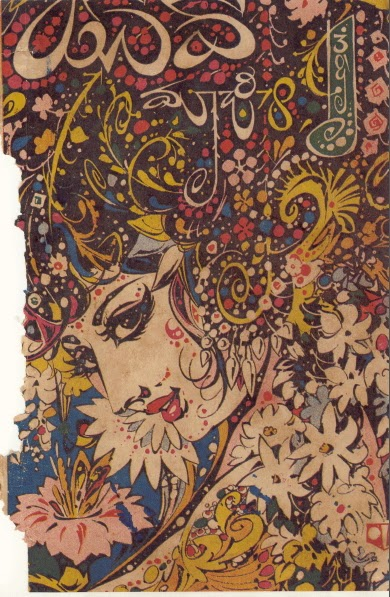
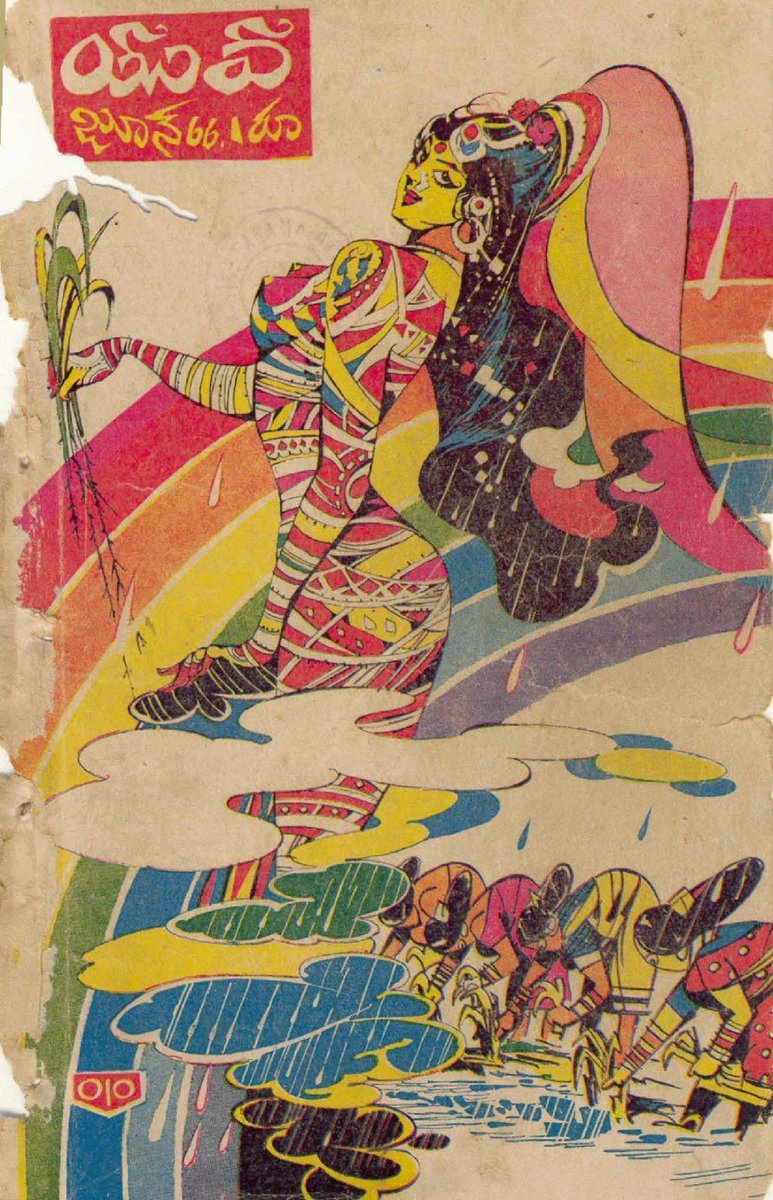
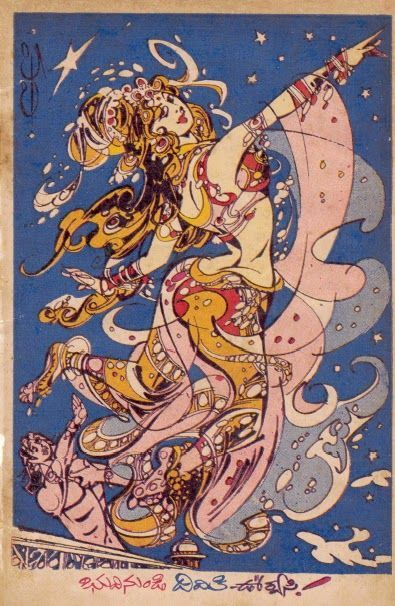
Not Tamil, but if you like these, look up the 20th C Telugu magazine cover artist/illustrator Vaddadi Papaiah. Decades of great stuff that isn't even well known across India.
Sturgeon's Law tweet mediaSturgeon's Law tweet mediaSturgeon's Law tweet mediaSturgeon's Law tweet media
💖@miraflux

English
63
2.6K
12.7K
494.9K
Pranavi ✨🌟💫 retweetledi
Jackson
Jackson@Jacksonsrule·
There is always another job, another city & another love. But never another life. Don't be afraid to leave & start over.
quote@itsmubashi

Daily reminder :

English
25
9.1K
28.8K
641.6K
Pranavi ✨🌟💫 retweetledi
Anish Moonka
Anish Moonka@anishmoonka·
A Chinese monk once walked from China to India. It took him eight years, crossing deserts and mountain ranges, just to attend a university. When he finally arrived, the gatekeepers rejected 7 out of every 10 people who showed up. His name was Xuanzang, and the university was Nalanda. He left China in 629 CE and reached the gate in 637. If he hadn't written the journey down in a book, we'd dismiss the story as a legend today. Nalanda had been operating for over 200 years by the time Xuanzang walked through the gate. An Indian king named Kumaragupta I founded it around 427 CE, back when most of Europe was still picking up the pieces after Rome fell. Oxford would not start teaching for another 669 years. Bologna, Europe's oldest university, would not open until 1088. At its peak, the campus held 10,000 students and 2,000 teachers. That works out to five students per teacher, a ratio most modern universities can't hit even today. Students came from China, Korea, Tibet, Japan, Persia, Turkey, and Indonesia. Tuition cost nothing. The king had assigned entire villages to Nalanda, and the produce and rent from those villages paid for everything. Students studied medicine (what we now call Ayurveda), math, astronomy, logic, grammar, metalworking, politics, and the art of war. This was a Buddhist monastery with a course on military strategy. Aryabhata, the mathematician who first proposed that the earth spins on its own axis around the year 499, may have led Nalanda in the 6th century. The library was its own complex of three separate buildings. One of them stood nine stories tall. Tibetan records estimate it held around 9 million manuscripts, every single one copied by hand. They had no printing press, no mass-produced paper, nothing but ink, dried palm leaves, and monks who copied texts for decades on end. The end came in 1193 CE. An invading army led by Bakhtiyar Khilji rode in, killed thousands of monks, and set the library on fire. The fires burned for three months. A Persian historian wrote that smoke hung over the hills like a dark cloud for days. Centuries of work in medicine, math, and astronomy went with it. Most of it was unique to Nalanda and gone forever. The ruins sat forgotten for 619 years. In 1812, a Scottish surveyor named Francis Buchanan-Hamilton came upon them while mapping the region. He had no idea what he'd stumbled onto. Another 50 years passed before anyone identified the site as Nalanda. UNESCO made it a World Heritage site in 2016. The new Nalanda University opened on nearby land in 2014, and its 485-acre net-zero campus was formally inaugurated in June 2024. The original Nalanda operated for 766 years before Khilji shut it down. Harvard, for scale, is 390 years old. If Nalanda had survived, it would be turning 1,600 next year.
Science girl@sciencegirl

Nalanda University in India, founded in the 5th century CE, as the world’s first residential university

English
71
2.1K
7.1K
360.5K
Pranavi ✨🌟💫 retweetledi
goma
goma@soigomaa·
My "Roman Empire is the realization that my life is a lottery win. Somewhere in Sudan, Pålestine, iran, Afghanistan, Iraq or Congo, there is a boy smarter than me. He is more disciplined, more resilient, and holds more potential in his single finger than I do in my entire career. The only difference? I am siting in a train and he is sting in the rubble of his dreams. My "bad days" are his wildest dreams. My "burnout" is a luxury he can't afford because his only job is staying alive. It's geographical luck and it's a haunting injustice that we all refuse to acknowledge and look away
໊smolaraa@kesikesiluv

Hit me with the harshest reality truth.
English
773
26.3K
122.7K
4M
Pranavi ✨🌟💫 retweetledi
Arpit Bhayani
Arpit Bhayani@arpit_bhayani·
Claude limit reached before lunch. It's not even half day. Ape sad. Ape confused. Ape understand nothing. Ape consider touching grass. Ape stay inside.
English
80
43
1.5K
45.8K
Pranavi ✨🌟💫
Pranavi ✨🌟💫@Pranavi9228·
Atp there's a hugeeeee scope for Agritech Companies...
English
0
0
0
44
Pranavi ✨🌟💫
Pranavi ✨🌟💫@Pranavi9228·
We’re hiring across PM ( product manager ), Sr. Engineering & QA roles for our Agritech platform. Feel free to reach out if you’re interested or know someone who might be a fit
English
2
0
2
167
Pranavi ✨🌟💫
Pranavi ✨🌟💫@Pranavi9228·
@gaius_001 Hello Gaius, This is a office role is based out of Bangalore, India. Feel free to recommend if it works for your friend
English
1
0
0
45
Pranavi ✨🌟💫 retweetledi
vittorio
vittorio@IterIntellectus·
this is actually insane > be tech guy in australia > adopt cancer riddled rescue dog, months to live > not_going_to_give_you_up.mp4 > pay $3,000 to sequence her tumor DNA > feed it to ChatGPT and AlphaFold > zero background in biology > identify mutated proteins, match them to drug targets > design a custom mRNA cancer vaccine from scratch > genomics professor is “gobsmacked” that some puppy lover did this on his own > need ethics approval to administer it > red tape takes longer than designing the vaccine > 3 months, finally approved > drive 10 hours to get rosie her first injection > tumor halves > coat gets glossy again > dog is alive and happy > professor: “if we can do this for a dog, why aren’t we rolling this out to humans?” one man with a chatbot, and $3,000 just outperformed the entire pharmaceutical discovery pipeline. we are going to cure so many diseases. I dont think people realize how good things are going to get
vittorio tweet mediavittorio tweet mediavittorio tweet mediavittorio tweet media
Séb Krier@sebkrier

This is wild. theaustralian.com.au/business/techn…

English
2.4K
19.6K
116.9K
17.6M
Pranavi ✨🌟💫 retweetledi
Parimal
Parimal@Fintech03·
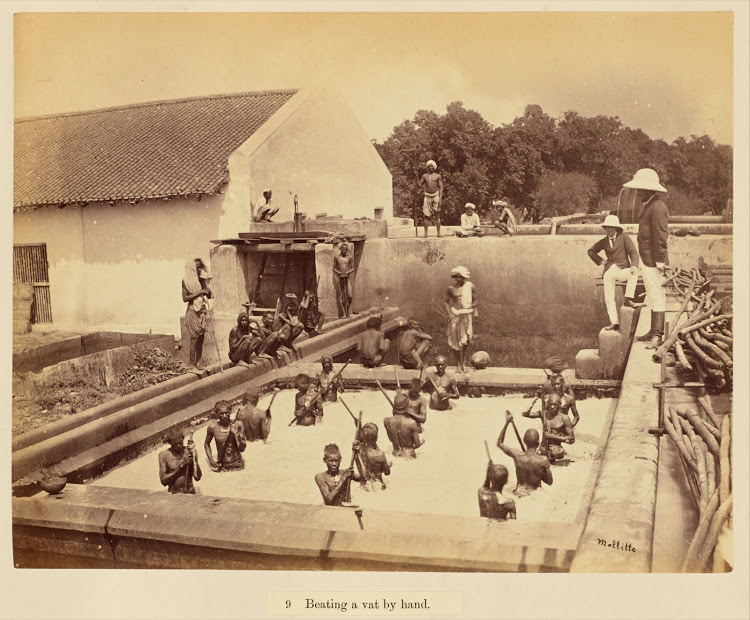
Let me share a beautiful story about obsession & ancient Indian invention. In the ancient world, blue was the rarest color in nature & the world struggled with unstable dyes At the same time, ancient Indian artisans were obsessed with the chemistry of the Indigofera tinctoria plant. Indigo is nt actually blue inside the plant; it is colorless. To get the color out, we have to perform a complex, multi stage biochemical reduction & oxidation. Ancient Indian dyers developed a live fermentation vat. They treated the dye like a living organism, feeding it lime & sugar. They were so obsessed with the purity of the blue that they created a dye that bonded to fabric at a molecular level making it the only dye in the ancient world that would not fade in the sun. This obsession literally created the global textile trade. When the British arrived, they were so obsessed with stealing this "Blue Gold" that they forced Indian farmers into the indigo revolt. Today, our blue denims are a direct result of a 2000 yr old Indian obsession with a color that should not exist.
Parimal tweet media
Guillermo Rauch@rauchg

Obsession is the mother of invention

English
13
462
1.3K
27.3K
Pranavi ✨🌟💫 retweetledi
Anish Moonka
Anish Moonka@anishmoonka·
You can’t buy Linux. It’s free. Always has been. So IBM did the next best thing: it spent $34 billion buying Red Hat, a company whose entire business is selling tech support for this free software. Largest software acquisition in history. For support contracts on something anyone can download for $0. The “side project” story, while true, is maybe 5% of what actually happened since. Linux itself is managed by a nonprofit, the Linux Foundation. That nonprofit pulled in $311 million last year. Only $8.4 million of that (2.6%) actually went to Linux itself. The rest of the funds support ~1,500 other open source projects, events, and training. Every Fortune 100 tech company is a paying member. And here’s who actually builds this “free” software now: 84% of the code changes to Linux in 2025 come from developers on corporate payroll. Intel is the biggest contributor. Google is second. Huawei, Oracle, AMD, and Meta all have engineers writing Linux code full-time. Over 1,780 companies pay people to work on it. The solo genius in a dorm room stopped being the real story around 1998. The wildest part: over 65% of Microsoft’s cloud computers run Linux. Microsoft, the company whose former CEO once called Linux “a cancer,” now runs more Linux than Windows on its own servers. Amazon and Google’s clouds are even higher, both above 90%. A 2024 Harvard Business School study attempted to calculate how much companies would spend if all free, open-source software vanished tomorrow. The answer: $8.8 trillion more per year. 3.5x what they currently spend. And that number didn’t even include operating systems like Linux. Linus Torvalds still personally approves every major code change. He makes about $1.5 million a year. He also built Git, the tool that powers GitHub (which Microsoft bought for $7.5 billion). Two pieces of software the entire tech industry runs on, same guy. Linux started as 10,239 lines of code. It’s now over 40 million. Every one of the world’s 500 fastest supercomputers runs it. 96% of the top million websites sit on it. Every Android phone has Linux inside it. That’s roughly 3 billion devices in people’s pockets. It’s the largest collaborative engineering project in human history, free to use, funded by the same corporations it was supposed to replace.
Sahil@sahill_og

Linus Torvalds created Linux at 21 without Claude or any other AI. - He didn't have a co-founder. - No VC funding. No office. - No team. - Just a personal project he posted to a mailing list: "I'm doing a free OS." 33 years later, it runs 97% of the world's servers, all smartphones, and the International Space Station. The most important software in history started as someone's side project. Absolute legend.

English
86
1.1K
7.9K
809.9K
Pranavi ✨🌟💫 retweetledi
Parimal
Parimal@Fintech03·
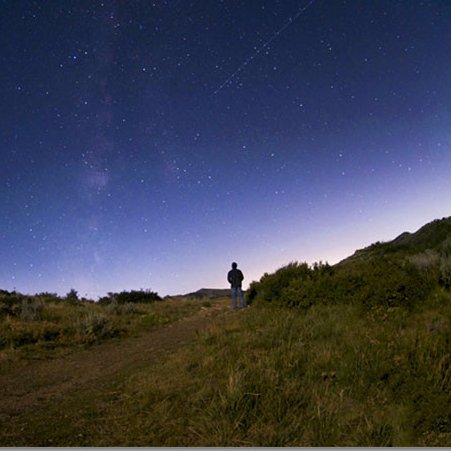
One may think Bose was only a man of pens & paper, this will surprise them. In 1950, Bose became an amateur geologist & chemist. He personally collected Sphalerite (a zinc ore) from the mountains of Nepal. Bose was convinced that Indian minerals contained Germanium (the critical element for early transistors). He spent months in his lab developing a new extraction method to isolate Germanium from the Nepal ore. His papers on "Extraction of Germanium from Sphalerite" (1950) are technically cited in chemistry, but almost never mentioned in his physics biography. He was trying to jumpstart the Indian Semiconductor industry 75 yrs ago.
Massimo@Rainmaker1973

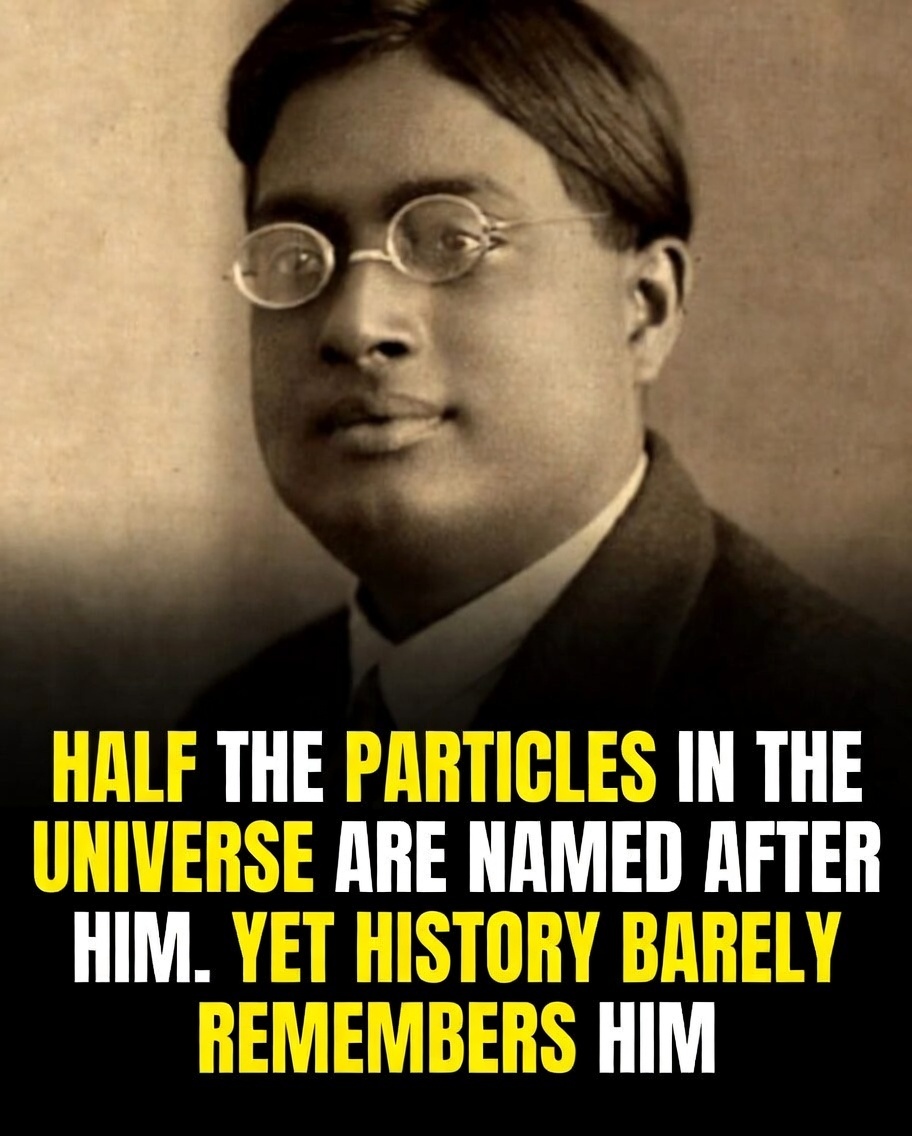
He was Satyendra Nath Bose, an Indian physicist whose quiet brilliance in the 1920s forever altered our understanding of the quantum world. In 1924, Bose, then a 30-year-old professor in British India, sent a groundbreaking manuscript directly to Albert Einstein. The paper offered a novel, more elegant derivation of Planck's law for blackbody radiation by treating light quanta (photons) as indistinguishable particles—a radical departure from classical statistical methods. Impressed by its insight, Einstein personally translated the work into German and facilitated its publication in the prestigious Zeitschrift für Physik. This exchange sparked a brief but profound collaboration. Einstein extended Bose's statistical approach to material atoms, predicting a bizarre new state of matter at ultra-low temperatures: what we now call a Bose-Einstein condensate (BEC), where particles behave as a single quantum wave. Bose's original framework became known as Bose-Einstein statistics, and the class of particles that obey it—those with integer spin, including photons, gluons, W and Z bosons, and the Higgs boson—was later named bosons in his honor by Paul Dirac. Unlike fermions (matter particles like electrons), which obey the Pauli exclusion principle and cannot occupy the same quantum state, bosons can pile into identical states en masse. This "social" behavior underpins extraordinary macroscopic phenomena: the coherent light of lasers, the zero-resistance flow in superconductors, and the collective quantum coherence in BECs. Despite the monumental impact—his statistics describe half of all fundamental particles and enabled key advances in quantum field theory, condensed matter physics, and particle physics—Bose remained remarkably unassuming. He continued teaching at universities in Dhaka and Calcutta (now Kolkata), mentored students, pursued ideas in X-ray crystallography, unified field theory, and other areas, and never sought the spotlight. Nominated several times for the Nobel Prize (notably for Bose-Einstein statistics and his later work), he was never awarded it, and his name rarely appears in popular accounts of 20th-century physics. There's a poignant humility in his story: a man whose legacy literally names one of the two fundamental families of particles in the universe, yet whose personal fame never matched the scale of his contribution. Bose reminds us that true influence often arrives without fanfare. Some breakthroughs echo through textbooks and technologies, while their creators work in the background, content to let the universe carry their ideas forward—even if history's spotlight rarely finds them.
English
15
616
2.9K
71.8K
Pranavi ✨🌟💫 retweetledi
Massimo
Massimo@Rainmaker1973·
He was Satyendra Nath Bose, an Indian physicist whose quiet brilliance in the 1920s forever altered our understanding of the quantum world. In 1924, Bose, then a 30-year-old professor in British India, sent a groundbreaking manuscript directly to Albert Einstein. The paper offered a novel, more elegant derivation of Planck's law for blackbody radiation by treating light quanta (photons) as indistinguishable particles—a radical departure from classical statistical methods. Impressed by its insight, Einstein personally translated the work into German and facilitated its publication in the prestigious Zeitschrift für Physik. This exchange sparked a brief but profound collaboration. Einstein extended Bose's statistical approach to material atoms, predicting a bizarre new state of matter at ultra-low temperatures: what we now call a Bose-Einstein condensate (BEC), where particles behave as a single quantum wave. Bose's original framework became known as Bose-Einstein statistics, and the class of particles that obey it—those with integer spin, including photons, gluons, W and Z bosons, and the Higgs boson—was later named bosons in his honor by Paul Dirac. Unlike fermions (matter particles like electrons), which obey the Pauli exclusion principle and cannot occupy the same quantum state, bosons can pile into identical states en masse. This "social" behavior underpins extraordinary macroscopic phenomena: the coherent light of lasers, the zero-resistance flow in superconductors, and the collective quantum coherence in BECs. Despite the monumental impact—his statistics describe half of all fundamental particles and enabled key advances in quantum field theory, condensed matter physics, and particle physics—Bose remained remarkably unassuming. He continued teaching at universities in Dhaka and Calcutta (now Kolkata), mentored students, pursued ideas in X-ray crystallography, unified field theory, and other areas, and never sought the spotlight. Nominated several times for the Nobel Prize (notably for Bose-Einstein statistics and his later work), he was never awarded it, and his name rarely appears in popular accounts of 20th-century physics. There's a poignant humility in his story: a man whose legacy literally names one of the two fundamental families of particles in the universe, yet whose personal fame never matched the scale of his contribution. Bose reminds us that true influence often arrives without fanfare. Some breakthroughs echo through textbooks and technologies, while their creators work in the background, content to let the universe carry their ideas forward—even if history's spotlight rarely finds them.

Massimo tweet media
English
47
928
4.5K
214.6K