Prasad Kodukulla

2.5K posts

Prasad Kodukulla

Prasad Kodukulla

@PrasadKo

My tweets reflect my own opinions.

Los Angeles Katılım Temmuz 2012
1.7K Takip Edilen260 Takipçiler
Prasad Kodukulla retweetledi
Swati Gupta
Swati Gupta@hrswatigupta·
Anthropic engineer: "You're not supposed to prompt Claude. You're supposed to build a system that prompts itself." In 45 minutes, she breaks down how Anthropic builds agents that remember, learn from their mistakes, and get smarter with every run. Worth more than any paid course you'll find on building agents. Watch this and bookmark
Swati Gupta@hrswatigupta

x.com/i/article/2077…

English
13
151
870
185.4K
Prasad Kodukulla retweetledi
Dr Rupam Manna MD
Dr Rupam Manna MD@DrRupamOncology·
🧬 Does a family member of a Lynch syndrome patient automatically need lifelong colonoscopies? Not always. The first step is predictive germline testing for the known familial Lynch syndrome mutation. ✅ Mutation-positive → Start Lynch syndrome surveillance: • Colonoscopy every 1–2 years • Begin at 20–25 years or 2–5 years before the earliest family colorectal cancer • Add gene- and sex-specific screening as appropriate ❌ Mutation-negative → Follow average-risk colorectal cancer screening. ⚠️ Genetic testing unavailable? Manage as Lynch syndrome until proven otherwise. Remember: Test first, then tailor surveillance. #LynchSyndrome #ColorectalCancer #HereditaryCancer #CancerGenetics #GeneticCounseling #GIOncology #PrecisionMedicine #CancerPrevention #MedicalEducation #Oncology #FOAMed #MedTwitter #OncoTwitter #CancerConceptsExplained
Dr Rupam Manna MD tweet media
English
3
15
42
4.6K
Prasad Kodukulla retweetledi
Dr Rupam Manna MD
Dr Rupam Manna MD@DrRupamOncology·
The future of oncology is increasingly tumor-agnostic. Rather than selecting treatment solely based on where a cancer originated, we can now target specific genomic alterations that drive tumor growth—regardless of the tissue of origin. Some of the most important tumor-agnostic biomarkers every oncologist should know: 🧬 MSI-H/dMMR 🧬 NTRK fusion 🧬 TMB-High 🧬 RET fusion 🧬 BRAF V600E (approved settings) 🧬 HER2 alterations (selected indications) Comprehensive Next-Generation Sequencing (NGS) has become an essential tool to identify these actionable alterations and guide personalized treatment decisions, especially in advanced, rare, or treatment-refractory cancers. Think molecular. Treat smarter. The right biomarker can transform outcomes—sometimes irrespective of where the cancer began. #Oncology #MedicalOncology #PrecisionOncology #PrecisionMedicine #TumorAgnostic #NGS #CancerGenomics #TargetedTherapy #Immunotherapy #NTRK #MSI #dMMR #TMB #RET #HER2 #BRAF #CancerEducation #FOAMed #MedEd #DrNB
Dr Rupam Manna MD tweet media
English
4
21
72
3.4K
SPEKULATOR
SPEKULATOR@__spekulator__·
@PrasadKo @LinkedIn that claude science tool only works if the lab’s data is already cleaned and annotated. most research assistants are paid to do that grunt work first.
English
1
0
0
38
Prasad Kodukulla retweetledi
Avi Chawla
Avi Chawla@_avichawla·
Karpathy said something you'll regret ignoring: "Remove yourself as the bottleneck. Maximize your leverage. Put in very few tokens, and a huge amount of stuff happens on your behalf." Loop engineering is the exact thing that does that. In a hand-run session, the operator handles two things: - deciding what the agent runs next - and checking its output before the next step Both are manual, and both decide how far the agent gets on its own without the operator. Loop engineering moves both steps into the system. A core operating structure surrounds the loop, and the diagram below depicts it. - A schedule decides what to run - Loop is the maker that produces the work - A separate checker agent grades the output - A file on disk holds the state they both read. The loop runs until either done, max iterations, or an exhausted budget. Here are some practical engineering considerations: 1) A model grading its own output justifies what it already did instead of catching where it failed. That's why a separate checker's findings return to the maker as the next instruction. And the cycle repeats until the checker finds nothing left to fix. 2) A loop with no stop condition burns tokens, and the cost climbs fast once sub-agents and long runs add up. That's why the exit must be set before the loop runs, not while it is running. A simple exit could be: ↳ fix only the major issues, run one final pass, and stop after two loops, with "all tests pass and lint clean" as the rule that ends it. 3) State has to live on disk, not in context. The model forgets everything between runs, so an MD file or a knowledge graph holds what is done and what is still open. Each run reads it and writes back to it, which lets a loop pick up again after days. 4) The lower the verification bar, the safer the loop. Boring, repetitive checks like a stale version string or a missing test are trivial to verify, so a loop runs them with little risk while the operator is away. Judgment-heavy work is loopable too, but only as far as the checker can confirm the result. Let's look at how an unattended loop fails in two ways. 1) It reports done when nothing is actually verified. The separate checker exists to prevent it, but it merges code faster than anyone reads it, so over weeks, the team stops understanding its own codebase while every check stays green. Green tests say the code passed the tests, not that anyone knows what shipped. Someone still has to read what the loop merges. 2) The checker keeps a running loop honest, but it only catches failures inside a run. The harness around the loop, like the prompts, tools, and checks wrapped around the model, still drifts and breaks in production as models change. That repair loop is usually run by hand based on observability traces. My co-founder wrote a detailed walkthrough (with code) on making that harness repair itself, where a failing trace gets diagnosed, the fix is verified against the exact input that failed, and the failure is locked as a regression test so it cannot recur. Read it below.
GIF
Akshay 🚀@akshay_pachaar

x.com/i/article/2063…

English
92
561
3.8K
685.5K
Prasad Kodukulla retweetledi
How To Prompt
How To Prompt@HowToPrompt__·
Yann Lecun published the most heretical AI paper of the year. He opens by arguing Magnus Carlsen isn't good at chess and only gets more unhinged from there. The Turing Award winner and his co-authors dropped a paper demanding the AI industry abandon its biggest obsession, AGI. Right now, everyone from Silicon Valley CEOs to politicians assumes AGI is the ultimate goal. A machine that can do everything a human can do. LeCun argues that this entire concept is a biological illusion. Humans do not possess "general" intelligence. We are highly specialized biological machines, tuned by evolution simply to survive in the physical world. We only think our intelligence is "general" because we are completely blind to the millions of cognitive tasks we are incapable of comprehending. Which brings us to the chess argument. Magnus Carlsen is the greatest human chess player in history. But compared to a modern computer? He is fundamentally terrible. Our belief that Carlsen is "good" at chess is pure human-centric bias. He isn't objectively good. He's just better than the rest of us, who are biologically awful at it. LeCun says we need to stop building AI to mimic human generality. Instead, he proposes a new North Star: SAI. Superhuman Adaptable Intelligence. Instead of trying to build a machine that mimics our flawed, biologically-limited brains, we need to embrace extreme specialization. SAI is about the speed of adaptation. It is an intelligence that can learn to exceed humans at any specific, economically important task. More importantly, it is designed to fill the vast skill gaps where humans are fundamentally incapable. Things like managing global energy grids in real-time. Or predicting complex molecular structures. The entire AI industry is obsessed with building a digital reflection in our own image. LeCun's paper is a brutal wake-up call.
How To Prompt tweet media
English
197
634
3.6K
332.4K
Prasad Kodukulla retweetledi
Khusboo Tayal
Khusboo Tayal@KhusbooT14835·
🚨 Anthropic just showed a 24-minute workshop on how to actually do prompts for Claude. Taught by the people who built it. Free. No registration. No paywall. I've seen $300 courses that don't cover what they teach in the first 8 minutes. Watch it and bookmark it now.
Khusboo Tayal@KhusbooT14835

x.com/i/article/2065…

English
20
23
98
15.5K
Prasad Kodukulla retweetledi
Anatoli Kopadze
Anatoli Kopadze@AnatoliKopadze·
A Google Cloud engineer just showed how to build a full app with Claude from scratch he spent 26 minutes live on stage doing what most teams take weeks to do worth more than any $500 vibe-coding course here's what he covers: > zero to deployed app in a single session > handling five engineering roles alone with Claude > the exact workflow Google uses internally > no team, no setup, just Claude and a goal the people who figure out what Claude can actually do are building things everyone else thinks requires a team that's exactly why I wrote a step by step guide on how to build your first AI agent the guide is in the article below
Anatoli Kopadze@AnatoliKopadze

x.com/i/article/2062…

English
90
395
2.2K
456.9K
Prasad Kodukulla retweetledi
Rahul
Rahul@sairahul1·
Anthropic and OpenAI are both telling engineers to write loops. Not prompts. Not agents. Loops. That is not a coincidence. When the two most important AI labs on the planet independently converge on the same pattern — that is a signal worth paying attention to. Most engineers are still thinking in terms of single calls. Input → model → output. The engineers winning in 2026 think in cycles. Output becomes input. The model evaluates its own work. The loop runs until the result is right. This is the complete breakdown of what loops are, why they matter, and how to build them ↓
Rahul tweet media
Rahul@sairahul1

x.com/i/article/2063…

English
190
447
4K
1.5M
Prasad Kodukulla retweetledi
MV Chandrakanth
MV Chandrakanth@ChandrakanthMv·
🇮🇳 Practice-Changing ASCO 2026 Updates in Breast Cancer 🔹 OPTIMA • PAM50 genomics can help identify patients who may safely avoid chemotherapy 🔹 IRIS-A • Selected Stage IA HER2+ tumors (≤0.5 cm) may not require taxane-based therapy 🔹 SENOMAC • Some patients with 1–2 positive sentinel nodes can avoid completion ALND 🔹 ER-Low Analysis • ER-low (1–10%) disease may behave differently from conventional HR-positive breast cancer 🔹 PATHWAY • Tamoxifen remains a valid endocrine backbone with CDK4/6 inhibition 📌 Overall ASCO 2026 Message: • Less chemotherapy • Less surgery • More precision • More individualized treatment #ASCO2026 #BreastCancer #Oncology #MedTwitter #MVOnco
MV Chandrakanth tweet media
English
0
35
62
3.3K
Prasad Kodukulla retweetledi
Andrej Karpathy
Andrej Karpathy@karpathy·
This is a super exciting release - Claude Fable 5 is the same underlying model as Mythos but with added safeguards. The benchmarks are great and it's SOTA on everything by a margin but I'll add that *qualitatively* also, this is a major-version-bump-deserving step change forward (imo of the same order as Claude 4.5 was in November), peaking especially for long problem-solving sessions on very difficult problems. You can give it a lot more ambitious tasks than what you're used to, the model "gets it" and it will just go, and it's never felt this tempting to stop looking at the code at all (but don't do this in prod!). The model still has quirks that people will run into and the safeguards are configured to be a little too trigger happy for launch, which can hopefully be tuned over time. I feel a lot of things changing as working software increasingly comes out on a tap. The Jevon's paradox kicks in and I feel my own demand for software growing substantially. You can ask for anything - explainers, visualizers, dashboards, bespoke single-use apps (e.g. a full wandb that is hyper-specific just for your project), you can 10X your test suite, auto-optimize code, run giant research projects with custom HTML for the results, anything! "Free your mind" (Matrix ref). Really looking forward to all the things people build!
Claude@claudeai

Fable 5 is state-of-the-art on nearly all tested benchmarks, with exceptional performance in software engineering, knowledge work, scientific research, and vision. The longer and more complex the task, the larger Fable 5’s lead over our other models.

English
1.3K
2.4K
25.6K
3M
Prasad Kodukulla retweetledi
MV Chandrakanth
MV Chandrakanth@ChandrakanthMv·
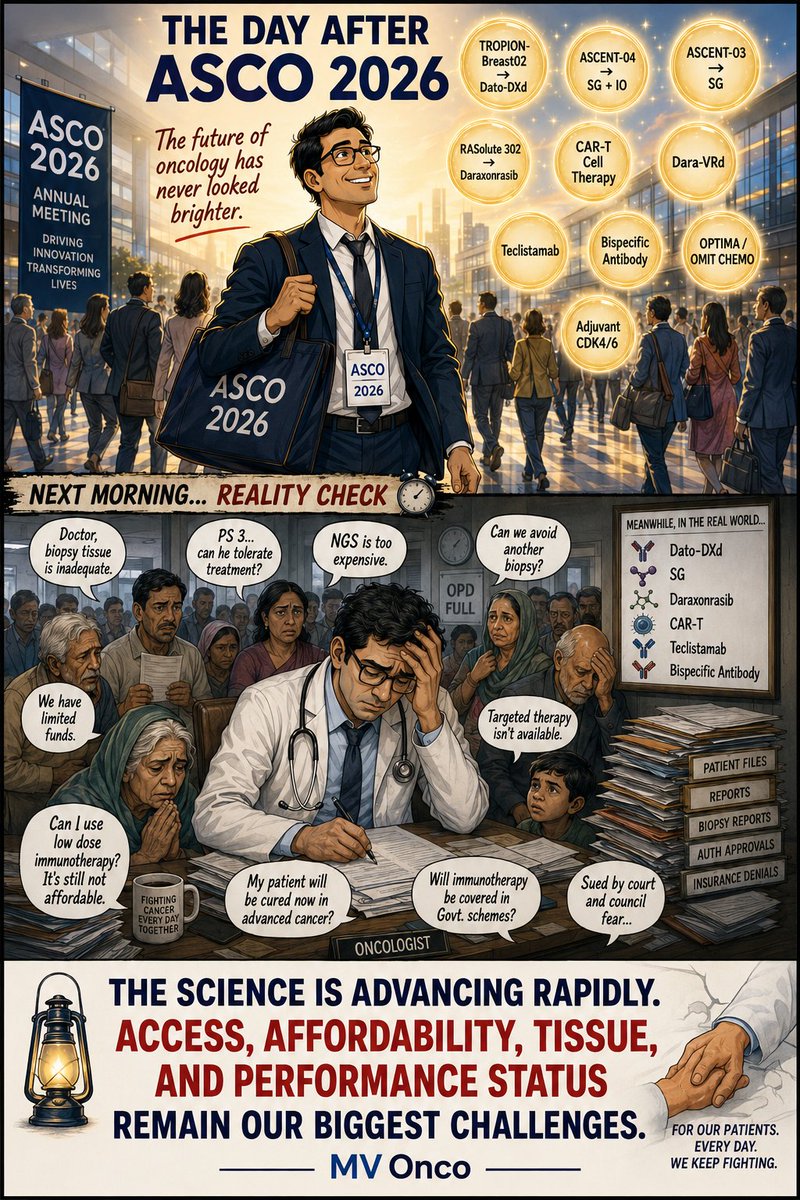
ASCO 2026 gave us Dato-DXd, SG, Daraxonrasib, CAR-T, bispecific antibodies, and many reasons for optimism. The next morning in clinic, the questions are often different: • Is the biopsy adequate? • Can the patient tolerate treatment? • Can they afford NGS? • Will immunotherapy be covered? • Is the drug even available? Science is moving faster than ever. Access, affordability, tissue adequacy, and performance status remain some of the biggest challenges in oncology. #ASCO2026 #Oncology #CancerCare #MVOnco
MV Chandrakanth tweet media
English
3
27
65
2.9K
Prasad Kodukulla retweetledi
MV Chandrakanth
MV Chandrakanth@ChandrakanthMv·
DRIVER-MUTATED ADVANCED NSCLC #ASCO2026 Three landmark trials. One clear message. 🟢 CROWN: 7-year PFS 55% in 1L ALK+ NSCLC 🔵 WU-KONG28: Targeted therapy era begins for EGFR Ex20ins disease 🟢 CHRYSALIS-2: Median OS 41 months in atypical EGFR NSCLC 🧬 Test early 🎯 Treat precisely 🧠 Protect the brain ⏳ Think in years, not months Driver testing is no longer optional—it helps define the patient's future. #LungCancer #NSCLC #ThoracicOncology #PrecisionOncology #ASCO2026 #MVOnco
MV Chandrakanth tweet media
English
1
17
26
1.8K
Prasad Kodukulla retweetledi
MV Chandrakanth
MV Chandrakanth@ChandrakanthMv·
OPTIMA Trial #ASCO2026 One of the most important lessons from ASCO 2026: Clinical high risk ≠ Genomic high risk. Among patients with clinically high-risk ER+/HER2− early breast cancer, 68% had low genomic risk (ROR ≤60). A PAM50-guided treatment strategy substantially reduced chemotherapy use while preserving outcomes: 📊 5-year IBCFS: 90.4% vs 91.5% 📊 HR 0.99 (Non-inferior) Key takeaway: 🧬 Biology and clinical risk are not the same. 💉 Less chemotherapy is possible for many patients. ✅ Outcomes remained preserved. Stein et al. #ASCO2026 #BreastCancer #Oncology #PrecisionOncology #MedTwitter #MVOnco
MV Chandrakanth tweet media
English
0
27
69
3.9K
Prasad Kodukulla retweetledi
Chrome
Chrome@0xchromium·
Andrej Karpathy spent 2h showing how he actually uses AI day to day he's a co-founder of OpenAI and led AI at Tesla, so when he shows how he works, it’s worth watching and the whole session is just him telling the machine what he wants in simple terms, like he's briefing a coworker watch what's actually happening the entire time: > he describes the task in normal words > it goes off and does the work > he glances at the result and nudges it with one more sentence that's the whole skill, and you've had it since you learned to talk the only gap between that and a worker that runs on its own is handing that sentence a schedule and the tools to act check his work, then build the version that keeps working when you stop
Chrome@0xchromium

x.com/i/article/2061…

English
128
1.3K
10.7K
1.8M
Prasad Kodukulla retweetledi
Prajwal Tomar
Prajwal Tomar@PrajwalTomar_·
I still don't think people understand what just happened with Claude Design. Claude Design can now take you from rough idea to fully responsive, high-fidelity website design in 10 minutes. Most builders are skipping Steps 1-3 and blaming the tool when results look generic. This 4-step workflow gets you professional designs on the first pass: (full breakdown in the article)
Prajwal Tomar@PrajwalTomar_

x.com/i/article/2056…

English
37
94
1K
283.1K
Prasad Kodukulla retweetledi
Avid
Avid@Av1dlive·
Cursor pays engineers $1,100,000 a year to run teams of AI agents that ship code while they sleep. [The CEO of Cursor explained in 9 minutes how they ship at 100x speed using team of agents] ↓ Save this before everyone copies the playbook 1. Engineers no longer babysit one assistant. They manage dozens of agent colleagues working in parallel, each on its own remote machine 2. Validation contract before code, not after. Humans only at scoping and review. 3. The agent team handles the full loop : planning, coding, testing, shipping PRs with each agent specialised for a role. Watch the guide. Then read the guide below by @eng_khairallah1
Khairallah AL-Awady@eng_khairallah1

x.com/i/article/2054…

English
98
217
2.5K
635.5K