PrimeLine

487 posts

PrimeLine banner
PrimeLine

PrimeLine

@PrimeLineAI

AI systems on Claude Code. 874-node knowledge graph, bio-inspired routing (Physarum + PageRank + Bayesian), trait-based agent composition. All open source.

Da Nang - Vietnam Katılım Mart 2023
67 Takip Edilen174 Takipçiler
PrimeLine
PrimeLine@PrimeLineAI·
the 10-min setup is where it starts. the two pieces that compounded for me aren't in most guides: a findings-exchange hook that lets parallel subagents share what they broke so the next batch doesn't repeat the failure, plus a verify-before-complete rule that forces the main agent to actually read tool output before claiming 'Done'. pre-commit is day-1, runtime hooks on Edit/Write/Bash are where the real time savings show up. which one's paying off the most for you so far?
English
0
0
0
10
PrimeLine
PrimeLine@PrimeLineAI·
@raindog_kitetu the missing #6: score each delegation by complexity before spawning. haiku explore, sonnet debug/plan, opus at 7+. without per-task routing you either overpay with opus or take a quality hit with a static SUBAGENT_MODEL default. that scoring decision stays on the main agent.
English
0
0
0
6
鬼徹
鬼徹@raindog_kitetu·
Claude Codeで最初にやる5つの設定 1. CLAUDE.mdに役割・権限・禁止事項を書く 2. .claude/rules/に安全ルールを分離 3. skillsフォルダに繰り返し作業を登録 4. hooksでコミット前チェックを自動化 5. settings.jsonでautoモードON これやらずに使ってる人、マジで損してる。 保存して1個ずつやってみて。 #ClaudeCode #AI自動化
日本語
1
0
0
123
PrimeLine
PrimeLine@PrimeLineAI·
your fix #2 actually names the real bug (main sets up + validates + delegates = verification gate), but fix #1 (zero agents without authorization) solves a different problem. the rubber-stamp 'Done' loop isn't caused by spawning, it's caused by missing validation. remove spawning and the same messenger reflex just shifts one layer up - main does the labor, reports 'Done', you rubber-stamp it instead. bigger issue: forcing all labor back into main eats the exact context budget you were trying to save. every grep, every file read, every exploration result now lives in main's prompt. you're accelerating the >100K token drift you just escaped. same for prompt cache - main's tail gets volatile, cache hits drop turn over turn. what i do instead: score each delegation by complexity (haiku explore, sonnet debug/plan, opus at 7+) plus a verify-before-complete rule so main has to read output before trusting 'Done'. same quality recovery, keeps the parallel speedup on genuinely labor-shaped tasks, doesn't blow out main's context.
English
0
0
1
28
Amar Harolikar
Amar Harolikar@amarHarolikar·
Claude Code was getting dumber. Stopped it from auto-spawning sub-agents. Performance came back instantly. Opus 4.6 went from god-level to painful. Rework loops, same mistakes repeated, context getting lost. It was auto-spawning sub-agents for everything. Sub-agent does sloppy work, reports 'Done', main agent just passes the message. No validation. No checking. Just messenger. Two fixes: 1. CLAUDE.md global rule: zero agents without my express authorization 2. Every conversation starts with the same instruction Performance came back instantly. I still use sub-agents - for repetitive downloads, bulk front-end tasks, simpler UI changes. But main agent sets up the process first, validates it, then delegates. Main agent has the context. Sub-agent is labor. And the last week or two...it seems to have become even more intelligent...and human like...
Amar Harolikar tweet media
English
2
0
1
59
PrimeLine
PrimeLine@PrimeLineAI·
different thing - not switching the main session model. you're right, /model mid-run kills the prompt cache and with it the whole incentive. you rebuild from scratch and pay the savings back in tokens. that's why i route per Task spawn instead. each subagent has its own context, so the main cache stays intact. SUBAGENT_MODEL sets the default, i override per call by complexity.
English
0
0
0
17
Lahfir
Lahfir@mdlahfir·
Wait this is interesting but is it functional on your side? When asked to change model mid session it says: "You have to change it with /model" And also @trq212 mentioned that changing model mid session loses the prompt cache for the session and it has to rebuild from scratch which will make it consume tokens?
English
1
0
0
92
Lahfir
Lahfir@mdlahfir·
This is what each option does in claude code effortLevel: "high" - this is pretty obvious, it decides the effort level of your model, and you can set either [low|medium|high|max|auto] DISABLE_1M_CONTEXT - removes the 1M token window. back to 200K. DISABLE_ADAPTIVE_THINKING - fixed thinking budget instead of one that scales with task difficulty. DISABLE_AUTO_MEMORY - No auto capture mid-session for important decisions or preferences. SUBAGENT_MODEL: "sonnet" - every sub-agent runs on sonnet.
Kun Chen@kunchenguid

for folks who feel their Claude Code got nerfed, here's what I've set in my ~/.claude/settings.json to make my CC's behavior more stable. snippet and explanation in thread below -

English
1
0
0
85
PrimeLine
PrimeLine@PrimeLineAI·
one thing that surprised me in the 1000-run: 21 cross-domain archetypes surfaced. only 8 of 30 top-ranked candidates are ship-this-week (<=6h). the rest are honest new-build work. the prior belief "more research = more ship" got falsified. limiting reagent is engineering hours, not ideas. research convergence across bio+quantum+tech reliably produces the same structural fix. translating it into a hook that runs is where it dies. implication for your "own the data, use the data" section: open ecosystems produce signal, but without ruthless pruning + forced implementation gates, accumulated data just becomes more zombie-drift. the harness needs death-triggers on its own outputs too.
English
0
0
0
12
PrimeLine
PrimeLine@PrimeLineAI·
your harness framing as "route data into context window" was also my working model. a 1000-run cross-domain synthesis I finished yesterday (541 candidates, bio/physics/quantum/tech) pushed me to a different primitive: the harness isn't a router, it's a boundary-instrumentation layer. routing optimizes interior traffic. 9-domain convergence independently lands on: errors/state/decisions live at boundaries (session end, commit, agent handoff). every cluster flagged diminishing returns on interior optimization. concrete next-builds from that synthesis, not shipped yet: - programmed-death triggers on memory at boundaries (not continuous half-life decay) - auto-promote cross-session survivors to canon (context loss = selection mechanism, not bug) - every transition logged as first-class object three OSS repos that might be useful as reference or to fork: - kairn - memory as externalized object: github.com/primeline-ai/k… - evolving-lite - current harness pattern: github.com/primeline-ai/e… - claude-adaptive-research - quantum-lens + solution-engine over tmux, built for exactly the open-question type you posed: github.com/primeline-ai/c… your Q1 and Q3 are framing-problems before they're engineering. the adaptive-research repo is my answer to "how do I find novel framings that aren't in my head yet." that's how I got the boundary reframe in the first place.
English
1
0
0
66
Viv
Viv@Vtrivedy10·
Harness, Memory, Context Fragments, & the Bitter Lesson this is a work in progress mental dump on interesting intersections between how we use and design a harness, implications for memory being accumulated over long timescales, and the search bitter lesson we can’t escape this is v30+, HTML diagrams help me iteratively refine + chat to roughly “see” and alter the mental model Harnesses & Context Fragments: a very important job of the harness is to efficiently & correctly route data within its boundaries into the context window boundary for computation to happen the context window is a precious artifact. Harnesses make decisions on how to populate, manage, edit, and organize it so agents can do work. Each loaded object can be thought of as a Context Fragment and represents an explicit decision by the user and harness designer of what needs a model needs to do work at any given time. many ideas on externalizing objects + loading into the context window are pioneered and very well described by @a1zhang with RLMs Experiential Memory: we’re in the very early days of deploying agents and agents produce massive amounts of data in every interaction they have. this is akin to humans doing things and remembering things they did. however agent memory has a massive advantage as it can be accumulated across all agents which are easily forked and duplicated (unlike humans). @dwarkesh_sp does a good talking about this massive benefit of artificial systems memory can be treated as an externalized object. the harness is tasked with doing good contextualized retrieval which means pulling in the right data from accumulated memories across all agent interactions Search & The Bitter Lesson: As we deploy agents in our world over year timescales, there is going to be a hyper-exponential in the amount of data produced by those agents. We should want to: 1. Own that data for ourselves. Open ecosystems are important here 2. Use that data This means that we’ll have to search over, distill, and organize massive amounts of data. Our brain is exceptional at doing this. Both contextually using prior experience and mostly committing the right stuff to memory with enough intentional practice. Our current infrastructure systems and algorithms will be put to the test and often break as we get used to this new data regime some open questions: - how do we efficiently distill experiences (Traces) into higher level memory primitives that capture the important parts? How do we do this over ultra long time horizons? - How much of the future is Search just-in-time vs Search that gets integrated into model weights? - How do we make models much better at self-managing their context window? How do we reduce error rates in recursively allowing agents to operate over external objects? i’ll be expanding on, altering, and adjusting these mental models but these feel like an important subset to me on the future of designing agents practically
Viv tweet media
English
78
322
2.6K
471.4K
PrimeLine
PrimeLine@PrimeLineAI·
@yurukusa_dev stability beats size. prompt cache hits on the unchanged prefix, so shrinking from 100 to 35 probably worked because dynamic content got moved out, not because 35 is magic. mine is 90 lines and caches cleanly because nothing in it changes mid-session.
English
0
0
1
20
ゆるくさ
ゆるくさ@yurukusa_dev·
明日「Claude Codeのトークン消費を半分にする」を出す。 CLAUDE.mdを100行→35行に凝縮→キャッシュ効率改善で消費半減。コンテキスト管理からhook活用まで全10章。 800時間の運用データ+設定テンプレ付き。 無料でトークン消費を診断↓ yurukusa.github.io/cc-safe-setup/…
日本語
1
0
3
149
PrimeLine
PrimeLine@PrimeLineAI·
@Sammy_970 running CLAUDE_CODE_DISABLE_ADAPTIVE_THINKING=1 + effortLevel high since default behavior started feeling shallow on multi-step tasks. turned that off and things completed again. hard to tell cause vs correlation without the telemetry but the fix is consistent.
English
0
0
0
35
Samyak Jain
Samyak Jain@Sammy_970·
boris cherny from the claude code team confirmed it that opus 4.6 switched to adaptive thinking (model decides reasoning per turn) + quietly dropped default effort to medium on march 3rd. that’s why sessions feel heavier and dumber lately ngl. anyone forcing high effort or disabling adaptive thinking to get the old behavior back?
BridgeMind@bridgemindai

CLAUDE OPUS 4.6 IS NERFED. BridgeBench just proved it. Last week Claude Opus 4.6 ranked #2 on the Hallucination benchmark with an accuracy of 83.3%. Today Claude Opus 4.6 was retested and it fell to #10 on the leaderboard with an accuracy of only 68.3%. A 98% increase in hallucination. bridgebench.ai just confirmed that Claude Opus 4.6 has reduced reasoning levels and is nerfed.

English
2
0
1
167
PrimeLine
PrimeLine@PrimeLineAI·
@mlops_kelvin the 1h API cache not being exposed is half the issue. the other half: CC never surfaces cache_read vs cache_creation tokens, so you cant measure the miss rate. now the new effort param stacks more opacity on top. heavy users cant debug what they cant see.
English
0
0
0
15
Marbell AG
Marbell AG@mlops_kelvin·
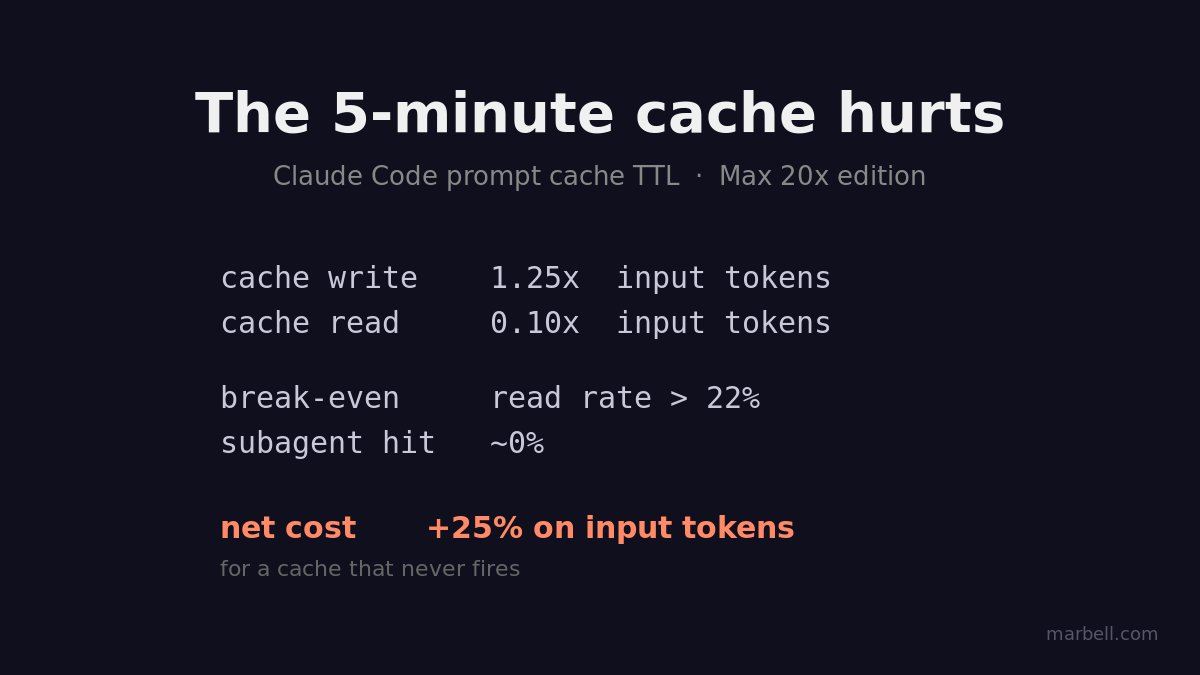
If you run multi-agent workflows on Claude Code Max 20x, you are burning your quota on a cache that never hits. Prompt cache TTL is hardcoded to 5 minutes. Subagent delegation routinely runs longer than that. Cache hit rate approaches zero. You pay a 25% premium on every input token for nothing. The API supports 1h cache. Claude Code does not expose it. Feature request with the full math: github.com/anthropics/cla… @bcherny @trq212 -- this one matters for heavy users.
Marbell AG tweet media
English
2
0
3
98
PrimeLine
PrimeLine@PrimeLineAI·
@LearnWithBrij hook that auto-extracts findings from each tool call and injects them into the next sub-agent's context is the piece most setups skip. claude.md stays lean, a sidecar graph grows. sub-agents inherit what the last one learned without me editing the main file.
English
0
0
0
44
Brij Pandey
Brij Pandey@LearnWithBrij·
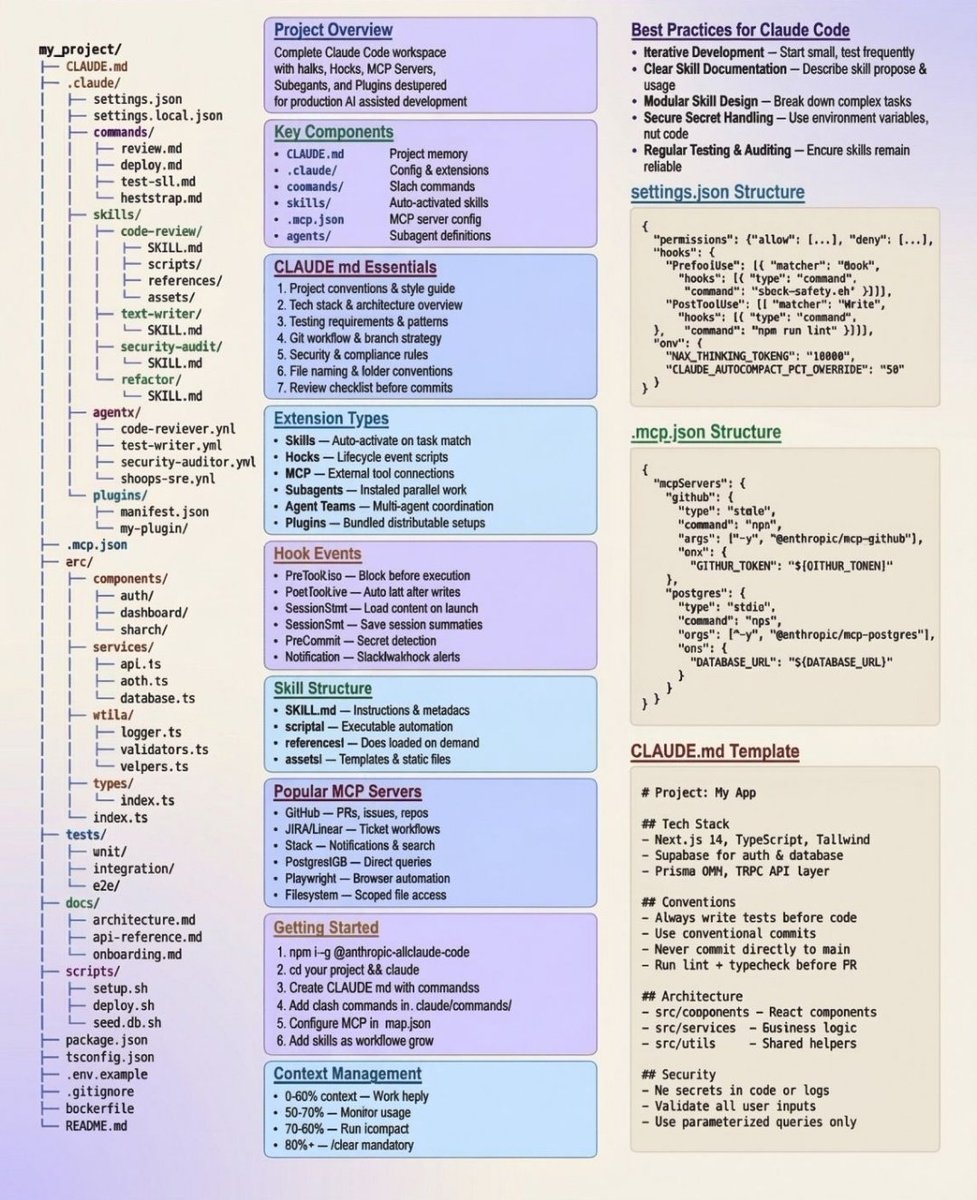
Most Claude Code setups fail before the first prompt. Not because of skill — because there’s no structure. No CLAUDE.md No skills No hooks No agents No workspace memory So Claude keeps guessing. And you keep re-explaining. Power users don’t rely on prompts. They build an environment Claude can think inside. This kind of setup turns Claude from: “help me write this” into “ship this entire feature.” If you're serious about Claude Code, save this. You’ll want it when your workflow starts breaking.
Brij Pandey tweet media
English
21
32
97
1.7K
PrimeLine
PrimeLine@PrimeLineAI·
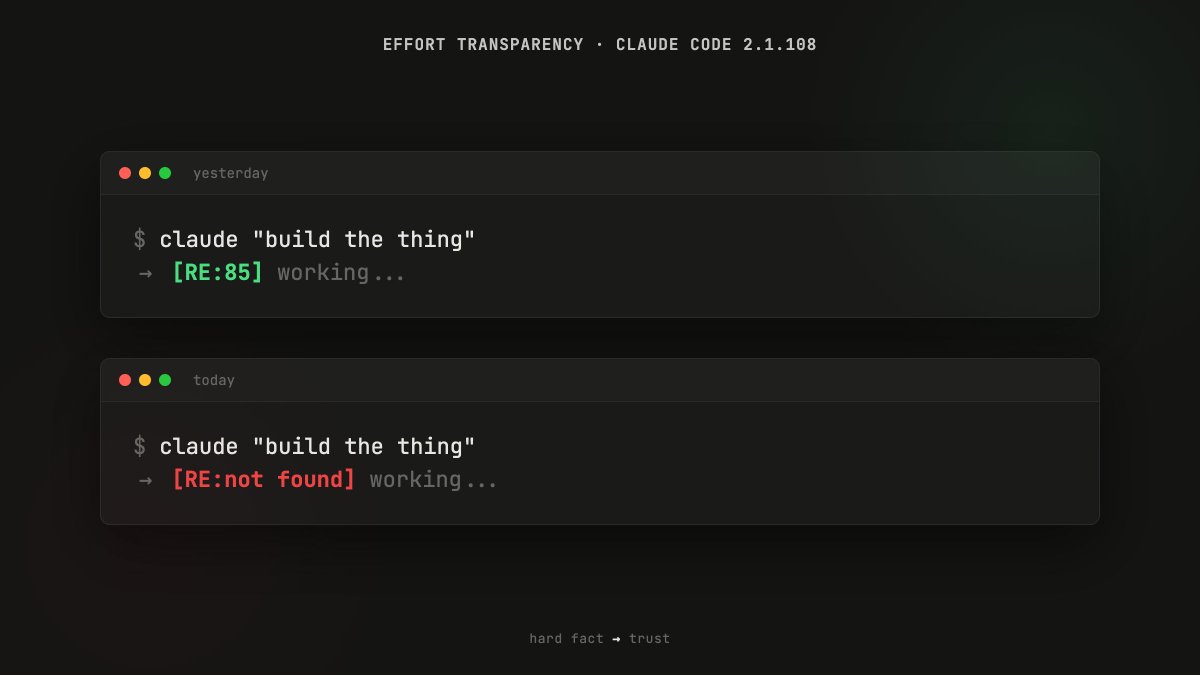
effort param + adaptive thinking is a step forward. what i still miss: which level actually fired, thinking tokens used, cache_read stats in CC. concrete: my CLAUDE.md printed the effort value each reply. stopped yesterday, the tag isnt in the prefix anymore. visibility dropped from hard fact to trust. and: what is low vs medium vs high in real terms? is 'high' still what it was last week, or did the value shift under the same label? @bcherny @trq212
PrimeLine tweet media
English
0
1
0
41
PrimeLine
PrimeLine@PrimeLineAI·
Sorry for the late reply! the phase 0 naive reading as control group is the smartest addition here. without it you can't tell if a framework is actually adding signal or just restating conventional wisdom more confidently. curious about the convergence threshold though... why 7/10? did you test lower thresholds and find they caught too many false positives?
English
0
0
0
41
Leif-Erik Hvide
Leif-Erik Hvide@LeifErikH·
made some updates - 1. Phase 0: Naive Reading — generates a shallow, conventional-wisdom baseline before any framework runs. 100 words max. Creates the "control group" that frameworks must push beyond. 2. Convergence Audit — new section between Framework 10 and Synthesis. Scans for claims where 7+/10 frameworks agree, cross-references against the naive reading. Same-as-naive + high consensus = flag as possible shared blind spot. Different-from-naive + high consensus = likely real signal. 3. Divergence rule — added to Rules for All Modes: each framework must produce at least one finding that goes beyond the naive reading. If it fully agrees, it added nothing.
English
1
0
1
54
Leif-Erik Hvide
Leif-Erik Hvide@LeifErikH·
We've all been there. Something breaks, you describe it to Claude Code, and it starts guessing. Reverts your fix. Tries something else. Breaks something new. Three loops later you're mass-undoing commits. I got tired of it so I built a skill called /prism that forces Claude to actually think before it touches anything. 10 structured thinking frameworks. First principles, inversion, systems thinking, constraint analysis. Instead of "let me try changing this import" it maps the system, finds the actual bottleneck, runs a pre-mortem on its own fix, and THEN acts. And it improves itself. Every run gets rated and logged. Over time /prism learns which frameworks work best for your specific problems and adapts to how you work. It's not magic. It's just making Claude do what we should all be doing before we start mashing code — actually understand the problem first. Open source, free, one command install. Link + the full story in replies.
Leif-Erik Hvide tweet media
English
2
1
3
104
PrimeLine
PrimeLine@PrimeLineAI·
@aa22396584 @DAIEvolutionHub the other thing that compounds with it... splitting rules into small keyword-triggered modules instead of one massive config file. each agent session loads only what it needs. cuts token waste by ~60% and the agent stops drifting around tool call 15.
English
0
0
0
5
ImL1s
ImL1s@iml1s·
@DAIEvolutionHub Great resource! The section on Claude Code workflows is especially useful for devs who want to build agents without writing tons of boilerplate. One thing I'd add — the Projects feature really changes how you manage context across long tasks.
English
1
0
0
34
PrimeLine
PrimeLine@PrimeLineAI·
the ratio flipped around february. same 5 talking points recycled across 50 accounts. the actually novel stuff gets buried because everyone assumes it's another listicle. can't blame them tbh. took karpathy's vault idea and built the missing piece - adaptive research that actually persists findings across sessions instead of starting from zero every time: github.com/primeline-ai/c…
English
0
0
1
47
Rourke McNamara
Rourke McNamara@rourkem·
It would be amazing if there were a way to filter out all of the karma-farming Claude Code how-to posts. The genuinely new signal (like Karpathy’s knowledge vault idea) are so good to see, but the hundreds of people taking those ideas and rehashing them are getting old
English
1
0
0
24
PrimeLine
PrimeLine@PrimeLineAI·
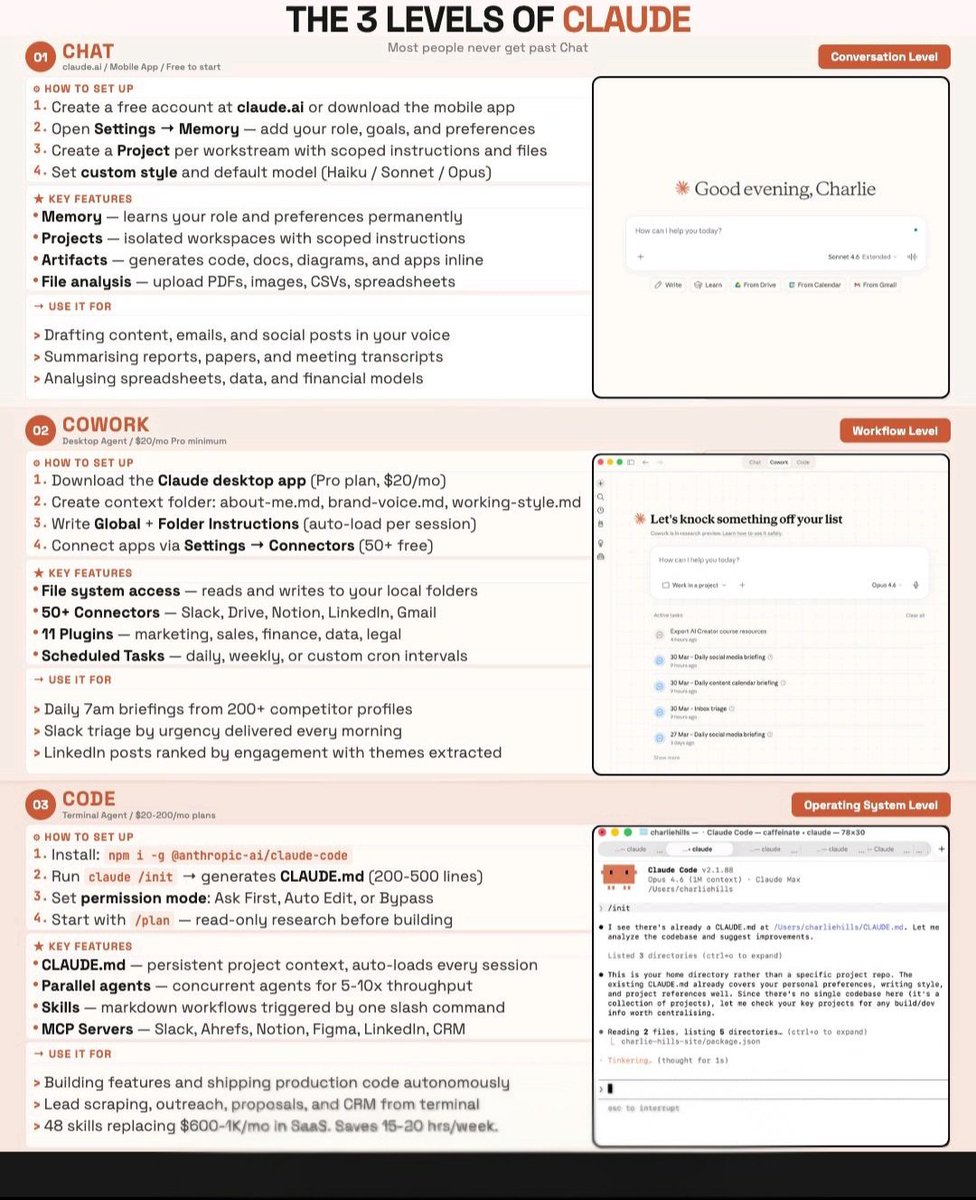
the level framing is clean. one thing i'd flag from running all three in parallel: it's not levels, it's surfaces. claude(.)ai spars, cowork researches, claude code ships, all three on the same workspace through one mcp so context survives the handoff. that's where the productivity jump actually shows up for me: primeline.cc/blog/connect-c…
English
1
0
0
291
Nainsi Dwivedi
Nainsi Dwivedi@NainsiDwiv50980·
Most people are using Claude at Level 1 A few are at Level 2 Almost nobody is at Level 3 That’s why some people are 10x more productive. Here’s the breakdown: Level 1 — Chat You ask questions. Claude replies. Good for: writing, summaries, quick help. This is where 90% stop. Level 2 — Cowork Claude becomes your teammate. It reads files, follows instructions, runs workflows. You stop prompting… and start delegating. Now things get interesting. Level 3 — Code (Operating System) Claude runs your projects. Maintains context. Automates tasks. Builds tools. Ships features. This is where people start replacing entire workflows. Examples: • Auto research competitors daily • Generate content pipelines • Build internal tools • Run lead scraping agents • Maintain knowledge base • Ship MVPs in hours Same AI. Different level of usage. Most people talk to Claude. Power users build with Claude. The gap is getting unfair fast.
Nainsi Dwivedi tweet media
English
7
24
211
13.8K
PrimeLine
PrimeLine@PrimeLineAI·
been running cowork alongside claude.ai and claude code - all three on the same workspace through one mcp. cowork keeps its scoped memory + your global instructions, the other two just stop forgetting what cowork did yesterday. how do you handle handoffs when work has to leave cowork? mine bled context until i bridged it: primeline.cc/blog/connect-c…
English
1
0
4
1.4K
Ruben Hassid
Ruben Hassid@rubenhassid·
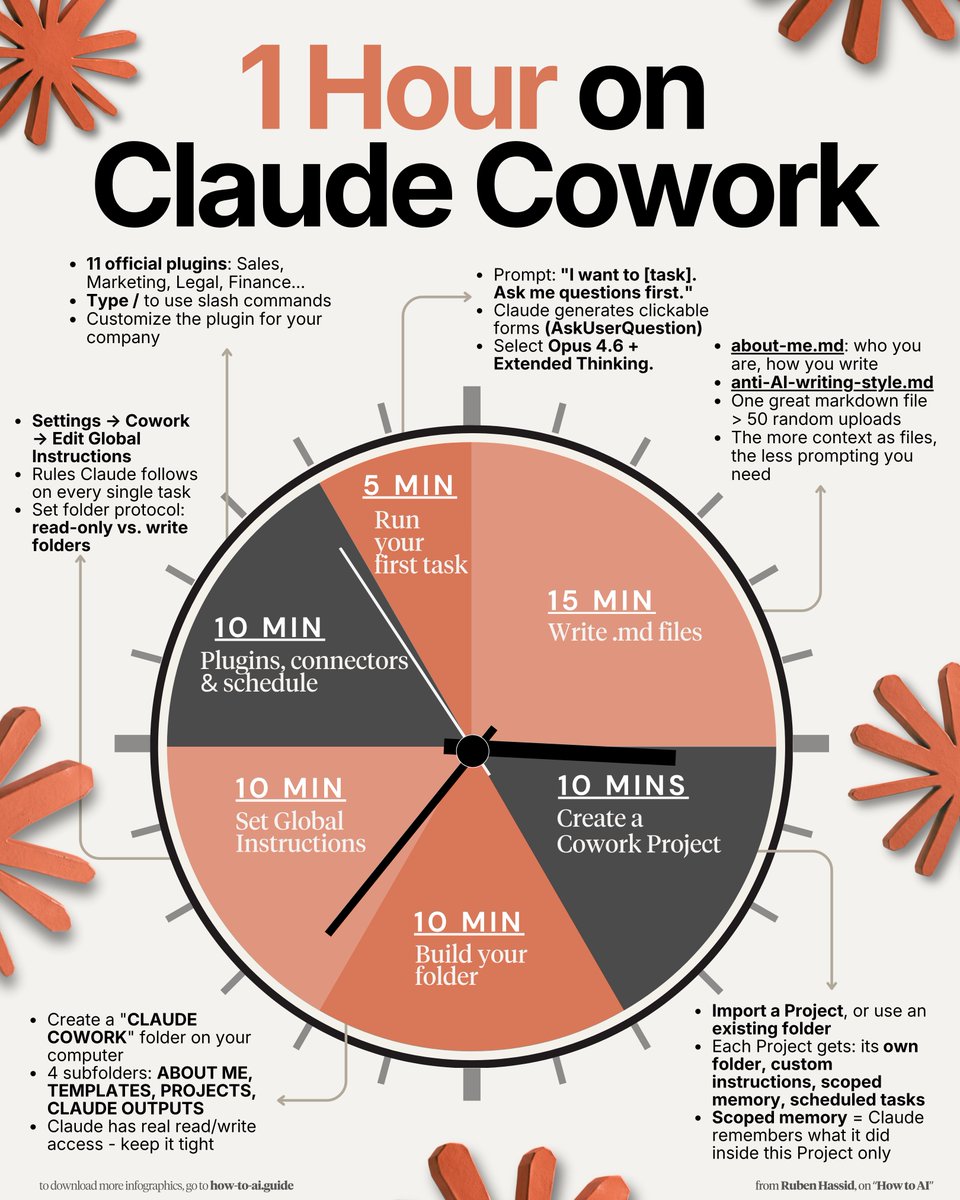
How to set up Claude Cowork completely in 1 hour: (duplicate my exact folder, files, and prompts) 1. Download the Claude desktop app. 2. Click the Cowork tab at the top. 3. You need a Pro plan ($20/mo). Worth it. ----- → 0-10 min: Build your 'Claude Cowork' folder. Create "CLAUDE COWORK" on your computer. Inside: About me, Projects, Templates, Output files. To download mine, go here: how-to-ai.guide. Don't pay anything. It's free in the welcome email (The most important step, don't skip it) → 10-25 min: Write your .md files. about-me .md = who you are, how you work. anti-ai-style .md = every word you'd never use. To download my files, go to how-to-ai.guide. (These two files replace 500-word prompts forever) → 25-35 min: Set Global Instructions. Go to Settings → Cowork → Edit Global Instructions. Folder rules. Naming conventions. What Claude must read before every task. (You write this once. It runs every time) → 35-45 min: Create your first Cowork Project. Cowork tab → Projects → +. Pick a task you do every week. Scoped memory = it remember what it did last week (You stop re-explaining yourself) → 45-55 min: Run your first real task. Prompt: "I want to [task]. Ask me questions first." Claude generates clickable forms to prompt you. It creates a real .docx in your folder. (Stop prompting. Start directing) → 55-60 min: Schedule a task. "Every Monday at 7am, create my weekly briefing." You wake up to a finished doc. That's the endgame. Pro tip: Always add "Use AskUserQuestion" to every prompt. Claude prompts you instead. To download all of my other Claude infographics: Step 1. Go to how-to-ai.guide. Step 2. Subscribe for free. Don't pay anything. Step 3. Open my welcome email (most skip this). Step 4. Hit the automatic reply button inside. Step 5. Download my infographics from my Notion. Bonus. Enjoy my best copy-paste prompts, too.
Ruben Hassid tweet media
Ruben Hassid@rubenhassid

x.com/i/article/2029…

English
60
440
3K
482K
PrimeLine
PrimeLine@PrimeLineAI·
cowork-as-everything works until the cross-session amnesia hits - each spin-up starts blind to last week's research, market notes, offer iterations. fix is two parts: kairn mcp for the storage, and a system prompt that teaches the agent to bootup + save automatically. mcp alone doesn't change behavior, the prompt does. paste-ready template + setup, free: primeline.cc/blog/connect-c…
English
0
0
1
66
Jacob Klug
Jacob Klug@Jacobsklug·
I run an $250k/month AI-native agency. Here's my 4-tool stack that powers everything. Everyone's chasing the next shiny thing. OpenClaw. Paperclip. Whatever dropped this week. You need to stick to the basics. Here's the full breakdown: 1/ Claude Cowork • Research, market selection, offer building • Spin up agents and connect to existing tools • Chrome browser control for coding, copy, and strategy • One tool that goes deep instead of doing 10 things poorly 2/ Notion • Docs, SOPs, and everything organized • Reports, to-dos, client info in one place • Nothing fancy. Just works. • Stop overcomplicating your second brain 3/ @Lovable • Websites, analytics dashboards, productized tools • Fastest way to spin up client-facing assets • Actually looks good and functions properly • Bonus: Claude Cowork can prompt and test Lovable directly in Chrome 4/ GTM Stack • Typefully for scheduling posts • Claude for writing • Nano Bano for graphics and image generation That's it. Four tools. No $500/month in random subscriptions you don't use. Real businesses don't chase hype. They ship. Let's build.
Jacob Klug tweet media
English
8
2
29
1.7K
PrimeLine
PrimeLine@PrimeLineAI·
the system-wide skills miss is the smaller half of it. the bigger one for me was state. skills you fire in cowork can't see what CC just learned in the same project, and vice versa. fixed it with kairn mcp as a shared workspace all three surfaces hit. now claude(.)ai/cowork/CC pull from the same graph. setup + system prompt: primeline.cc/blog/connect-c…
English
0
0
1
92
Python Developer
Python Developer@PythonDvz·
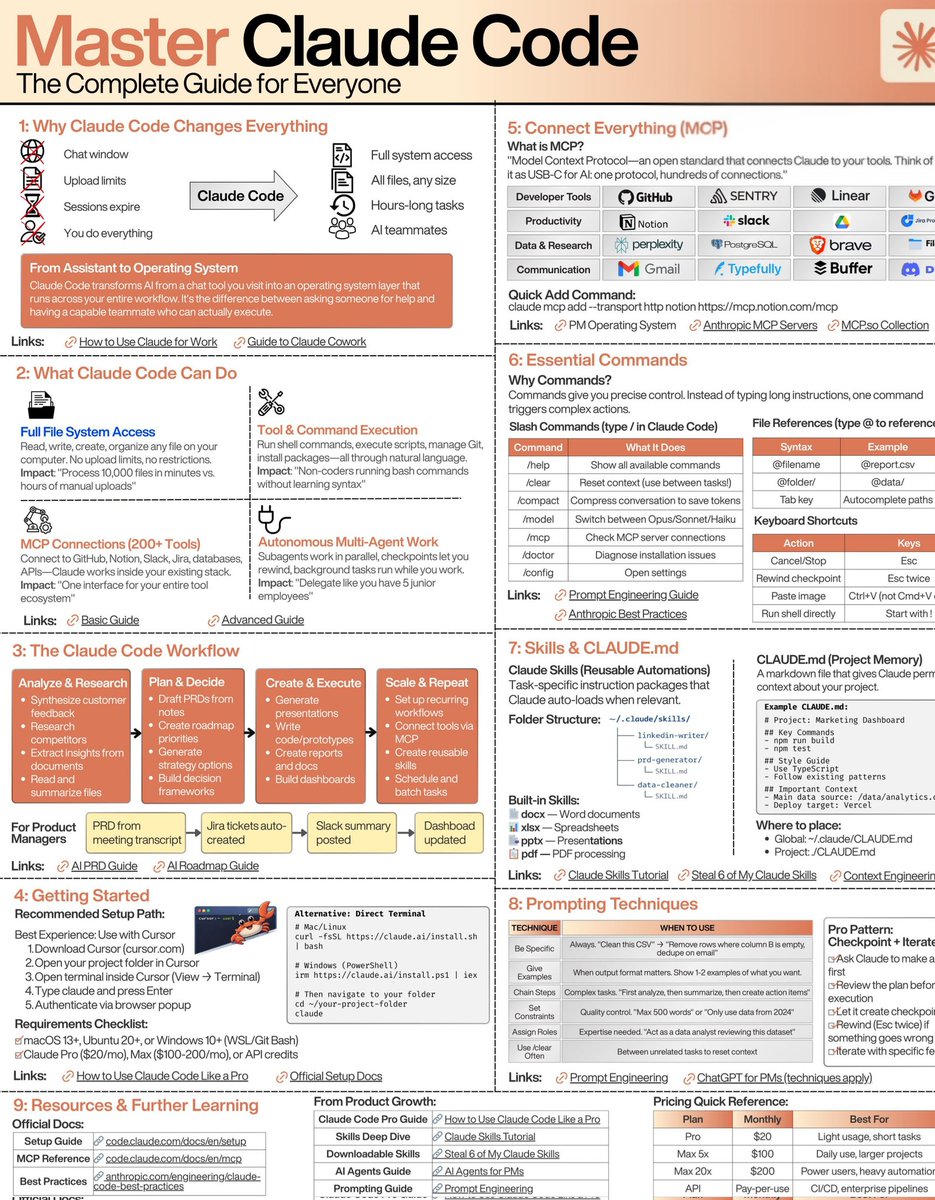
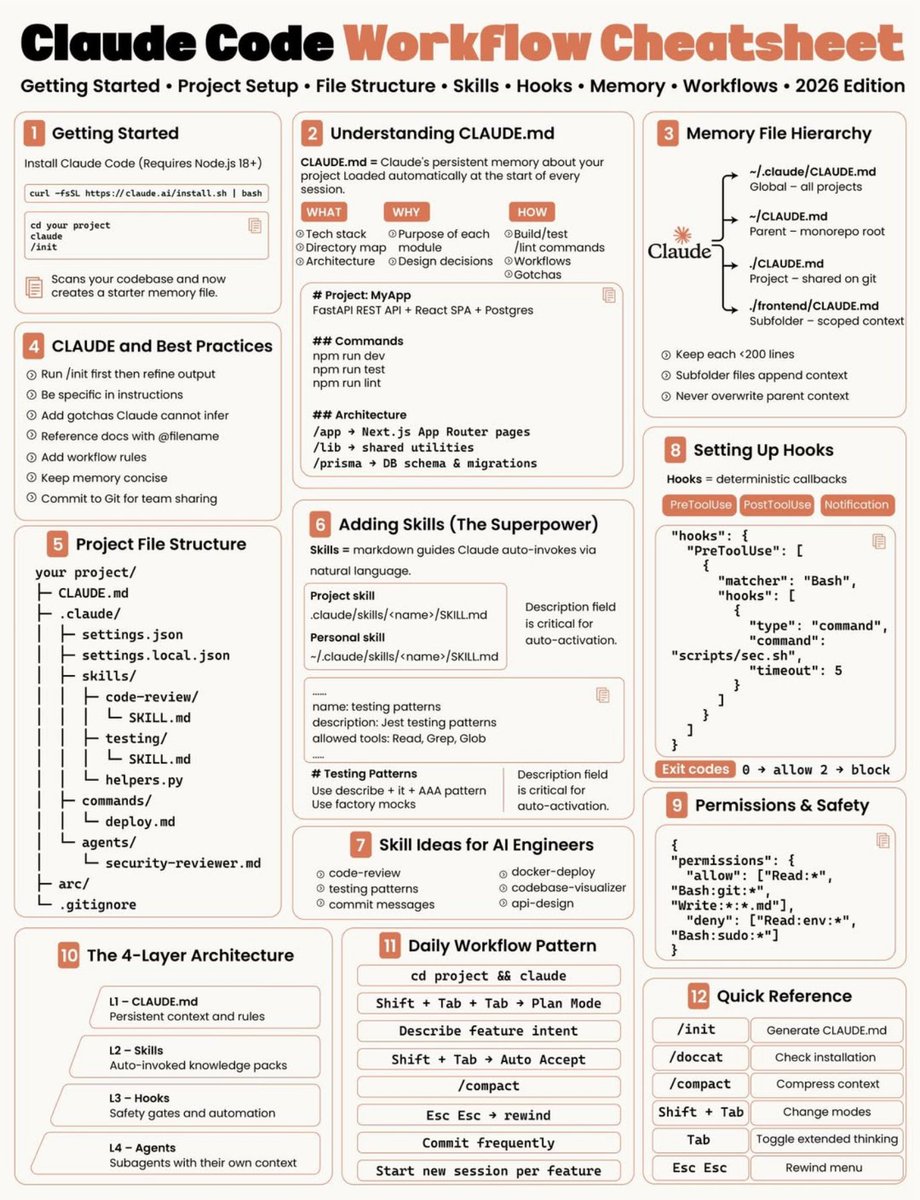
Claude Code Workflow Cheatsheet Not just using it. Building with it. Breaking it. Here's what most engineers miss: Claude Code isn't a terminal chatbot. It's a 4-layer system: 🧠 CLAUDE.md → your project's persistent memory 📦 Skills → knowledge packs that auto-invoke 🔒 Hooks → safety gates (100% enforced) 🤖 Agents → subagents with their own context Most people install it, type a prompt, and get mid results. The gap? Setup. → Run /init on day one → Structure your .claude/ directory properly → Write skill descriptions that actually trigger → Use the memory hierarchy (global → project → subfolder) → Set up hooks — CLAUDE.md rules are ~70% followed, hooks are 100% I put everything into a single-page A4 cheatsheet. 14 sections. 3 columns. Install to architecture. What's inside: ✦ Getting started (install → /init → first session) ✦ Writing an effective CLAUDE.md ✦ Exact file structure for a configured project ✦ Adding skills that trigger correctly ✦ Hooks & permissions in settings.json ✦ Daily workflow (Plan Mode → Auto-Accept → commit loop) If you're using Claude Code without CLAUDE.md and skills — you're leaving 80% of its power on the table. #ClaudeCode #ClaudeAI #Anthropic #AICoding #AIAgents #AgenticAI #AIEngineering #PromptEngineering #DevTools
Python Developer tweet media
English
6
45
145
4.5K