WooLLaaa
2.4K posts



WooLLaaa retweetledi

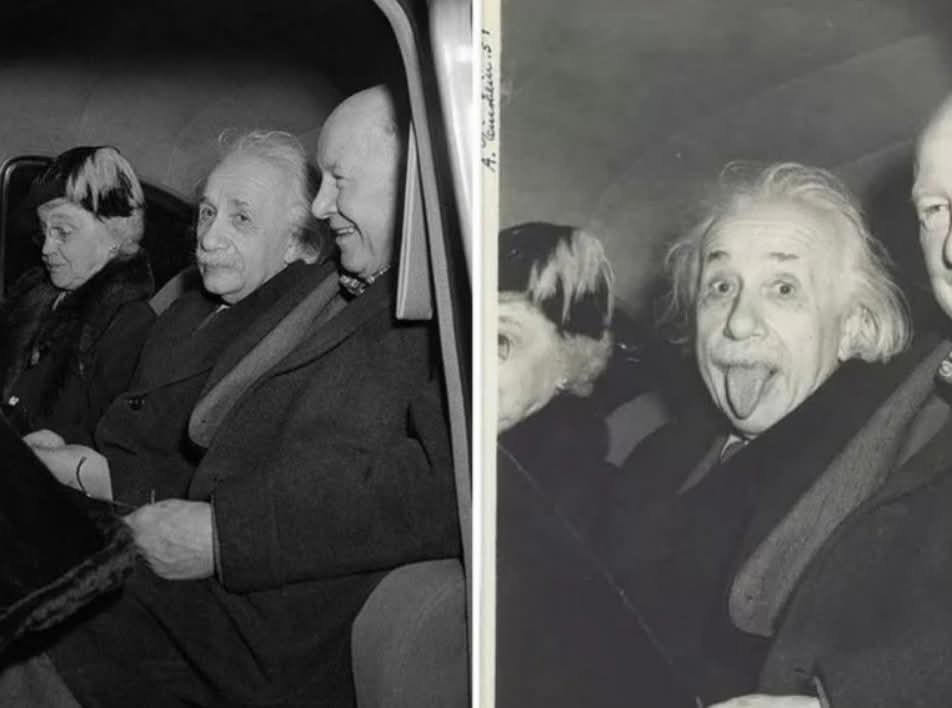
Albert Einstein before his iconic photo with his tongue out....
This moment comes from a sequence of photographs taken on March 14, 1951, the 72nd birthday of Albert Einstein, in Princeton, New Jersey. After a long day of celebrations at the Institute for Advanced Study, Einstein was seated in a car with friends, tired of posing for photographers who continued to call for “one more smile.”
Instead, he responded with something entirely unplanned, sticking out his tongue. The image was captured by photographer Arthur Sasse, who had the reflex to snap at exactly the right moment. Out of several frames taken that evening, this single shot became one of the most recognizable portraits in modern history.
Einstein liked the image so much that he later requested copies and even had it cropped to focus solely on his face, using it on personal greeting cards. It quietly reinforced his public persona: a brilliant mind paired with a playful disregard for convention.
By that point, Einstein had already reshaped physics with the Theory of Relativity, and had received the 1921 Nobel Prize in Physics (awarded in 1922) for his work on the photoelectric effect, not relativity.
The original uncropped photo includes two companions in the car, but Einstein preferred the tighter version, turning a spontaneous, slightly mischievous gesture into a lasting symbol of intellectual freedom and individuality.
© Historical Photos
#archaeohistories
English
WooLLaaa retweetledi

Joseph Stalin was born on December 18, 1878, in Gori, Georgia, then part of the Russian Empire, the only surviving child of a poor cobbler and his wife.
His father was an alcoholic who beat the family, and Stalin suffered smallpox scars and a permanently injured left arm from childhood accidents.
He enrolled at the Tiflis Theological Seminary in 1894 but abandoned religious studies after discovering Marxist literature, particularly the works of Karl Marx.
By 1899 he had left the seminary entirely and committed himself to underground revolutionary work, organizing strikes and demonstrations across the Caucasus.
He joined the Bolshevik faction led by Vladimir Lenin and funded the movement through bank robberies, extortion, and kidnapping for ransom, including a 1907 Tiflis stagecoach ambush that killed around 40 people.
He was arrested and exiled to Siberia multiple times but repeatedly escaped, adopting the alias "Stalin," meaning Man of Steel, derived from the Russian word for steel.
After the Bolsheviks seized power in the October Revolution of 1917, Stalin rose steadily through the party hierarchy, serving in key roles including People's Commissar for Nationalities and editor of the party newspaper Pravda.
Lenin appointed him General Secretary of the Communist Party in 1922, a position Stalin used to systematically place loyalists throughout the bureaucracy.
Following Lenin's death in January 1924, Stalin outmaneuvered rivals including Leon Trotsky, Zinoviev, and Kamenev to become the Soviet Union's undisputed leader by the late 1920s.
He launched a brutal program of forced agricultural collectivization beginning in 1929, stripping millions of peasants known as kulaks of their land and property.
His policies triggered a catastrophic famine from 1932 to 1933 that killed an estimated five to seven million people, including millions in Ukraine in what became known as the Holodomor.
Between 1936 and 1938 he orchestrated the Great Purge, a campaign of mass arrests and executions targeting party officials, military commanders, and ordinary citizens he perceived as enemies.
Over 700,000 people were shot during the purge, and an estimated 18 million people passed through the Gulag system of forced labor camps during his reign.
In 1939 Stalin signed the Molotov-Ribbentrop Pact with Nazi Germany, dividing Eastern Europe between the two powers and enabling the Soviet invasion of Poland.
When Germany invaded the Soviet Union in June 1941, Stalin initially was caught by surprise despite repeated intelligence warnings, but rallied to serve as Supreme Commander of the Red Army.
The Red Army absorbed catastrophic losses in the early years of the war before mounting a devastating counter-offensive that culminated in the capture of Berlin in April 1945.
Stalin attended the Tehran, Yalta, and Potsdam conferences alongside Churchill and Roosevelt, securing Soviet dominance over Eastern Europe in the post-war settlement.
The Soviet Union successfully tested its first atomic bomb in August 1949, cementing its status as a superpower and deepening the Cold War rivalry with the United States.
In his final years Stalin launched an antisemitic campaign that included show trials and the arrest of prominent Jewish doctors in what became known as the Doctors' Plot.
He died on March 5, 1953, following a stroke, and was succeeded by a collective leadership that included Georgy Malenkov and eventually Nikita Khrushchev.
Khrushchev denounced Stalin's cult of personality and mass repressions in his landmark 1956 Secret Speech, launching a period of de-Stalinization across the Soviet bloc.
Scholars estimate that Stalin's regime was directly or indirectly responsible for the deaths of millions of Soviet citizens through executions, famine, and the Gulag system.
#archaeohistories

English
🤬 A shocking scandal in Dnipro. A cadet took a photo next to the body of a deceased girl
Students from the local university of internal affairs were involved in the search for the 14-year-old teenager.
After the girl's body was found, In the picture, the young man is smiling.

English