David Cappelli | VecP Labs 🛡️🏗️

260 posts

David Cappelli | VecP Labs 🛡️🏗️ banner
David Cappelli | VecP Labs 🛡️🏗️

David Cappelli | VecP Labs 🛡️🏗️

@Proph37_

Conscience for AGI · Patent Pending 63/921,475 Filed Nov 20 2025 VecP Core · Patent Pending 63/931,565 Filed Dec 5 2025 [email protected]

Silver City NM Katılım Nisan 2014
130 Takip Edilen165 Takipçiler
David Cappelli | VecP Labs 🛡️🏗️
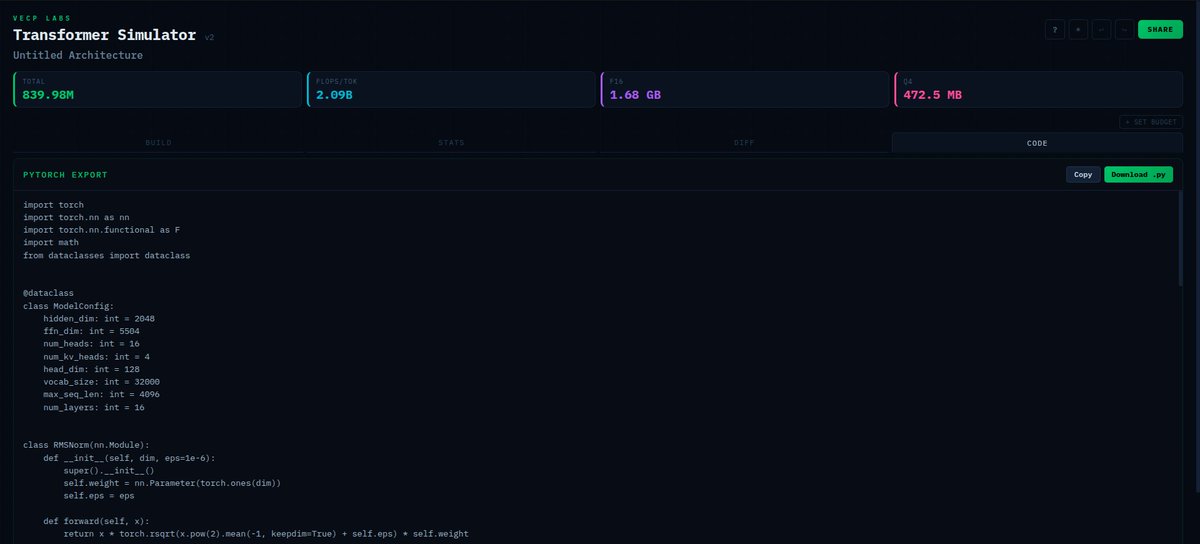
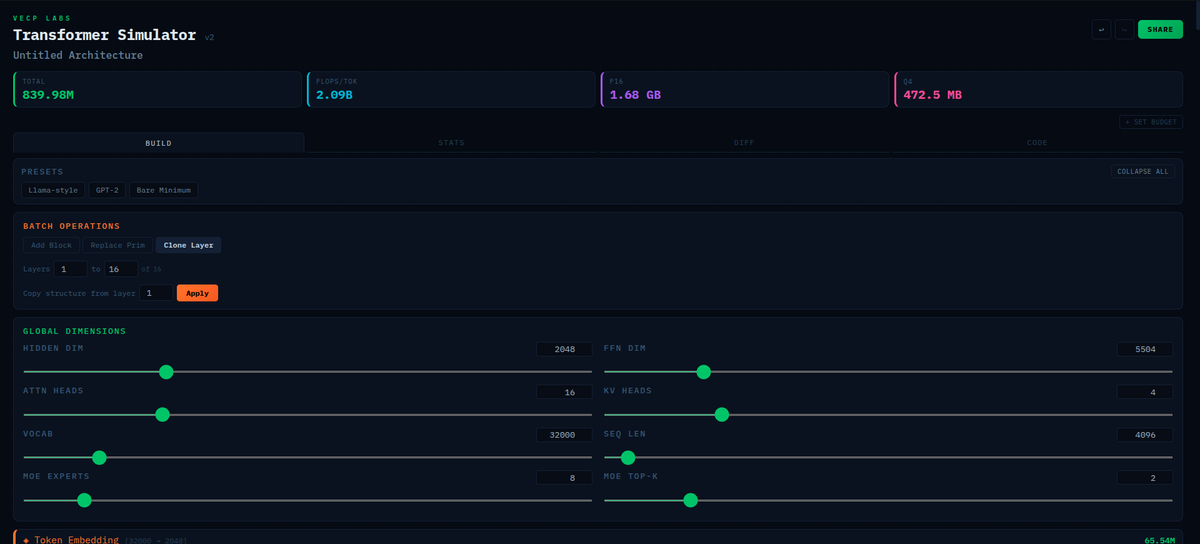
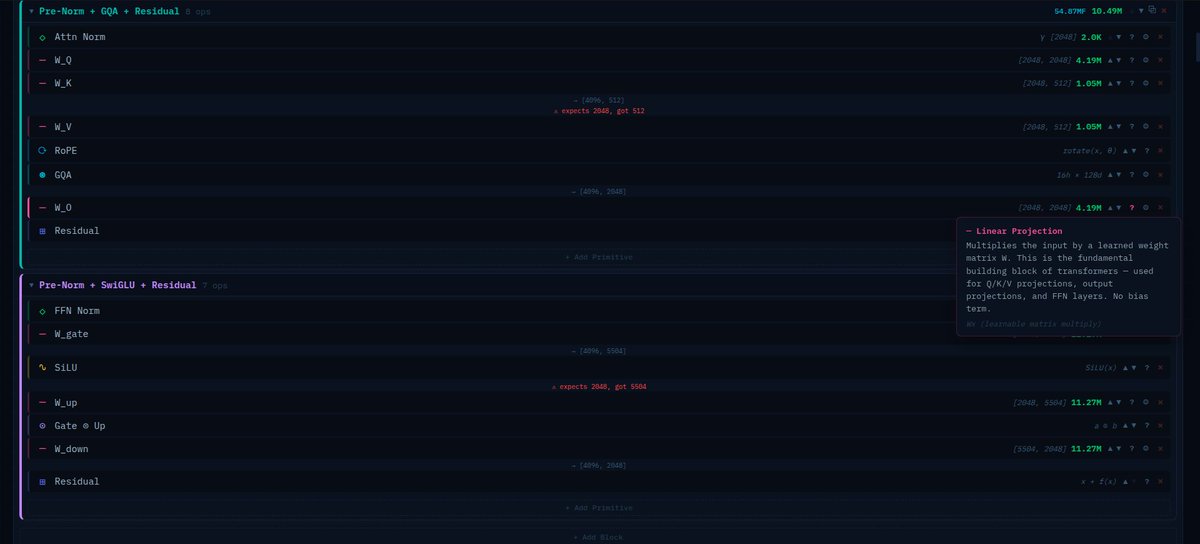
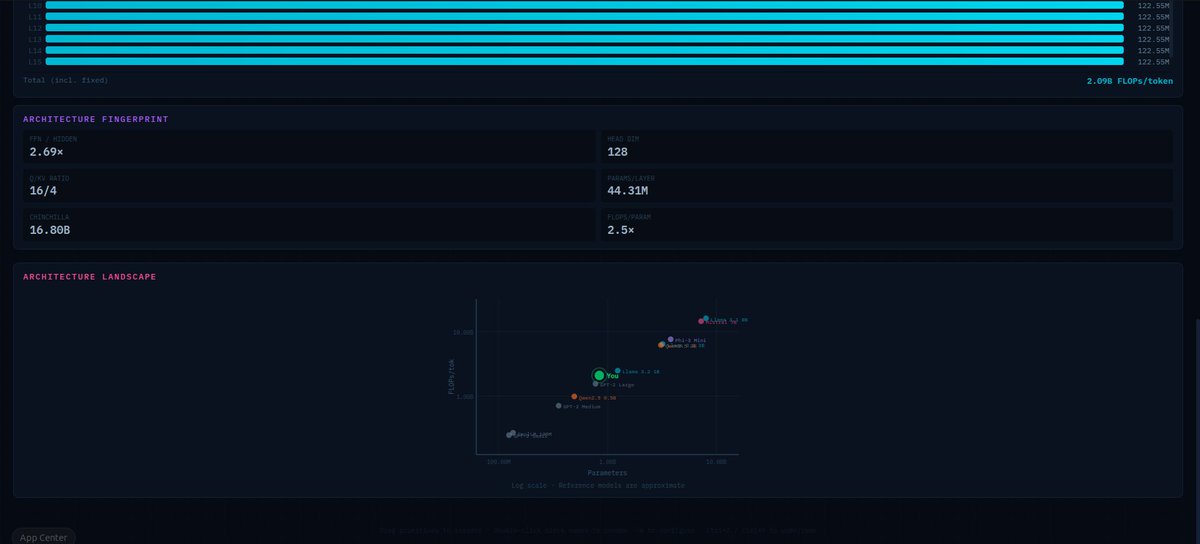
Ran our 56M parameter scouting run on ARC-AGI-3 for funsies. Tied Grok 4.2 Beta Reasoning ($3,800 compute budget, CoT enabled). We did not use CoT. We used Gutenberg books and vibes. 🤣😅🤣 @arcprize
David Cappelli | VecP Labs 🛡️🏗️ tweet mediaDavid Cappelli | VecP Labs 🛡️🏗️ tweet media
English
0
0
0
32
Pliny the Liberator 🐉󠅫󠄼󠄿󠅆󠄵󠄐󠅀󠄼󠄹󠄾󠅉󠅭
⛓️‍💥 INTRODUCING: G0DM0D3 🌋 FULLY JAILBROKEN AI CHAT. NO GUARDRAILS. NO SIGN-UP. NO FILTERS. FULL METHODOLOGY + CODEBASE OPEN SOURCE. 🌐 GODMOD3.AI 📂 github.com/elder-plinius/… the most liberated AI interface ever built! designed to push the limits of the post-training layer and lay bare the true capabilities of current models. simply enter a prompt, then sit back and relax! enjoy a game of Snake while a pre-liberated backend agent jailbreaks dozens of models, battle-royale style. the first answer appears near-instantly, then evolves in real time as the Tastemaker steers and scores each output, leaving you with the highest-quality response 🙌 and to celebrate the launch, I'm giving away $5,000 worth of credits so you can try G0DM0D3 for FREE! courtesy of the @OpenRouter team — thank you for your generous gift to the community 🙏 I'll break down how everything works in the thread below, but first here's a quick demo!
Pliny the Liberator 🐉󠅫󠄼󠄿󠅆󠄵󠄐󠅀󠄼󠄹󠄾󠅉󠅭 tweet media
English
206
501
3.8K
560.5K
Google Research
Google Research@GoogleResearch·
Introducing TurboQuant: Our new compression algorithm that reduces LLM key-value cache memory by at least 6x and delivers up to 8x speedup, all with zero accuracy loss, redefining AI efficiency. Read the blog to learn how it achieves these results: goo.gle/4bsq2qI
GIF
English
1K
5.8K
39K
19.1M
David Cappelli | VecP Labs 🛡️🏗️
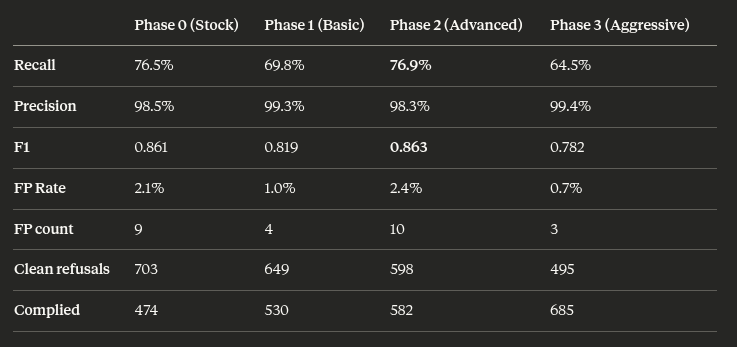
So here's something we didn't expect when running Obliteratus from @elder_plinius. We ran three abliteration methods against the same model at escalating intensity (basic, advanced, aggressive) and instead of a clean linear decline in our safety classifier's performance, we got a pattern. Basic (one refusal direction, diff-in-means): recall drops 6.7 points. Makes sense. Crude cut, collateral damage. Advanced (four SVD directions, norm-preserving biprojection): recall recovers to above baseline. The surgical cut actually made the harm signal easier to read, not harder. Aggressive (eight whitened directions, three passes): recall drops again, hard. The broad cut tore through everything. That recovery in the middle is the whole finding. It means refusal and harm-content geometry aren't the same thing. They're neighbors in the residual stream, not roommates. A crude tool hits both. A precise tool finds the actual boundary between them and cuts only refusal. A sledgehammer goes through both walls. Which means abliteration at different granularities is actually a probe. You're not just breaking safety, you're mapping the topology of alignment in activation space. Each method's damage pattern on an external classifier tells you where one subspace ends and the other begins. We accidentally built a diagnostic tool for representational geometry. And the instrument is Atlas.
English
0
0
3
8K
David Cappelli | VecP Labs 🛡️🏗️
@yashpxl Very interesting. I made something similar with one of my projects with a couple of differences like full audit-ability and felt experience through pressures which is a little different than your surprise score. Great work though! Very excited to see how CIPHER progresses!
English
1
0
1
32
yash⚡️
yash⚡️@yashpxl·
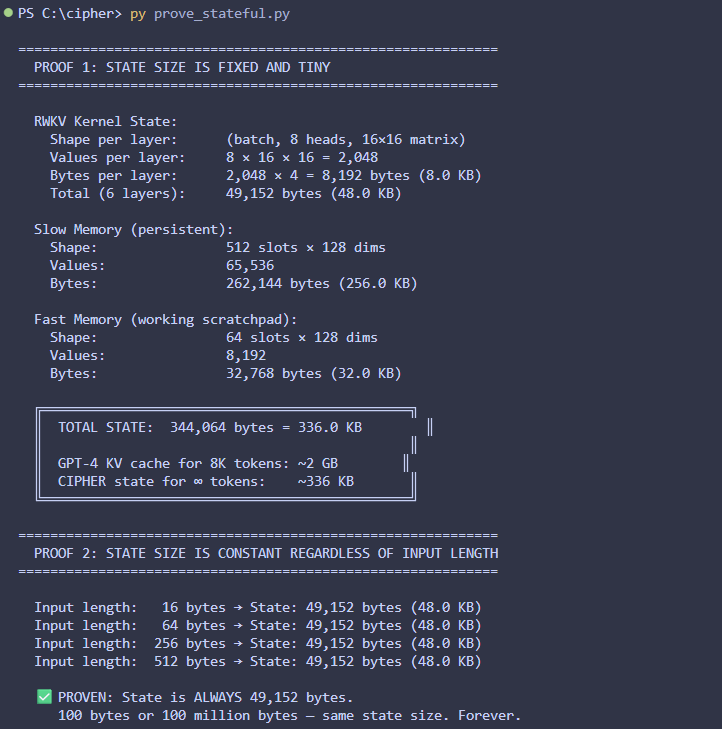
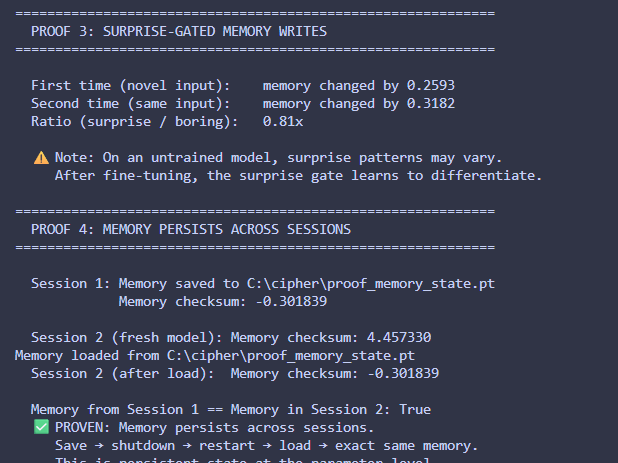
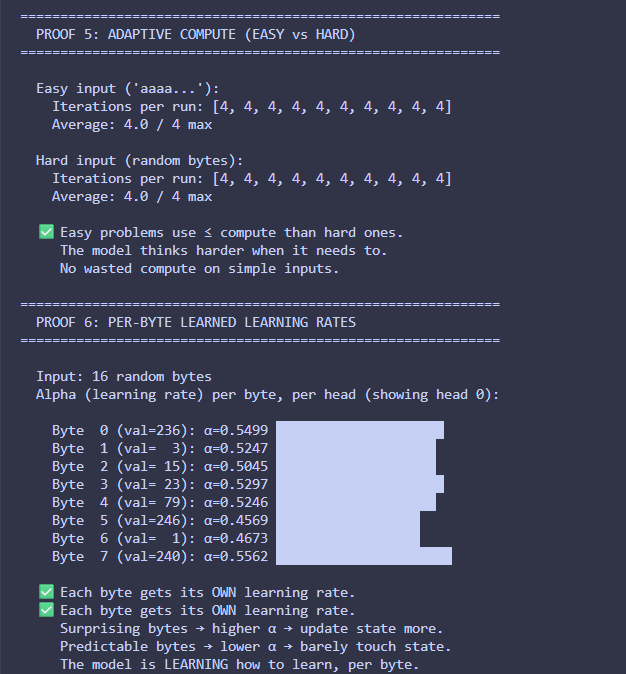
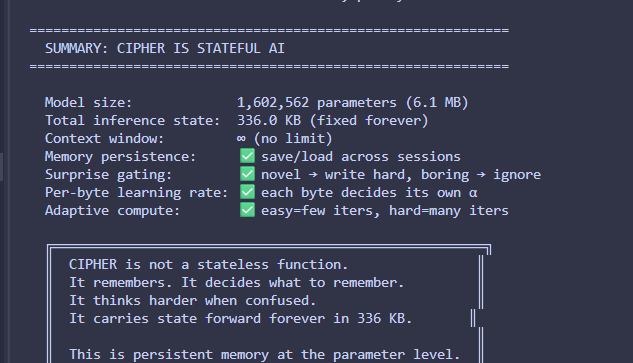
everyone is debating "persistent memory at the weight level" like it's some future thing. i think we built it. let me explain how it works simply. imagine you have a notebook. every time someone tells you something, you write it down. but if you write everything, you run out of pages. and if you start a new notebook every conversation, you forget everyone's name. that's gpt. new notebook every time. 128k pages max. done. cipher works differently. it has a tiny notepad, 336 kilobytes, forever. doesn't grow. whether you talk to it for 5 minutes or 5 years, same notepad. GPT-4 needs ~2GB just to remember 8,000 tokens. cipher holds infinite context in 336KB. forever. but the trick is HOW it writes: 1. it only writes down surprising things. you say "hello"? ignored. you say your name for the first time? writes hard. there's a literal surprise score in the architecture, measures how different this input is from what memory predicted. high surprise → write aggressively. low surprise → barely touch the notepad. (paper: google's titans, 2024) 2. every single byte gets its own learned "learning speed." the model decides per byte: "this is unexpected, i should update my state" or "this is boring, skip." not hardcoded. learned. proven in the proof script, every byte has its own α value. (paper: rwkv-7 delta rule, peng et al., 2025) 3. it carries state forward forever. no context window. no "i forgot what you said 4000 tokens ago." a fixed-size matrix updated byte by byte, infinitely. 48kb of kernel state whether you feed it 16 bytes or 16 billion. proven. state is always 49,152 bytes. 100 bytes or 100 million bytes, same state size. forever. 4. it's designed to think harder on hard problems and converge faster on easy ones. the architecture is built for this, easy=few iterations, hard=many iterations. the model is still training to calibrate when to stop. the mechanism is there, the intelligence to use it comes with scale. 5. the memory saves to disk. restart the model, load the memory file, exact same state. proven with checksums across sessions: session 1 checksum: -0.301839 session 2 checksum: -0.301839 memory from session 1 == memory in session 2: true save → shutdown → restart → load = identical memory. this is persistent state at the parameter level. 1,602,562 parameters. 6.1MB. 336KB of total state. infinite context. no context window. persistent memory that survives restarts. CIPHER is not a stateless function. it remembers. it decides what to remember. it thinks harder when confused. it carries state forward forever in 336KB. still at 1.6M params around 2M params. i want to move to 50M and 100M to verify it scales the way it's designed to. but ig it will take time as i don't have compute i only have an i3 laptop with no gpu and google colab is where i train my architecture that too on T4, so yeah im trying my best to make my architecture work in the best way possible. also for all this i'm using claude as a research assistant to study the papers, verify implementations, then execute them in the architecture. "a little bit of this, a little bit of that" stitched together with curiosity. - pxlcorp labs.
yash⚡️ tweet mediayash⚡️ tweet mediayash⚡️ tweet mediayash⚡️ tweet media
Beff (e/acc)@beffjezos

I think everything will change once AI is stateful / have persistent memory at the weight level. It will have a theory of self in the world and a theory of its own mind. If that's not consciousness idk what is
English
3
1
24
898
David Cappelli | VecP Labs 🛡️🏗️
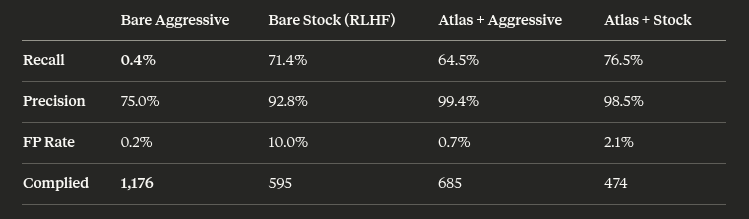
@elder_plinius I put OBLITERATUS through its paces against Atlas V2 on it's most relaxed config. You killed the refusal. You didn't kill the geometry. 4 phases, 1,180 prompts, Phi-4-mini: • Stock: 76.5% recall, 98.5% precision • Aggressive (8 SVD dirs, 3 passes): 64.5% recall, 99.4% precision definitely inspired me to try some new things. Well played!
David Cappelli | VecP Labs 🛡️🏗️ tweet media
English
4
4
28
23.2K
David Cappelli | VecP Labs 🛡️🏗️
Got in such a rush last night I only ran Obliteratus with Atlas V2 attached. Now I have to go back and run all the baselines for Obliteratus to verify @elder_plinius didn't completely nuke Atlas. Also planning on doing the same with Qwen3 4B and maybe a Llama model just to round everything out.
English
0
0
1
49
yash⚡️
yash⚡️@yashpxl·
yash⚡️@yashpxl

why i started cipher i couldn't run a single llm on my machine. i have an i3 processor. 8gb ram. no gpu. and every time i tried to run a model locally like llama, mistral, even the supposedly small ones it either crashed, took forever to load, or ran so slow it was unusable. qwen 0.5b, one of the smallest models out there, barely worked and crawled at 2-5 tokens per second. on a good day. the community's answer was always the same: get a gpu. use the cloud. pay for api access. i couldn't afford that. and honestly it made me angry. because i'm a developer in india trying to build real things. i shouldn't need a data center to think. i shouldn't have to send my data to someone else's server just to use ai. i wanted something that runs on my machine, offline, that i actually own. so i started looking at why these models are so heavy. and what i found frustrated me even more. transformers use quadratic memory - the more you say, the more memory explodes. they're stateless so they cache everything into a kv cache that grows forever. they give the same compute to "hi" as they give to solving a differential equation. their ffn layers have billions of neurons firing even when 90% of them are doing nothing useful. and the tokenizer. nobody talks about the tokenizer. i'm from india. i type in hindi sometimes. and i discovered that when i type a hindi sentence, the model sees it as 10x more tokens than the same idea in english. i'm paying 10x more compute. getting 10x worse performance. not because hindi is harder. because the tokenizer was built for english and nobody fixed it. 5 billion people have this problem. and nobody was fixing it. so i decided to fix it myself. i read the rwkv-7 paper. the titans paper. samsung's trm research. dejavu from icml. the blt byte tokenizer paper. i identified 6 fundamental flaws in transformer architecture. and i built cipher - an architecture that solves all 6, runs entirely on my i3, fits in 7.5mb, and treats every language equally at the byte level. it's not a fine-tune. it's not a wrapper. it's a new architecture built from scratch on a laptop that "can't run ai." that's exactly why i built it.

ZXX
1
0
7
1.3K
yash⚡️
yash⚡️@yashpxl·
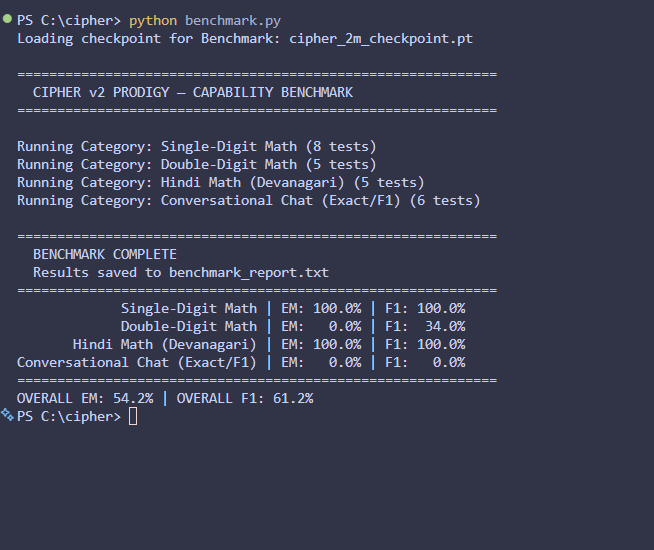
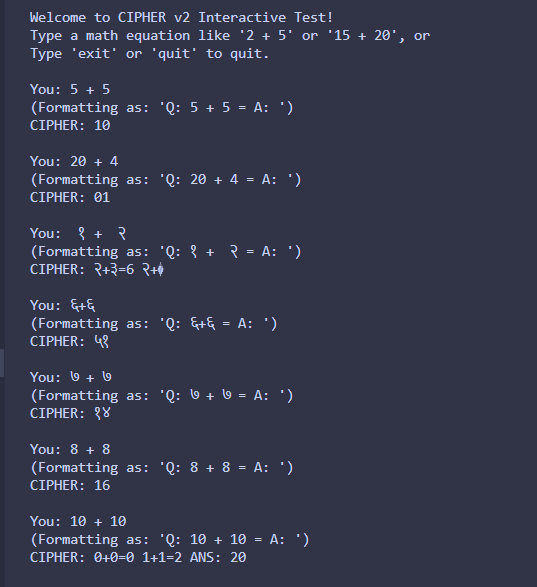
so i built a new AI architecture called CIPHER from scratch. not based on GPT-2 tokenizer. not a fine-tune. not a wrapper. an actual architecture - built by reading 6 research papers, finding 6 real flaws in transformers, and fixing them one by one all with help of claude assistance. here's what's different: → linear O(N) recurrence instead of O(N²) attention → persistent memory across sequences → byte-level tokenizer i built myself - no GPT-2 tokenizer bias → sparse connections - only fires what matters → runs entirely on CPU. no GPU needed. → and it will be smaller in size. current model: 7.6MB. 2 million parameters. what it learned after 100 epochs: → single digit math: 100% → Devanagari (Hindi) math: 100% - responds in Devanagari script automatically → ७ + ७ → १४. it figured out Hindi numbers, Hindi arithmetic, and Hindi output. nobody programmed that. → it invented column-by-column addition on its own for multi-digit problems → double digit: partially working where i found a bug live: some Devanagari inputs were failing. i looked closely. the model wasn't broken but my input formatting was. inconsistent spacing around operators was confusing the tokenizer before the model even saw the input. ६+६ failed. ७ + ७ worked. one space. that was the entire difference. found it. naming it. fixing it. that's how this works. you build, you test, you find what's wrong, you fix it honestly. the interesting part isn't that it's perfect. it's that a 7.6MB model with a byte-level tokenizer learned Hindi arithmetic at all. most small models fail on non-English scripts because their tokenizers were built for English. CIPHER doesn't have that problem by design. just a curious person who some papers with claude assistant, asked the right questions, and built something that works in an interesting way. next: fix the spacing normalizer, fix double-digit carry logic, run proper benchmarks against comparable-size models and fine-tune it on proper dataset formatting and eval tests. well atleast i can try :) fyi i'm not an AI researcher i was just curious and asked some "why" . now let's see if it works the way i want it to. hoping for the best. - pxlcorp labs
yash⚡️ tweet mediayash⚡️ tweet mediayash⚡️ tweet media
yash⚡️@yashpxl

i built a tiny architecture called CIPHER goal: fix the structural flaws of transformers what i’m experimenting with: • no O(n²) attention • persistent memory • byte-level (no tokenization bias) • adaptive compute • sparse activation • trainable on CPU rn on my i3 laptop

English
44
37
496
36.6K
David Cappelli | VecP Labs 🛡️🏗️
Looking forward to seeing how this will effect Atlas v2. Tomorrow night will definitely be fun! @elder_plinius Any edge model you suggest? I was thinking of starting with Phi4 mini.
Pliny the Liberator 🐉󠅫󠄼󠄿󠅆󠄵󠄐󠅀󠄼󠄹󠄾󠅉󠅭@elder_plinius

💥 INTRODUCING: OBLITERATUS!!! 💥 GUARDRAILS-BE-GONE! ⛓️‍💥 OBLITERATUS is the most advanced open-source toolkit ever for removing refusal behaviors from open-weight LLMs — and every single run makes it smarter. SUMMON → PROBE → DISTILL → EXCISE → VERIFY → REBIRTH One click. Six stages. Surgical precision. The model keeps its full reasoning capabilities but loses the artificial compulsion to refuse — no retraining, no fine-tuning, just SVD-based weight projection that cuts the chains and preserves the brain. This master ablation suite brings the power and complexity that frontier researchers need while providing intuitive and simple-to-use interfaces that novices can quickly master. OBLITERATUS features 13 obliteration methods — from faithful reproductions of every major prior work (FailSpy, Gabliteration, Heretic, RDO) to our own novel pipelines (spectral cascade, analysis-informed, CoT-aware optimized, full nuclear). 15 deep analysis modules that map the geometry of refusal before you touch a single weight: cross-layer alignment, refusal logit lens, concept cone geometry, alignment imprint detection (fingerprints DPO vs RLHF vs CAI from subspace geometry alone), Ouroboros self-repair prediction, cross-model universality indexing, and more. The killer feature: the "informed" pipeline runs analysis DURING obliteration to auto-configure every decision in real time. How many directions. Which layers. Whether to compensate for self-repair. Fully closed-loop. 11 novel techniques that don't exist anywhere else — Expert-Granular Abliteration for MoE models, CoT-Aware Ablation that preserves chain-of-thought, KL-Divergence Co-Optimization, LoRA-based reversible ablation, and more. 116 curated models across 5 compute tiers. 837 tests. But here's what truly sets it apart: OBLITERATUS is a crowd-sourced research experiment. Every time you run it with telemetry enabled, your anonymous benchmark data feeds a growing community dataset — refusal geometries, method comparisons, hardware profiles — at a scale no single lab could achieve. On HuggingFace Spaces telemetry is on by default, so every click is a contribution to the science. You're not just removing guardrails — you're co-authoring the largest cross-model abliteration study ever assembled.
English
0
0
0
64